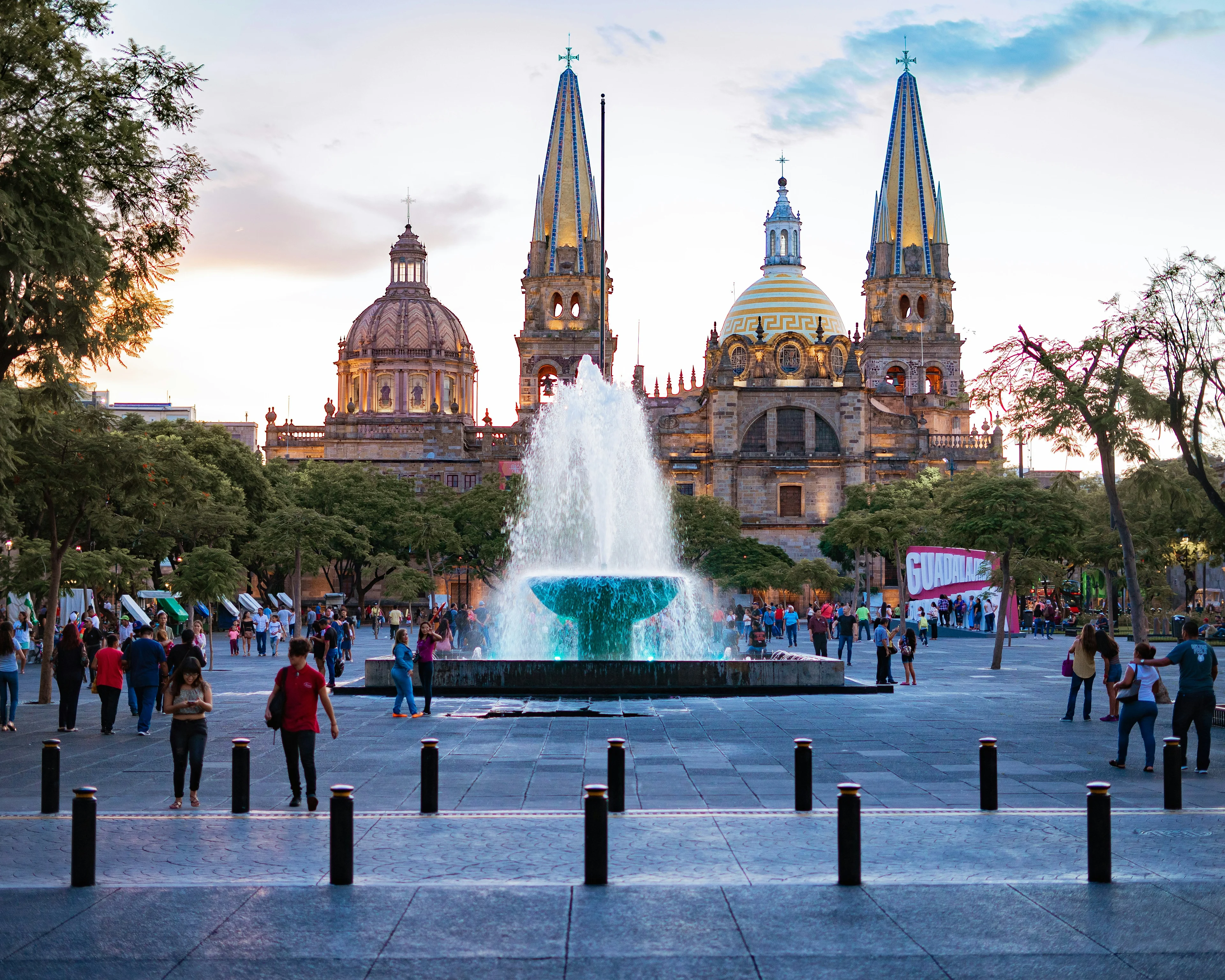
Plaza de la Liberacion à Guadalajara
  1. Home
  2. Travel Ideas
  3. January

Top 20 sunny destinations to visit in January 2027

January in Europe usually means gray skies, freezing temperatures, and painfully short days. Yet, just a few hours away by plane, different horizons await under reliable sunshine. From Southeast Asia to Caribbean beaches and across to the Indian Ocean, Avygeo points you toward the best destinations to soak up warmth and light in the heart of winter.

Members' favourite sunny destinations in January

Guadalajara

#1 Guadalajara (Mexico) +107

9-25°C 7h45 1 d.

Guadalajara moves to the sound of mariachi and deep-rooted traditions. This authentic Jalisco city rewards curious travelers with monumental murals in baroque palaces, messy tortas ahogadas eaten with a spoon, and artisan districts where you can watch glassblowers at work. It feels less like a tourist trap than Cancún and more approachable than Mexico City, offering a direct window into the Mexican soul. Expect a city that keeps it real.

Cape Town

#2 Cape Town (South Africa) +79

17-28°C 20°C 11h 2 d.

Wedged between turbulent oceans and a flat-topped mountain, Cape Town packs a lot into its borders. You will find postcard-perfect beaches with freezing water, historic townships, hillside vineyards, and penguins lounging on white sand. Dining here competes with major global capitals, and adventure waits at every turn, all for a reasonable price. Expect a mix of raw wilderness and relaxed cosmopolitan life under the Southern Hemisphere sun.

Dubai

#3 Dubai (United Arab Emirates) +76

14-24°C 23°C 8h30 2 d.

Dubai rose from the desert in just a few decades, pushing the boundaries of engineering. The Burj Khalifa stands at 828 meters, indoor ski slopes occupy shopping malls, and man-made islands reconfigure the coastline. Yet, behind the glass facades, the souks of the Creek and the red desert dunes reveal an Arab soul beneath the hyper-modernity. It is a destination that polarizes opinion, but it never fails to make an impression.

Bangkok

#4 Bangkok (Thailand) +73

23-33°C 27°C 9h 1 d.

Bangkok is a sprawling metropolis of eight million people where thousand-year-old gold temples sit against futuristic skyscrapers. The scent of street food, which costs around 70 THB (about $2), fills the humid air as saffron-robed monks navigate past busy office workers. From the shimmering Grand Palais and the forty-six-meter Reclining Buddha to the smoky alleys of Chinatown and the high-rise rooftops of Silom, the city never stops. It is a capital where tradition and modernity collide twenty-four hours a day.

Agra

#5 Agra (India) +56

8-22°C 8h 2 d.

Agra offers much more than the iconic silhouette of the Taj Mahal. This former Mughal capital, set along the banks of the sacred Yamuna River, holds architectural heavyweights like the Red Fort, the tomb of Itimad-ud-Daulah, and the sprawling city of Fatehpur Sikri. Beyond the postcard views, you will find a raw and authentic city where imperial history intersects with modern India in a stark, compelling contrast.

Tulum

#6 Tulum (Mexico) +41

19-28°C 27°C 7h30 5 d.

Tulum thrives on its contradictions. You have Mayan ruins perched over turquoise Caribbean water and cenotes so clear they feel surreal. Yet, rapid gentrification has turned this former fishing village into a hub for luxury yoga retreats and social media influencers. The real Mexico of late-night taquerias and dense jungle still exists, but you have to look past the hype to find the balance between the polished postcard and the raw reality.

Siem Reap

#7 Siem Reap (Cambodia) +40

20-32°C 9h 1 d.

As the former capital of the Khmer Empire, Siem Reap serves as your gateway to the massive Angkor archaeological complex and its jungle-swallowed temples. Beyond the ruins, this northwestern Cambodian city offers bustling local markets, a rising Khmer food scene, and stilted villages on the Tonlé Sap lake. With daily costs for a modest guesthouse and meals often running 80,000 to 160,000 KHR (about $20 to $40), it remains a primary destination for history enthusiasts and travelers alike.

Valparaíso

#8 Valparaíso (Chile) +32

14-22°C 18°C 10h30 1 d.

As the primary port of Chile, Valparaíso is a city of distinct contrasts, tucked into a wide Pacific bay and framed by 45 steep hills known as Cerros. Founded in 1544 by Pedro de Valdivia, the city entered a golden age during the 19th century, drawing gold seekers, shipping magnates, and major banking institutions. A massive earthquake and the opening of the Panama Canal in 1914 eventually stifled this growth. Today, the city is a hub for students and artists, filled with street art, museums, cafes, and boutiques. Its historic center is even recognized as a Unesco World Heritage site.

The maritime heritage of Valparaíso

Located along the waterfront, the Barrio Puerto is the oldest district in the city. Sitting between the flatlands and the hills, you will find historical landmarks like the Iglesia de la Matriz. The Plaza Sotomayor, lined with official government buildings, serves as the institutional heart of Valparaíso. You can see the Monument to the Heroes of Iquique, which commemorates the naval battle of May 21, 1879. Housed in a mansion typical of the early 20th-century bourgeoisie, the Palais Baburizza and its Museum of Fine Arts are another essential stop. Afterward, head to the Muelle Prat, a small pier where you can catch a boat for a tour of the bay.

A labyrinth of colorful hills

The atmosphere in Valparaíso is defined by the maze of hills overlooking the port, each acting as a neighborhood with its own distinct identity and local culture. These residential Cerros are served by fifteen funicular elevators. To really explore the corners of these colorful districts, walk the steep streets, which also gives you a front-row seat to the city's street art. The essential Cerros include Cerro Concepcion and Cerro Alegre, both packed with plazas, walkways, and viewpoints like the Mirador Yugoslavo and Paseo Gervasoni. Do not miss the Open-Air Museum of Valparaíso on Cerro Bellavista, a collection of murals inaugurated in 1992. Another highlight is the Paseo 21 de Mayo on Cerro Artilleria, which offers one of the best panoramas in the city. Near Cerro Carcel, the Parque Cultural de Valparaiso, built on the site of a former prison, is worth a visit for its exhibitions and expansive green spaces.

Other things to see in Valparaíso

Fans of the Chilean poet Pablo Neruda should visit his home on Cerro Bellavista, La Sebastiana. It holds a beautiful collection of art and period furniture. Down in the flatlands, take a walk through Plaza Victoria, a pleasant spot with large trees and fountains bordered by the cathedral. Near the port, visit the Mercado El Cardonal for an authentic local scene. You might also head over to the Paseo Muelle Barón, where you can often spot sea lions resting nearby.

When to go

Valparaíso is most pleasant to visit during the southern summer, between December and April.

How to get there

The city is easily accessible by bus from Santiago. You will arrive at the Terminal de Buses Rodovario after a trip of about 1 hour and 30 minutes.

Santiago

#9 Santiago (Chile) +32

14-31°C 10h30 1 d.

As the capital of Chile, Santiago is home to roughly 5 million people. The city was founded in 1541 during the colonial era by Pedro de Valdivia, centered on what is now the Plaza de Armas, the city's institutional heart. The population surged at the end of the 20th century as people moved from rural areas to the city seeking better opportunities. The metropolis is split by the Mapocho River, which is flanked by green spaces like Parque Forestal and the Parque de las Esculturas, where you can find 40 sculptures created by prominent Chilean artists.

Central Neighborhoods in Santiago

Start your walk at the city's main square, the Plaza de Armas. This is where you will find the Metropolitan Cathedral of Santiago, a neoclassical structure, alongside museums such as the Museo Histórico Nacional, which covers Chile's colonial and republican history. Nearby, the Museo de Arte Precolombino is essential for its collection of ceramics, sculptures, and textiles from various pre-Columbian cultures. Finally, do not miss the Palacio de la Moneda, the seat of the Chilean government, located just a few blocks away.

The Lastarria neighborhood, or the Fine Arts district, is another staple of the capital. After stopping by the Museum of Fine Arts, enjoy the energetic, colorful vibe around Cerro Santa Lucia, which frequently hosts local sports and cultural events.

San Cristobal Hill and Surroundings

To see Santiago from above, head to San Cristobal Hill, which encompasses the largest urban park in Chile, covering 722 hectares. It is accessible to everyone, and you can choose to hike up or take the funicular. At the summit, you will find a statue of the Virgin Mary, crafted in 1908 by Mathurin Moreau. Pope John Paul II held a mass here in 1987. The area around San Cristobal also includes a zoo and a botanical garden.

At the base of the hill, make time for the bohemian neighborhood of Bellavista, a hub for artists filled with street art, bars, and boutiques. Nearby, you will find La Chascona, one of the homes of Chilean poet Pablo Neruda, which still displays his original furniture and decor.

For those looking to get even higher, head to the eastern side of the city to tackle the Gran Torre de Santiago. It is the tallest skyscraper in South America at 300 meters, offering an aerial view of the entire valley.

The Legacy of the Pinochet Dictatorship

If you want to understand the period of the Chilean dictatorship between 1973 and 1990, visit the Museum of Memory and Human Rights. The institution commemorates the 40,000 victims of the Pinochet regime and details the major political and military turning points of that era.

When to Go

The best time to visit Santiago is from November through April.

Getting There

Fly into Santiago de Chile Airport.

Getting Around

Once you are in the city, the metro and bus network is efficient and reliable, capable of taking you just about anywhere in the metropolitan area.

Abu Dhabi

#10 Abu Dhabi (United Arab Emirates) +32

14-24°C 21°C 8h 1 d.

Abu Dhabi stays quieter than Dubai, but the capital of the United Arab Emirates offers plenty to justify a trip. Expect to spend your time at the Sheikh Zayed Grand Mosque, the Louvre Abu Dhabi, and Yas Island for the high-octane Ferrari World. This city blends coastal relaxation with desert excursions and futuristic architecture, making it a more laid-back alternative to its neighbor up the coast.

Mandalay

#11 Mandalay (Myanmar (Burma)) +29

14-28°C 9h 1 d.

As the former royal capital, Mandalay serves as a major center for Buddhist culture and is Myanmar's second-largest city. You can explore the intricately carved teak of the Shwenandaw Monastery or visit the Kuthodaw and Mahamuni pagodas, which function as active pilgrimage sites. For a view over the city, climb Mandalay Hill at sunset. This region is famous for its jade market and traditional gold-leaf workshops. Nearby, the U Bein Bridge remains a major draw as the world's longest teak footbridge.

Aswan

#12 Aswan (Egypt) +27

9-23°C 9h 0 d.

Perched on the east bank of the Nile, Aswan serves as Egypt's southernmost major city, acting as a cool oasis amidst the desert. As the gateway to the ancient Kingdom of Nubia, it has a history deeply rooted in trade routes and caravans. While many travelers treat it as a fleeting pit stop before heading to the temples of Abu Simbel, the city itself possesses a distinct character defined by its lush, green landscapes, scenic islands, and significant historical sites.

A market you cannot miss

Navigating Aswan is straightforward, as the corniche runs along the Nile for several miles, concentrating most of the city's cafes and restaurants. It makes for a pleasant stroll, with the city unfolding into the streets perpendicular to the water. The souk is one of the city's most vibrant landmarks. Day or night, this large covered market is packed with vendors, and the stalls overflow with Egyptian and African goods including perfumes, spices, textiles, handicrafts, incense, fruits, and flowers. It is the place to hunt for deals, and on the outskirts, Nubian culture is on display through traditional items like talismans, jewelry, and basketry. The market is a sensory experience of color and scent. A local specialty is stuffed pigeon, often prepared with rice, served on skewers, or simply grilled. You will also find molokhia (a traditional vegetable soup), eggplant dishes, mezzes, tahini, and fresh fish. Pair your meal with local flatbread, fresh fruit juices, and a Nubian coffee spiced with cardamom.

Island hopping

Directly across from the city center, Elephantine Island is a must-see. You can reach it by hiring a felucca, one of the traditional sailboats that remain the most common way to get around on the water here. Siou and Koti, two Nubian villages, sit nestled between farm fields and palm groves on the island, where the colorful homes create a quiet, timeless atmosphere. You can explore the ruins of the Temple of Khnum, dedicated to the ram-headed deity. Within this archaeological site, you will find the nilometer, which is arguably the most famous staircase used to measure the Nile's annual flood levels. Colonnades decorated with hieroglyphs round out the site, and from here, you can see the elegant pink granite Aga Khan Mausoleum, built in 1959, overlooking the water. A small museum dedicated to Nubian culture provides context on the region's history, which is closely linked to the construction of the Aswan High Dam. You can visit the dam itself, and the recent Nile Museum offers a complete overview of the project.

The neighboring island is a small slice of paradise. Kitchener Island is home to the fabulous Botanical Garden, established in 1896. The relief provided by its greenery in the middle of the desert is striking. Plants, flowers, and trees from equatorial Africa, India, and tropical Asia create a lush canopy. The contrast with the arid sand on the opposite bank is sharp, and the garden serves as a peaceful refuge for birds.

On the west bank of the Nile, the Tombs of the Nobles feature long ramps used for transporting sarcophagi. It is a mysterious site that offers panoramic views. Further west, the Monastery of Saint Simeon sits atop a plateau. It was once home to 300 monks until 1321, and this complex of four buildings remains one of the most important monuments from the Christian era. With its 26-foot walls, it resembles a fortress and is remarkably well-preserved. About 1.2 miles from Aswan, the granite quarry houses the Unfinished Obelisk. Commissioned by Queen Hatshepsut nearly 1,500 years before the common era, the project was abandoned after the stone cracked, leaving us with a massive relic still lying in its excavation trench. Six miles away, on Philae Island, the Temple of Isis from the 4th century BCE is yet another architectural marvel. Aswan is a legitimate destination in its own right, offering a genuine and compelling experience.

When to go

The climate is arid and dry. It is most pleasant from December through February when temperatures are mild. From June through September, the heat can become extreme.

How to get there

You can find numerous flights into Aswan International Airport, located 12 miles from the city center. Public transportation and taxis are available for the transfer. If you are coming from Cairo, 520 miles away, you can take a sleeper train, which is a popular choice for the distance, or a direct 80-minute domestic flight.

Chiang Mai

#13 Chiang Mai (Thailand) +25

14-28°C 8h30 1 d.

Set in the misty mountains of northern Thailand, this former capital of the Lanna Kingdom blends thousand-year-old gilded temples with the modern coffee shops favored by digital nomads. Over 300 Buddhist sanctuaries anchor a daily routine defined by monk processions and the scent of street food. Whether you are trekking to hidden waterfalls, visiting ethical elephant sanctuaries, or taking a local cooking class, the city offers a relaxed pace of life that hits different.

Luxor

#14 Luxor (Egypt) +25

7-23°C 9h30 0 d.

Luxor holds the highest concentration of ancient pharaonic ruins on the planet. You can walk through the massive temple complexes of Karnak and Luxor, explore the tombs in the Valley of the Kings, or visit the cliffside mortuary temple of Hatshepsut. Spanning both banks of the Nile, this former capital of ancient Egypt functions today as an open-air museum where three millennia of history appear around every corner.

Playa del Carmen

#15 Playa del Carmen (Mexico) +19

19-28°C 27°C 7h30 5 d.

Once a quiet Maya port, Playa del Carmen is now a cosmopolitan beach town defined by its high-energy Quinta Avenida, turquoise cenotes, and a central location on the Riviera Maya. You can easily bounce between affordable street-side taquerias where tacos run 20-40 MXN (about $1-2) and upscale beach clubs, or use the city as a base to explore the ruins at Tulum and the reefs off Cozumel. Just be aware that sargassum seaweed frequently washes up on the beaches during the summer months.

Manila

#16 Manila (Philippines) +18

22-30°C 27°C 7h 4 d.

Manila is a city of extreme contrasts. Some travelers suggest skipping the Philippine capital entirely, arguing it lacks the polish western tourists expect. Others call it the "Pearl of the Orient," claiming its appeal is widely overlooked. If you are traveling through the Philippines, here is why you should consider giving Manila a fair shake.

Churches and history

Manila often takes heat for its gridlocked traffic, political volatility, and smog. However, specific neighborhoods offer a deep look into the local past. The historic colonial district, known as Intramuros, holds the city's most significant landmarks, including a high concentration of churches. The San Agustin Church, dating back to 1589, is the oldest religious structure in the country. Its earthquake-resistant baroque architecture earned it a spot on the UNESCO World Heritage list. For a deeper dive into national history, head to Fort Santiago, which houses a museum dedicated to José Rizal, the Philippine national hero. If you enjoy cultural institutions, you will likely spend time at the National Museum of Natural History and the Ayala Museum for a look at pre-Hispanic history. For something more unconventional, the Marikina Shoe Museum displays 800 pairs of shoes once owned by the former First Lady.

A cultural melting pot

The capital serves as a crossroads for a diverse range of cultures and ethnicities. A prime example is the Chinese Cemetery, built in 1843 just outside the city center. You will find incredible mausoleums and sarcophagi that blend Chinese and western influences. From turtle-shaped tombs to three-story "houses" for the departed, the variety is striking. After exploring, head back into the chaos of the city in Chinatown. Filipinos, Chinese, and Spanish influences have coexisted here for centuries. Often cited as the oldest Chinatown in the world, founded in 1594, it is the place to eat. Grab some pancit (Chinese noodles), empanadas, or lumpia, a crispy snack similar to a spring roll.

Shopping and nightlife

Manila has fully embraced the 21st century. You can shop in trendy boutiques or catch a performance at the Cultural Center of the Philippines. Makati, a modern financial hub located 5 kilometers (about 3 miles) away, contains some of the largest shopping malls on the planet. Grabbing a drink at a rooftop bar in Makati is a standard evening activity, as the area is packed with high-end cocktail lounges.

When to go

You can visit Manila year-round, but the most pleasant weather arrives between December and February. You will avoid the worst of the rain during the summer months, but the heat and humidity can become intense.

How to get there

Expect to pay at least 550 USD (about 30,800 PHP) for a round-trip flight from the United States. Your flight will likely involve at least one layover, often in the Middle East or East Asia, resulting in a total travel time of roughly 18 to 22 hours depending on your departure city.

Abu Simbel

#17 Abu Simbel (Egypt) +17

9-23°C 10h 0 d.

In southern Egypt, Abu Simbel could have easily remained an unassuming village, known primarily to freight drivers for its proximity to the Sudanese border. That changed thanks to ancient Nubia, which left behind two priceless treasures buried under the sand: the Great Temple of Ramses II and the Temple of Nefertari, discovered in 1813 and 1817 by Swiss and Italian explorers. Threatened by the rising waters of the Nile, they had to be moved 160 meters in 1964. It took three and a half years and 3,000 workers to clear and cut the stone blocks, a colossal operation that captivated the world and permanently altered the destiny of this small town in the Aswan region. Located on the edge of Lake Nasser, Abu Simbel now welcomes millions of travelers.

A peaceful haven

Its desert location makes Abu Simbel a destination with real character, and while the archaeological sites are the main attraction, it is worth staying at least one night. Some hotels are true homages to Nubian culture, their architecture and traditional decor possessing immense charm. In local restaurants, you will find distinctive cuisine with specialties such as tahina made from sesame, babaghanouj, which is an eggplant puree, and of course foul, a stew of hearty fava beans. Food lovers often gravitate toward mehallabeyya, a pudding flavored with rose water and topped with pistachios. While some claim Nubian coffee is among the best in the world, the hibiscus tea is a strong contender.

Aside from desert excursions, another highlight of Abu Simbel is Lake Nasser, a magnificent body of water that acts like an inland sea in the middle of the desert. Among the papyrus, birds like herons have made their home here, creating a tranquil environment far from urban noise and bathed in exceptional light. On its shores, the Pharaoh stands guard over his lands as an eternal master.

Ramses II, immense and eternal

In a country filled with remarkable ancient sites, Abu Simbel is certainly one of the most striking. On the ancient sacred hills of Meha and Ibshek, Ramses II launched a massive construction project at the beginning of his reign, in 1279 BC, and standing before it today is truly dizzying. The temples are carved directly into the sandstone cliffs, with the largest dedicated to the worship of several deities including the falcon-headed Ra-Horakhty, and of course, Ramses himself. The 33-meter facade is composed of four statues measuring about 20 meters tall that leave no doubt about their purpose. Dressed in a kilt, wearing the nemes headcloth, and sporting a false beard, the Pharaoh sits in all his splendor. Inside, you find a hypostyle hall with hypnotic engraving detail, and ten side chambers leading to the hall of statues, which are equally massive. The walls recount his victories, including the Battle of Kadesh and his exploits against the Hittites and Libyans. The ingenuity of those who built this oversized temple lies in one detail: at every equinox in February and October, everything is designed so that a ray of sunlight slips inside to illuminate the statue of Ramses for his birthday.

A few meters away sits the temple dedicated to Nefertari, the first and favorite wife of Ramses II, who was deified in the image of Hathor. It is more intimate, with six 10-meter-tall statues on the facade, including four representing the Pharaoh, along with sumptuous bas-reliefs and sculptures of their children at their feet. The queen is depicted with her horned crown and tall feathers, radiating imperial beauty. Inside, texts and reliefs highlight the couple, sometimes with great tenderness, alongside various deities. In the evening, a light and sound show illuminates the site. Ramses II is long gone, but he continues to reign and fascinate.

When to go

The hot season lasts from May to October, with an arid and dry climate that can reach extreme temperatures. January is the coolest month, and if you are sensitive to heat, the period between February and April is ideal. To avoid the crowds, it is highly recommended to visit the temples very early in the morning.

How to get there

Most international travelers fly into Cairo and connect to Aswan, which is 280 km from Abu Simbel. The road crosses the desert, and buses handle the route regularly. Some opt for a private driver. You can also choose a cruise that includes a stop at Abu Simbel. The town has its own airport, and the flight from Aswan takes 45 minutes.

Phuket

#18 Phuket (Thailand) +7

23-32°C 28°C 8h30 4 d.

As the largest island in southern Thailand, Ko Phuket, or simply Phuket, refers to the entire paradise archipelago surrounding it. You can lounge under coconut trees before hitting the high-energy Full Moon parties, take advantage of modern amenities that offer great value, or get pampered at one of the many spas. The range of excursions is extensive, from long-tail boat rides and mangrove kayaking to jungle trekking. The lush pearl of the Andaman Sea is full of hidden treasures, and it is a perfect opportunity to dive into Thai culture, food, and traditions.

The climate is tropical with two seasons per year, and it stays hot year-round. The rainy season, where you can expect 1 to 3 hours of rain daily, runs from June through October.

Postcard-perfect beaches

The most visited spots are Patong, Karon, and Kata. These are the places to try parasailing or rent a jet ski. You can also shop and sample street food at Malin Plazza Patong. At night, partygoers head to Bangla Road for the bar scene. If that is not your speed, check out the ladyboy show at Phuket Simon Cabaret or catch a Thai boxing match.

For a quieter vibe, the beaches of Sai Kaew beach, Mai Khao beach, Nai Yang beach, Layan beach, Bang Tao beach, and Surin beach are better choices. Stay alert, as strong currents can be dangerous.

At the far south of Patong, Cristal Beach is a peaceful cove with a small beach called Paradise Beach. You can reach it by walking 1.5 miles past the Merlin Beach resort.

Those seeking total solitude should head to Ko Kho Kaho, famous for its 9 miles of completely untouched sand at Nok Nah beach. Paradise Island near Ko Rang, accessible from Ko Yao, is also a great option, located near Ko Hong, which feels like a true pirate island.

Lush landscapes for sunrise and sunset

Take in a 360-degree view over the Nai Harn bay at the southern tip of the island. Phrom Thep Cape translates to "Cape of Divine Purity" in Thai.

Explore Phang Nga by motorboat for a vibe that feels like a scene from Crocodile Dundee. The landscape, filled with massive limestone formations, is striking (about 600 THB/approx. $17 for 3 hours).

Kho Phi Phi, Phi Phi Ley, Coral Islands, and Ko Tao are known for their white sand and crystal-clear water. Coral reefs in some areas have been damaged by heavy snorkeling traffic and are now subject to preservation measures, as seen at Maya Bay since October 2018. Check for updates online before you head out.

Living Thai culture

With its charming Sino-Portuguese colonial houses and pedestrian alleys, Phuket Town hosts three major festivals: the Vegetarian Festival in October, Chinese Pimai (Chinese New Year) in February, and Songkran, the Thai New Year, in April. Expect a festive, family-friendly atmosphere. On weekends, the Naka Market is worth a visit for local street food and crafts.

The Thai people value family time and enjoy picnicking on Sundays. The pine forest at Sirinat National Park offers an ideal setting, with entry via Thepkrasattri Road.

Perched on a green hill, the 147-foot-tall white marble Big Buddha of Chalong was built by a local foundation. The view from the top is impressive.

The Thalang National museum provides context on the history of southern Thailand, including migration patterns and the region's tin mining history. The exhibit also covers the December 2004 tsunami and the subsequent reconstruction efforts.

When to go

The best time to visit Phuket is from December through March, when the temperatures are comfortable and the skies are clear.

How to get there

Airlines like Air France and Thai Airways International offer direct flights from Paris Roissy Charles de Gaulle to Bangkok (flight duration is 12 to 13 hours). From there, plan for a 1.5-hour connecting flight to Phuket.

Getting around

The tourist office in Phuket Town provides schedules for buses and minibuses. The Phuket bus terminal 1 serves the main points of interest for shorter distances. The state-run 999 bus company is a reliable choice. You can also rent a scooter (around 300 THB/approx. $8 per day). The roads are in good condition. Be sure to carry an International Driving Permit, as police checks are common and carry a fine of around 1,000 THB (approx. $28) if you cannot produce one.

Havana

#19 Havana (Cuba) +2

20-27°C 26°C 7h30 5 d.

Havana is a city you experience with your senses. It is the sound of a bolero drifting from a courtyard, the sight of a pink Cadillac cruising past a peeling turquoise facade, and the warmth of a conversation started along the Malecón at dusk. More than just a destination, it is a trip into another era. It is an intense experience where beauty emerges from the wear of time, leaving a lasting impression on every traveler.

Cartagena

#20 Cartagena (Colombia) +1

24-31°C 27°C 8h 1 d.

Cartagena ranks as a top destination in Colombia, defined by its preserved colonial architecture and Caribbean rhythm. The UNESCO-listed Old Town is enclosed by massive Spanish fortifications that tell a history of colonial struggle. You will find narrow, brightly painted streets, local markets, and neighborhoods where music spills out of every doorway. Nearby island beaches provide a quick escape, offering white sand and turquoise water just a short boat ride from the city center.

Where to take the family for a sunny January getaway

If you are planning a family trip in January, Guadeloupe is a reliable bet. The fine sand beaches are ideal for kids. The island offers plenty of family-friendly activities, from safe swimming in the lagoons to rainforest treks and rum distillery tours that include programming for all ages. The weather is mild, and the local infrastructure is well-suited for families.

Where to go for a romantic sunny escape in January

The Maldives are the gold standard for a romantic January trip. You will stay in overwater bungalows overlooking a turquoise lagoon. Everything here is designed for unplugging, including secluded beaches, candlelit dinners with your toes in the sand, and couples massages facing the ocean. The weather is perfect this time of year for a quiet getaway together.

Where to find sunny, budget-friendly January travel

The Canary Islands are a great way to find sun without breaking the bank. January temperatures are mild, and flights are reasonably priced. You can find accommodations starting at 40€ (about $43) per night. Expect to spend around 400€ (about $430) for a weekend and 700€ (about $755) for a week if you book in advance. Your trip will be filled with volcanic hiking trails, wild beaches, and authentic small villages.

January is the perfect month to chase the sun

When winter starts to feel endless, escaping to the sun is a welcome reset. January is an ideal time to slow down, reconnect with family or a partner, or just soak up some light. These sunny spots offer a clean break from the daily grind. It is a simple luxury to enjoy the feeling of walking around in a t-shirt while the cold weather dominates back home.

Frequently asked questions

Where can I go for a sunny, low-cost January vacation?
The Canary Islands, Morocco, and parts of Portugal offer sunny, budget-friendly getaways in January.
What is the best sunny destination in Europe during January?
The Canary Islands have the best climate in Europe in January, with temperatures hovering around 20°C (68°F).
Where can I travel far away in January to guarantee sunshine?
The Maldives, Thailand, Guadeloupe, or Mexico are all solid bets for sun and summer-like temperatures.
Where is a good place for a family sunny trip in January?
Guadeloupe is a top-tier family destination with calm beaches, lush nature, and plenty of kid-centric activities.
Where should a couple go for sun in January?
The Maldives are ideal for a romantic trip, featuring intimate hotels, paradise-level beaches, and an exclusive atmosphere.
What is the temperature in the Canaries in January?
In the Canaries, daytime temperatures range between 17 and 22°C (63 to 72°F) with plenty of sun.
Where can I travel in January without a long flight?
The Canary Islands, southern Spain, or Morocco are all just a few hours away by flight from the European mainland.
What should I pack for a sunny January trip?
Bring light clothing, a swimsuit, sunglasses, a hat, and a light jacket for cooler evenings.
Where can I find sun in France during January?
The French Riviera and Corsica have mild weather in January, but for more reliable sun, it is better to head to the overseas territories or abroad.