Visiting the Camargue
A delta as flat as your hand, between the two arms of the Rhône and the sea. Here the horizon is all sky. At its heart lies the Vaccarès lagoon and its reed beds; to the south, pink salt pans, grey salt marsh and beaches without a single building. The ranches, called manades, raise black bulls and white horses, still herded on horseback by the gardians.
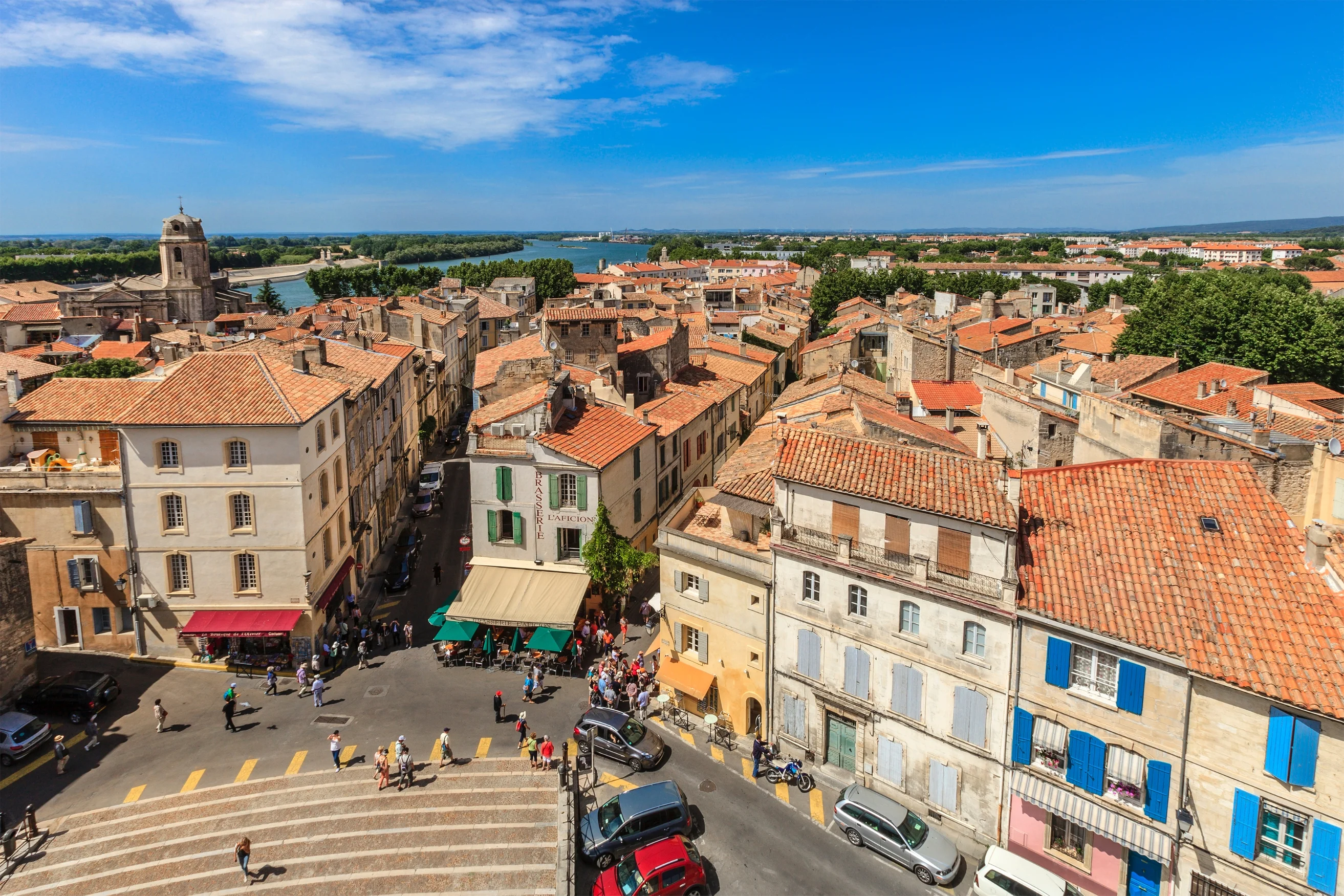
West of the Petit Rhône, the Gard side of the Camargue leads to the ramparts of Aigues-Mortes. To the north, Arles closes off the delta with its Roman arena. You come here for the light, the birds and the bull traditions, not for hills or shade.
You will love it if
- You want to see flamingos by the hundred, a few metres away
- You like cycling car-free tracks with the sea alongside
- Living traditions appeal to you more than museums
Give it a miss if
- Mosquitoes ruin your evenings: in summer they are everywhere at dusk
- You are after hills and hilltop villages
- You cannot stand wind: the mistral often blows for days on end
The must-sees
-
1 The Pont de Gau bird park +21 recs
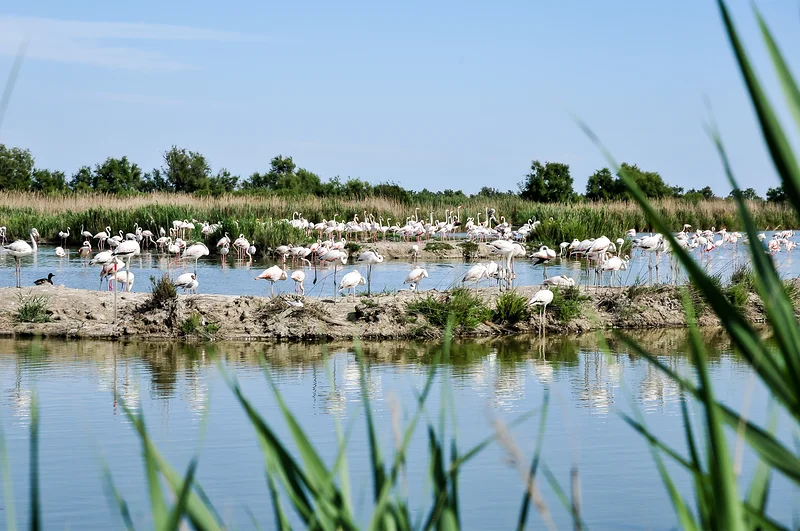
Sixty hectares of marsh and lagoon beside the Arles road, four kilometres from Saintes-Maries. The flamingos feed a few metres from the paths, paying you no attention. Come at opening time or late in the afternoon, when the low light turns the feathers pink. Allow two hours, and bring binoculars.
-
2 The digue à la mer By bike
A sea wall built in 1859 to protect the delta, closed to cars, running 33 kilometres between Saintes-Maries and Salin-de-Giraud. The sea on one side, the lagoons and their birds on the other. The Gacholle lighthouse makes a good half-day out and back. Avoid it after rain: the track turns to mud.
-
3 A course camarguaise April to October
In the ring, raseteurs dressed in white race to snatch the rosette tied between the bull's horns. The bull is not killed, and the best bulls are more famous than the men. Contests are held in village arenas and in Arles, where the Cocarde d'or is fought for in early July.
-
4 The Aigues-Mortes salt pans +7 recs
Pools of pink water stretching to the sea, below the town walls. A little train takes you round for an hour and a quarter, out to the camelles, the mountains of white salt. Come in late August or September: that is harvest time, and the machines work around the heaps.
-
5 The Saintes-Maries pilgrimage 24 and 25 May
Roma from all over Europe gather at the church to honour Sara, their patron saint. On 24 May her statue is carried down to the sea, escorted by gardians on horseback. The next day it is the turn of the Holy Marys. A second procession takes place in October. Book your room months ahead.
The classic trap
Seeing the Camargue only from the road between Arles and Saintes-Maries, between two paddocks of rental horses. The delta reveals itself elsewhere: around the Vaccarès, on the road to Salin-de-Giraud and along the sea wall. Keep at least one day for that side, by bike or on foot, ideally at dawn.
Our itineraries in the Camargue
| Length | Itinerary | What you see |
|---|---|---|
| 2 days | Arles › Saintes-Maries-de-la-Mer | Arena, flamingos, beach |
| 4 days | Arles › Salin-de-Giraud › Saintes-Maries › Aigues-Mortes | Vaccarès, sea wall, salt pans, ramparts |
| 1 week | Arles › Grande Camargue › Saintes-Maries › Aigues-Mortes › Le Grau-du-Roi | The whole delta, beaches included |
Start in Arles, the gateway to the delta, then head south along the eastern shore of the Vaccarès to Salin-de-Giraud. Work your way back to Saintes-Maries, and cross the Petit Rhône on the Sauvage ferry to reach Aigues-Mortes. Plan short days: here you move at the pace of the birds.
When to visit the Camargue
| Appeal | Season | Temperatures | Sea | Crowds and prices |
|---|---|---|---|---|
| WinterDec. to Feb. | 3 to 13°C | 11 to 13°C | Low | |
| SpringMar. to May | 7 to 22°C | 13 to 18°C | Medium | |
| SummerJun. to Aug. | 18 to 31°C | 21 to 24°C | High | |
| AutumnSep. to Nov. | 9 to 26°C | 16 to 22°C | Medium |
Our advice
Aim for April-May or September-October: the birds are there in numbers, the heat is bearable and the mosquitoes give you some peace. In summer, go out at dawn and be back before evening, with repellent and long sleeves. Winter has its fans too: the flamingos stay, the tourists leave, but the mistral can blow for a whole week.
Getting to the Camargue
-
By train via Paris The simplest
Take the Eurostar to Paris, then a TGV to Avignon or Nîmes and a regional train on to Arles. Regional trains also link Marseille to Arles in an hour. From Nîmes, a local line serves Aigues-Mortes and Le Grau-du-Roi.
-
By air From further away
Marseille-Provence, an hour from Arles, has direct flights from the UK and Ireland. Montpellier is half an hour from Aigues-Mortes, and Nîmes, the closest, has a handful of low-cost routes. From North America, connect in Paris or another European hub, and pick up a car on arrival.
-
By car The most freedom
The A54 motorway serves Arles, and the A9 runs past Nîmes and Lunel, north of the Gard side. In the delta, roads are narrow, straight and slow, with horses on the verge.
Arrive by train in Arles if you are staying in town, but rent a car for the delta: buses link Arles and Saintes-Maries, but nothing reaches the Vaccarès or Salin-de-Giraud at the right time of day.
Getting around the Camargue
The car gets you between bases; the bike shows you the Camargue. The land is flat, the tracks are many, and the sea wall is closed to cars. Hire a bike in Saintes-Maries and set off early: the wind often picks up in the afternoon, and you will ride home into it.
Good to know
South of Arles you will find no bridge over the Rhône: you cross it by ferry. The Barcarin ferry links Salin-de-Giraud and Port-Saint-Louis day and night, for €6 per car and free on foot or by bike. The Sauvage ferry crosses the Petit Rhône near Saintes-Maries, free of charge. At summer peak times, expect a wait.
What to eat in the Camargue
- Gardiane de taureau: Camargue bull stewed in red wine, served on rice.
- Camargue rice: round, long or red, grown in the delta's paddies.
- Tellines: tiny clams gathered from the sand, sautéed with garlic and parsley.
- Fleur de sel: the crystals raked by hand from the surface of the Aigues-Mortes salt pans.
- Fougasse d'Aigues-Mortes: a flat brioche with sugar and orange blossom, sold in bakeries.
- Vins des sables: very pale rosés, the gris, from vines planted in the coastal sand.
To eat like the people of the delta, look for a table serving ranch-raised bull and rice from down the road, rather than a seafront paella. In Saintes-Maries, tellines are ordered with the aperitif. Take some salt home: it keeps, it weighs little, and you will find it cheaply on the spot.
Where to stay in the Camargue
| Area | What for | Good to know |
|---|---|---|
| Arles | Roman sites, Van Gogh, photo festival | Station on hand, no car needed |
| Farmhouses of the Grande Camargue | Horses, ranches, silence | Car essential |
| Saintes-Maries-de-la-Mer | Beach, flamingos, sea wall | Packed in summer and at weekends |
| Aigues-Mortes and Le Grau-du-Roi | Ramparts, salt pans, Espiguette beach | The Gard side |
| Salin-de-Giraud | Wild beaches, the Vaccarès | Few places to stay, at the end of the road |
How much does a trip in the Camargue cost?
| Trip | Length | Budget per person |
|---|---|---|
| Budget (campsite or B&B, bike, picnics) | 3 days | €200 to €350 |
| Comfort (hotel or farmhouse, car, restaurants) | 3 days | €450 to €750 |
| Luxury (boutique farmhouse, top tables, guided outings) | 3 days | €1,000 to €1,800 |
- The season: in July and August and during the May pilgrimage, rooms in Saintes-Maries cost far more than in April or October.
- Horse rides: an hour starts at €30, two hours around €55; sunset rides cost more.
- Paid sites: the bird park, the salt pan tour and the Arles arena each have their own ticket; added up, they weigh on a few days.
- The Barcarin ferry: €6 per crossing by car, nothing by bike.
- The bike: once there, it replaces the car and spares you the paid beach car parks in summer.
Traditions and way of life in the Camargue
The Camargue lives to the rhythm of the bouvine: bull rearing, the gardians, street games. During an abrivado, riders drive the bulls in a diamond formation to the arena, while locals try to make them break loose. In the early 20th century the Marquis Folco de Baroncelli, a rancher and Provençal poet, set these traditions down; the Camargue cross, with its trident, heart and anchor, dates from that time.
On 1 May, the gardians' festival fills Arles with horses and Arlésiennes in costume. In 1888, Van Gogh painted his fishing boats on the beach at Saintes-Maries. Catch a contest in a small village arena: you will hear the crowd applaud the bull as much as the men.