
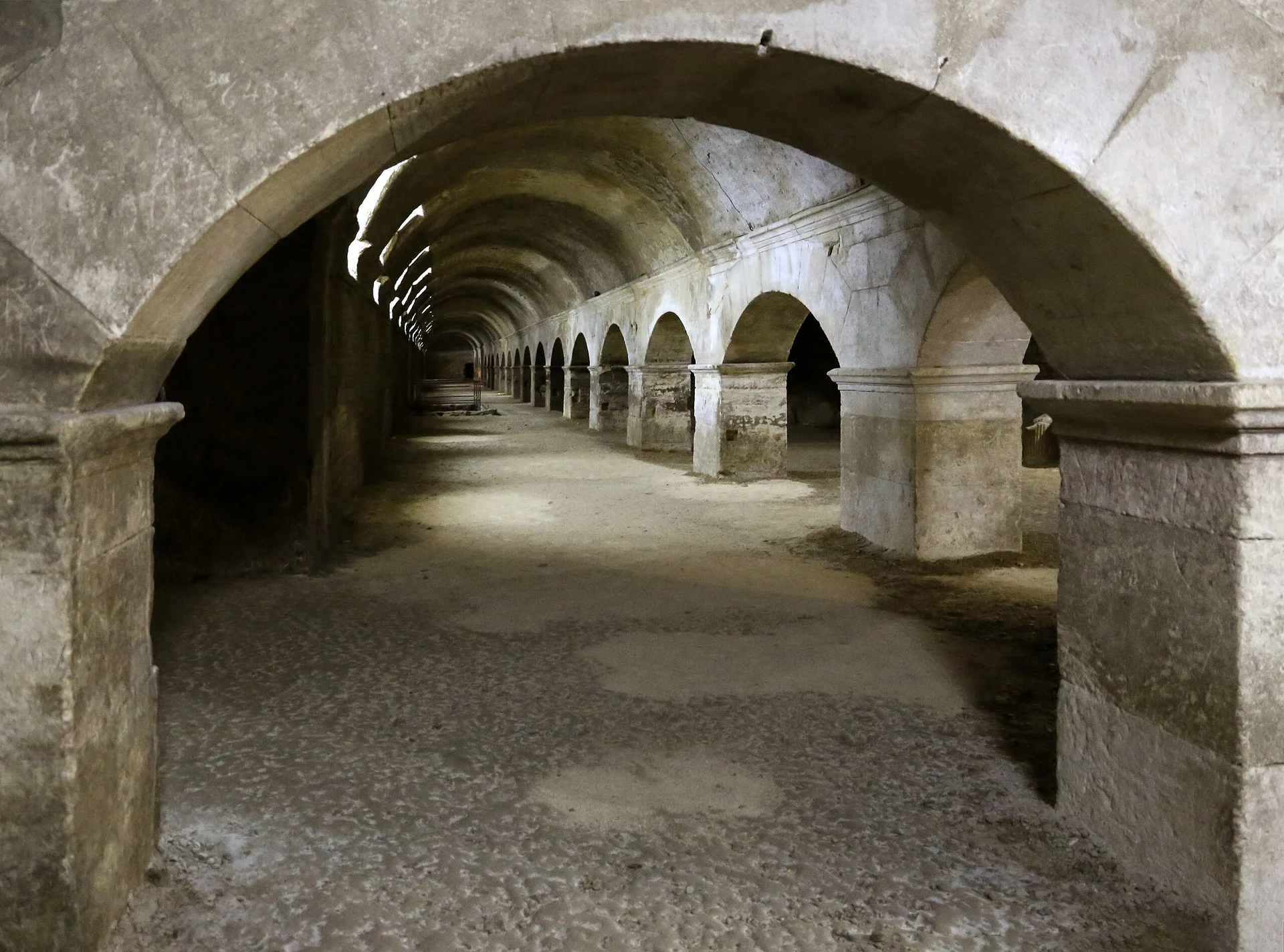
Cryptoportiques of Arles: deep inside the Roman forum
Head down the steps from the town hall and the world changes. The temperature drops by several degrees. The air turns damp and heavy. Beneath your feet lies the original stone floor where the people of Arelate walked two millennia ago. The Cryptoportiques of Arles offer an experience unlike any other, a subterranean journey into the heart of Roman engineering.
Why are these galleries so fascinating?
Built in the late 1st century B.C., these vaulted galleries served as the hidden foundation for the forum, the beating heart of the Roman city. The engineers faced a difficult task, as they needed to construct a vast public square on ground that sloped naturally toward the Rhone River. They solved the problem with impressive precision.
Three massive galleries arranged in a U shape create an artificial terrace 90 meters long. Each branch consists of a double gallery 8.5 meters wide, supported by rectangular pillars made of large stone blocks. The barrel vaults rest on arches with a lowered curve. It is a masterpiece of architecture that has survived for two thousand years, recognized as a UNESCO World Heritage site since 1981.
The visitor experience: a dive into the dark
Do not expect a polished museum experience here. The cryptoportiques retain a raw and mysterious character. The constant coolness, which is particularly welcome during the intense heat of a Provence summer, provides a sharp contrast to the surface. Your eyes will gradually adjust to the dim light.
The path winds through the three main galleries. The south gallery is carved directly into the bedrock of the hill. To the north, the ground was filled in by several meters, which helped preserve remnants of the pre-Roman city. Ventilation shafts once provided airflow and natural light. Massive pillars line the space in a striking perspective, creating a play of light and shadow.
The fourth gallery: a witness to another era
An additional gallery stands out for its use of brick in the walls and vaults. It marks a complete restructuring of the city center in late antiquity, likely during the 4th century A.D. This section, attached to the former shops of the Augustan era, reveals the different layers of the urban history of Arles.
What the galleries tell us
Contrary to what you might imagine, these galleries were not open to the general public during the Roman era. Only two narrow service entrances provided access. They likely served as storage and service areas for the activities taking place in the forum above.
By the beginning of the 5th century, as the forum began to be dismantled, the cryptoportiques were partitioned off to serve as cellars for private citizens. Later on, some sections were even used as prison cells. Every stone bears the marks of these successive uses.
Friendly tip: The visit takes about 30 minutes and can feel quite stark because there are few explanatory signs. Take the time to pause in each gallery to study the architectural details. Look closely at the pillars. Their construction using large stones, perfectly fitted without mortar, illustrates the technical mastery of the Romans. Try to visit in the late morning or early afternoon when the natural light from the shafts is at its best.
Important: The site is not accessible to those with limited mobility due to the many stairs. The atmosphere can be difficult for those who suffer from claustrophobia. The floor is sometimes damp and slippery, so bring appropriate footwear.
Opening hours
May-September: 9:00 AM to 7:00 PM.
November-February: 10:30 AM to 4:30 PM.
Special closures: January 1 and December 25.

The most obscure part of Arles' ancient history. A fascinating discovery that made me fully appreciate the ingenuity of our ancestors. This crypt stretches out under the entire city. It goes without saying that this is a vast and impressive place. A visit that is a nice change of pace and makes you feel like an explorer.
It is cool down there, so it is definitely something to do in the summer!