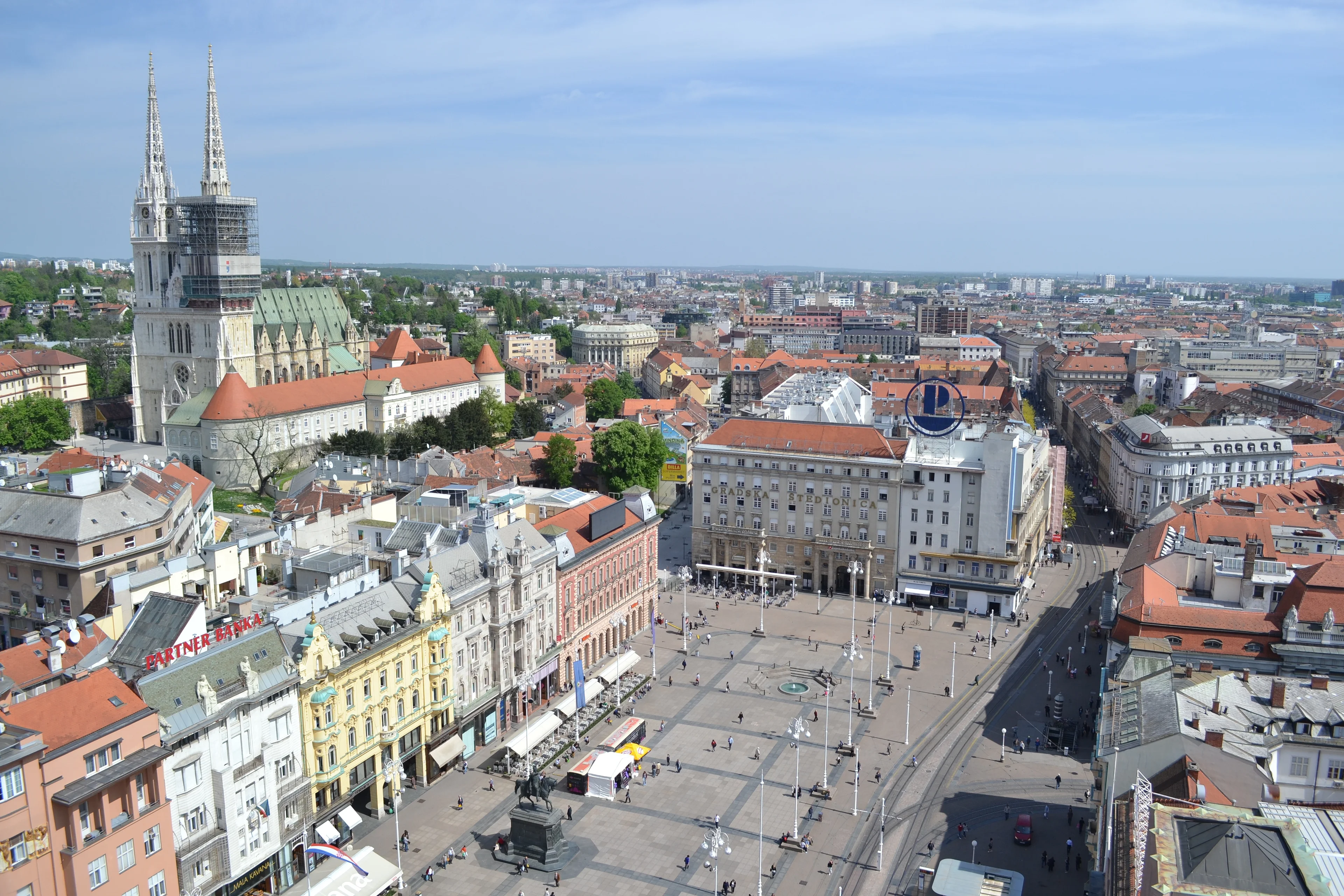
Place Ban Jelacic à Zagreb

Top 10 most beautiful cities in Croatia to visit2026 ranking

Discover our members' favourite cities in Croatia. Feel free to publish your own reviews to take part in this collaborative ranking.

Favourite cities in Croatia among our members, approved by the editors

#1 Zagreb +138

Zagreb has a low-key appeal that rewards those who linger. Between the medieval Upper Town with its cobblestone alleys, the green parks lined with Austro-Hungarian facades, and a sidewalk cafe culture that forces you to slow down, the Croatian capital feels refreshingly authentic. With quirky museums, hearty comfort food, and prices that often run 30-50 EUR (about $32-54) for a solid dinner for two, it is a smart pick for travelers looking to avoid the crushing crowds of Western Europe.

#2 Dubrovnik +102

Enclosed by massive stone walls, the historic heart of this former maritime republic is a UNESCO World Heritage site where every block reflects a history of fierce independence. The contrast between deep turquoise Adriatic waters and orange-tiled rooftops is iconic, though the heavy crowds and high prices, often reaching 15 EUR (about $16) for a simple beer inside the walls, can be a reality check. Seek out quiet beaches, nearby islands, and sunset views from Mount Srđ to escape the intensity of the main thoroughfares.

#3 Cavtat +31

Just 12 miles south of Dubrovnik, Cavtat is a quiet coastal town defined by its Roman roots and preserved historic center. You can walk the cobblestone streets to see the Račić Mausoleum or explore the Vlaho Bukovac Museum for a deep dive into local art. The town is surrounded by accessible coves and nature trails that offer a relaxed alternative to the crowds nearby.

#4 Mljet +27

A tangle of deep green forests and brilliant blue water, the island of Mljet is the southernmost of the major islands in Croatia. Since 1960, more than one third of the island has been protected as a national park. Its landscape is defined by five distinct forest ecosystems. According to The Odyssey, this is where the nymph Calypso lived and kept Ulysses captive for seven long years.

An island of myths and legends

Your trip begins at the docks in the villages of Pomena and Polače. You will find remnants of Illyrian fortifications here, alongside the ruins of one of the largest Roman palaces in Croatia. These villages serve as the trailheads for the Mljet National Park. During peak season, entry to the reserve costs 125 EUR (about $135). Within these woods, nature created two saltwater lakes, Veliko Jezero (the large lake) and Malo Jezero (the small lake), which are connected to each other and the open sea by narrow channels.

In the middle of the larger lake, you can explore a 12th-century Benedictine monastery perched on the islet of Saint Mary. The boat shuttle to reach the islet is included in your park entrance fee. Local lore credits the monks with the early preservation of the island's natural heritage. You can circle the lakes on foot or by bike, and swimming is permitted.

Near the village of Babino Polje, visit Ulysses' Cave. It is a natural karst formation with a collapsed ceiling, creating a deep pool filled with seawater. It is said to be the very spot where Ulysses took refuge after battling the rough currents of the Adriatic.

Immersing in nature

Mljet is well-suited for hiking. From the small village of Pristaniste, you can take a trail that climbs for about forty minutes to the top of the Montokuc viewpoint. From there, you get a clear view of the island, the surrounding coastline, and the deep blue sea.

If you have a car, head to the eastern half of the island to find sandy beaches, which are rare enough in Croatia to be notable. Sablunara beach offers several amenities, while for those seeking quiet, Blace beach is a solid spot to relax.

When to go

Mljet has a Mediterranean climate with hot, dry summers and plenty of sunshine from March through October. Be aware that July can see intense heat waves. Winters can be rainy.

How to get there

Numerous tourist boats and catamarans serve the island, docking in Pomena and Polače. You can make the crossing from Dubrovnik, the Peljesac peninsula, and the neighboring islands of Hvar and Korcula.

There are also car ferry connections from Dubrovnik to the island's largest town, Sobra, operated by Jadrolinija. These trips take about two hours and allow you to bring your own vehicle.

Must-see

#5 Split +25

Split is built directly into and around a 4th-century Roman palace, making ancient history a part of your daily routine. You can dine inside imperial cellars, hike the narrow lanes of the Varoš neighborhood up to the pine forests of Marjan Hill, or catch a morning ferry to the islands of Hvar, Brač, or Vis. This is where Dalmatia begins.

Must-see

#6 Bol +18

During your trip to Croatia, make sure to explore the island of Brač and one of its most charming towns, Bol. This Dalmatian island is a collection of Croatian treasures, and Bol itself is a signature site on the Adriatic Sea. You only need to see the view of the Zlatni Rat beach, or Golden Horn, and its V-shaped sandbar to understand why.

Coastal living on the Adriatic

Start your visit by walking along the small fishing port, which has managed to hold onto its traditional character. If you enjoy historic architecture, head to the Church of Our Lady of Carmel, then stop by the small Saint Anthony Chapel and the fortified palace that now houses the Branislav Dešković contemporary art gallery. For lunch, you will be just steps away from the town market, which stocks plenty of local products.

The rugged surroundings of Bol are a playground for hikers of all levels. Feel free to wander along the many walking paths. The most popular trail, Zlatnog Rata, takes you past several hidden coves. You can also hike to the summit of Mount Vidova Gora, which towers over the town. Expect spectacular views of the island and the surrounding archipelago.

If you are looking for history and authenticity, head to the Blaca Hermitage, founded in the 16th century. For an entry fee of about 5.50 EUR (approximately $6), you can take a guided tour of the hermitage and see its original facilities, including the church, library, school, armory, and astronomical observatory. The site also features a museum with a collection of Venetian furniture and paintings.

Classic Balkan experiences

If you are looking for nightlife, you will find it here. Just a short distance from Zlatni Rat beach is the epicenter of partying on Brač. A cluster of hotels, bars, and clubs will keep you dancing until dawn. Bol also offers a variety of water sports, with windsurfing and kitesurfing being particularly popular due to the consistent coastal winds.

For more adventure, you can book excursions through local tour agencies. A trip to the Dragon's Cave will bring you to a stunning carved grotto once occupied by Glagolitic priests in the 15th century. Alternatively, take a boat trip to see the famous Blue Cave, known for its intense blue light, on the neighboring island of Bisevo.

When to go

Bol enjoys a pleasant Mediterranean climate with plenty of sunshine from March through November. Just be aware that July can bring intense heat waves.

How to get there

During the high season, the island is easily accessible by air via Croatia Airlines, which operates flights to its small airport from Zagreb in about 50 minutes.

The best way to reach Bol is by ferry. You can either take a ferry from Split to Supetar, the largest town on the island, and then take a bus or rent a car, or take a direct ferry from Split to Bol.

Must-see

#7 Pula +14

Pula, located at the southern tip of the Istrian Peninsula, holds one of the best-preserved Roman amphitheaters in existence. This port city pairs ancient ruins with clear Adriatic waters, offering a laid-back alternative to the country's more crowded coastal hubs. Expect a mix of secluded swimming coves, historical sites, and regional cuisine featuring local truffles and wine.

#8 Jezerce +13

You might not recognize the name Jezerce right away, but you definitely know the reason for its fame: the iconic Plitvice Lakes National Park. Located within the Plitvička Jezera municipality, Jezerce is a practical home base if you are planning to spend time in the park. While the village itself has only a few hundred permanent residents, that number is dwarfed by the daily influx of travelers arriving to explore the 16 lakes, which have been a UNESCO World Heritage site since 1979.

Trails for every hiker

Jezerce is just a five-minute drive from the two main entrances of the Plitvice Lakes National Park. It is worth booking a hotel, guesthouse, or campsite for the night before your visit. Getting an early start allows you to explore the park before the peak crowds arrive. Plus, the morning light hitting the water is spectacular, and the forest trails feel far more peaceful. The park spans a karst plateau of nearly 30,000 hectares. Over a distance of more than 8 kilometers, the 16 lakes connect via 92 waterfalls and a network of subterranean channels.

The park is well-organized, offering eight different routes starting from either Entrance 1 or Entrance 2. There is no single best path, as the right choice depends on your fitness level and how much time you have. You can opt for easy two-hour walks that are perfect for younger children, or choose more strenuous routes that involve some elevation gain through the woods. Regardless of your choice, you will inevitably end up walking on the 18 kilometers of wooden boardwalks that wind around the lakes.

Upper and lower lakes

Plitvice is a case study for geologists. The sedimentation process between the water and the karst landscape creates massive travertine barriers, which are visible between every pool. The lake system is split into two sections. The lower section, near Entrance 1, is narrower and features smaller lakes set in a canyon. The upper lakes, closer to Entrance 2, are more spacious and surrounded by gentle, sloping paths.

Your park admission includes access to a boat crossing and a panoramic train ride to help you navigate the terrain.

When to go

Spring and fall are the best times to visit the Plitvice Lakes National Park. Summer can be extremely crowded and prone to heatwaves. In winter, park hours are significantly restricted and the landscape is less vibrant.

Getting there

Renting a car is the most efficient way to reach Jezerce and gives you total flexibility to get to the Plitvice Lakes National Park gates. Alternatively, taking a bus to Plitvička Jezera is a solid option. Carriers like Flixbus, Blablacar, Autobusni Promet, and the national line BusCroatia make the trip from Zagreb in just over two hours.

#9 Starigrad +12

Starigrad offers a quiet pace, sitting right at the base of Paklenica National Park with a rugged, undeveloped coastline. It is a solid pick if you want to swap crowded tourist hubs for a more grounded side of Dalmatia, where your day shifts from mountain canyon hikes to secluded Adriatic swims. Expect a straightforward, balanced stop that lets you decompress without missing the main draw of the region.

#10 Zadar +12

On the Dalmatian coast, Zadar balances Roman ruins and Venetian walls with modern installations like the Sea Organ and the Greeting to the Sun. The city serves as a base for exploring the surrounding archipelago and the limestone canyons of Paklenica National Park, which feel like a more rugged version of the trails in Zion. Beyond the coast, you will find a local calendar packed with museums, festivals, and concerts that lean into the city's artistic side.

Must-see

The rest of the ranking of the most beautiful cities in Croatia

Latest reviews

Very relaxing

I stayed in Zadar for a few days and I really loved the atmosphere. The city is pretty calm and peaceful. It is located right by the sea, which is super nice. The historic center is really pretty and…

14 0

Nice

The capital of Croatia is a very lively and vibrant city that attracts a lot of people. I found the city pretty nice even if it wasn't my favorite one during my trip to Croatia. Like all capitals, it…

12 0

Rich history

Pula is a city with a rich, ancient history that you can discover through its ruins and museum. Even though the city is touristy, I found that it wasn't too crowded, which is really nice for sightseei…

5 0

Stunning historic city

I spent a week in Dubrovnik in September and I really loved it. The city was a little bit quieter during that time. If possible, avoid the months of July and August. The center is perfectly preserved…

13 0

A must-visit in southern Croatia

Along with Zadar and Dubrovnik, Split is a must-see seaside destination in southern Croatia. There are plenty of monuments to visit and alleyways with little taverns to enjoy the Mediterranean climate…

7 0

Rankings by travellers, for travellers

Our rankings are powered by thousands of reviews from travelers like you, not the arbitrary pick of a single editor. Every positive review you publish raises the destination’s score.

1 positive review = +1 reco

Your voice matters!

Have you travelled and discovered amazing places? Share your experience and help the community rank the most beautiful destinations! Sign up for free to post reviews and make your voice heard.