
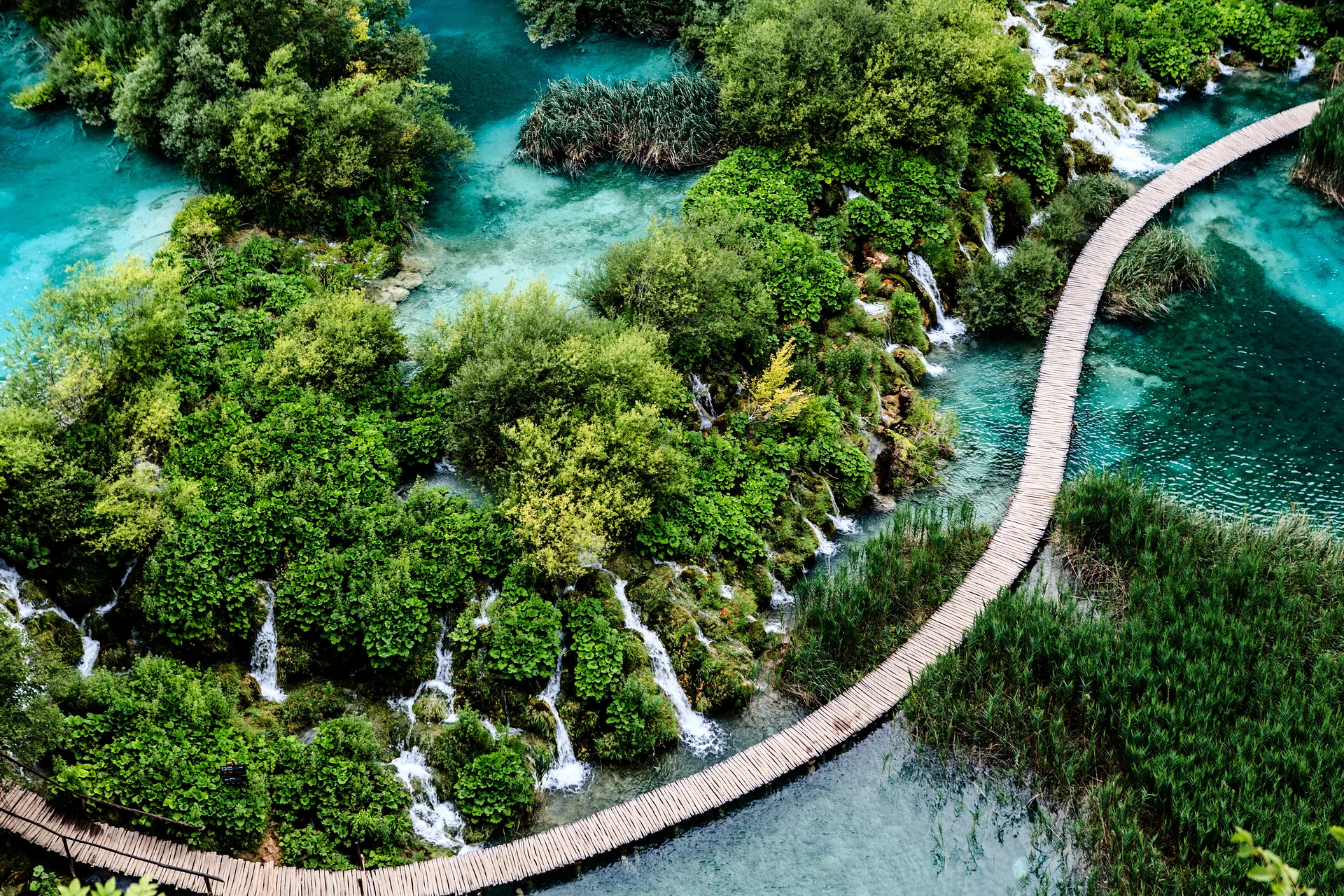
Plitvice Lakes National Park, a corner of Croatia reinvented under your feet
The water here does not just carve through rock. It builds it. Every year, travertine deposits raise the natural barriers by a few millimeters, constantly redrawing the cascades and pools. The 16 lakes you see today will have shifted their shape within a decade.
This slow metamorphosis is why UNESCO designated the park as a World Heritage site in 1979.
Why visit Plitvice Lakes National Park?
Established in 1949, the oldest national park in Croatia spans nearly 297 square kilometers of karst forests and waterways. Its terraced lakes drop 140 meters in elevation from the highest basin to the lowest, connected by more than 90 waterfalls. The geological phenomenon at work, the formation of limestone tuff through the action of water, moss, and bacteria, remains active today. The park forests are home to brown bears, wolves, and some 157 bird species.
Upper Lakes or Lower Lakes: two faces of the park
The Lower Lakes and Veliki Slap
From Entrance 1, the trail dips toward wooden walkways that skim the water surface. The sound of your footsteps on the planks blends into the roar of Veliki Slap, the tallest waterfall in Croatia: 78 meters of rock face draped in spray. A side staircase leads to a viewpoint where the panorama of emerald basins makes the hike worthwhile.
The Upper Lakes: calm after the intensity
The 12 Upper Lakes stretch from Prošćansko jezero to the expansive Kozjak. The atmosphere is more muted, the cascades are discreet, and there are many quiet corners. The crossing of Lake Kozjak by electric boat, included in the ticket price, offers a welcome change of pace after several hours of walking.
Choosing your route from 8 marked programs
Programs A, B, and C depart from Entrance 1 toward the Lower Lakes. Programs E, F, and H depart from Entrance 2 and begin with the Upper Lakes. Program K, the most comprehensive, covers the entire lake system and requires a full day. All routes combine walking, a panoramic train ride, and an electric boat trip. For a first visit, programs C or H offer the best balance of coverage and effort, taking 4 to 6 hours.
Friendly tip: Book your tickets online at least 3 days before your visit, especially between June and September. The park enforces a daily quota and early time slots sell out quickly. A 7 AM slot in the summer allows you to enjoy the Lower Lakes in near solitude for a good hour.
A landscape that changes with the season
Spring swells the waterfalls with snowmelt, autumn colors the beech trees in rust and gold, and winter freezes Veliki Slap into a sculpture of ice. The colors of the lakes shift from deep turquoise to fluorescent green depending on mineral concentration and the angle of the light.
May, early June, and September remain the most pleasant times to visit. You get mild weather, admission rates lower than peak summer, and manageable crowds. The walkways are in good condition, and both boats and trains run on full schedules.
Opening hours
- Winter (November to March): 8:00 AM to 4:00 PM, last entry at 2:00 PM
- Spring (April to May): 8:00 AM to 7:00 PM, last entry at 5:00 PM
- Summer (June to August): 7:00 AM to 8:00 PM, last entry at 6:00 PM
- Fall (September to October): 7:00 AM/8:00 AM to 6:00 PM/7:00 PM, last entry at 4:00 PM/5:00 PM
*Information subject to change

Savez vous si on peut s'y baigner (l'été) ?