
Where to stay in Santo Domingo: the 4 neighborhoods to know in 2026
Santo Domingo is visited by coach, in a day, from the beaches of Punta Cana: five hours on the road for a few hours of cobblestones, and a member who made that trip says what it left her with. Sleeping here means having what the coach does not give: the Zona Colonial after nightfall, once the groups have left, Plaza de España with its terraces full, the first cathedral of the Americas in the morning, before the heat, and Calle Las Damas, the oldest paved street on the continent, empty under its lanterns. Around this listed square kilometer, the capital is a city of three million that looks elsewhere: Gazcue and its 1940s villas along the Malecón, the ten-kilometer promenade facing the Caribbean Sea; Piantini and Naco, the towers, the malls and the restaurants where the city dines; and, to the east, the Columbus Lighthouse, the caves of Los Tres Ojos and, thirty kilometers away, the beach of Boca Chica, ten minutes from the airport, for the night before a flight.
The price scale runs from the dorm to the colonial mansion. In the hostel of the Zona Colonial, a bed is bargained between $16 and $21*; in a guest room in Gazcue or Boca Chica, $46 to $74*; in a mid-range hotel, restored convent in the old town, tower on the Malecón or suites in Piantini, somewhere between $96 and $158*; and in the three houses at the top of the guide, colonial palace, grand hotel of 1942 and five-star of the business district, $192 to $340*. Four areas, three addresses each, and for each address the score, how many travelers stand behind it and the complaint they repeat.
But honestly, spending 1 or 2 weeks tanning in a country on the other side of the Atlantic without making a little effort to learn something about its heritage would be a shame.
Compare hotel prices in Santo Domingo
In a hurry? Find the best accommodation deals in 3 clicks.
Compare live deals from Booking, Expedia, Agoda and other partners.
At a glance: our picks by traveller type
Pick the profile that suits you to head straight to the recommended neighborhood.
The neighborhood map in Santo Domingo
Get your bearings on the neighborhoods and must-see sights before choosing where to drop your bags. Click a name to jump to its description.
- 1The Zona Colonial: the first city of the Americas, on foot and in the evening
- 2Gazcue, the Malecón and Plaza de la Cultura: the villas, the sea and the museums
- 3Piantini, Naco and the modern city: the towers, the malls and baseball
- 4The east: Los Tres Ojos, the Columbus Lighthouse and the beach of Boca Chica
The Zona Colonial: the first city of the Americas, on foot and in the evening The Zona Colonial: Parque Colón and the cathedral, Calle Las Damas, the Ozama Fortress and the Tower of Homage, the Alcázar de Colón and Plaza de España, the Casas Reales, the Pantheon, the Casa del Cordón, the Dominican convent, the Casa de Tostado, the Casa de Bastidas, the amber, larimar and children's museums, Calle El Conde up to the Puerta del Conde; to the north, Santa Bárbara and the Mercado Modelo
for a first visit, everything on foot, the terraces of Plaza de España in the evening and the colonial houses
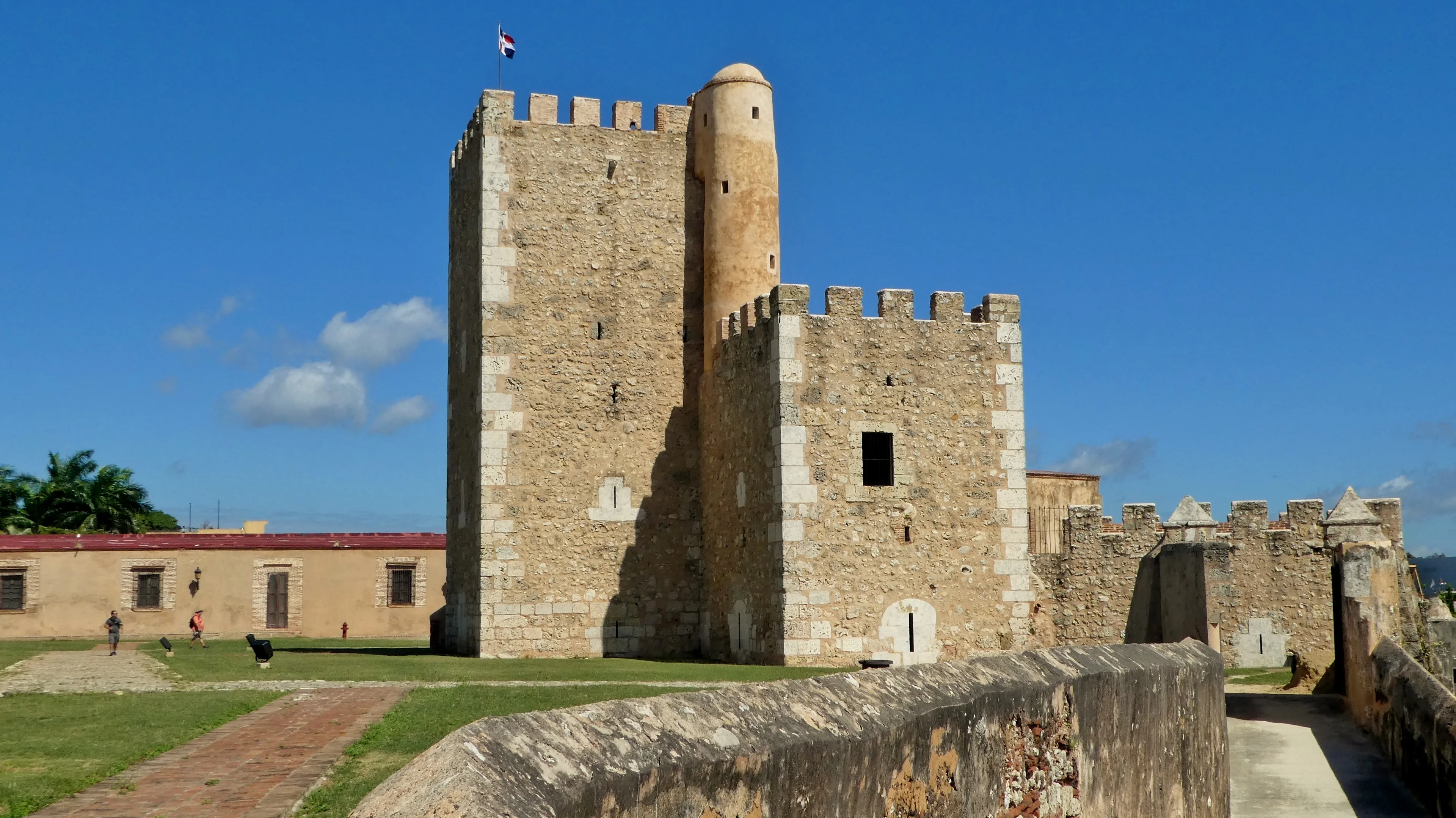
The Zona Colonial is a rectangle one kilometer by five hundred meters between the Ozama river and Calle Palo Hincado, and everything Europe built first in the New World fits inside it: Calle Las Damas, paved in 1502, the Ozama Fortress and its Tower of Homage, completed in 1508 on the river, the Alcázar of 1512, the coral-stone palace of Diego Columbus, son of Christopher, which looks over Plaza de España, the cathedral Santa María la Menor, begun in 1512 and consecrated in 1540, the first in the Americas, the Casas Reales, the Dominican convent of 1510 where the first university opened, the Pantheon in a Jesuit church of 1714, and the Casa del Cordón, the first two-story stone house. By day, the pedestrian Calle El Conde runs from Parque Colón to the Puerta del Conde, where independence was proclaimed in 1844, between sellers of cigars, larimar and amber; in the evening, once the coaches from Punta Cana have left, Plaza de España lines up its terraces facing the lit Alcázar, and Calles Hostos and Arzobispo Meriño open their bars in sixteenth-century houses. You sleep here to do everything on foot, for the colonial houses turned into hotels, and for the city at the hour when it becomes its own again. The downside: streets under construction and cobblestones that echo, hotel reviews that speak of noise, and the Mercado Modelo and the north of the district to be crossed by day.
The moments that really stuck with me: the colonial neighborhood, the cathedral, Christopher Columbus's house, and the Three Eyes Park (Parque Los Tres Ojos) with its underground caves.
Where to stay in this neighborhood
Casas del XVI Luxury
In the Zona Colonial, three sixteenth-century houses joined around patios: rooms rated 9.6 for comfort, staff who know the district, a pool in a courtyard, and an 8.9 on two hundred and eighty-five reviews, 9.5 for cleanliness. The best-rated house in the guide; value for money drops to 8.2.
El Beaterio Casa Museo Mid-range
On Calle Duarte, in a convent of 1530: rooms with high ceilings and stone walls, a patio where you have breakfast, a rooftop terrace, and an 8.7 on a thousand reviews, 9.5 for location. The street is under construction by day and mosquitoes visit the patio, the reviews say.
Island Life Hostel Budget
In the Zona Colonial, two streets from Parque Colón: dorms and rooms in a colonial house, a courtyard where travelers meet, and a 7.9 on eleven hundred and forty reviews, 9.3 for location. Cleanliness is rated 7.5: the only hostel in the district with this many reviews, you sleep here for the price and the courtyard.
Pros
- The first cathedral, the Alcázar, the fortress and Calle Las Damas on foot
- Plaza de España and the bars of Calle Hostos in the evening, once the coaches have left
Cons
- Streets under construction and cobblestones that echo, hotel reviews speak of noise
- The Mercado Modelo and the north of the district are crossed by day
Gazcue, the Malecón and Plaza de la Cultura: the villas, the sea and the museums Gazcue and its villas, the National Palace; Plaza de la Cultura, the National Theater, the Museum of the Dominican Man, the national museum of history and geography, the national museum, the Palace of Fine Arts; the Malecón, Güibia beach, the Obelisk, Parque Hostos; the grand hotels of Avenida George Washington
for the grand hotels on the sea, the museums, families and a quiet district ten minutes on foot from the old town
West of the Puerta del Conde, Gazcue is the district where the capital's bourgeoisie built its villas in the 1930s and 1940s, low houses under the flame trees, quiet streets and guest houses in the old mansions, around the National Palace of 1947 and its dome. To the north, Plaza de la Cultura, the museum park laid out in the 1970s: the Museum of the Dominican Man, which tells the story of the Taínos, the museum of history and geography, the national museum of natural history, the National Theater of 1973, and, next door, the Palace of Fine Arts of 1956. To the south, the Malecón, Avenida George Washington, ten kilometers of promenade between the city and the Caribbean Sea, where the grand hotels of the 1940s to 1970s stand, the Obelisk of 1937, Güibia beach and its park, and where the city comes to walk on Sundays and dance merengue in July. You sleep here for the hotels with pools facing the sea, for the guest rooms in the villas, and for the old town ten minutes on foot along Calle El Conde. The downside: a sea you do not swim in, the Malecón to avoid on foot at night, the reviews repeat, and villas that empty in the evening.
Where to stay in this neighborhood
Renaissance Santo Domingo Jaragua Luxury
On the Malecón, in gardens: the city's grand hotel since 1942, rebuilt as a tower in 1988, an Olympic pool, a casino, tennis courts, staff rated 9.3, and an 8.8 on six hundred and thirty reviews, 9.2 for cleanliness. Value for money drops to 8.3, and the casino brings crowds in the evening.
Catalonia Santo Domingo Mid-range
On the Malecón, at the corner of Avenida Lincoln: a twenty-two-story tower with rooms over the sea, a pool on the tenth floor, a casino, and an 8.1 on four thousand reviews, the largest number of reviews in the guide, 8.9 for location. Value for money is rated 7.9: the view has a price.
Hotel Enrique I Gazcue Budget
In a Gazcue villa, ten minutes on foot from the Zona Colonial: simple, clean rooms, an included breakfast the reviews mention first, staff they describe as a family, and an 8.0 on two hundred and sixty reviews. The price of a guest room, in the quietest district in the guide.
Pros
- The grand hotels with pools facing the sea, the museums of Plaza de la Cultura
- The old town ten minutes on foot, quiet streets under the flame trees
Cons
- A sea you do not swim in, and the Malecón to avoid on foot at night
- Villas that empty in the evening
Piantini, Naco and the modern city: the towers, the malls and baseball Piantini and the Blue Mall, Naco and the Acrópolis, Bella Vista and the Agora Mall; the Olympic Center and Quisqueya Stadium; the Bellapart museum; Plaza de la Bandera; to the northwest, Arroyo Hondo, the botanical garden and the zoo; the Country Club
for the new business hotels, the restaurants, shopping, a baseball game and families
North of Gazcue, the city changes century: Piantini and Naco are the districts of glass towers, banks and embassies, where the capital works, dines and shops, between the Blue Mall, the Agora and the Acrópolis, and where the restaurants of Avenida Gustavo Mejía Ricart serve until midnight. The Olympic Center of 1974 cuts the district in two, a park of stadiums where the city runs in the morning, and Quisqueya Stadium, from October to January, hosts the games of Licey and Escogido, the capital's two clubs, the most Dominican evening there is, beer, merengue and forty thousand people singing. The Bellapart museum, on the sixth floor of a car dealership, holds the best collection of Dominican painting. Further northwest, the botanical garden of 1976, two square kilometers and a little train, the zoo of 1975 and, to the west, the Country Club. You sleep here for the new chain hotels at the price of a European three-star, for the restaurants and for children. The downside: nothing old, eight-lane avenues you do not cross on foot, and the Zona Colonial twenty minutes away by car.
Where to stay in this neighborhood
JW Marriott Hotel Santo Domingo Luxury
In Piantini, in the Blue Mall tower: rooms rated 9.3 for comfort, an infinity pool above the city, a spa, the mall at the foot, and an 8.8 on two hundred and forty reviews, 9.3 for location. The five-star of the business district, for those who come to work or to spend.
Embassy Suites by Hilton Santo Domingo Mid-range
On Avenida Tiradentes, in Naco: two-room suites, a full breakfast and an evening drink included, a pool, and an 8.7 on eight hundred and twenty reviews, 9.2 for cleanliness and comfort. For families, at the price of a hotel room.
Aloft Santo Domingo Piantini Budget
In Piantini, next to the Agora Mall: a recent hotel with rooms rated 9.4 for comfort, a rooftop pool, a bar, and a 9.0 on two hundred reviews, 9.6 for location. The cheapest of the three in the district, and the best score: you sleep here for value for money, rated 8.9.
Pros
- The new chain hotels, the restaurants and the malls on foot
- A baseball game at Quisqueya Stadium, from October to January
Cons
- Nothing old, eight-lane avenues you do not cross on foot
- The Zona Colonial twenty minutes away by car
The east: Los Tres Ojos, the Columbus Lighthouse and the beach of Boca Chica Santo Domingo Este: Los Tres Ojos park, the Columbus Lighthouse, the National Aquarium, the water park, the Megacentro; on the airport road, La Caleta; thirty kilometers away, Boca Chica, its beach and its lagoon
for the beach, the night before or after a flight, the caves of Los Tres Ojos and families
Across the Ozama river, Santo Domingo Este is the city where a million Dominicans live, and where two of the things the member quoted remembered from her day are: Los Tres Ojos, three underground lakes in collapsed limestone caves, reached by stairs cut into the rock and crossed on a hand-pulled raft, and the Columbus Lighthouse, inaugurated in 1992 for the five hundredth anniversary, a concrete cross two hundred and ten meters long that projects a cross of light into the sky and houses what is said to be the admiral's tomb; next door, the National Aquarium on the sea and the water park. Then the road to Las Américas airport heads east, and, ten minutes past it, Boca Chica, the capital's beach: a lagoon of white sand closed by a reef, waist-deep water for two hundred meters, fried-fish shacks, the families of Santo Domingo on Sundays and the hotels of the night before a flight. You sleep here for the beach, for children, and for an early plane. The downside: forty minutes by car to the Zona Colonial, a seaside town that is noisy on weekends, and the big resort on the beach that carries years of scores under 6, left out of this guide.
Where to stay in this neighborhood
Hampton by Hilton Santo Domingo Airport Mid-range
In Boca Chica, on the road, five minutes from the airport and ten from the beach: a new chain hotel, rooms rated 9.1 for cleanliness, breakfast included, a pool, staff rated 9.2, and an 8.7 on eleven hundred reviews. The night before a flight, without surprises.
Hotel Agua Dulce Mid-range
In Boca Chica, in the streets behind the beach: a renovated guest house, a pool in a garden, a bar, a breakfast the reviews praise, staff rated 9.1, and an 8.5 on seven hundred reviews, 8.7 for value for money. Location drops to 7.9: ten minutes on foot from the sea.
Hotel Magic Tropical Budget
In Boca Chica, on a quiet street: studios with kitchens around a pool, an owner the reviews name, breakfast included, and an 8.8 on three hundred and twenty-five reviews, 9.4 for staff and 9.2 for cleanliness. The best value for money in the east, rated 8.9.
Pros
- The beach of Boca Chica ten minutes from the airport, waist-deep water for children
- The caves of Los Tres Ojos and the Columbus Lighthouse on the way
Cons
- Forty minutes by car to the Zona Colonial
- A seaside town that is noisy on weekends, and no reliable luxury hotel
Our tips for booking the right place
- One night more than the coach: The excursions from Punta Cana and La Romana do the capital in a day, five hours of coach included: the member quoted did it and recommends it. With a night here, you also get the Zona Colonial in the evening, once the coaches have left and Plaza de España lights up, and the cathedral in the morning, before the groups and the heat; with two nights, Los Tres Ojos and the Lighthouse one morning, Boca Chica in the afternoon. The Expreso Bávaro bus links Punta Cana to the Malecón in four hours, several times a day, for about ten euros: it is the same trip as the coach, without the guide.
- Dry season, hurricane season, and baseball in between: It is thirty degrees all year round. From December to April, the dry season and the most sought-after, prices at their highest around Christmas and carnival, in February; from June to November, the rainy season, short afternoon showers and, from August to October, the hurricane risk, which empties the hotels and halves the prices. The merengue festival takes over the Malecón at the end of July, and the baseball season, from October to January, fills Quisqueya Stadium three evenings a week: the city shows itself there better than on any tour.
- The airport is to the east, thirty minutes away, and the metro does not go to the old town: Las Américas is thirty kilometers to the east, on the road to Boca Chica: the official taxi to the Zona Colonial or Gazcue takes thirty to forty minutes and costs $40 to $46*, a ride-hailing car a little less; to Boca Chica, ten minutes. The metro, two clean, air-conditioned lines, comes down from the north to Centro de los Héroes station, far from everything this guide describes: it serves Piantini and Naco, not the old town. In town, you walk in the Zona Colonial and in Gazcue, and take a ride-hailing car for the rest, at any hour.
- The Zona Colonial is visited early and lived late: The coaches from Punta Cana arrive around eleven and leave around three: the cathedral, the Alcázar and the Casas Reales are visited at nine, doors open and streets empty, or after four. The Chu Chu Colonial, the little train that tours the district in forty-five minutes, leaves from Parque Colón and gives you the map in your head for the rest of the stay. In the evening, Plaza de España and Calles Hostos and Arzobispo Meriño are full and watched until midnight; the north of the district, around the Mercado Modelo, and the Malecón are walked by day.
- The big resort on Boca Chica beach, sold under a new name: its listing still carries six hundred reviews under 6 out of 10, sheets, food and tired rooms, and the recent scores are not enough to erase them.
- A street-side room in the Zona Colonial without asking which street: the district has been under renovation for years, and the reviews of the houses on Calles Duarte and El Conde speak of jackhammers from eight in the morning.
- The hotels of the western Malecón, beyond Avenida Lincoln, for visiting on foot: well rated, but three kilometers from the Puerta del Conde along an avenue you do not walk at night.
FAQ: where to stay in Santo Domingo
Which area should you stay in for a first time in Santo Domingo?
Where can you stay cheaply in Santo Domingo?
How many nights should you plan in Santo Domingo?
Is Santo Domingo safe for a traveler?
How do you get to the center from the airport?
How much does a night in Santo Domingo cost?
 Keep exploring
Things to do in Santo Domingo
Keep exploring
Things to do in Santo Domingo
Comments (0)
No comments yet. Be the first!