

Where to stay in Manaus: the 4 neighborhoods to know in 2026
Photo : brazilecotour
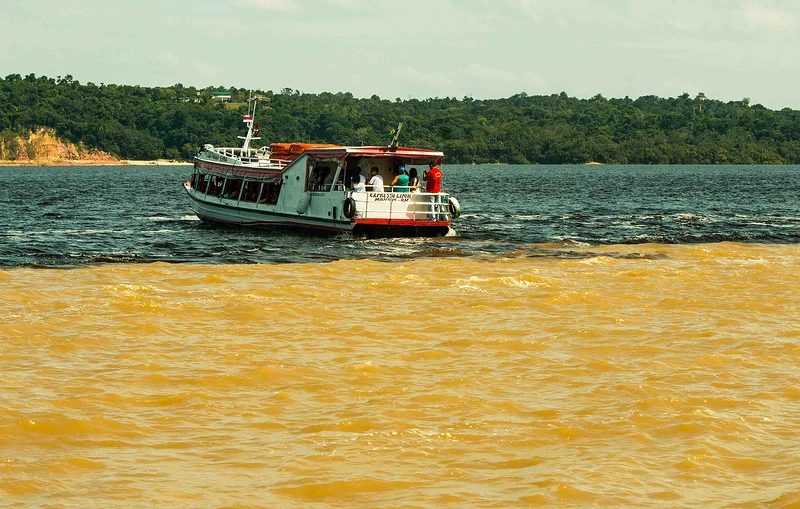
In Manaus, the real choice is not the neighborhood: it is where to sleep in relation to the forest. The city is a gateway, two million people set on the bank of the Rio Negro, ten kilometers from the spot where its black water meets the muddy water of the Solimões without mixing, and almost everyone spends a night here before the forest, a night after, and the rest inside it. For the two nights in town, the choice fits in three names: the historic center, the pink and gold Amazonas theater of 1896, its square paved in black and white waves, its cafés where you dine under the watch of the police; Adrianópolis, the new town of shopping malls and bars, ten minutes north; Ponta Negra, the white sand beach on black water, thirteen kilometers away. For the other nights, the lodges, three hours by boat and road, on the lakes of Careiro and Autazes. A member who made the trip says in one sentence where to sleep before and after.
Count the night in town on one side, the night in the forest on the other. In town: a dorm bed two streets from the theater, between $14 and $21*; $46 to $74* if you want a room of your own, in the center as in Adrianópolis; $74 to $124* for a four-star with a pool; $192 to $300* for the luxury house on São Sebastião square. In the forest, the lodges sell packages of two or three nights, boat, meals and guide included: $181 to $400* per person per night. Twelve addresses follow, three per area, with their score, how many travelers awarded it, and the grievance that keeps coming back.
If you want to spend a night or two before or after a jungle tour, the area around the opera house is perfect.
Compare hotel prices in Manaus
In a hurry? Find the best accommodation deals in 3 clicks.
Compare live deals from Booking, Expedia, Agoda and other partners.
At a glance: our picks by traveller type
Pick the profile that suits you to head straight to the recommended neighborhood.
The neighborhood map in Manaus
Get your bearings on the neighborhoods and must-see sights before choosing where to drop your bags. Click a name to jump to its description.
The historic center and the port: the Amazonas theater and São Sebastião square Centro: the Amazonas theater, São Sebastião square and its church, the courthouse, the Rio Negro palace, the Palacete Provincial and its museums, the Adolpho Lisboa market, the customs house, the floating port, the municipal clock, the cathedral; Praça 14 and the Indian museum; to the east, Cachoeirinha and the chapel of the Poor Devil, the cultural center of the peoples of the Amazon, the Distrito Industrial; by boat, the meeting of the waters
for one or two nights before or after the forest, the theater, the market and the boats
The center of Manaus fits in a few streets between the port and the theater, and it was the rubber city that built them, in twenty years, when Manaus was the richest city in Brazil: the Amazonas theater of 1896, its dome of thirty-six thousand glazed tiles in the colors of the flag, its Italian marble and Parisian ironwork, which still gives free concerts and can be visited by day; São Sebastião square in front of it, paved in black and white waves that depict the meeting of the waters, the church of 1888, and the terraces where everyone who goes out comes to dine, under the eye of the police guarding the square. Around it, the courthouse of 1900, the Rio Negro palace of 1903, the house of a German rubber baron turned cultural center, the Palacete Provincial of 1875 and its five museums, including the Museum of the Northern Man and the numismatic cabinet. Toward the river, the Adolpho Lisboa market of 1883, iron halls designed on the Paris model, where you eat grilled fish at noon, the customs house of 1906 shipped from England in parts, the floating port that rises and falls fourteen meters with the river, and the clock of 1929. The boats to the meeting of the waters leave from here: ten kilometers downstream, the black Rio Negro and the café-au-lait Solimões run side by side for six kilometers without mixing. You sleep here to do everything on foot, for the concerts, and for the cheapest hostels in the guide. The downside: after seven in the evening, outside the square and its three streets, the center empties and the member quoted says to take a car home.
Be careful to take an Uber to get back. From 7 PM on, it gets seriously sketchy.
What to see & do in the neighborhood
Where to stay in this neighborhood
Hotel Villa Amazônia Luxury
A hundred meters from São Sebastião square, in a house from the rubber city: thirty rooms around a garden and a pool, a restaurant the reviews rank with the rooms, and a 9.5 on six hundred reviews, 9.7 for cleanliness, comfort and facilities. The best-rated house in the guide, and the most expensive in the city, the reviews say.
Hotel Saint Paul Mid-range
Five hundred meters from the theater, in the center: large, clean rooms, a breakfast the reviews mention, staff who speak English, and an 8.3 on twenty-three hundred reviews, 9.1 for location. The wifi is weak, the reviews say.
Local Hostel Manaus Budget
One street from the theater: dorms and rooms, a breakfast the reviews put first, lounges where you plan your excursion with the others, and a 9.0 on a thousand reviews, 9.6 for location. The access lane is uninviting at night, solo women travelers write.
Pros
- The theater, the square, the market and the boats to the meeting of the waters on foot
- The cheapest hostels and hotels in the guide, two streets from the theater
Cons
- After seven in the evening, the center empties outside the square and its three streets
- The port and the market are crossed by day only
Adrianópolis, Vieiralves and Parque 10: the new town, the bars and the parks Adrianópolis and the Manauara, Nossa Senhora das Graças and the bars of Vieiralves, Parque 10 and Mindu park, Aleixo and the Bosque da Ciência, Flores and the Arena da Amazônia; to the north, Cidade de Deus and the Adolpho Ducke botanical garden; to the west, São Jorge and the CIGS zoo
for bars and restaurants in the evening, hotels with pools and the parks with the collared monkey
Ten minutes north of the center, Adrianópolis is the town where the Manauaras who can afford it live and go out: towers, the Manauara, the shopping mall of 2009 where the whole city takes refuge in the air conditioning, and, in Vieiralves, the streets Rio Içá and Rio Purus, where bars and restaurants serve until midnight without anyone thinking about the time. It is also the neighborhood of parks: Mindu park, thirty hectares of forest in the city where the sauim-de-coleira lives, the little collared monkey that exists nowhere else than around Manaus; the Bosque da Ciência of the Amazon research institute, thirteen hectares with its manatees and giant otters, the natural science museum and its aquarium of two-meter pirarucus; further north, the Adolpho Ducke botanical garden and its forty-two-meter tower above the canopy; to the west, the zoo of the army's jungle school. In between, the Arena da Amazônia of 2014, built for the World Cup in place of the old Vivaldão stadium. You sleep here to go out in the evening without a car, for hotels with pools at the price of a three-star, and for the parks. The downside: nothing old, and the theater, the market and the port twenty minutes away by car.
Where to stay in this neighborhood
Blue Tree Premium Manaus Luxury
In Adrianópolis, ten minutes from the center: large rooms, a pool, a massage service, staff rated 9.0, and an 8.3 on a thousand reviews. The avenue is busy and the air conditioning noisy in some rooms, the reviews say.
Intercity Manaus Mid-range
In Adrianópolis, on Marciano Armond street: a chain hotel with a rooftop pool, a view over the city, a morning buffet with made-to-order omelets the reviews mention first, and an 8.3 on seventeen hundred reviews. Value for money is rated 7.6: you pay for the roof.
Hotel Adrianópolis All Suites Budget
In Adrianópolis, on Salvador street, next to the Manauara: suites with kitchens, a pool, a gym, a breakfast the reviews praise, and an 8.4 on five hundred and seventy reviews, 8.9 for location. The wifi is rated 7.1, the reviews say.
Pros
- The bars of Vieiralves and the Manauara on foot, in the evening too
- Hotels with pools at the price of a three-star, the parks and their monkeys
Cons
- Nothing old, and twenty minutes by car to the theater and the port
- Noisy avenues, the hotel reviews note
Ponta Negra and Tarumã: the beach on black water Ponta Negra and its promenade, the beach, the amphitheater; Tarumã and the Davi marina; by boat, Moon beach, the Seringal museum and Tupé beach; the Rio Negro bridge toward Iranduba
for the beach and the sunset over the river, families, and the first lodge thirty minutes away by boat
Thirteen kilometers west of the center, Ponta Negra is where Manaus goes to the beach: a cove of white sand on the black water of the Rio Negro, a two-kilometer promenade redone in 2012, with its amphitheater, its kiosks and its tacacá sellers, and, every evening, the whole city coming to watch the sun fall into the river, several kilometers wide here. The sand only appears at low water, from August to November; the rest of the year, the river rises to the promenade and the beach becomes a quay. From the Davi marina, in Tarumã, the boats cross in fifteen minutes to Moon beach, on the other bank, in thirty to the Seringal museum, a rubber plantation rebuilt for a film, where you see how the trees were tapped and the latex smoked, and in an hour to Tupé beach and its village. Above Ponta Negra, the bridge of 2011, three and a half kilometers over the Rio Negro, leads to Iranduba and the road to the southern lodges. You sleep here for the beach and the sunset, for children, and for the lodge closest to the city, thirty minutes by boat into the Tarumã forest. The downside: thirty to forty minutes by car to the center, and hotels that have aged, the reviews say.
Where to stay in this neighborhood
Amazon Ecopark Jungle Lodge Luxury
In the Tarumã forest, thirty minutes by boat from the Davi marina: air-conditioned bungalows on the edge of a red-water creek, a private beach, monkeys and agoutis in the camp, staff rated 9.3, and an 8.3 on about a hundred reviews. The rooms are simple for the price and the food repeats itself, the reviews say: you sleep here to be in the forest on the first night.
Tropical Executive Hotel Mid-range
On Ponta Negra beach: a four-star tower with balcony rooms over the river, an infinity pool, a sauna, staff rated 8.3, and an 8.0 on twenty-two hundred reviews, 8.7 for location. The hotel is dated and poorly maintained in places, the reviews repeat: you sleep here for the view.
Life Ponta Negra Budget
In Ponta Negra, a few streets from the beach: new apartments with kitchens in a residence with a pool, wifi rated 10, and a 9.6 on only twenty-one reviews, 9.3 for value for money. The price of a simple room, for those who accept having no reception desk.
Pros
- The beach, the promenade and the sunset over the river, for families
- The boats from the Davi marina to the other bank, and the lodge thirty minutes away
Cons
- Thirty to forty minutes by car to the center
- No sand from December to July, when the river is high
The forest: the lodges of Careiro, Autazes and the Rio Negro South of the Solimões, the lakes of Careiro and Lake Mamori, Autazes and Lake Juma; to the northwest, the Rio Negro, Novo Airão, the Anavilhanas archipelago and Jaú national park
for sleeping in the forest, two or three nights, caimans at night and canoe at dawn
This area is not a neighborhood: it is the reason for the trip. The lodges are three hours from Manaus, and you go on a package of two, three or four nights, boat, meals and guide included, picked up at the hotel in the morning and returned to the same place on the last evening. To the south, over the Rio Negro bridge, then the road and a boat, the lakes of Careiro, Lake Mamori and its lodges on stilts, where you fish for piranha in the afternoon, where you look for the red eyes of caimans by torchlight at night and where you set off by canoe at dawn into the igapó, the forest flooded from April to July; further on, Autazes and Lake Juma, three hours by road and boat, for the most isolated lodges. To the northwest, by the Novo Airão road, the Rio Negro, the Anavilhanas archipelago, four hundred islands and the pink dolphins, and, at the end, Jaú national park, two million hectares you enter only with a permit. The three lodges in the guide are those whose listings carry the most reviews and the best scores; the member quoted at the top states the rule of choice: the more expensive it is, the better it is. The downside: the forest is booked before you arrive, not on the quay, and the comfort is that of the forest, frogs included, the reviews say.
Where to stay in this neighborhood
Juma Amazon Lodge Luxury
On Lake Juma, in Autazes, three hours by road and boat: bungalows on stilts at canopy level, a pool, a kitchen that mixes regional and international, guides the reviews put first, and an 8.9 on seventy reviews, 9.5 for location. The most expensive lodge in the guide: value for money is rated 7.7.
Dolphin Lodge Mid-range
In Careiro, on the lake shore: rooms by the water facing the sunset, guides and a boat pilot the reviews name, monkeys and caimans in the garden, and a 9.2 on three hundred and thirty reviews, 9.8 for location. The rooms are average and the frogs get in, the reviews say.
Amazon Arowana Lodge Budget
In Careiro, in the lakes: a small family lodge, guides rated 9.9, a kitchen the reviews praise, and a 9.6 on fifty-six reviews, 9.4 for value for money. The cheapest package of the three, and the best score in the guide along with the house on São Sebastião square.
Pros
- Sleeping in the forest, caimans at night, canoe at dawn, pink dolphins
- All inclusive: boat, meals, guide, picked up and returned to the hotel
Cons
- Three hours by road and boat, to be booked before you arrive
- The comfort of the forest, frogs and mosquitoes included
Our tips for booking the right place
- The forest is booked before you arrive, not on the quay: The lodges sell packages of two, three or four nights, boat, meals, guide and transfer from the hotel included, and the best are full in the dry season. The touts at the airport and on the square offer cheaper: the member quoted at the top has settled it, the more expensive, the better. Three nights is the right length, two is the minimum to see anything other than the journey. A light bag is enough, the hotels in the center keep the rest of the luggage, and most travelers come back to sleep one last night in the same place before the plane.
- Two seasons, two forests: high water and low water: It is thirty-two degrees and humid all year round, and the storms fall in the late afternoon from December to May. What changes is the river: from March to July, it rises ten meters, the forest is flooded and you glide by canoe between the trunks; from August to November, it falls, the sand beaches appear at Ponta Negra and on the Rio Negro, the animals gather at the water's edge and forest walks become possible. Prices rise in July, during the Brazilian holidays, and at the end of June for the Parintins festival, when the hotels of Manaus fill up with people passing through.
- The airport is thirty minutes away, the port is a station: Eduardo Gomes is fourteen kilometers to the north, and there is no train: a taxi or ride-hailing car takes thirty minutes to the center and twenty to Ponta Negra, $9.10 to $17*; the hotels send a car on request. The port is the city's other station: the hammock boats leave for Santarém and Belém, four to five days downstream, and for Tabatinga and the border, seven days upstream; the member quoted says it, very long but cheap. In town, you take a ride-hailing car at any hour, and the bus by day only.
- In the evening, the square or Ponta Negra, and nothing in between on foot: Manaus is a big port city, and the member quoted writes it bluntly: in the evening, you dine on São Sebastião square, which the police guard, or in Vieiralves, or on the Ponta Negra promenade, and you go home by car, even for five hundred meters. The port, the market and the streets between the theater and the river are visited in the morning, when they are full. The theater gives free concerts several evenings a week: it is the best evening in the city, and it is at the door of the three hotels in the center.
- A room in the center outside the three streets around São Sebastião square: the port and market district empties at nightfall, and the reviews of the cheap hotels speak of deserted streets and forced rides home.
- The hotels of the Distrito Industrial, Coroado and the bus station, for visiting: well rated, but made for the business travelers of the free trade zone, eleven kilometers from the theater and with nothing around in the evening.
- A lodge sold on the quay or at the airport, with no listing and no reviews: $57* less per night, and the stories of absent guides, broken-down boats and missing meals come back in the reviews of those who tried.
FAQ: where to stay in Manaus
Which neighborhood should you stay in for a first time in Manaus?
Where can you stay cheaply in Manaus?
How many nights should you plan in Manaus?
Is Manaus safe for a traveler?
How do you get to the center from the airport?
How much does a night in Manaus cost?
 Keep exploring
Things to do in Manaus
Keep exploring
Things to do in Manaus
Comments (0)
No comments yet. Be the first!