
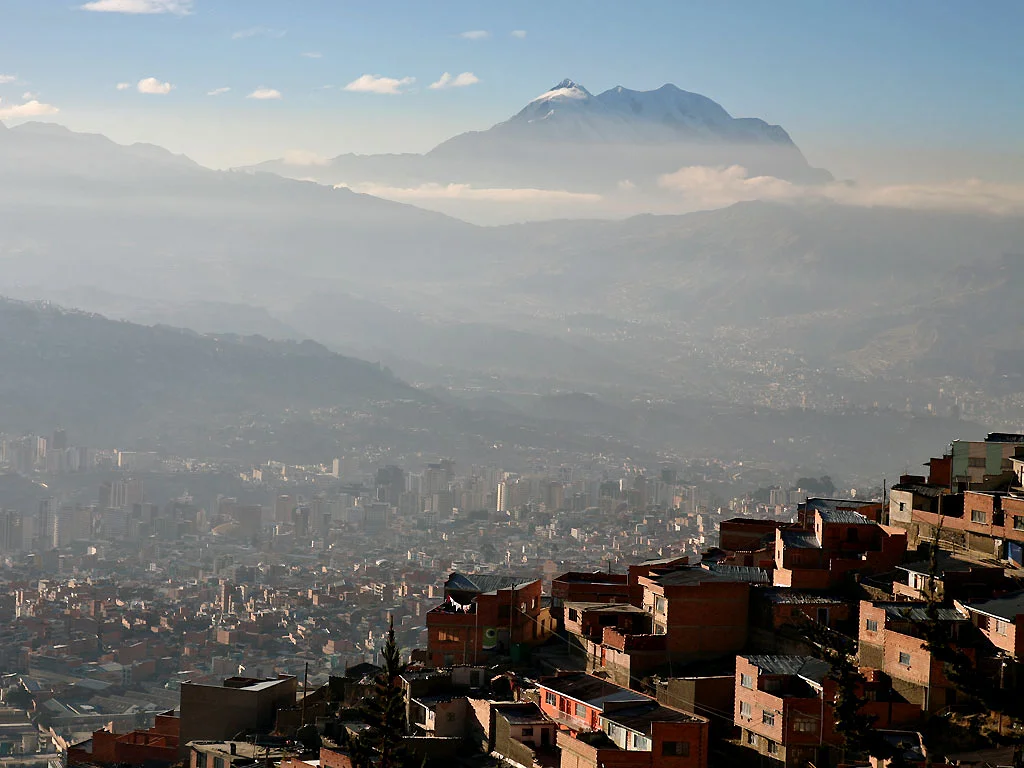
La Paz et Illimani depuis les antennes de El Alto ©Thaki Voyage

Top 6 most beautiful cities in Bolivia to visit2026 ranking

Photo : Thaki Voyage

Discover our members' favourite cities in Bolivia. Feel free to publish your own reviews to take part in this collaborative ranking.

Favourite cities in Bolivia among our members, approved by the editors

#1 La Paz +29 recs

Sitting at 3,650 meters (11,975 feet) above sea level, La Paz holds the title of the world's highest capital city. This geographical extreme is only the starting point for exploring this massive city, which serves as the historical and cultural heart of Bolivia. For any traveler looking to understand the country, La Paz is a non-negotiable stop.

A canyon city beneath the peaks

La Paz is built directly into a canyon, surrounded by towering Andean summits. Eternal snow glitters on peaks reaching over 6,000 meters (nearly 20,000 feet), including Mount Illimani, the city's iconic guardian. To grasp the scale of this sprawling metropolis, take the cable car system. For the price of a subway fare, roughly 3 BOB (about $0.40), you can glide over the dense urban basin with the Andes as a backdrop. For a quieter vantage point, head to Mirador Kili Kili on the east side of town. It offers a panoramic view of the entire city. At sunset, the light hits the mountain flanks, and the reflection off the snow creates a shifting array of colors. Once you have taken it all in, it is time to head back down to ground level and navigate the daily life of the locals.

An intense city with quiet corners

La Paz can be overwhelming at first. The pace of life is fast, loud, and constant. You will need to weave through endless street vendors and crowds that seem to congregate on every corner. To get a look at indigenous culture, visit the Mercado de las Brujas (Witches' Market), where you can find artifacts used in Aymara rituals, such as dried llama fetuses, which are traditional good-luck offerings for the Pachamama (Earth Goddess). We also recommend the Mercado Rodriguez, a more traditional market where you can find local ingredients and grab a quick meal at one of the many food stalls.

You cannot miss La Plaza San Francisco, the historical heart of the city, to admire its stunning church. Step inside to experience the gold-leaf interior and its quiet, heavy atmosphere. For a more bohemian vibe, head to Calle Jaén. This narrow, colonial-era street is a hidden treasure lined with elegant, historic houses. Take time to visit the five museums located on this street with a single combined ticket, and enjoy the bright colors and festive energy of the area. Finally, to recharge away from the downtown chaos, La Plaza Murillo is an ideal spot to grab an ice cream or try some salteñas (savory baked pastries filled with meat or vegetables and often spiced).

When to go

La Paz has a subtropical climate, meaning winters are dry and summers are rainy. We recommend visiting between September and December to avoid the coldest temperatures and the peak rainy season.

How to get there

Bolivia has an extensive bus network that connects La Paz to every other major city in the country. You can also reach the city from Peru via Puno, located across Lake Titicaca about 250 kilometers (155 miles) away. If you are flying in from the United States, you will likely connect through major South American hubs like Lima or Bogotá, as there are no direct flights from the US to La Paz.
Must-see

#2 Uyuni +19 recs

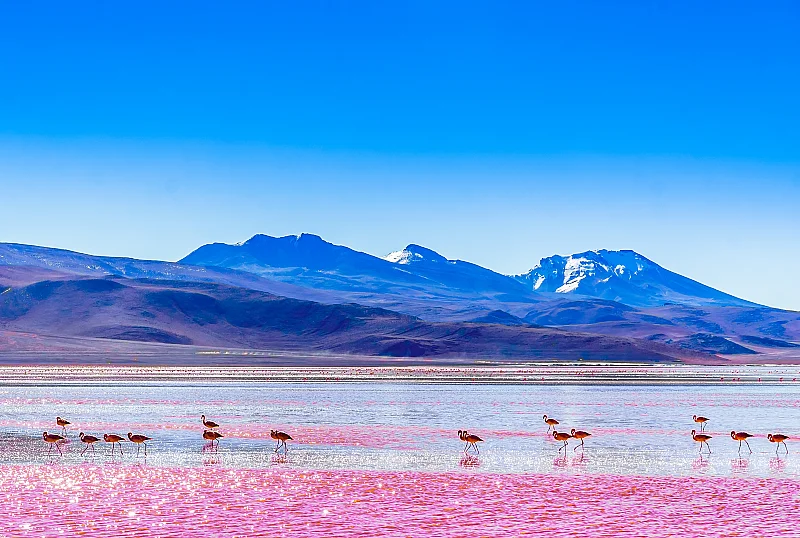
Perched at 12,000 feet in the Bolivian Andes, Uyuni is a remote, dusty town that serves as the gateway to the world's largest salt flat, where the horizon disappears into an infinite, reflective mirror. This is a high-altitude expedition through kaleidoscopic lagoons, active geysers, and Andean flamingos that feels more like visiting another planet than a typical vacation. It is a raw, unvarnished trip for travelers who prioritize surreal sights over creature comforts.

Must-see

#3 Copacabana +12 recs

Perched at nearly 12,500 feet on the shores of Lake Titicaca, this Bolivian town centers around the sacred Basilica of Our Lady. You can hike up Cerro El Calvario for expansive views of the water or explore the pre-Inca astronomical site at Horca del Inca. It is a high-altitude destination that feels miles apart from the coastal vibe of Santa Monica.

Must-sees

#4 Sucre +8 recs

Sucre is Bolivia's constitutional capital, defined by its crisp white colonial architecture and a pace of life that feels far removed from the country's busier hubs. You can walk through the UNESCO-listed historic center to see the Casa de la Libertad and the cathedral, or head to Cal Orck’o to stand in front of massive prehistoric dinosaur tracks. With year-round mild temperatures and a high concentration of language schools, it is a practical base for learning Spanish while exploring the local culture.

#5 Potosí +7 recs

Potosí is a city in Bolivia that experienced a massive boom during the 16th and 17th centuries when Spanish colonists began extracting silver from a major mine, the Cerro Rico. This "rich mountain" dominates the Potosí skyline, and you will see it from almost every street corner. While still active today for tin, the mines can only be visited through organized tours. This excursion provides a look into the difficult living and working conditions of Bolivian miners, many of whom have lost their lives in the belly of the mountain. Deep inside the mines, you will find a representation of the god Tío, the master of the depths.

The mining heritage of Potosí

Mining in this part of Bolivia has continued for four centuries and significantly enriched the European continent under the Spanish crown, which minted currency from Potosí silver. To learn about the industrial and financial history of the city, do not miss the Casa de la Moneda, an 18th-century structure that remains the largest colonial building in all of Latin America. Touring the facility explains how currency was once struck. The museum houses collections of period coins and interesting artwork.

Perched at an altitude of 13,418 feet (4,090 meters), Potosí was once a Spanish stronghold and one of the most populous cities in the 17th century, surpassing London and Paris. At its peak, the city was home to 160,000 people. Mining operations were gradually modernized in the 16th century with the installation of aqueducts and mills to crush ore, structures that are still standing today. From the top of the Cerro Rico, you get a sweeping panoramic view of the surrounding Andes.

A major colonial city in Latin America

The layout of Potosí was built entirely around the mining industry and colonial occupation, which earned it a spot as a UNESCO World Heritage site in 1987. Numerous buildings bear witness to this history, starting with those surrounding the Plaza 10 de Noviembre, the beating heart of the city. You will also find many baroque-style churches and religious monuments, such as the cathedral and the Santa Teresa Convent, which has been converted into a museum of religious art. Take a look at the facade of the Tower of the Compañía de Jesús with its 32 twisted columns and intricate stone carvings.

Unfortunately, after centuries of human extraction, the Cerro Rico has become porous and unstable. It is prone to landslides, which pose a constant threat to both the residents of Potosí and the preservation of its local heritage.

When to go

Because of its high altitude, Potosí can get cold very quickly. Plan your visit between the months of April and October.

How to get there

Beyond its historical significance, Potosí is well-positioned on the route to the Salar de Uyuni. Numerous bus lines serve Potosí from Sucre, a trip that takes about 3 hours.

#6 Tarija +4 recs

Tarija is a laid-back city in southern Bolivia, known for its mild weather and colonial architecture. The surrounding valley hosts the country's main vineyards, making it a prime spot for wine tasting, while local markets offer a genuine look at daily life. For those seeking nature, the nearby Los Cardones reserve provides an escape into rugged, preserved landscapes that feel a world away from the pace of major US cities.

Latest reviews

A total change of scenery

La Paz is a city that surprises you from the moment you land. You really get the feeling of being transported somewhere else. The altitude hits you immediately at around 4,000 meters, and your eyes a…

36 0

An elegant city in Bolivia

Just like Potosi, Sucre is a city that is very popular with tourists in Bolivia. It is undeniable that its colonial architecture is splendid. Added to this is a gentle way of life linked to its climat…

8 0

Go see the Christ of Cochabamba

I ended up in Cochabamba, Bolivia, by chance. I was coming back from the Oruro Carnival and heading toward Santa Cruz with a friend. The stop was forced by the bus schedule. It was still carnival time…

9 0

The must-see mining city

Potosi is a must-see city in Bolivia, right after La Paz, Lake Titicaca, and the Salar de Uyuni. They say capitalism was born in its Cerro Rico because so much silver ore was extracted from there duri…

9 0

Unlikely car blessing

Copacabana is the starting point for the islands of Lake Titicaca on the Bolivian side: Isla del Sol and Isla de la Luna. This little town is therefore very (too?) touristy for my taste, with a lot of…

10 0

Rankings by travellers, for travellers

Our rankings are powered by thousands of reviews from travelers like you, not the arbitrary pick of a single editor. Every positive review you publish raises the destination’s score.

1 positive review = +1 reco

Your voice matters!

Have you travelled and discovered amazing places? Share your experience and help the community rank the most beautiful destinations! Sign up for free to post reviews and make your voice heard.