

Visiting Nîmes, the "French Rome"
Picture a Mediterranean town where a Roman amphitheater still hosts bullfights and a 2,000-year-old temple faces a Norman Foster glass-and-steel museum across the same square. That is Nimes. Nicknamed the "French Rome" for its exceptional antiquities, it pairs well-preserved monuments with narrow, charming lanes and a culture shaped by bullfighting tradition.
The Arènes de Nîmes: a remarkably preserved amphitheater
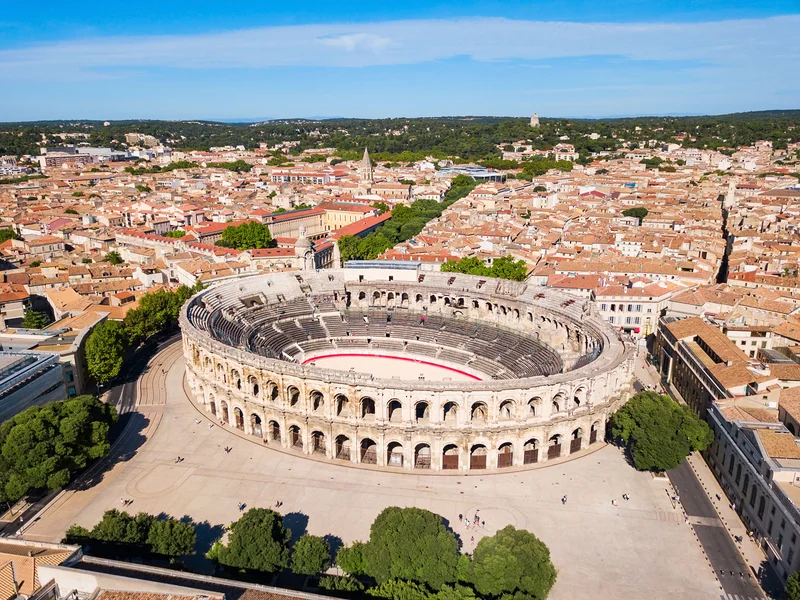
You can't visit Nimes without stopping at its emblematic Roman amphitheater. Built at the end of the 1st century, it ranks among the best-preserved ancient arenas in the world. It still hosts shows today: corridas, concerts and historical reenactments. Even if bullfighting isn't your thing, going inside is worth it for the architecture and the atmosphere of the place.
The Maison Carrée and the Carré d'Art: past and present face to face
Another jewel from the Roman era, the Maison Carrée is a remarkably well-preserved ancient temple, inspired by the temples of Augustus in Rome. Its elegance and restraint make it a fascinating stop for history lovers. Right across from it, the Carré d'Art, designed by architect Norman Foster, offers a surprising contrast. This modern building houses a contemporary art museum and a media library.
The Jardins de la Fontaine and the Tour Magne: a green corner steeped in history
If you want a pleasant walk, the Jardins de la Fontaine are perfect. This 18th-century landscaped park was laid out around an ancient site that includes the Temple of Diana and the spring that gave birth to the city. Climb up to the Tour Magne, a remnant of the Roman fortifications, and you'll be rewarded with a panoramic view over the whole city.
The historic center: picturesque lanes and lively squares
Wandering the historic center of Nimes means discovering a city where every street hides a surprise. From the Place aux Herbes with its busy café terraces to the Saint-Castor Cathedral, by way of the Tour de l'Horloge, the atmosphere is pure southern France. The Halles market is an excellent spot to watch local life and taste regional specialties.
A cuisine between farmland and Mediterranean influence
Nimes is known for its hearty specialties. The signature dish is probably the brandade de morue, a silky blend of salt cod and olive oil. Meat lovers can try the gardiane de taureau, a bull stew typical of the region. For something sweet, the croquants Villaret, crunchy anise-flavored cookies, are a well-loved local treat.
Where to eat
- Le Lisita (Esplanade): refined cooking facing the arena, with local ingredients at their best.
- La Table du 2 (Maison Carrée): a fine-dining restaurant with a great view and modern cuisine.
- Le Wine Bar du Cheval Blanc (Arènes): a warm atmosphere and tapas with southern influences.
- Restaurant Skab (city center): one Michelin star and elegant dishes built on regional produce.
When to go
Nimes has a Mediterranean climate with hot, dry summers and mild winters. Spring and fall are the best times to visit without suffering through the summer heat. The Féria de Nîmes, held in May and September, is the high point of the year, when the city comes alive around the bullfights and popular festivities.
How to get there
Nimes is well served by train: the high-speed TGV from Paris takes about 3 hours. From Marseille or Montpellier, plan on 30 minutes to 1 hour. Nîmes-Alès-Camargue Airport serves a handful of European destinations, but Montpellier Airport (45 minutes by car) has more options.
How to get around
The center of Nimes is easy to cover on foot. For longer trips, the Tango bus network runs throughout the metro area. There is also a bike-share service if you'd rather explore the city at an easy pace.



I was pleasantly surprised by Nimes! The atmosphere is nice and it is well located in relation to other points of interest in the region. History buffs will be thrilled by the arena (and its really interesting shows) and other ruins. On the other hand, I do not recommend going there during the feria... Well, that is up to you, of course!