
Museum of Old Nîmes, where jeans were born
The floorboards creak under your feet. Inside a display case, an 18th-century blue casaquin jacket catches your eye. It is the ancestor of the jeans you are likely wearing right now. This serge de Nîmes garment, woven nearly three centuries ago, serves as a reminder of a time when the city stood as one of the textile capitals of Europe.
Why visit the Museum of Old Nîmes?
This museum chronicles the history of Nîmes starting where the Museum of Romanity leaves off, beginning in the Middle Ages. Established in 1921 by Henri Bauquier, a local journalist and scholar, it was born out of an urgent need to preserve traces of a way of life and local industries that were rapidly disappearing. The setting for these collections is quite impressive.
The former episcopal palace, built in 1684 by local architect Jacques Cubizol, unfolds its rooms between a courtyard and a garden. French-style ceilings and 18th-century woodwork provide a backdrop for the 15,000 objects on display. You wander through a cabinet of curiosities where every piece reveals a different facet of the identity of the Gard region.
The denim room: origins of a global icon
The star of the show occupies an entire room. The famous serge de Nîmes, a wool and silk fabric dyed with indigo that Cévennes shepherds were weaving as early as the 16th century, reveals its secrets here. Blue warp threads crossed with white weft threads create that signature diagonal pattern. Exported to England and then to America, this sturdy fabric eventually took the name de Nîmes, which became denim across the Atlantic.
Levi Strauss did nothing more than harness a raw material whose reputation for durability had already crossed the oceans. The museum displays weaving samples and period clothing, tracing this unexpected lineage between the Cévennes mountains and the California gold rush.
Regional collections and furniture
Languedoc armoires
The massive carved walnut armoires are captivating due to their intricate details. These dowry pieces, handed down through generations, feature floral motifs, scenes of daily life, or religious symbols chiseled into the wood by local craftsmen.
Textiles and cashmere shawls
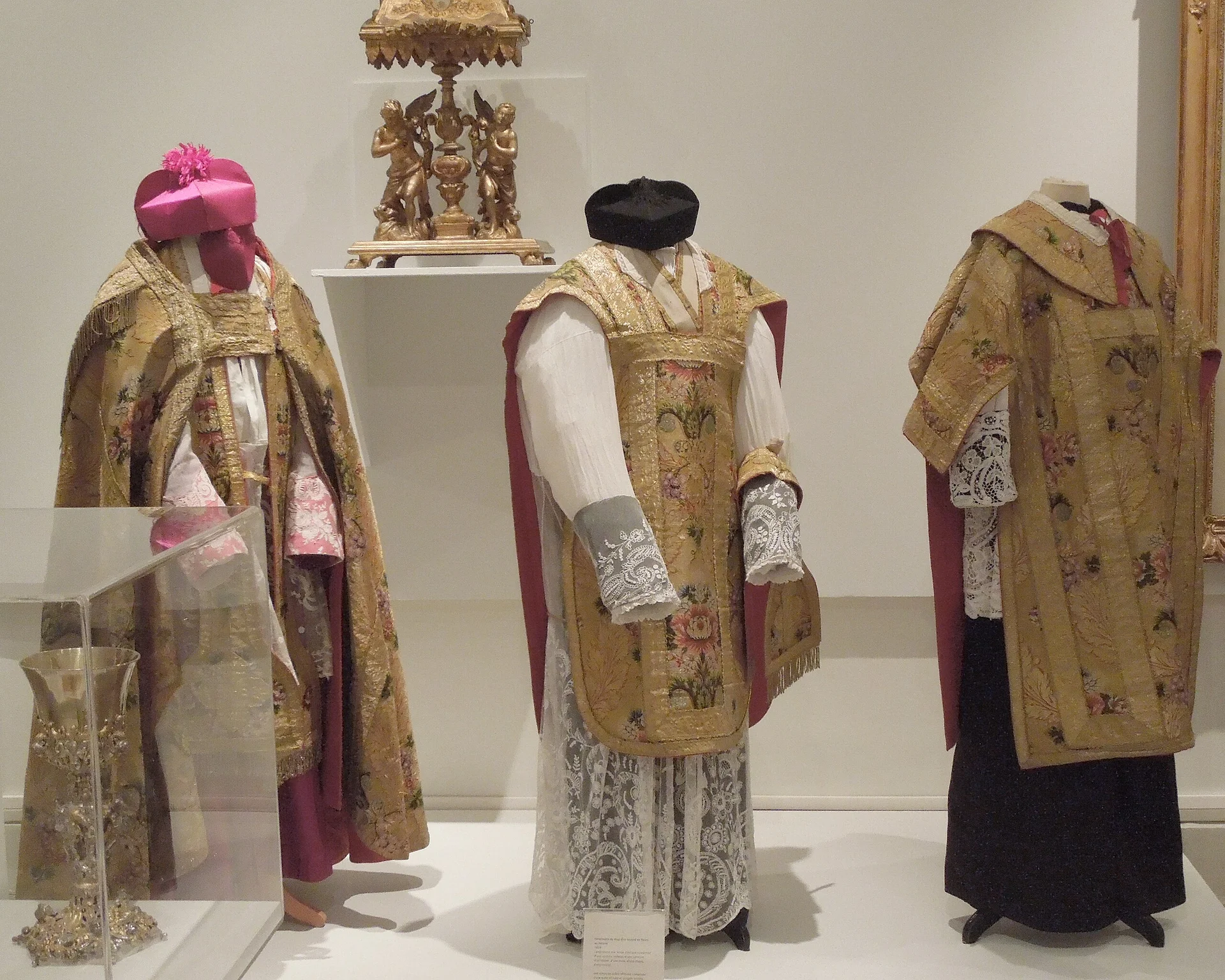
Beyond denim, the museum holds a remarkable collection of 19th-century shawls. Known as four-season shawls, they were worn by women in Nîmes in different ways depending on the time of year, and they remain among the most refined items in the collection.
Friendly tip: Ask for the visitor guide in English at the front desk. Explanations in the galleries can sometimes be brief, and this free document significantly improves your understanding of the collections.
The secret garden
Behind the building, an enclosed garden offers a moment of quiet. A jasmine-covered fountain sits in the center of this courtyard, which is surrounded by blonde stone walls. A few benches shaded by trees offer a place to catch your breath after your tour. Access is free, even if you do not have a museum ticket.
Look for these in the collections:
- The 18th-century serge de Nîmes casaquin, the centerpiece of the textile collection
- Glazed earthenware from the Uzège (the area around Uzès), pottery with colorful enamels typical of the region
- Iconographic documents tracing the city's transformations over the last five centuries
Opening hours
| Monday | Closed |
|---|---|
| Tuesday | 10:00-18:00 |
| Wednesday | 10:00-18:00 |
| Thursday | 10:00-18:00 |
| Friday | 10:00-18:00 |
| Saturday | 10:00-18:30 |
| Sunday | 10:00-18:30 |
Ticket sales close at 5:40 PM on weekdays and 6:10 PM on Saturdays and Sundays. Closed on January 1, May 1, November 1, and December 25.

This small museum showcases objects related to the history of Nîmes. From paintings and ceramics to clothing, the collections are very eclectic. The layout is quite chaotic, and I had a hard time following the flow of the exhibition, which is pretty disorganized in its presentation. However, I really liked the furniture and the room dedicated to denim fabric, which is used to make jeans. The visit really isn't a must if you are short on time. Go more out of curiosity.