
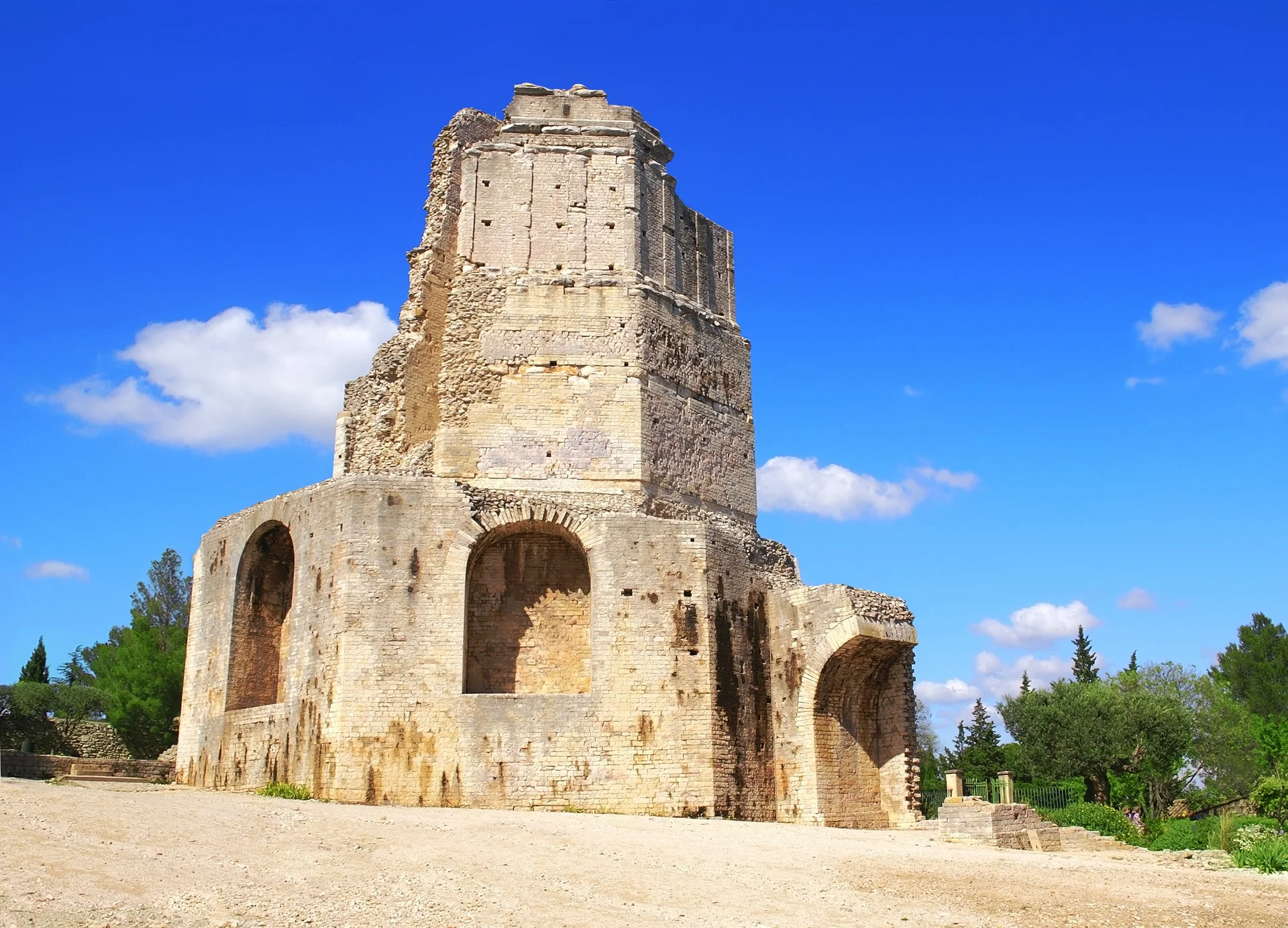
Tour Magne, a 2,000-year-old lookout over Nimes
The 140 steps of the spiral staircase climb through the dim light. Then, the sun hits. From the terrace, your view stretches to Mont Ventoux, the Alpilles, and the ocher rooftops of the city below. This 360-degree panorama rewards the effort of the climb.
Why visit Tour Magne?
This 32-meter octagonal tower is the last remaining piece of the Roman defensive wall of Nimes. Of the 80 towers that once made up the ramparts built under Emperor Augustus around 15 B.C., only this one has survived the centuries. The Romans constructed it by wrapping it around a pre-existing Gallic tower, which had been built by the Volques Arecomiques four centuries earlier.
Perched at the top of Mont Cavalier, at an altitude of 114 meters, it served as a watchtower to monitor the Via Domitia, the major trade route connecting Rome to Spain. It also signaled the power of Nemausus, a flourishing Roman colony, to passing travelers.
The climb to the tower
You reach the Tour Magne by walking through the Gardens of the Fountain, one of the oldest public parks in France. The path winds steadily uphill under pine and holm oak trees. Expect a solid fifteen-minute walk from the park entrance. It is a real workout on a hot day, but the park fountains and basins make the walk pleasant.
Once you are at the base of the tower, the interior staircase awaits. With narrow steps, rough stone walls, and low-angled light, the atmosphere changes completely. Those prone to vertigo or claustrophobia might hesitate. Access is limited to 12 visitors at a time on the top terrace, which can create a line during peak hours.
The legend of Nostradamus and the treasure
In 1601, a gardener from Nimes named Francois Traucat received permission from King Henri IV to excavate the tower. A prophecy by Nostradamus supposedly predicted that a gardener would discover a golden rooster buried under the monument. Traucat dug relentlessly, emptied the interior of the tower, and weakened its foundations. The result was no treasure, but significant damage that required structural repairs in the 19th century.
The irony of history is that this same Traucat introduced mulberry tree cultivation to Provence and Languedoc, launching the silk industry that brought wealth to Nimes. His obsession with the treasure ruined him, but his plantations enriched an entire region.
Friendly tip: A free audio guide tells the legend of Traucat during the ascent. Ask for it at the front desk. And if you also plan to visit the Arena and the Maison Carree, the Pass 3 Monuments for $17* offers much better value than individual tickets.
What you see from the top
The orientation table helps you identify landmarks in the landscape. On a clear day, you can see more than 50 kilometers in every direction. The Arena appears as a perfect ellipse in the middle of the buildings. The Pic Saint-Loup stands out to the west, and Mont Ventoux to the northeast.
Key landmarks to spot:
- The Nîmes Arena, a Roman amphitheater that ranks among the best-preserved in the world
- The Cathedrale Notre-Dame-et-Saint-Castor and its Romanesque bell tower
- The Vistre plain and the foothills of the Cevennes in the distance
- The path of the old Roman wall, recognizable by the lines of trees
Opening hours
*Information subject to change

The Tour Magne is an impressive relic from the Roman era. It is worth the trip.
You get there by taking a pleasant walk through the Jardins de la Fontaine.
Once at the top, the panoramic view of Nîmes and the surrounding area is magnificent.
Avoid it during a heatwave though, as the climb can be exhausting in the middle of summer.