
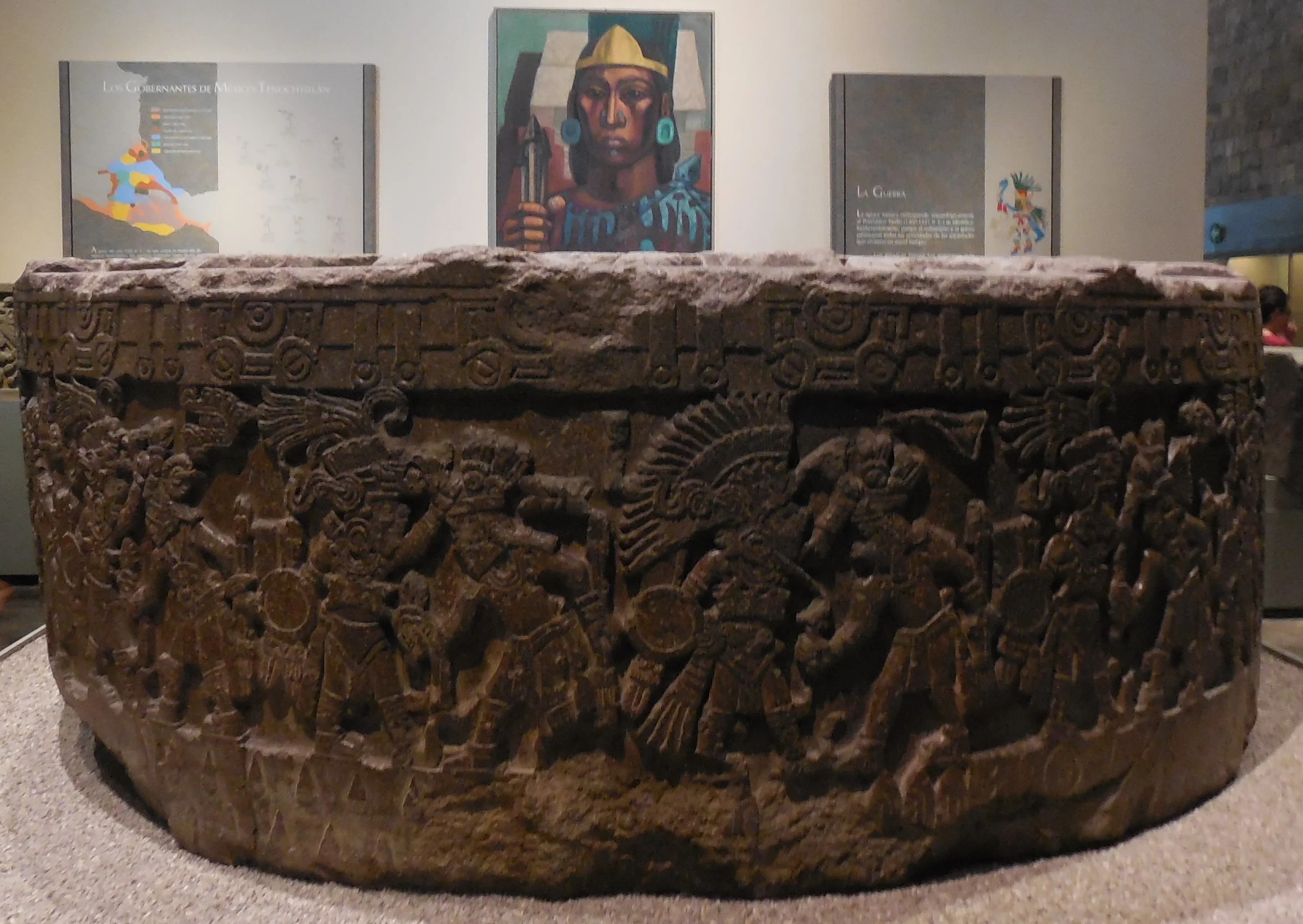
Cover photo: Temalacatl, or stone cylinder adorned with reliefs, on display at the National Museum of Anthropology in Mexico City
By 2000 BC, the first traces of civilization appeared in the Anáhuac Valley, where modern-day Mexico City is located. At an average altitude of 7,350 feet (2,240 m), this valley spans five great lakes, the largest being Texcoco. It is surrounded by mountain ranges and massive volcanoes, such as Popocatépetl, which peaks at 17,800 feet (5,426 m). Consequently, seismic activity in the region is quite significant. Nomadic tribes lived off agriculture, pottery, and basket weaving.
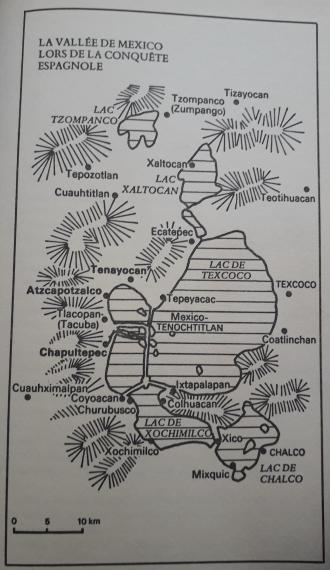
Map of the Anáhuac Valley, taken from the novel Le Dernier Soleil by Jean DUCHÉ (1978)
These peoples began to settle in the valley around the 2nd and 1st centuries BC, during the Pre-Classic period. Cities were founded, such as Cuicuilco to the south or Huixachtecatl to the southeast in the mountains. Even then, they practiced cults dedicated to the ancient Fire God, Xiuhtecuhtli.
By the 1st century AD, the valley was under the control of the great Teotihuacán, established to the northeast. This was the Classic period, and the valley traded goods, most notably obsidian extracted from the volcanoes. It was during this time that the cult of Quetzalcóatl, the Feathered Serpent and God of Knowledge, emerged.
Around the 10th century, following the decline of Teotihuacán, it was the Toltecs' turn to rule the valley from their capital, Tula, in the north. The God-King Quetzalcóatl (977, 987) forbade human sacrifice. This drew the wrath of his brother Tezcatlipoca, God of Darkness, who drove him out. Quetzalcóatl fled across the eastern sea and prophesied his return and vengeance in the year One-Reed.

Chronological frieze photographed at the Templo Mayor museum
The first Aztecs appeared in the 14th century. Originating from tribes in the north, they wandered in search of a promised land. Their god Huitzilopochtli, the Eagle-Sun and God of War, had issued a prophecy: the Aztecs were to establish the city of Tenochtitlán, the Center of the World, at the spot where they saw an eagle devouring a serpent while perched on a prickly pear cactus (the nopal).

Mexican flag raised on the Zócalo of Mexico City
In the year 1325, the prophecy was fulfilled and the city of Tenochtitlán was founded. Today, the eagle devouring the snake on its nopal is depicted on the emblem of the Mexican flag. The city was built right in the middle of Lake Texcoco, on a small islet expanded by artificially draining the land. Four large causeways connected the city to the mainland, aligned with the four cardinal points. A massive aqueduct was constructed to bring fresh water to the city from the hill of Chapultepec. The Aztecs became sedentary and were then known as the Mexicas. Religious and military powers were the foundations of their society, which was organized into different castes.
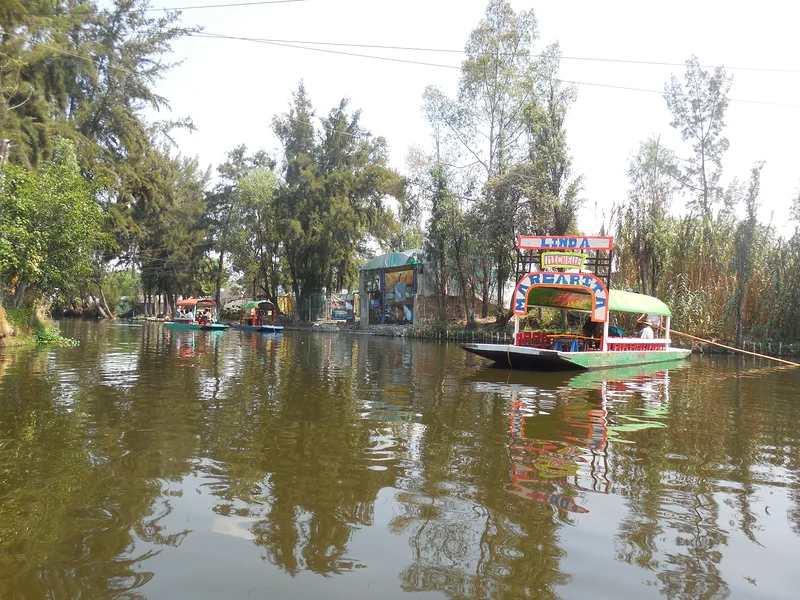
Farmers built artificial islands called chinampas, developed soil fertilization techniques, and dug an entire network of canals and gardens on Lake Xochimilco. They grew corn, beans, chili peppers, tomatoes, and squash, staples that remain central to traditional cuisine today.

The canals and gardens of Xochimilco today
Other products were imported by the merchant caste, the Pochteca. Because they traveled throughout all the provinces, they also served as informants for the ruling class, earning them high social standing. They traded goods like cacao, which was widely consumed by the nobility as a cold beverage.
The calpixque caste managed the cities. They collected taxes and handled other administrative tasks. They also received tributes from the various provinces of the kingdom, often paid in cacao beans, which served as a genuine form of currency.

Painting depicting the daily life of the Aztecs, Templo Mayor museum
The artisan caste produced fine jewelry using precious stones from across the kingdom, such as jade or gold. They also created stunning featherwork. The feathers of the quetzal bird from the Mayan jungle were the most sought-after for their magnificent green and blue iridescence. Today, this beautiful bird is nearly extinct.
Priests held immense power. They organized ceremonies to honor the gods and performed sacrifices. Every day before dawn, men, women, and children, often under the influence of octli, an intoxicating fermented agave drink, were sacrificed atop the temples. These sacrifices were meant to ensure the sunrise, the continuation of time, and to honor the gods. The heart was offered to the sun, and the blood, or Precious Water, was offered to the earth. Heads were lined up on tzompantli, large platforms with spikes. The limbs were then butchered, roasted, and... eaten.

The Chac-Mool of the Templo Mayor, the sacrificial altar used to collect Precious Water

Tzompantli of the Templo Mayor
Warriors were essential to Aztec society, which was built on warfare and conquest. They enabled the Aztec Empire to rule over no fewer than 38 provinces. Unlike other peoples, they mastered the bow and developed formidable military strategies. Conquered provinces paid tribute in the form of goods, soldiers, and men for sacrifices. To select future victims, they organized Flowery Wars: defeated enemies were not killed on the spot but taken to be sacrificed. They also played the Juego de Pelota, a ball game where the losing team was sacrificed.
Finally, the ruling class occupied the most luxurious quarters of Tenochtitlán. The king had the power to communicate with the gods. He did not address the people directly; he spoke through the Tlacotzin, the Snake-Woman, a sort of Prime Minister. The first known sovereign, Moctezuma I, reigned starting in 1440.
The 4th king, Ahuitzotl (1486, 1502), later formed the Triple Alliance with the kings of Texcoco in the east and Tlacopan in the west, which helped defend the city. He was also the one who commissioned the Templo Mayor, consisting of two massive pyramids dedicated to Huitzilopochtli, the God of War, and Tlaloc, the God of Rain. It is reported that to inaugurate this temple in 1487, approximately 20,000 prisoners of war were sacrificed.

12-ton sculpture of Tlaltecuhtli, the Earth Goddess, discovered in 1981 and displayed as a centerpiece at the Templo Mayor museum
The last three sovereigns are likely the best known: Moctezuma II, who opened the city gates to Hernán Cortés in 1519; Cuitlahuac (1520), who then fought the conquistadores; and finally Cuauhtémoc (1521), the last emperor and a true hero of the resistance.
Like the Mayans, the Aztecs possessed complex, albeit different, calendars. The religious calendar consisted of 260-day cycles, divided into 20 months of 13 days. The solar calendar counted 365 days and was based on observations of the stars and seasons. It had 18 months of 20 days, plus 5 "unlucky" days during which no work was done and prayers were offered to the gods to ensure time continued.

The Sun Stone representing the Aztec calendar, discovered under the Templo Mayor in 1790 and exhibited at the National Museum of Anthropology
According to the creation myth, every 52 years, the world could potentially be destroyed and the Sun God Tonatiuh reborn. When the Aztecs founded Tenochtitlán, four Suns had already collapsed. This 52-year cycle is called a Bundle. Thus, with each Bundle, they rebuilt temples over the old ones. A Bundle consists of four periods of 13 years. Each 13-year series has its own name: Rabbit, Reed, Flint, and House. Thus, the year 1517 corresponds to the year Twelve-House in the Aztec calendar; 1518 corresponds to Thirteen-Rabbit; and finally, 1519 corresponds to One-Reed.

Reconstruction of the Templo Mayor and other important buildings of Tenochtitlán, photographed at the National Museum of Anthropology
And so, by a twist of fate, Hernán Cortés landed on Aztec soil in the year One-Reed of the fifth Sun, precisely as the prophecy of Quetzalcóatl's return had indicated. Moctezuma II was a very pious sovereign and placed great importance on the fulfillment of the prophecy. He therefore welcomed Cortés and his men as gods, the Teteo. Unfortunately, Cortés razed the city in 1521 and used the stones from the temples to build the cathedral of Mexico City.

View of the remains of the Templo Mayor and the cathedral of Mexico City
Sources:
- The National Institute of Anthropology and History (INAH): www.inah.gob.mx
- Le Dernier Soleil, Jean DUCHÉ, 1978
For more information in pictures, you can check out my Avygeo photo albums on:
Comments (3)