
A natural wonder!
They arrive by the thousands every year, those small orange, black, and white creatures that travel thousands of miles from Canada or the United States to spend the winter in the lush green hills of the Mexican state of Michoacán. What a journey!

The landscapes of the Monarch Butterfly Biosphere Reserve, at an altitude of nearly 3,000 meters.
It was a Canadian naturalist who first noticed the annual migration of monarch butterflies to the south. He set out to find the secret place where they took refuge, but it took several years before the five sanctuaries known today were finally identified.

Entrance to the El Rosario Sanctuary, near the small village of Angangueo.
The El Rosario Sanctuary, which we are highlighting here and which is the most visited, has only been known since 1975. Today, the site is a UNESCO World Heritage site, and about 80 people work there as tour guides or forest rangers.

Preserving the local flora plays an essential role in the butterflies' migration.
The monarch butterfly has become a true symbol for the state of Michoacán, and even for Mexico as a whole. In fact, it is featured on the 50-peso banknote (about €2.50), fluttering around the arches of the aqueduct in Morelia, the state capital.

The 50-peso banknote, the currency of Mexico.
The life cycle of the monarch butterfly is particularly fascinating: from March to October, they spend their time feeding on yellow flowers and reproducing across various parts of the United States and Canada. Their bright colors, which signal danger, attract few predators, and their poisonous wings make them a poor meal. Their life expectancy is only a few months. By the time the chill of October arrives, three generations have already passed.

The monarch butterfly is recognizable by its three bright colors. You won't find them in Europe.
It is therefore the fourth generation of the year that undertakes the long winter journey starting in November. But how do they know the way, and more importantly, the exact location of the sanctuaries? Their precise sense of direction remains a mystery, though it is believed they rely on the position of the sun, to which they are very sensitive.

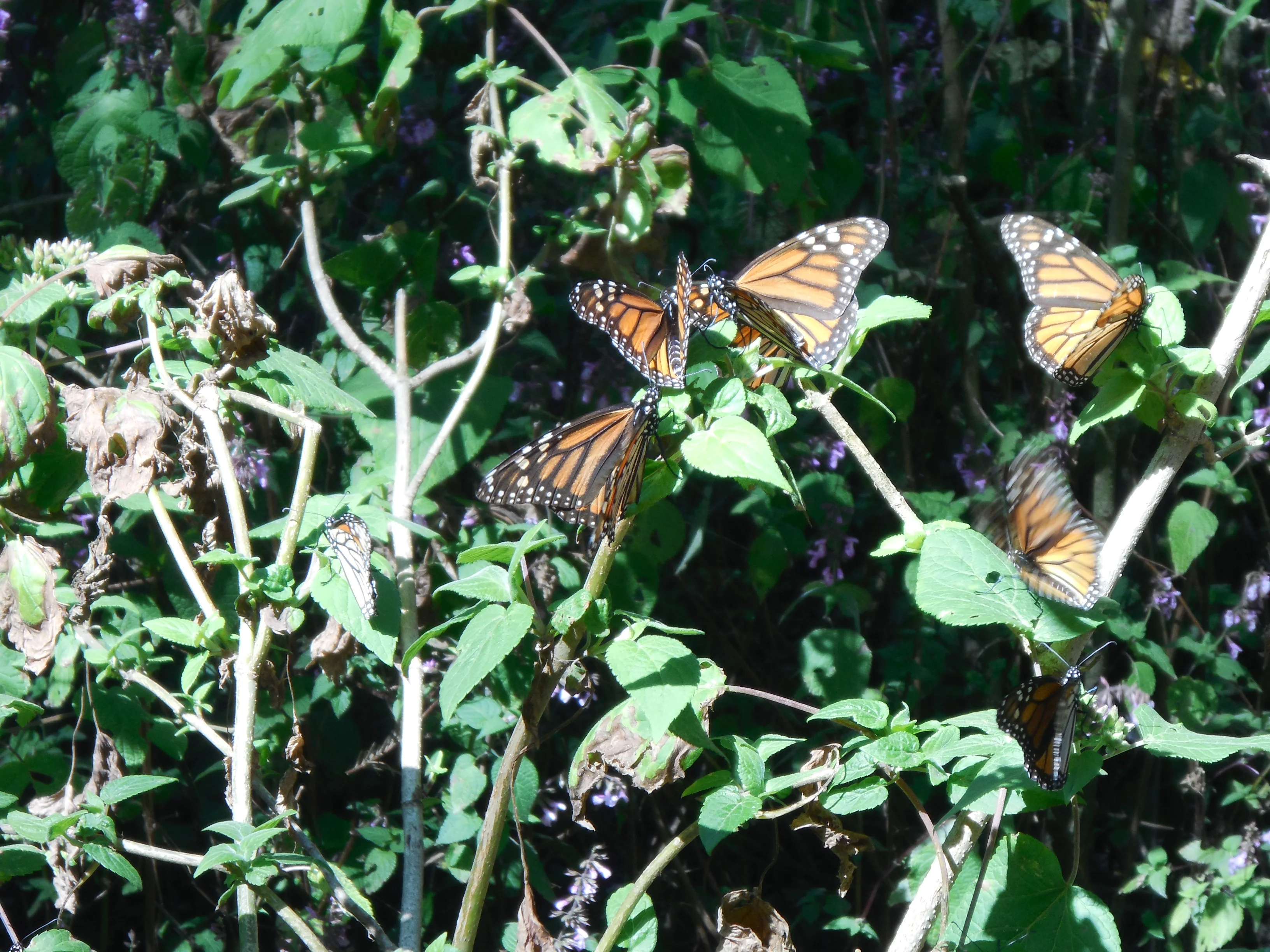
The butterflies spread their wings and take flight as soon as a ray of sunshine appears.
Another remarkable phenomenon: the fourth generation of the year lives longer than the others. In fact, once they reach Mexico, the species is unable to reproduce! Even if you might see some butterflies mating during your visit, their efforts are in vain. It is the same generation of butterflies that makes the return trip during the first half of March.

An unsuccessful attempt at reproduction.
Butterflies are extremely sensitive to climate change, and in recent years, biologists have observed a shift in their departure dates. Previously, they could still be seen at the sanctuary until the end of March. They are also very fragile, and the slightest contact with human skin can kill them. Finally, the use of insecticide sprays in nearby agricultural operations poses a real danger to the preservation of the species.

You will come across several dead butterflies on your path. Please be sure to follow the safety guidelines when visiting the park.
Access to the sanctuaries is particularly difficult if you don't have a vehicle. To make the most of the site, it is recommended to book through a tour agency from Morelia or directly from Mexico City. Once at the entrance, guides offer the option to go up on horseback or on foot. The climb to the summit takes about an hour.

You can rent a horse for 200 pesos if you aren't up for the hike, but the ascent is relatively gentle and the wooded trail is very pleasant.
The activity of the butterflies depends essentially on the sun. It can be worth heading up at dawn to watch them take flight from the branches at the first light of day. Remember to check the weather before booking your tour: if it's cloudy all day, the butterflies will stay huddled on the trees. But don't lose hope, the slightest beam of light will make them take off!

The butterflies form actual clusters on the pine branches.
Once you reach the clearing, enjoy this magical moment! Stay silent and let yourself be lulled by the fluttering of thousands of wings, the forest air filling your lungs, the soft crunch of your footsteps on the trail, and your eyes wide with wonder at this spectacle of graceful, colorful movement! Children will be mesmerized, and couples will find themselves swept up in the bucolic romance of it all.

Look up to the sky, the butterflies will show you the way!

Antoine