
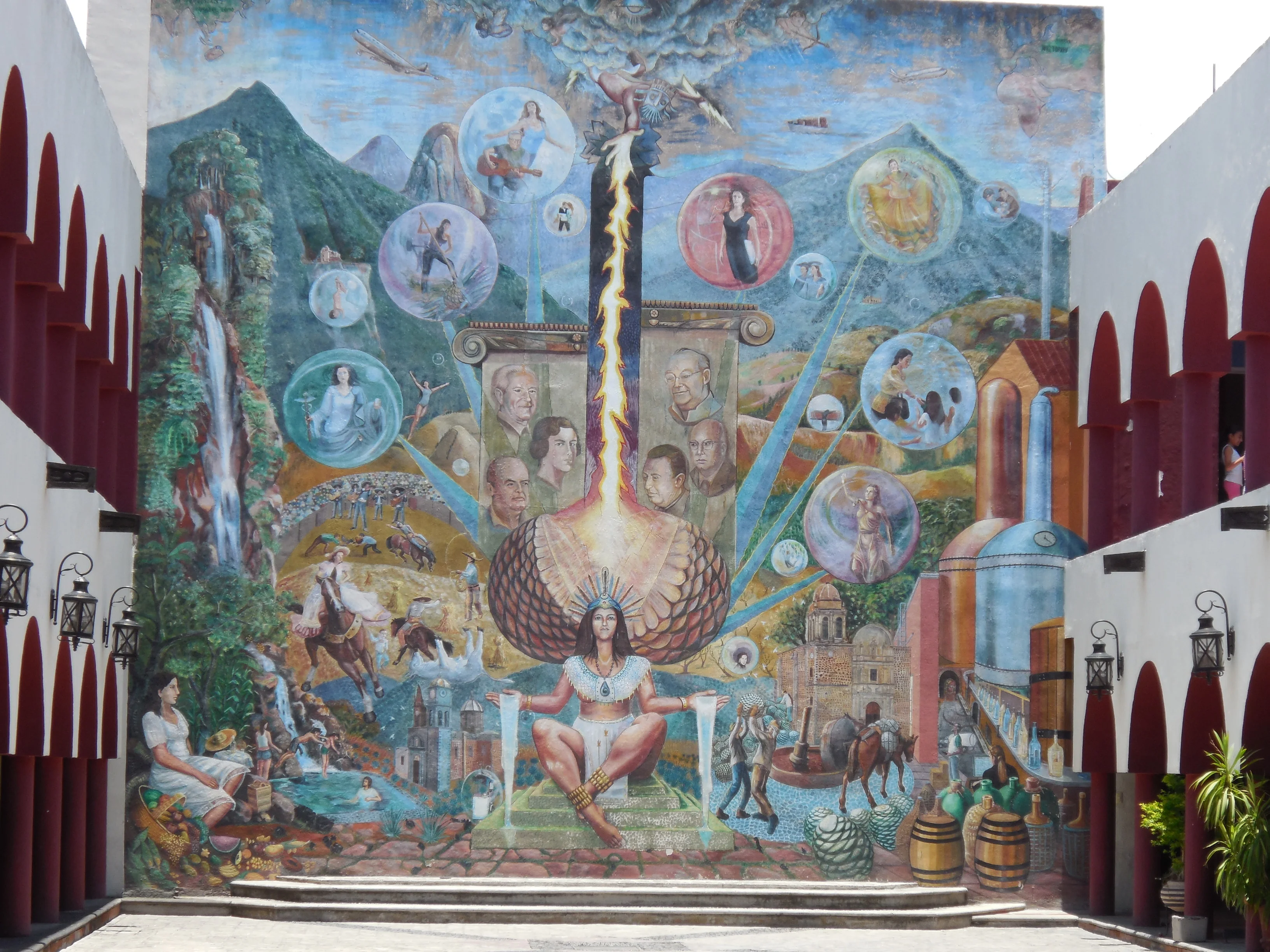
Cover photo: Allegorical mural in the town of Tequila, depicting local traditions, agave farming, and tequila production.
“Pulque, mezcal y tequila
Cuba libre y cerveza
Tonight I’ll be borracho, hombre
¡Qué viva México, borracho!”
Hubert-Félix THIÉFAINE, 1995
https://www.youtube.com/watch?v=KeThyai_GW0
Of all the Mexican spirits, tequila (actually el tequila, as it’s a masculine noun in Spanish) is arguably the most famous worldwide. In fact, it’s estimated that between 1970 and 2000, consumption of this drink increased 15-fold! There are reportedly over 500 brands in existence.

Label of José Cuervo tequila, the world's best-selling brand.
Where is the best tequila produced?
El Jimador, Don Julio, José Cuervo, Sauza, Herradura, or even Tres Generaciones… These are a far cry from the San José we used to buy at the supermarket for college parties! These tequilas are meant to be sipped neat, or with salt and lime. Good Mexican tequilas, the ones not intended for industrial export, truly have depth and character.

Painting depicting the hand-harvesting of agave in the fields of Jalisco.
To taste the best tequilas, you need to head to the state of Jalisco, in northwestern Mexico. Tequila has a protected designation of origin: it can only be produced within this state. This is where you can visit the oldest factories, such as the José Cuervo distillery (also known as the Fabrica La Rojeña), located right in the town of Tequila.

Statue of a jimador, an agave farmer, at the entrance to the town of Tequila.
A UNESCO World Heritage site and a Pueblo Mágico (a Mexican designation given to the country's most beautiful towns), Tequila is home to no fewer than 18 operating distilleries. The town feels frozen in the colonial era, with its church, grid-patterned streets, and statues of figures commemorating the region's rise thanks to the production and export of this precious nectar.

Mural depicting traditional festivals in the town of Tequila. At the top center, you can see the town’s crest featuring the church, the ovens, and the agave fields.

Tequila Church. In the foreground, the stylized transport vehicles that bring tourists from Guadalajara, the capital.

Statue of a colonial-era tequila merchant. One of the bottles she is offering is a jícara: a hollowed-out gourd used as a flask.
But how do you choose your tequila? First of all, the bottle should state "100% agave." Tequila is a distillation of the sap of the blue agave (agave azul). This cactus species is currently endangered due to over-exploitation. When you enter the Jalisco region by land, you immediately recognize the blue fields stretching across hundreds of hectares.

Fields of agave azul stretching across the mountainous regions of Jalisco.
The stages of tequila production
The first step is the harvest. The piña, the heart of the cactus, must be fully ripe and of a good size. The leaves are then cut away (they can be used for textile fibers) and the heart of the plant is extracted. The leaf cutters who worked by hand were called jimadores, because they would groan (gemir) under the grueling effort.

The jimador on the right, and on the left, the old-fashioned extraction of fibers using oxen to crush the pieces of piñas.

Harvested piñas arriving at the factory.
The piñas are then transported to the factory to be cooked in large ovens. This cooking stage releases the sugars that will be transformed into alcohol during distillation. The piñas are then sliced into small pieces and crushed so the fibers can be separated from the liquid.

Traditional column ovens.

Piñas ready to be cooked in modern ovens.

The product of the cooking process: small, candied pieces of sweet agave.

Fibrous residues after crushing the piñas, which are then used as highly resistant textile fiber.
The liquid is then left to ferment in large vats so that the sugar turns into alcohol. This results in a sort of agave beer.

Traditional fermentation vats, kept in the factory cellars to protect them from the heat.

Modern fermentation vats, kept at a controlled temperature by a sensor system.
Distillation takes place in large copper vats. Like any distilled product such as Calvados or schnapps, the result is a very strong first white alcohol, over 70% ABV. It is then diluted with water to bring it down below 45%. At this point, the white tequila, which is not aged in barrels, can already be sold.

Tequila stills with their heated vat and distillation column. The pipes carry the alcohol vapors so they can be condensed.
The final and certainly most complex stage is aging. Oak barrels are used, most of which are imported from other countries and have sometimes previously held wine or whiskey. These different barrels impart various aromas to the spirit. The wood actually absorbs some of the alcohol, about 3% per year. This is what is known as "the Angel's Share."

Tequila aging barrels, stored in cellars with regulated temperature and humidity.

For less colored tequilas, larger barrels can be used, similar to those for Pommeau de Normandie or other aperitifs. The surface area of contact between the liquid and the wood is therefore smaller.
The catadores, or cellar masters, regularly taste the spirits in the barrels to decide on the aging process. The resulting tequila can be reposado if aged for two months to a year, or añejo if aged for one to three years. There is even extra-añejo, which has aged for more than three years. These are the Spanish equivalents of VSOP, Old, and Extra-Old.

Statue of catadores tasting the tequila and deciding on the aging.

José Cuervo Reposado tequila, aged for a maximum of one year.

José Cuervo Extra-Añejo tequila, aged for more than three years.
These photos were taken at the José Cuervo factory, the oldest in Tequila. The brand's symbol is a large black raven. The family business received an award at the 1889 Paris World's Fair, presented by the Mexican dictator Porfirio Díaz. Today, it is the best-selling brand in the world: the distillery accounts for about one out of every three bottles sold.

The José Cuervo factory, in the heart of Tequila, is a true colonial hacienda.

The black raven, the emblem of José Cuervo.

Award from dictator Porfirio Díaz at the 1889 Paris World's Fair.
Comments (1)