
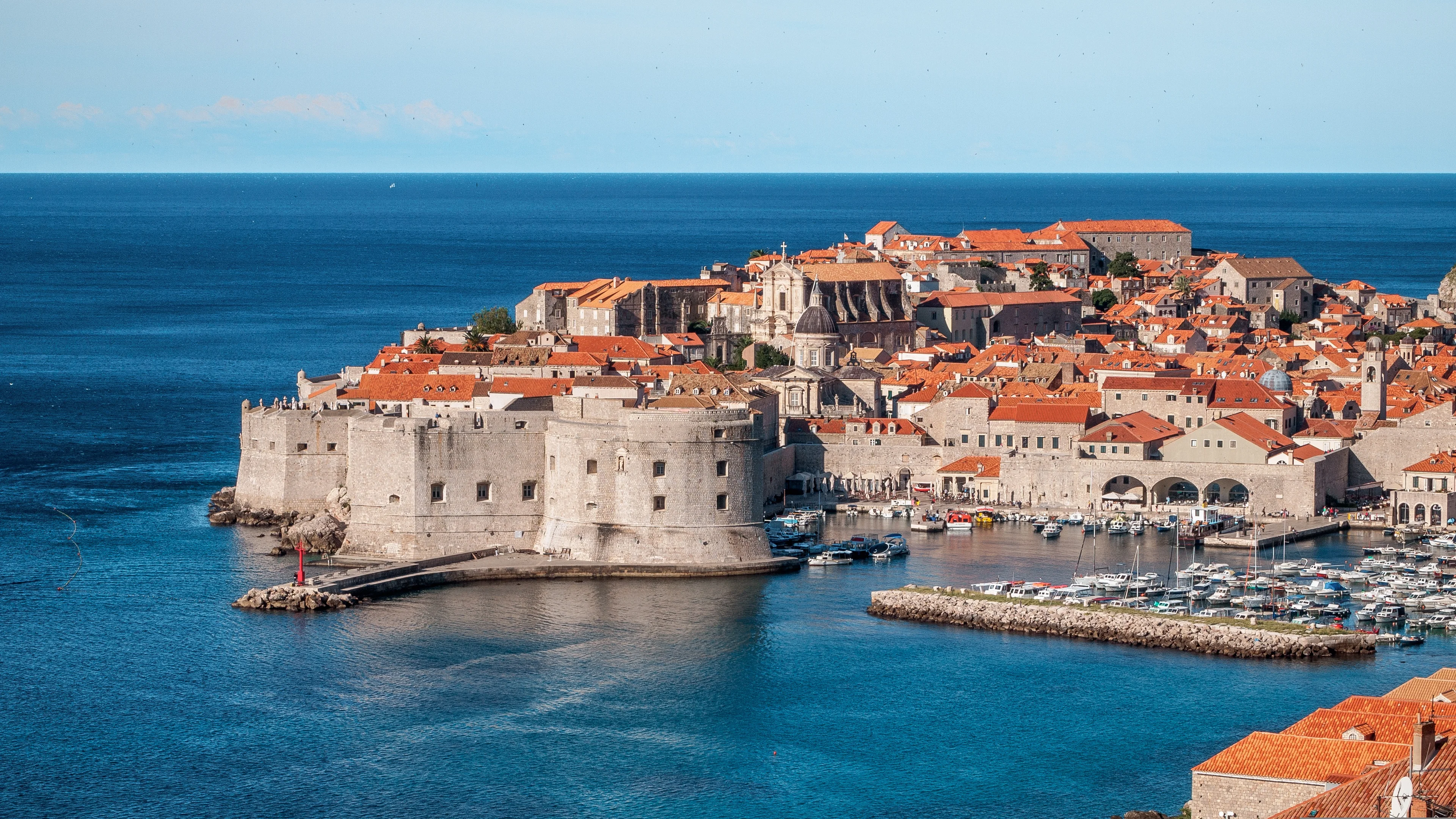
 Thanks, GlobeTrotter, for your article on Croatia (A beautiful week in Croatia). It brought back some great memories since I’ve been there too. But I didn't spend my time in Istria: I enjoyed three days in Dubrovnik, way down in the south of Croatia.
I can't resist sharing my memories of this incredible city (nicknamed "the Pearl of the Adriatic" by Lord Byron), just to encourage you to go.
In fact, as soon as the plane starts its descent toward the city airport, you can see the sunlight dancing on the sea. The shades of blue are simply striking. As GlobeTrotter pointed out, the water is just magnificent: I feel like I haven't seen water that pure in a long time. On the way down, if you’re paying attention and lucky enough to have a window seat, you can catch a glimpse of the Old Town and the fort.
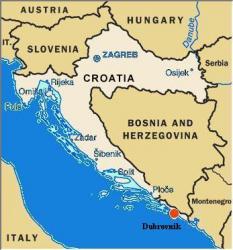
Where is Dubrovnik?
It’s located in the former Yugoslavia, in the Dalmatia region. This coastal city plunges straight into the Adriatic Sea.
It sits at the very southern tip of the country's coastline. While it opens onto the Adriatic to the west, it shares land borders with Montenegro and Bosnia and Herzegovina. It faces Italy across the water. From abroad, you can get there via Dubrovnik International Airport, located about 20 kilometers (12 miles) southeast of the city. By road, the trip to Dubrovnik takes about thirty minutes.
History of the city
 Having fallen in love with this city, I’ve kept a wealth of information that will allow me to offer you a bit more than just a basic travelogue, as I’ve done in my previous posts.
The city's roots go back a long way, as the first settlers reportedly arrived in the 7th century, when the inhabitants of the city of Epidauros (modern-day Cavtat) fled Slavic invasions and took refuge on this rocky outcrop, which gave the city its first name: Ragusa. Integrating with the existing population, they built the city's first walls. This allowed them, centuries later (in the 9th century), to resist Arab invasions. Meanwhile, another town emerged between Zaton to the north and the port of Cavtat: the current Dubrovnik, which took its name from the oak trees (dub) that were once very common in the region. The two cities merged in the 12th century, and the channel separating them was filled in, creating Placa, the wide paved street that is, among other things, the city's claim to fame.
By the end of the 12th century, it had become a key hub for trade between the Mediterranean and the Balkans. This power bothered the other great city of the basin: Venice. Before long, Dubrovnik fell under the domination of the "Serenissima." Despite its allegiance, it continued to develop independent trade ties with other partners.
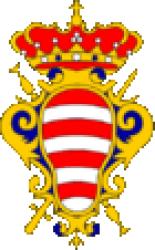 Modern-day Dubrovnik was for a long time a maritime republic, known as the Republic of Ragusa. Maritime republics were coastal city-states, mainly Italian, that existed between the 10th and 13th centuries. They used their economic prosperity to gain political autonomy. The most famous ones in Italy were Pisa, Genoa, and Venice. In the rest of the Mediterranean basin, only Ragusa enjoyed this status. The Republic of Ragusa was founded in 1358 and existed until January 1808, the date of the invasion by Napoleon's armies. Upon its creation, it joined the Hungarian-Croatian kingdom. At the height of its expansion, it included the port of present-day Dubrovnik and that of Cavtat (formerly called Ragusavecchia). It also extended into the hinterland and took control of several nearby islands. It had about 30,000 people under its jurisdiction, including 5,000 within the walls of Ragusa. It sent its fleet to Egypt, France, Syria, and Turkey. It was the first state in Europe to abolish slavery in 1416.
Very prosperous, it saw a great development of arts and sciences. Unfortunately, a 17th-century earthquake destroyed many Renaissance-style buildings. A few still remain, however: the Rector's Palace and the Sponza Palace.
The layout of new economic routes accelerated the city's decline, which had begun after the earthquake. The Napoleonic invasion of 1808 marked the end of the Republic of Ragusa. In 1815, it passed under Austro-Hungarian rule, and in 1918, it joined the Kingdom of Serbs, Croats, and Slovenes, later known as Yugoslavia.
Between 1991 and 1993, Dubrovnik became sadly famous due to the bombings it endured, before entering the period of calm and peace it enjoys today.
Accommodation
There’s a good chance you’ll be offered residences or hotels in the Lapad district, which houses a good portion of the hotel supply, while the rest (especially the seaside resorts) are located to the east of the city. There is also a youth hostel there. You’ll be at the foot of the Old Town and have the opportunity to enjoy the area's greenery and access to the beaches.
Here is a link to a complete list of Dubrovnik hotels.
Even though the city lives mainly off tourism today, urban development is carried out with an effort to respect the character of the site.
Must-sees in the Old Town
Go visit the old fortified city and do some shopping or try the restaurants on the Placa. As mentioned above, this main pedestrian thoroughfare (the Old Town is car-free) was built on the site of a channel that separated the two entities that formed the original city of Dubrovnik.
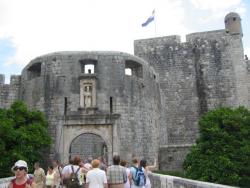
To get in, do as everyone else does: head to the Pile Gate (Vrata Pile), which is part of the defensive system. Under the stone bridge that leads you there, admire the lovely gardens located below. Nestled in the ramparts and protected by its drawbridge, the gate is topped by a statue of the city's patron saint: Saint Blaise. Legend has it that he appeared in a dream to the Rector, warning him of a Venetian attack. Prepared, the city repelled the attackers. Once you pass through this gate and the subsequent inner gate, you arrive directly on the Placa.
You will immediately see the remains of Onofrio's Fountain, which unfortunately suffered a lot of damage during the 1667 earthquake I mentioned earlier. It was one of the components of the system that brought water from a nearby lake twelve kilometers away.
Note that there are two Onofrio fountains; the second (called the Small Onofrio Fountain) is located at Luza Square. More fortunate and less damaged, you will see the Church of Saint Saviour next to it, along with the remains of a monastery. A museum has been opened there. Inside is one of the three oldest pharmacies in Europe open to the public, and it’s still in operation! When I visited, I was able to enjoy the quiet of the cloister. However, in the middle of the season, I don't know if everything will be as peaceful as it was during my visit, as Dubrovnik attracts tourists and wealthy Croatians who love to enjoy the area.
The city, a reflection of the country's history and culture, also includes a synagogue and an Orthodox church that you will find near the Placa.
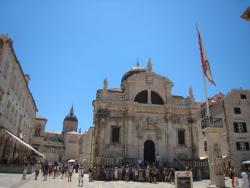
When you head toward the eastern end of the Placa, you can't miss Orlando's Column (or Roland's Column), which stands on Luza Square (Loggia Square), formerly a marketplace. When you take a photo next to the column, know that the statue's forearm served as the official measurement standard for the republic. This lovely paved square was public, and all the Republic's proclamations were announced there.
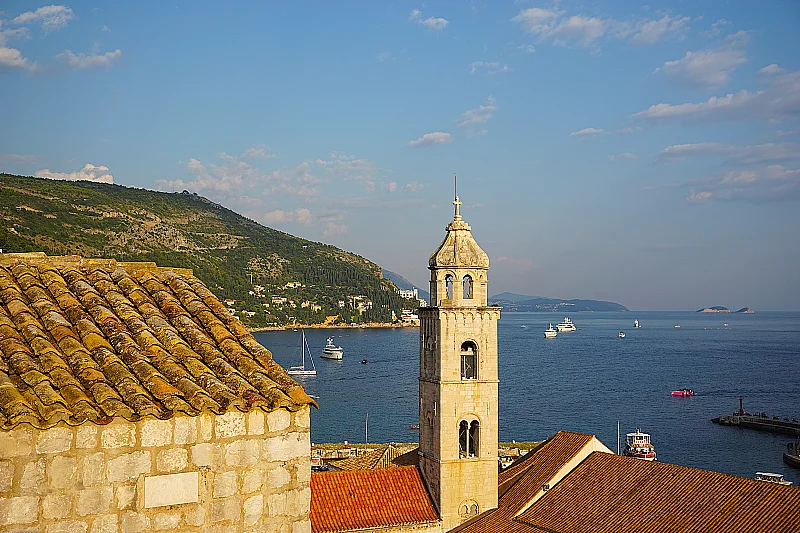
But you will also discover the Clock Tower, on which two bronze figures mark the hour. And on the other side of the square, the Sponza Palace looms. With a porch resting on six columns, it is a beautiful example of the Renaissance style. Before going to see the Church of Saint Blaise, head toward the Ploce Gate, where you will discover the Dominican monastery and museum (yes, it really is a monastery, not a fortress!!).
Retrace your steps and continue on your way. As I wrote above, you will come across the "small" Onofrio fountain that supplied the market. And you won't be able to miss the Church of Saint Blaise, whose architecture contrasts with the sobriety of the square... And if you go inside following the flow of tourists, you can see the silver statue of Saint Blaise. He holds in his hand a model of the city as it was before the earthquake.
Leaving the church, continue along the thoroughfare to see the Rector's Palace and admire its facade. Don't hesitate to extend your visit inside as well, because the atrium is worth a look. Plus, it's nice and cool when the sun is beating down outside! Under the Republic of Ragusa, the Rector was elected every month from among the city's notables and lived in the palace. It also housed his secretariat, his offices, and public halls. During those thirty days, he could not leave the palace unless he obtained special authorization issued by the Senate. The museum that is now inside teaches you a lot about the city's history.
Opposite the palace stands a cathedral: the Cathedral of the Assumption of the Virgin Mary. It was reportedly embellished thanks to donations sent by the King of England, Richard the Lionheart, who was saved from a shipwreck on one of the nearby islands. This cathedral houses the relics of Saint Blaise. From the cathedral, head to the aquarium. I didn't visit it, but it seems to have a good reputation, and in any case, given the number of families coming out of it and the smiles on the children's faces, it seems to be a perfect fit for both young and old.
Visiting the ramparts
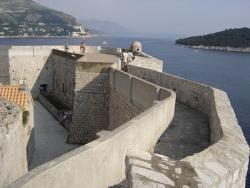 The ramparts alone are worth a visit, or even a mini-tour. Be careful, though: to access all parts of the fortifications, you will have to pay an entrance fee.
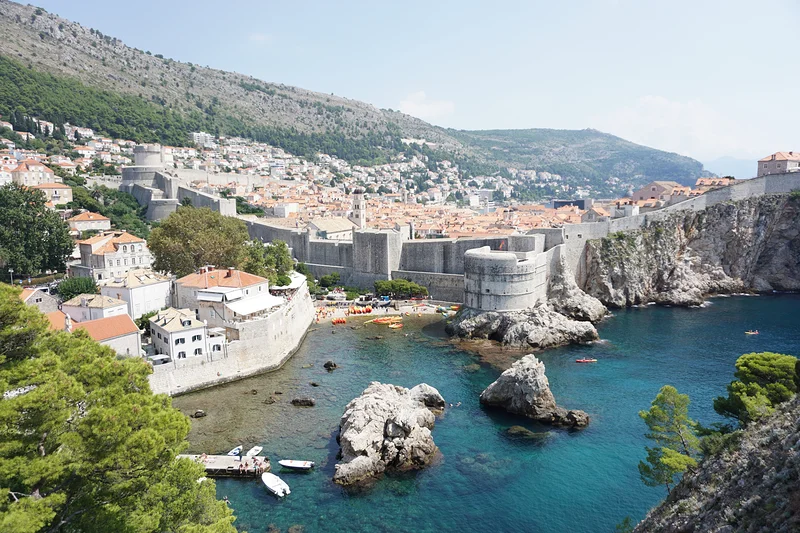
The first walls of the defensive system were erected in the 13th century. Two centuries later, about fifteen square defensive towers were added. Bastions were added later to complete the structure and repel attackers more effectively. The effectiveness of these defenses was proven during the Arab siege of the city, which lasted fifteen months without them ever managing to occupy it. The walls run along the city for two kilometers (1.2 miles), while in some places, the ramparts rise up to thirty-five meters (115 feet) in height!
Beyond the historical and architectural aspect, the tour will offer you splendid views of the Adriatic. And you will certainly notice a few small islands that will make you want to go visit them.
NB: If you choose a local Croatian guide, they will almost certainly have you start with the ramparts before showing you the interior of the city.
Outside the Old Town
Lokrum Island
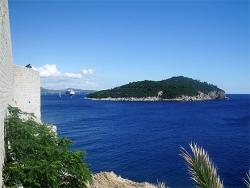 If the view from the ramparts made you want to take a trip to the islands, you can take advantage of it to go to Lokrum Island, for which a ferry provides a connection with a departure every hour in the high season. The price of the trip is around 35 Kuna (the kuna is divided into 100 lipas, but the euro is also accepted by merchants).
The island, which is supposedly the place where Richard the Lionheart was saved, still shows traces of a medieval monastery. It also offers a lovely botanical garden and, for enthusiasts, a (rocky) naturist beach. It is a very beautiful island, very green and wooded. Spending at least half a day there does you a world of good!
The "New" Town
To go out, especially in the evening, the "new" town offers a multitude of trendy bars. The Lapad districts are full of them, but don't hesitate to look further afield. We were recommended the must-visit Troubadour Hard Jazz Café (Bunićeva poljana 2). Indeed, despite the crowds, it is very nice for starting the evening or continuing it if you don't want to be in too much of a rush. As for the rest, there is still quite a lot of choice and very different atmospheres depending on what you are looking for: lounge, electro, jazz... It's up to you.
In short, one thing is for sure: I will be back! It is one of my most beautiful discoveries so far.
And, not having the ease of expression of the British playwright Bernard Shaw, I leave it to him to conclude with a sentence that this -visionary!- author proclaimed in 1929:
"Those who seek paradise on earth should come to Dubrovnik."

Comments (0)
No comments yet. Be the first!