
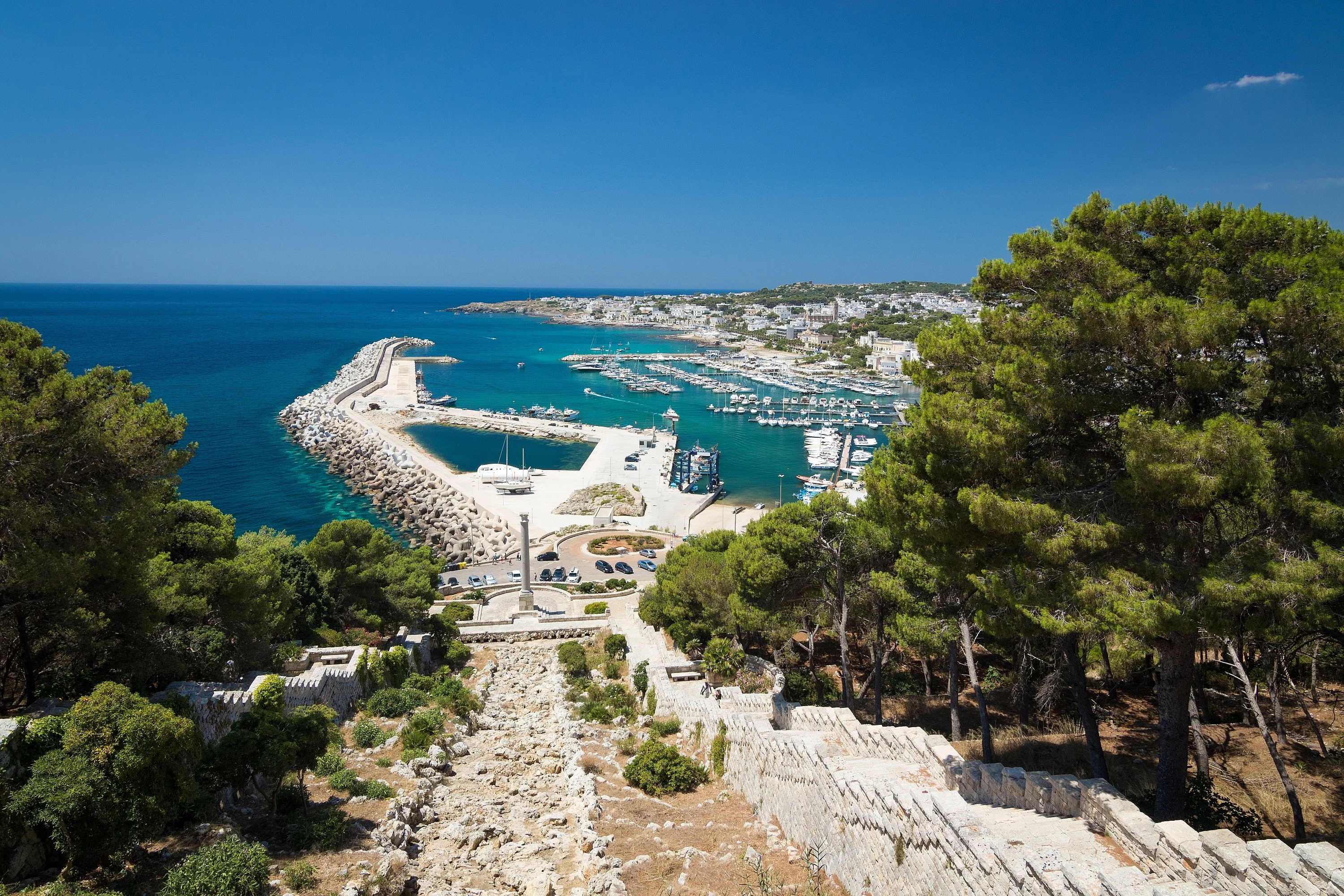
Why Puglia is so great for motorhoming
We were looking for an Italian destination that wouldn't force us to spend our days on the highway. Apulia checked all the boxes: between Bari and the tip of the Salento, there are less than 250 kilometres. Everything we wanted to see fit within a comfortable radius, and best of all, every stop completely changed the scenery.
In eight days, we went from a bustling Adriatic port to dry stone houses capped with grey cones, then to a baroque town entirely carved out of honey-coloured stone, before ending up with our feet in the Ionian Sea. All without ever driving for more than two hours in a single day.
We landed at Bari Karol Wojtyła airport and picked up our campervan right there. Like everywhere in Italy, rates vary wildly from one rental company to another depending on the season, so we compared options before booking. Here is the comparison tool we used to rent a campervan.
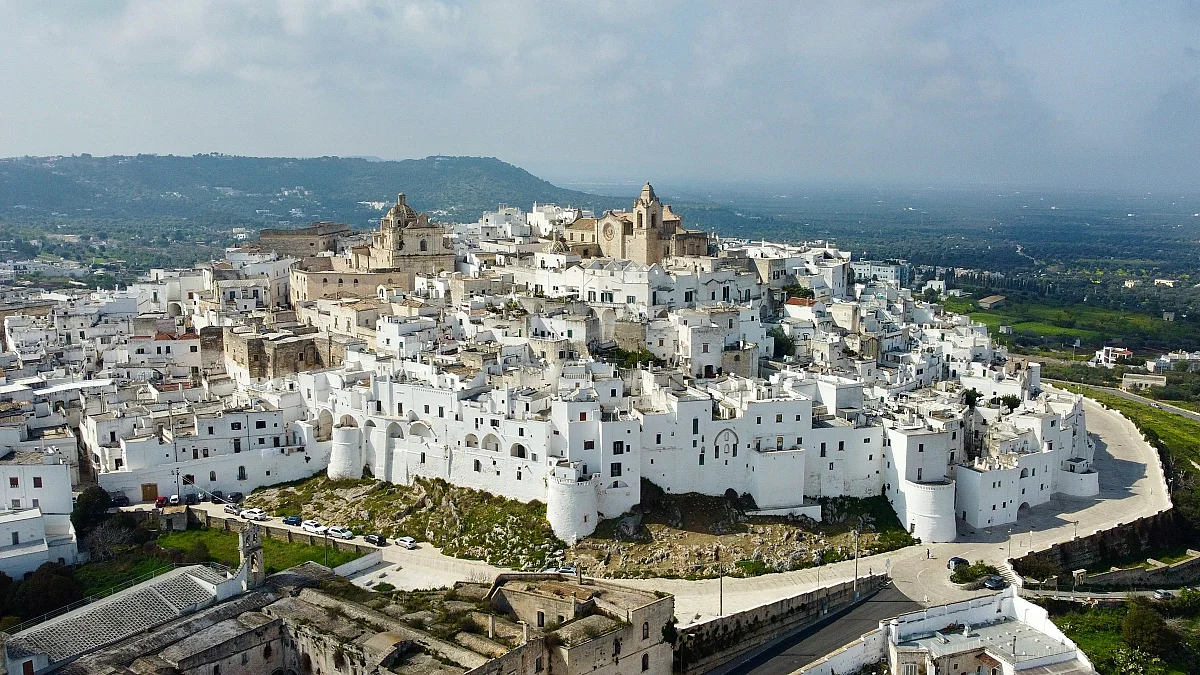 The village of Ostuni, in Puglia
Plan your trip: season, budget, and driving
When to visit Puglia
We went at the end of May, and looking back, it was the right call. May, June, September and October offer great weather without the crowds. In July and August, locals are on vacation too, meaning Salento's campgrounds sell out, historic centers get packed, and the heat inland becomes seriously heavy.
Good deal
If you don't have a choice of dates and have to go in July or August, book your vehicle and campsites several months in advance.
What we spent
Here is our actual budget for two people, for reference. The rental expense remains by far the most variable part.
| Poste de dépense | Budget (2 personnes, 8 jours) | Nos remarques |
|---|---|---|
| Location du camping-car | 700 à 1000 € | Écart énorme entre mai et août sur le même véhicule. |
| Carburant | 140 à 190 € | Environ 650 km parcourus. Le gazole dépassait les 2 € le litre durant notre séjour, avec de gros écarts entre stations. |
| Nuits (aires et campings) | 150 à 220 € | Comptez 15 à 25 € en aire de sosta, 30 à 40 € en camping équipé. |
| Visites et activités | 100 à 150 € | Grottes de Castellana, musées, quelques entrées payantes. |
| Nourriture | 200 à 250 € | En cuisinant à bord le midi et en sortant le soir. |
| Péages et parkings | 30 à 50 € | Peu de péages : l'essentiel du trajet se fait sur les routes nationales. |
Driving a motorhome in Apulia
Three things we wish we had known before leaving.
The ZTLs are everywhere. The Zona a Traffico Limitato is a zone off-limits to unauthorized vehicles in almost all historic city centers. The cameras are automatic and the fine arrives in the mail several months later right at your door, with rental car agency processing fees on top. We got into the habit of parking outside the center every time and finishing on foot. In cities of this size, that never adds more than a ten-minute walk.
Wild camping is not an option. It is illegal in Italy unless you have explicit local permission. On the other hand, the network of aree di sosta (camper service areas) is dense in the region, and many farms and olive oil estates welcome motorhome travelers.
Fuel is cheaper when you pump it yourself. Italian gas stations display two prices: fai da te (self-service) and servito (an attendant pumps it for you). The difference is 20 to 30 cents per litre. On a motorhome tankful, that is far from negligible.
- An essential camper van spot-finding app for when you're improvising your overnight stops
- Cash: several small areas still operate on a cash-only basis
- A real hat, shade is hard to come by in the Valle d'Itria
Day 1: Bari, picking up your car and first evening in the old town
Pick up the vehicle late morning, run some errands at an outlying supermarket, then head for downtown. We left the RV in a parking lot near the port and set off on foot.
Bari Vecchia, the basilica, and the orecchiette
Bari Vecchia is a labyrinth. You willingly get lost in it. The Basilica di San Nicola is its heart, and it's here that the relics of Saint Nicholas, brought back from Myra by Bari sailors in 1087, are kept. The low, massive crypt alone is well worth the detour.
Then we looked for the famous Strada delle Orecchiette, officially Arco Basso. The women of the neighborhood shape pasta right outside their doors, on tables set up in the alleyway. We bought a dried bag of it, which ended up in a pot three days later somewhere in the Valle d'Itria.
Day 2: Polignano a Mare and Monopoli, the Adriatic coast in postcard form
Only thirty-five kilometres, which left us the whole day to wander around.
Lama Monachile, the most photographed cove in Apulia
Polignano a Mare is built on a limestone cliff plunging straight into turquoise water. The cove of Lama Monachile (Cala Porto) is nestled between two walls, beneath a bridge fifteen metres high. Many visitors mistake it for a Roman structure, but it is actually the Ponte Borbonico, built by the Bourbons in the 1830s. The real Roman bridge does exist, but it is lower and more discreet, down below in the bed of the lama: a single arch made of tufa blocks, a vestige of the Via Traiana that once connected Benevento to Brindisi. Few people head down to see it, and that is a shame.
It is genuinely spectacular, and genuinely packed by 10 AM. We headed back down in the late afternoon, when the light turns golden and half the visitors have left.
Polignano is also the birthplace of Domenico Modugno, the writer of Nel blu, dipinto di blu, which everyone knows as "Volare". His statue looks out at the sea, arms wide open.
Monopoli and its Porto Vecchio
Twenty minutes further south, Monopoli is quieter and, honestly, we liked it better. The Porto Vecchio with its blue and white fishing boats, the cathedral, the ramparts: everything is right there, without the lines to snap the exact same angle.
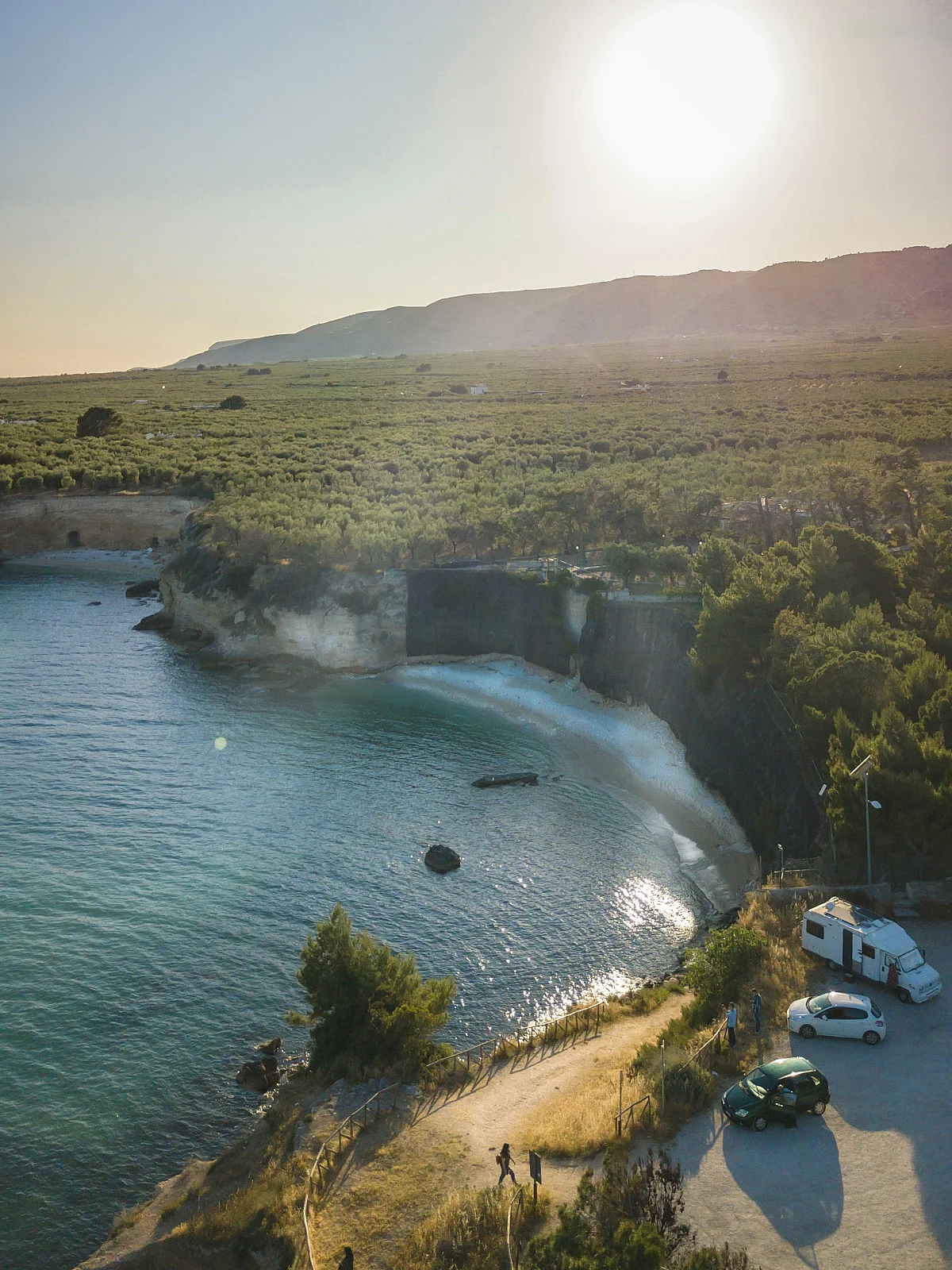 Cove in Apulia
Day 3: Alberobello and the Valle d'Itria, the land of the trulli
We left the coast to head inland. The landscape changes fast: dry-stone walls, ancient olive trees, and those little conical buildings appearing first one by one, then by the dozen.
Rione Monti, and why you need to go there early
The trulli of Alberobello have been a UNESCO World Heritage site since 1996. The Rione Monti neighborhood packs over a thousand of them into a few sloping alleys. It is stunning and very touristy, with souvenir shops on the ground floors and tour buses dropping off passengers non-stop.
A friendly tip
Get there before 9:00 AM, or head over to the Aia Piccola neighborhood on the other side of the square. Fewer trulli, barely any shops, and locals who actually still live there. Also, do not miss the Trullo Sovrano, the only one with an upper floor.
Locorotondo for the night
Just a few kilometres away, Locorotondo gets its name from its perfect circular layout. It is white, quiet, covered in flowers, and ranked among the most beautiful villages in Italy. We slept in a camper area surrounded by vineyards, overlooking the valley. The next morning, coffee drunk outdoors and not a single sound.
Day 4: White Ostuni and the Torre Guaceto Reserve
Ostuni can be seen from afar: a completely whitewashed town perched on a hill above a sea of olive trees. You'll understand the nickname of Città Bianca long before you get there. The maze of alleyways winds all the way up to the cathedral and its large Gothic rose window.
In the afternoon, head for the Torre Guaceto nature reserve, about twenty kilometres away. It's a protected marine area with controlled access and a shuttle service in high season. Sandy beaches, dunes, wetlands: a far cry from the concrete lidos you'll find further south.
Good to know
As you drive through Salento, you'll see a lot of dead or severely pruned olive trees. This is the consequence of the bacterium Xylella fastidiosa, detected in the region in 2013, which has ravaged a huge portion of the local olive-growing heritage.
Day 5: Lecce, the Florence of the Baroque
Eighty-five kilometres and a total change of scenery.
An entire city carved from the same stone
Lecce is built from pietra leccese, a soft, almost buttery limestone that is easy to carve and takes on a honeyed hue in the setting sun. The result is facades packed with details, garlands, and grotesque figures. The Basilica di Santa Croce is the pinnacle of this art form. You will easily spend several minutes staring up without taking it all in.
In Piazza Sant'Oronzo, a Roman amphitheater sits right in the downtown area, half-excavated. The layering of different eras is striking.
Cartapesta and pasticciotto
Lecce is also the capital of cartapesta, the art of papier-mâché, with workshops still running in the center. And on the sweet side, you can't leave without trying a pasticciotto, that little pastry filled with custard and served warm in the morning. We ate one every single day until the trip ended.
Day 6: Otranto and Santa Maria di Leuca, where the two seas meet
The mosaic of Otranto
Otranto is the easternmost town in Italy. Its cathedral houses a floor entirely covered by a 12th-century mosaic created by the monk Pantaleone, featuring a massive tree of life blending biblical scenes, fantastic animals and secular figures. You literally walk right on top of it. It is one of the strangest and most beautiful things we saw on the trip.
North of town, Baia dei Turchi offers a pine-fringed beach, accessible on foot from a secluded parking lot.
Finibus Terrae
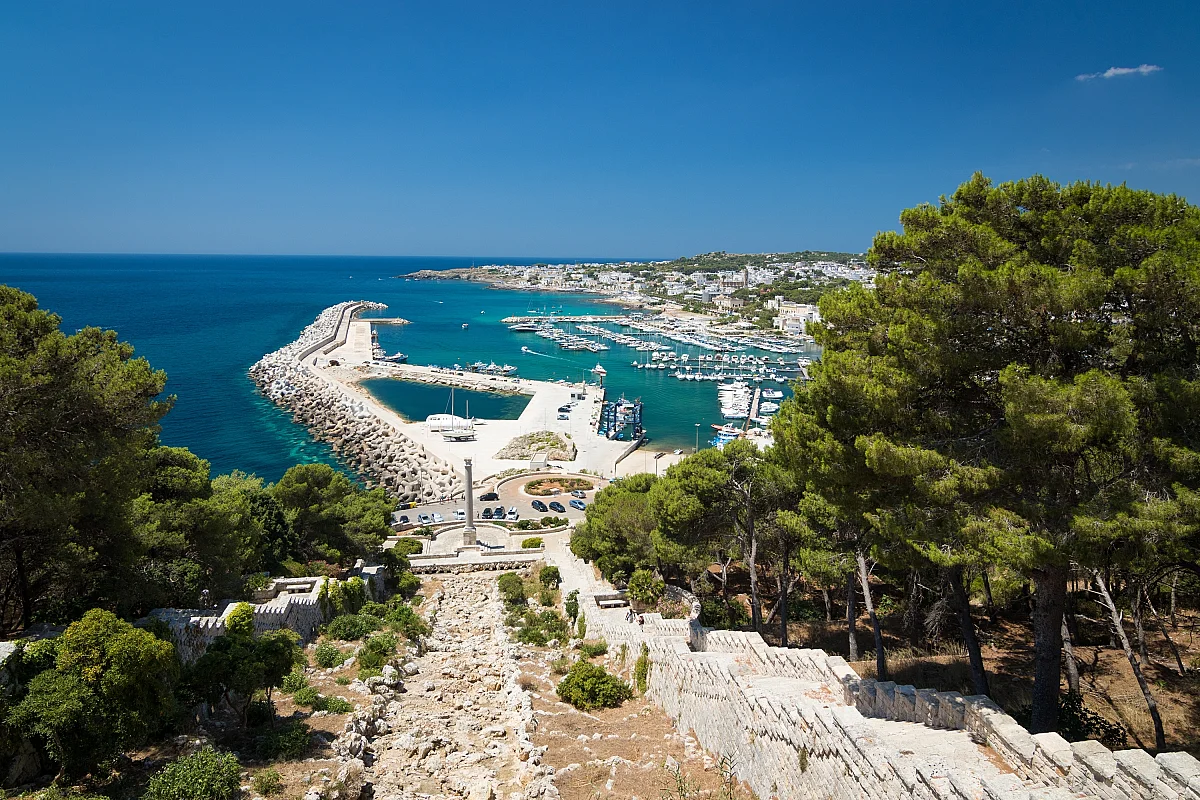 Santa Maria di Leuca
The winding and gorgeous coastal road heading south leads to Santa Maria di Leuca, at the very tip of the heel. The De Finibus Terrae sanctuary, literally meaning "at the ends of the earth," overlooks the cape. It is here, on Punta Méliso, that the Adriatic and Ionian seas meet, at least according to the boundary established by the International Hydrographic Organization. Other nautical conventions place the border about sixty kilometres further north, at Punta Palascìa, near Otranto.
The locals have no doubts, however: it is in Leuca. On certain days, when the salinity of the two bodies of water differs enough, people say a demarcation line is visible to the naked eye. We didn't spot anything like that, but the view from the square was well worth the detour.
Day 7: Gallipoli and the Ionian coast
Heading up the Ionian coast, which is milder and more sandy.
Gallipoli is divided into two parts, the modern city on the mainland and the historic center on an island connected by a bridge. The Castello Angioino guards the entrance. In the narrow streets, you can visit old frantoi ipogei, underground oil mills carved into the rock where people used to work by the light of oil lamps.
For swimming, we preferred the Porto Selvaggio Regional Nature Park, a bit further north near Nardò, featuring pine forests, rocky coves, and no beach resorts.
Day 8: The Castellana Caves and back to Bari
For our last day, we cut inland toward the Grotte di Castellana. The underground network stretches for about three kilometres, with a constant temperature of around 15 °C, which feels amazing after a week of sunshine. The highlight is the Grotta Bianca, an alabaster cavern of an almost unearthly whiteness.
Forty kilometres later, back in Bari, we filled up the gas tank and dropped off the car.
Heads up
Visiting the Castellana Caves is only available in guided groups, so book in advance.
Our verdict after 8 days in Puglia
Eight days is just the right amount of time for this loop. You have time to pull over, stay two nights in the same spot when you fall in love with it, and head home without feeling like you rushed through everything.
What really stands out is the density of it all. Every stretch of fifty kilometres brings something radically different, and an RV is the only way to link it all together without constantly packing and unpacking your bags. Next time, we are adding the Gargano up in the far north, which we deliberately skipped due to lack of time. That will be our excuse to come back.
Comments (0)
No comments yet. Be the first!