

Where to stay in Rotterdam: the 6 neighborhoods to know in 2026
One afternoon in May 1940 erased the centre of Rotterdam, and what was rebuilt on top looks like no other Dutch city: no canals lined with gables, but a market under a painted vault, yellow houses balanced on a footbridge, and a river five hundred metres wide crossed by a white bridge. Anyone arriving in search of Amsterdam leaves disappointed. Anyone expecting nothing finds the most surprising city in the country.
Price, for once, decides nothing: no address in this guide goes past $124* for a room when the first one asks $96*, and all six of their location scores clear 9.2. In other words, none of the six neighbourhoods below will leave you stranded. So what you pick is an era and a bank: the new north of the river, the towers to the south, and one single neighbourhood the bombs missed.
Compare hotel prices in Rotterdam
In a hurry? Find the best accommodation deals in 3 clicks.
Compare live deals from Booking, Expedia, Agoda and other partners.
At a glance: our picks by traveller type
Pick the profile that suits you to head straight to the recommended neighborhood.
The neighborhood map in Rotterdam
Get your bearings on the neighborhoods and must-see sights before choosing where to drop your bags. Click a name to jump to its description.
The centre, from the Coolsingel to the Lijnbaan The 1920 city hall, one of the few buildings left standing after the bombing, the Coolsingel and its trams, the pedestrian arcade of the Lijnbaan, the Koopgoot sunk below street level, the De Doelen concert hall, the city theatre, Miniworld and its model trains, and the Groothandelsgebouw near the station
for a first visit, for the shops, for doing without transport
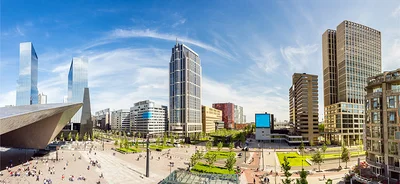
This is where the city was rebuilt, and you can see it at eye level: the Lijnbaan is a car-free shopping street opened in 1953, lined with concrete canopies, and the Koopgoot that extends it drops a full storey below the roadway to pass under the Coolsingel. The 1920 city hall, on the other hand, was here before: it stayed upright when everything around it burned, and its dark stone says so at first glance. In the evening the terraces on the Meent take over from the shops.
Where to stay in this neighborhood
The James Rotterdam Mid-range
8.8 from more than seven thousand reviews, and its value for money reaches 8.9, higher than its overall score: no other address in this guide has guests saying that. The rest follows, location 9.6, staff 9.3, cleanliness and comfort 9.2. It stands on Aert van Nesstraat, between the Coolsingel, the Meent and the Lijnbaan, so in the middle of all three. Around $113*.
Pros
- Shops, trams and the station in the same few blocks
- The best value-for-money score in this guide
Cons
- Nothing old to look at, apart from the city hall
- The streets empty out as soon as the shops close
Blaak, the Markthal and the old harbour The yellow cube houses of 1984 perched on a pedestrian bridge, the Markthal and its painted vault, the 1898 White House that survived the bombs, the old harbour basin and its wooden boats, the Maritime Museum and Blaak metro station
for architecture, for eating, for sleeping inside a cube
Four hundred metres of quay hold three eras. The cube houses of 1984 are thirty-eight yellow cubes tipped onto one corner and raised on stilts above the street: you walk underneath them, and you can sleep inside them. The Markthal dates from 2014: a horseshoe of flats whose inner face is painted with ten-metre fruit, with the covered market underneath. Between the two, the 1898 White House and its forty-three metres were the tallest office in Europe when it was born. The wooden boats in the basin finish the picture.
Where to stay in this neighborhood
citizenM Rotterdam Mid-range
8.8 from more than five thousand reviews, with 9.7 for location, the highest location score in this guide, plus 9.4 for staff, 9.1 for cleanliness and comfort, 8.7 for value for money. It sits on Gelderseplein, a hundred metres from the cubes and the metro station. Rooms are small and everything in them is ordered from a tablet. From $96*.
Stayokay Hostel Rotterdam Budget
7.8 from more than three thousand five hundred reviews, and the gap says exactly what you are buying: 9.4 for location against 7.8 for comfort, a 1.6-point spread, with 8.9 for staff and 7.9 for cleanliness and for value for money. It is a hostel, and it occupies several of the cube houses, facing the Markthal: you sleep inside what everyone else photographs. A dorm bed starts at $34*.
Pros
- The highest location score in this guide, at 9.7
- Covered market, cubes and metro within the same three hundred metres
Cons
- The quay is a sight in itself: groups file under the cubes all day
- The terraces on the basin run late at weekends
The Museumpark, Witte de Withstraat and the Euromast Rem Koolhaas's Kunsthal, Het Nieuwe Instituut and the 1933 Sonneveld house kept in its original state, the mirrored depot in the Museumpark, Witte de Withstraat and its bars, the Wereldmuseum on Willemskade, and the 185-metre Euromast at the end of the park
for museums, for bars, for modernist architecture
One park, six institutions and a street of bars. The Kunsthal exhibits without a permanent collection, the 1933 Sonneveld house can be visited with its period furniture, and the round mirrored building set on the corner of the park is the depot of the city's great museum, where you can see the collection while you wait for it to reopen. The moment you leave the park, Witte de Withstraat lines up bars for three hundred metres. The Euromast closes the park to the south: one hundred and eighty-five metres, with the whole port below.
Where to stay in this neighborhood
Bilderberg Parkhotel Rotterdam Mid-range
8.2 from close to six thousand reviews, with 9.3 for location, 8.6 for cleanliness and comfort, 8.2 for facilities, but 7.8 for value for money, the lowest score in this guide on that count. It stands on the Westersingel, the canal that runs along the park, two hundred and fifty metres from Witte de Withstraat. From $107*.
Pros
- Six institutions and a street of bars, without taking any transport
- The Euromast at the end of the park, and the view over the port
Cons
- The park's great museum is closed: its depot stands in for it
- The lowest value for money in this guide, at 7.8
Kop van Zuid and the south bank The Erasmus bridge and its eight hundred metres, the former headquarters of the ocean liner company turned hotel, the Luxor theatre, the Photography Museum, the cruise terminal, the towers of the Wilhelminapier, and further south the De Kuip stadium, the Ahoy arena and the Zuidplein shopping centre
for the view, for the towers, for a match or a concert
You cross the Erasmus bridge on foot in ten minutes, and the bank changes century. The quays from which liners left for America are now a row of towers, with the Photography Museum and the Luxor theatre at their feet. The old shipping company headquarters stayed standing at the end of the point, between two basins, and it has become a hotel. Three kilometres further south, the De Kuip stadium and the Ahoy arena fill up on match and concert nights.
Where to stay in this neighborhood
Hotel New York Mid-range
8.7 from more than thirteen hundred reviews. Location climbs to 9.5, staff and comfort to 9.2, cleanliness to 9.1, but value for money stops at 8.2: you are paying for the house, and guests say so. This was the headquarters of the company that carried emigrants to New York, left alone at the end of the point with its two turrets. From $107*, more like $124* on the river side.
Room Mate Bruno Mid-range
8.6 from more than ten thousand seven hundred reviews, and no other address on this page has as many; the scores do not suffer for it: location 9.2, cleanliness, comfort and facilities 8.8, value for money 8.4. It occupies a converted warehouse on the Wilhelminakade, opposite the cruise terminal, five minutes from the metro. From $96*.
Pros
- The centre seen head-on, with the river in between
- One address here has already been rated by ten thousand seven hundred guests
Cons
- Everything is new except one house: the point was built in the 1990s
- The stadium and the arena are further south, not here: count on the metro
The west: Delfshaven, Blijdorp and the port The Delfshaven basin and its leaning houses, the only neighbourhood the bombing missed, the quay from which English emigrants embarked in 1620, Blijdorp zoo to the north-west, and the port quays running out to sea for some forty kilometres
to see what was left, for the zoo, for the port
Delfshaven is what Rotterdam might have been: two basins, leaning brick houses, a windmill, a lock. The bombs missed it, and it is the only piece of pre-1940 city you can still walk through. It is also from this quay that a group of English men and women left in 1620 to found a colony on the other side of the Atlantic. To the north-west, Blijdorp zoo occupies a park laid out in the 1930s. And the port begins here and ends at sea, forty kilometres further on.
Pros
- The only pre-war neighbourhood, ten minutes by metro from the centre
- The zoo and its 1930s park, to the north-west
Cons
- No address kept here, and this guide says why
- The port cannot be seen from the quay: you need the boat
The east: Kralingen and its lake The Kralingen lake and its woods, the two windmills still standing at the water's edge, the Trompenburg arboretum and its century-old trees, the Erasmus University campus, and the Alexandrium shopping centre further to the north-east
for running, for trees, for quiet
Three kilometres east of the centre, the city stops dead at the edge of a lake. The Kralingse Plas measures six kilometres around, with woods on one side and two windmills on the other, one of which still grinds spices and can be visited. The Trompenburg arboretum, two streets away, lines up trees planted in the nineteenth century across four hectares. The university campus closes the neighbourhood to the east. People come here to run, to row and to breathe, not to sleep.
Pros
- A lake, woods and two windmills three kilometres from the centre
- The arboretum and its nineteenth-century trees
Cons
- No address kept here either: this is residential
- Nothing to do in the evening, and the metro takes a quarter of an hour
Our tips for booking the right place
- The city's great museum is closed until 2030, its depot is open: This is the first thing to know if you are planning a day of museums here. The Boijmans Van Beuningen museum closed in mid-2019, the renovation works on its building start at the end of this month, and reopening is announced for the end of 2030. Its collection, though, has not vanished: it is on view in the round mirrored depot set on the corner of the Museumpark, open since 2021, where you move among the stores instead of walking past picture rails. The ticket is separate, and the roof carries a restaurant and a birch wood.
- What survived 14 May 1940 comes down to three addresses: The bombing flattened the centre in one afternoon and the fire finished the job. Three things can still be visited: the 1920 city hall on the Coolsingel, the 1898 White House beside the old harbour, and the neighbourhood of Delfshaven, to the west, which the bombs missed entirely. The great church in the centre burned and was put back up stone by stone in the 1950s. Knowing that changes the way you look at everything else: here, the new is not a fashion, it is a reconstruction.
- The south bank is one stop away, and the ferry hardly counts as transport: The metro runs under the river: from Blaak, the south bank is one stop away, and twenty minutes on foot are enough to cross the centre from one pavement to the other. The Erasmus bridge can also be walked, with a footway on each side and the view that goes with it. And a ferry links the two banks further west, at the price of a tram ride. Keeping a car here only buys you a parking space: all six addresses in this guide score above 9.2 for their location.
- The port is seen from the boat, and the rain does not last: The port begins at the foot of the centre and ends at sea, some forty kilometres to the west: from the quay you see one crane and two containers. The boats that leave from the Leuvehoofd, under the bridge, go round it in a little over an hour, and that is the only way to grasp the scale. As for seasons, the wind off the river makes all the difference between two days of the same temperature, and showers here pass quickly: this particular city withdraws under cover without losing a thing, between the market, the museums and the depot.
- Coming in search of Amsterdam: there are no gabled houses along the water, the centre was rebuilt after 1940.
- Planning the Boijmans Van Beuningen museum: it is closed until the end of 2030. Its depot, though, is open.
- Booking in Delfshaven: its two addresses do not carry the review volume, and this guide keeps neither.
- Taking a car for the centre: twenty minutes on foot go right round it, and the metro runs under the river.
FAQ: where to stay in Rotterdam
Which neighbourhood should you stay in in Rotterdam?
How much does a night in Rotterdam cost?
How many days for Rotterdam?
Can Rotterdam be seen on foot?
When is the best time to come to Rotterdam?
What should you see in Rotterdam in one day?
 Keep exploring
Things to do in Rotterdam
Comments (0)
No comments yet. Be the first!