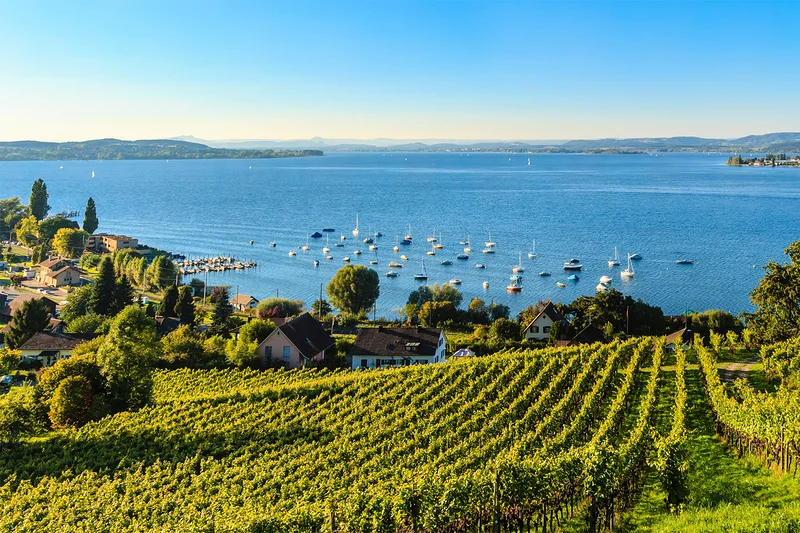
Visiting the Black Forest
A range of low mountains in south-west Germany, facing the Vosges across the Rhine. It stretches a hundred miles, from Pforzheim to the Swiss border, and owes its name to its fir forests, so dense they look black from afar. The highest point, the Feldberg, barely tops fifteen hundred metres.
In the north, Baden-Baden has its thermal baths and its casino, and the Black Forest High Road runs on towards Freudenstadt. In the centre, the Kinzig valley and Triberg keep the farmhouses, the waterfalls and the cuckoo clocks. In the south, Freiburg opens onto the Titisee and the high plateaus. You come to walk, to soak in hot spring water and to eat cherry cake, not for Alpine peaks.
You will love it if
- You enjoy gentle hiking, through forest and from farm to inn
- You are after thermal baths, spas and elegant spa towns
- You want a nature break an hour from Strasbourg
Give it a miss if
- You want high mountains and glaciers
- You travel without a car and are aiming for remote farmhouses
- You hate rain: the forest owes its green to a damp climate
The must-sees
-

1 The thermal baths of Baden-Baden +8 recs
Germany's most famous spa town, since Roman times. At the Caracalla baths you move from indoor pools to outdoor ones, in water above thirty degrees. At the Friedrichsbad next door, bathing follows a seventeen-step ritual. A word to the shy: in the saunas, swimwear stays outside.
-
2 The Triberg waterfalls Waterfalls
The Gutach tumbles a hundred and sixty metres in seven leaps, at the bottom of a gorge of fir trees. A path climbs alongside the falls, and squirrels come to eat from your hand. In the village, the cuckoo clock shops are a reminder that the whole craft was born here.
-
3 The Black Forest High Road Road
Sixty kilometres of scenic road between Baden-Baden and Freudenstadt, along the northern crest. It passes the Mummelsee lake and the foot of the Hornisgrinde, from where, on a clear day, you can see Strasbourg Cathedral. Stop at the national park to walk among the firs.
-
Its red sandstone spire towers over Germany's sunniest city. Around it, the market is held every morning on the square, and little channels, the Bächle, run along the cobbled streets. Climb the Schlossberg at sunset to watch the minster light up.
-
5 The Gengenbach Advent calendar Christmas
In December, the twenty-four windows of Gengenbach town hall become the world's largest Advent calendar, and a new one opens every evening. The Christmas market fills the half-timbered old town. Come midweek, at nightfall.
The classic trap
Reducing the Black Forest to the Titisee and a cuckoo clock bought in passing. Along the lake, souvenir shops follow one another, and so do the coaches. Head up to the high plateaus instead, walk an hour to a farm inn, and taste the smoked ham where it is made.
Our itineraries in the Black Forest
| Length | Itinerary | What you see |
|---|---|---|
| 3 days | Baden-Baden › High Road › Freudenstadt | The baths, the crest lakes, the national park |
| 5 days | Freiburg › Titisee › Triberg › Gengenbach | The city, the high plateaus, the waterfalls, the half-timbered villages |
| 1 week | From Baden-Baden to Freiburg via the Kinzig valley | The whole range, from the northern baths to the southern summits |
Start in the north, in Baden-Baden, for a day at the baths, then take the High Road to Freudenstadt and its vast square. Head down the Kinzig valley to Gengenbach and the open-air museum at Gutach. Got a week? Finish with Triberg, the Titisee and the Feldberg, before two nights in Freiburg.
When to visit the Black Forest
| Interest | Season | Temperatures | The highlight | Crowds and prices |
|---|---|---|---|---|
| WinterDec. to Feb. | -6 to 4°C | Skiing on the Feldberg and Christmas markets | Medium | |
| SpringMar. to May | 2 to 18°C | Cherry blossom in the valleys | Low | |
| SummerJune to Aug. | 12 to 25°C | Hiking and swimming in the lakes | High | |
| AutumnSept. to Nov. | 4 to 18°C | The grape harvest and golden forests | Medium |
Our advice
Come in September or October: the beech woods turn gold among the firs, the foothill vineyards bring in the harvest, and new wine is served with onion tart. Summer is ideal for walking, but the lakes get crowded. In December, the Christmas markets alone are worth the trip.
Getting to the Black Forest
-
By train via Paris No plane needed
From London, the Eurostar reaches Paris in two and a quarter hours, and the TGV then takes you to Strasbourg in under two. From there, regional trains run on to Offenburg, and the Black Forest Railway climbs to Triberg through some forty tunnels.
-
By car from Alsace The most freedom
From Strasbourg, cross the Kehl bridge: the first valleys are half an hour away. From Mulhouse, Freiburg is three quarters of an hour away. German motorways are toll-free for cars.
-
By plane to Basel or Stuttgart The quickest
Basel-Mulhouse airport is an hour from Freiburg and the high plateaus, Stuttgart an hour and a half from the northern Black Forest. Both have direct flights from several UK airports.
Come by car if you are aiming for the farm inns and the small crest villages. For a stay between Freiburg, Baden-Baden and Triberg, the train is enough, especially with the guest card that most hotels hand out.
Getting around the Black Forest
The range is well served: regional trains run up most of the valleys, and buses link the crest villages. In many municipalities, the guest card your hotel gives you lets you ride buses and trains across the region for free. For the High Road and the hamlets, a car remains more practical.
Good to know
Ask reception for your guest card as soon as you arrive: it opens up public transport and, often, discounts on museums and lifts. A UK licence is accepted for driving in Germany, but remember they drive on the right. In winter, suitable tyres are compulsory on snowy roads.
What to eat in the Black Forest
- Black Forest gateau: the real local cake, chocolate, cream and cherries, laced with cherry brandy.
- Black Forest ham: salted and smoked over fir wood, best in thin slices with farmhouse bread.
- River trout: caught in the mountain streams, served pan-fried or smoked.
- Spätzle: little fresh noodles with cheese, or alongside dishes in sauce.
- Baden wines: pinot noir and pinot gris from the slopes of the Ortenau and the Markgräflerland.
- Onion tart and new wine: the autumn duo, served in the cellars during the harvest.
To eat like the locals, look for a farm inn up on the heights, serving ham, cheese and house beer. In the foothill valleys, the cellars open their doors in season, and winegrowers' taverns pour the year's wine. Save room for the cake, preferably in a village tea room.
Where to stay in the Black Forest
| Area | What for | Good to know |
|---|---|---|
| Baden-Baden and the north | Thermal baths, casino, High Road | The most elegant |
| Freudenstadt and Baiersbronn | National park, hiking, fine dining | The most outdoorsy |
| The Kinzig valley and Triberg | Farmhouses, waterfalls, cuckoo clocks | The most traditional |
| Freiburg | Old town, minster, markets | The liveliest |
| Titisee and the Feldberg | Lakes, skiing, high plateaus | The most alpine |
How much does a trip in the Black Forest cost?
| Trip | Length | Budget per person |
|---|---|---|
| Budget (hostel, free transport, farm inns) | 5 days | €350 to €550 |
| Comfort (village hotel, car, thermal baths) | 5 days | €700 to €1,200 |
| Luxury (luxury hotel, spa, Michelin-starred restaurants) | 5 days | €1,800 to €3,500 |
- The guest card: given free by your hotel in many municipalities, it saves you every bus and train ticket.
- The thermal baths: entry is charged by the hour; two or three hours are enough to enjoy them without paying for a full day.
- Farm inns: you eat generously there for far less than in town.
- The season: in spring and late autumn, rooms cost noticeably less than in summer and December.
- Fine dining: Baiersbronn has several Michelin-starred restaurants; the lunch menu often costs far less than dinner.
Traditions and way of life in the Black Forest
For a long time the Black Forest lived from timber: the trunks floated down the rivers as rafts to the Rhine and on to the Netherlands. On the isolated farms, winters were long, and in the 18th century people began making clocks; pedlars sold them all over Europe. The cuckoo clock became the emblem.
In a few villages of the Gutach valley, women still wear the Bollenhut at festivals, a hat topped with big woollen pompoms, red for unmarried girls, black for married women. In the 19th century, Baden-Baden became Europe's summer capital, where kings, writers and gamblers crossed paths. Passing through Gutach? Its open-air museum has rebuilt centuries-old farmhouses, with roofs that come down almost to the ground.