
What happens in Vegas stays in Vegas!
TRUE, when it comes to the many sins you might commit in this city of over-the-top, unbridled craziness.
FALSE, when it comes to the many natural treasures scattered across the arid, desert lands of Nevada, which deserve to be brought to light and shared with as many people as possible, especially nature lovers and souls in search of well-being!
Because, yes, Nevada isn't just Las Vegas and its endless slot machines, it's also a state rich in natural gems and little jewels that most of you probably don't even suspect exist, yet turn out to be wonderful surprises.

That is why it would be a crime to visit Las Vegas without planning a relaxing, rejuvenating detour to these various places that I am about to reveal to you, which, unlike the artificial nature of the gambling and entertainment empire, seem to have remained just as they were at the birth of Earth, immaculate and untouched by any human footprint!
So, for those who want to, drop your sequin dresses or poker chips, and follow me on a breathtaking journey to the heart of the Earth!
1/ Lake Mead

That September afternoon, as we had just arrived at the pool of our lavish hotel (the Stratosphere Las Vegas), overcome by a feeling of anxiety and awkwardness amidst all those waitresses in swimsuits and high heels and jet-setters with "bling-bling" necklaces, we felt the need to escape all that hustle and bustle and take refuge outside the city in a wilder place. Where? We didn't know yet, the idea was to get in our car and set out to explore the desert expanse surrounding Sin City.
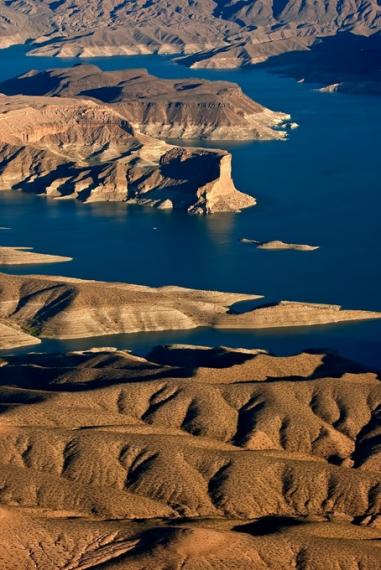
And it was by sheer coincidence, after driving for about thirty minutes southeast of Las Vegas, that the road suddenly revealed a breathtaking, striking panoramic view of a huge lake with turquoise waters bordered by ochre and white rocks: the majestic Lake Mead in all its splendor!

Captivated by such beauty and seized by an irrepressible curiosity, we decided to go take a closer look at this body of water whose smooth, sparkling surface was winking at us, calling out loud and clear like an invitation for a quick refresh! By the way, a quick refresh that was very welcome at that exact moment given the blazing sun and the outside temperature hovering around 45 °C! And in a convertible, I can tell you that you feel it!
So we let ourselves be tempted, and as we continued along our way following the road signs, we arrived at the entrance of this exceptional site: the Lake Mead National Recreation Area, whose exact address is: Lake Mead Visitor Center, 10 Lakeshore Rd, Boulder City, NV 89005 (about 35 minutes from Las Vegas by car).
So, just like "all dreams have a price" (according to Marc Levy), the dream of getting a closer look at this natural gem comes with a cost, as indicated by the official website of the lake, for the modest sum of $25 per vehicle, $20 per motorcycle, or $15 if you are on foot or on a bicycle. Keep in mind that this entry ticket is valid for 7 consecutive days! Given the extraordinary scenery awaiting us, there was of course no question of counting pennies, but rather of diving right in!
So, you will certainly ask me this inevitable question: "How do you explain the presence of such a lake in this desert and arid expanse?"
Well, before going any further in my story, I suggest a quick info session to better understand the essence and very existence of this exceptional site.
An artificial lake
Straddling the borders of Nevada and Arizona, Lake Mead is unfortunately not a gift from God or Mother Nature! Instead, it is a purely human-made creation, which owes its existence in particular to the Hoover hydroelectric dam, erected in the 1930s on the Colorado River with the goal of ending the river's floods and generating electricity using water power.
The dam now produces electricity not only for Las Vegas but also for Nevada, Arizona, and California. The lake supplies these same regions via an aqueduct, thus meeting the irrigation, recreation, and drinking water needs of more than 20 million people!
An exorbitant figure, but not so much when you know the impressive dimensions of the lake, which proudly stretches for a length of 180 km upstream from the dam, boasts 885 km of shoreline, covers a surface area of 640 km2, and holds a staggering 32 236 km3 of water on its own, making it the largest man-made lake in the world and the largest water reservoir in the United States when full.

Something that, unfortunately, hasn't happened since 1983 due to droughts caused by global warming and increased water demand. Filled to only 35% of its maximum capacity, the lake's future is under threat.
What's more, this continuous drop in the water level is bringing an old ghost town back to the surface, namely: Saint Thomas, a pioneer town that was evacuated in 1936 following the creation of the lake.
Vengeance from the dark souls of this town swallowed beneath tons of water, or divine punishment for a population too greedy for water?
One thing is certain, if no solution is found in the coming years, Lake Mead might well become nothing more than a mirage in this desert region, just like the ones seen by lost and thirsty souls in the middle of the desert!
A truly sad reality when you know the splendor of this lake, which takes your breath away at first glance! Indeed, how can you remain unmoved by this turquoise water gently kissing the sides of massive lunar rock formations boasting black, red, orange, ochre, and white colors, like a painting by the greatest masters?

How also can you skip a lake that offers visitors a myriad of water activities, such as jet skiing, paddleboarding, water skiing, boat tours, or simply a nice swim, all in water reaching between 25 and 30 °C in summer?
Not to mention the various scenic drives ("scenic drives") that let you head into the desert, canyons, and colorful rugged mountains surrounding the lake, discovering sublime red-orange landscapes typical of Arizona and Nevada. Personally, we ventured onto the "Northshore Road", and our wonder and admiration knew no bounds when the road led us through brilliant red mountain areas and huge rock formations, remnants of ancient lava flows now solidified and petrified by time. In other words, we were in absolute ecstasy before this scenery of unreal beauty that makes you feel like you've stepped back into the time of the dinosaurs!
Finally, Lake Mead is also fantastic fishing for fresh fish enthusiasts, countless hikes for wide-open spaces lovers, and photo opportunities. The less active can make the most of delicious barbecues and picnics that anyone can set up along the shores of the lake and its many sandy beaches, thanks to the facilities provided for this purpose. Indeed, multiple picnic areas equipped with tables, water, barbecues, and restrooms (extremely clean, I guarantee it!) await every visitor all around the lake, with the bonus of a privileged view of it!
And for those of you who are best organized and want to spend an extended stay near the lake, keep in mind that the Lake Mead National Recreational Area contains several campgrounds, lodges, and motels where you can pitch a tent, park your XXL RV, or rent a small, well-equipped room with cozy beds.
In short, there is something for everyone, and everyone can find what they are looking for at Lake Mead, which unquestionably knows how to charm and captivate its visitors!
Now, beyond the water issues, let's hope Mother Nature doesn't reclaim this extraordinary place, and let's hope mankind doesn't end up destroying the fabulous "toy" they built from scratch! So, dear reader friends, when health conditions allow, I have only one piece of advice for you: hurry up and discover this wonderful place before it disappears! And by the way, I suggest piquing your curiosity a bit more by extending your trip to the Hoover Dam, a true architectural and technical feat!
2/ Hoover Dam or "Hoover Dam"
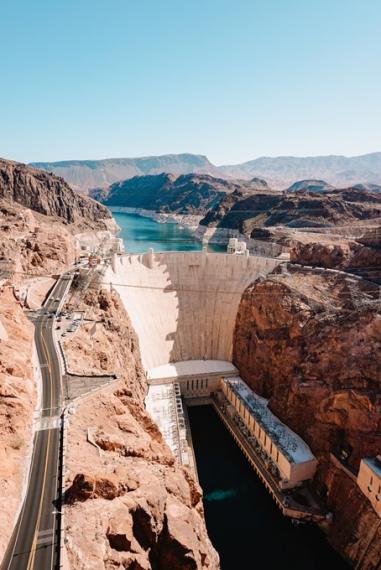
Here we finally are, at this famous Hoover Dam I briefly mentioned earlier, which in my opinion is well worth a stop if you are passing through the American West. It is located just 54km from Las Vegas, or about a 40-minute drive.
But before telling you more about this architectural marvel, it would be interesting to know the reasons why mankind took on such a pharaonic challenge in such a hostile and inhospitable region.
To do that, it is very simple, you just have to go back to the early twentieth century, more precisely to the 1930s.
Regulating the flow of the Colorado River
The first reason why humans wanted to embark on such a massive project is related to floods.
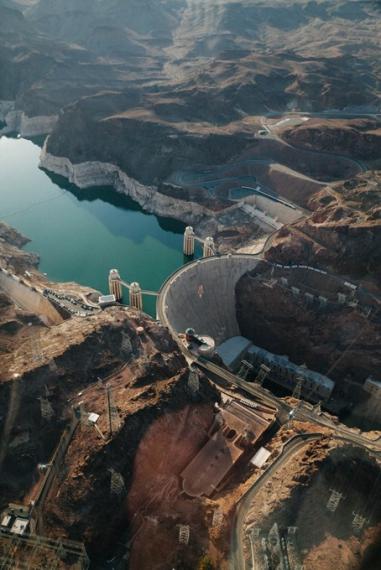
Indeed, the Hoover Dam is located on the border between Nevada and Arizona, in the Black Canyon of the Colorado River, fed by mountain water covering seven American states! Before the construction of the structure in 1931, during the spring snowmelt, a massive influx of water inevitably caused destructive floods in both villages and crops along the river. One solution back then: the creation of a dam to control the river's flow and store water in calculated locations.
Ensuring economic development
The second reason for the existence of this "behemoth": the economic development of several states in the American West.
Because, indeed, mastering the river's flow means agricultural growth in the southwestern region of the United States. Furthermore, the electricity generated by the dam would eventually make the construction profitable and thus ensure the economic and urban growth of all of southern California, as well as Nevada and, in particular, fabulous Las Vegas, the city of thousands of neon signs which, in 1930, had only 5,000 residents compared to 600,000 today!
Restoring employment
The Hoover Dam was built during the Great Depression in the United States, at a time when American leaders initiated a policy of major public works to revive the economy and employment.
Indeed, the dam allowed thousands of Americans victimized to the Great Depression to acquire a stable subsistence income throughout the duration of construction, which lasted from 1931 to 1935. As a fun fact, in the three weeks following the announcement of the project, the employment office closest to Las Vegas had received 12,000 applications, and thousands of unemployed people traveled across the United States in the hope of getting a job that was certainly difficult, but would pay them between $4 and $5.60 per day, a substantial wage at the time!
Thus, in addition to its major impact on the economy and the development of the American Southwest, the Hoover Dam also proved to be a lifesaver for thousands of American families taking the full brunt of the 1930s crisis.
Could it then be called the "savior of the American West"?
One thing is certain, it represents an essential element of regional heritage. Visiting it and discovering its history allowed me to learn more about the history of the United States, experience thrills, and forge indelible memories. I seriously invite you to go visit this fantastic place!
If despite this you are still not convinced, I still have one major argument left to definitively persuade you to go meet this desert giant: it is indeed its COLOSSAL character, which makes it one of the most famous landmarks and one of the most impressive monuments in the country!
Indeed, have you ever seen a dam whose arch-shaped structure measures 379 m long and 221 m high, with a base 200 m thick compared to 14 m at its summit?

And that is not all! Did you know that the amount of concrete needed for this extraordinary project was 2,480,000 m3? In other words, an exorbitant quantity that, according to some calculations, would have made it possible to build a two-lane highway connecting New York to San Francisco!
And these staggering figures do not stop there if you look at the power plant housed by the Hoover Dam.

It features 17 giant turbines thanks to which it is capable of producing 4 billion Wh per hour and thus supplying electricity to a population of several million residents spread across three states: Nevada, Arizona, and California.

Besides, if you want to get a little closer to these turbines and if you want to realize for yourself the gigantism of the power plant, know that you can go inside it and tour it by purchasing an entry ticket online or directly on-site at the rate of $15 per person for the classic tour and $30 per person for the complete tour. During the latter, you will discover the entire history of the power plant through films and exhibits, and you will also be led through gigantic tunnels and able to photograph these famous colossal turbines! But beware, the last tour of the power plant takes place at 3:45 PM, which means arriving in the late morning at the dam site to have time to appreciate all its beauty without rushing.

That's right, a structure of this scale is well worth taking the time to explore, especially since Hoover Dam is about a lot more than just the dam and its power plant! If you look up, you'll see that Hoover Dam is also home to the Mike O’Callaghan-Pat Tillman Memorial Bridge, that famous span linking Nevada and Arizona by crossing the Colorado River. Built between 2005 and 2010 to let commercial traffic bypass the dam and ease road congestion between the two states, it's quite a sight.

Having walked across it using the pedestrian walkway built just for this purpose, I can assure you that, much like its neighbor down below, this bridge is enough to give even the biggest adrenaline junkies among you a thrill, with its 580 m length and 270 m height!
So it would be a real shame to leave Hoover Dam without daring to challenge this bridge, which offers breathtaking views of the dam, the Colorado River, and the surrounding desert mountains while feeling like a true roller coaster!

Ultimately, Hoover Dam stands out as a truly titanic feat of engineering on every level, one that economically boosted the entire American Southwest and has always captured, captures, and will continue to capture the hearts of millions of us tourists, left in awe by the sheer scale and supremacy of such a site!

And as the cherry on top, I couldn't wrap up this section without sharing this little anecdote: because Hoover Dam straddles the border between Nevada and Arizona, when you stand right in the middle of it, you're also standing between two time zones. Nevada to the west is in the Pacific Time Zone, while Arizona further east is in the Mountain Time Zone. So when it's noon on the Nevada side of the dam, it's 1:00 PM on the Arizona side...


So, a warning to anyone who doesn't want to age: by visiting Hoover Dam, you can turn back the clock by an hour in your life thanks to a quick space-time jump between Arizona and Nevada!

And if you want to stop time altogether, why not stop by Boulder City? This charming, peaceful little town is right on your way back from a trip to the dam or a swim in Lake Mead, and it proves to be a true haven of peace that contrasts sharply with the excitement and buzzing atmosphere of the nearby Strip!
Well, if you're in the mood, follow me!
3/ Boulder City

As I mentioned earlier, if you want to take a break through time, I've got just the thing for you: Boulder City, where time seems to have completely stopped as a well-deserved rest after years of hard labor building the very thing it was born for, namely Hoover Dam.
Indeed, the town's origins date back to the early 1930s, when housing was specially built to shelter the workers tasked with constructing the nearby dam.
But with bustling Las Vegas nearby and slot machines found everywhere, even in the most unexpected places (from gas stations to laundromats!), how can we explain such tranquility in this little Nevada town?
To tell you the truth, if Boulder City has proven and continues to prove itself an example of tranquility, serenity, security, and order, it is primarily thanks to one unique thing: the ban on gambling within its municipal boundaries (the sole exception to the permissive laws of the state of Nevada)!
Back then, the goal was notably to prevent rowdiness among the 5,000 workers hired to help build the dam who were required to stay on site for the entire duration of the project. Besides, gambling wasn't the only thing prohibited; alcohol was also completely banned from this worker camp to prevent any trouble!
Since that time, still no roulette tables or casinos, but instead, it is now possible to sip a good beer at one of the many shaded terraces you will find downtown and which we simply couldn't resist after spending a completely dehydrated afternoon driving along Lake Mead and its scenic roads in temperatures nearing 50 °C! Stopping in Boulder City was obviously a must, especially since its shops filled with jewelry and Native American crafts, its antique stores, and its location overlooking the surrounding desert with a breathtaking view of Lake Mead (especially from downtown, behind Bicentennial Park) truly deserve a moment of your time to enjoy its charms and exceptional atmosphere!
Personally, I strongly advise you to take a little break at the Jack’s Place Bar & Grill on the main avenue, where backpackers, bikers of all kinds, and locals await you, all in a super warm and sporty atmosphere!
And if you are even slightly organized, think about checking out the many events held to liven up Boulder City. I'm thinking in particular of custom car gatherings, arts and crafts festivals, the Christmas tree lighting, the beer festival, giant barbecues, and so on.
As for us, we stumbled completely by chance upon a gathering of vintage Volkswagen beetles right in the heart of Bicentennial Park, and I can guarantee you we had a wonderful time in many ways!
So, what more can be said about Boulder City, other than it being one more idea to add to the long list of activities offered by Las Vegas and its surroundings.
Next, I would like to tell you about a moving and magnetic place, I would even say something almost unreal... My dear fellow readers, let me transport you to the heart of this sublime Nevada valley, which owes its name to the blazing color of its sandstone rocks that seem to catch fire at sunset: the "Valley of Fire" (or "Valley of fire"), or rather let's call it the "Valley of the supernatural" (you're about to understand why...)!
4/ Valley of fire or the "Valley of fire"

There are places on Earth that carry a certain scent of immortality, an inexplicable je ne sais quoi that leaves you speechless, motionless, tearing at your guts and your heart...; those blessed places where everyone can recharge, where you think you can tame the elements, but where you realize that they are the ones taming us...; those places you return from with the feeling of having measured yourself against life and learned a true life lesson...; in short, those places after discovering which you simply say to yourself: "tomorrow, I can die in peace"...
Well, I found that place, and as you can guess, it is the prodigious "Valley of fire", which was and will forever remain my favorite spot in the United States!
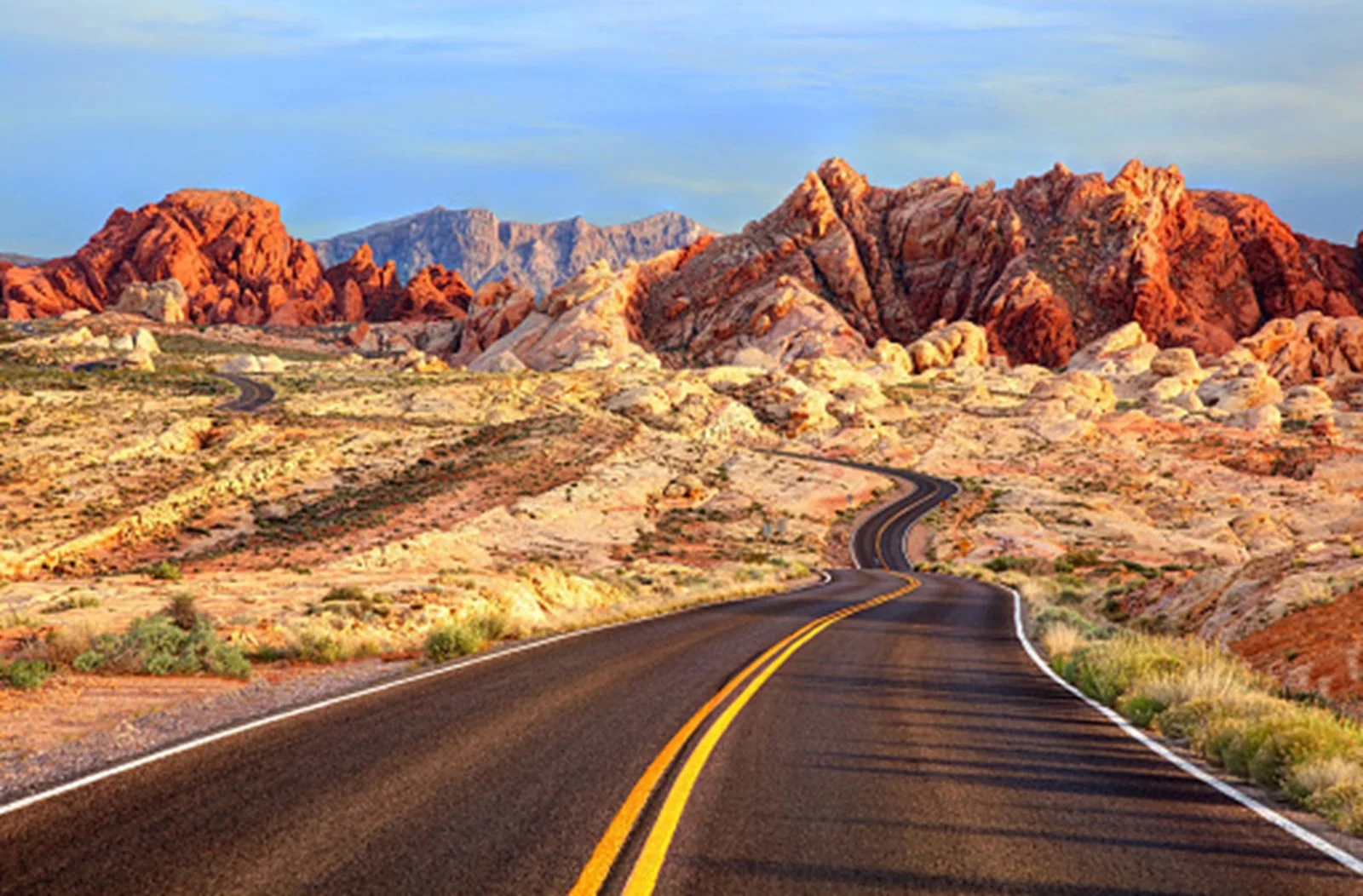
Down there, no neon lights or oversized lighted signs, no incessant noise from "one-armed bandits" or the "boom-boom" of trendy nightclubs, just silence and rocks ranging from bright red to beige, passing through pink, orange, and even purple depending on the sun's rays... In other words, a true painting, a real artist's palette, and all of that just 92 km from the Las Vegas Strip (about 1 h 15 by car) and 6 km from Lake Mead, for the sum of $10 per vehicle.

But what is $10 compared to the promise of returning with a heart full of indescribable emotions and indestructible memories, even though you would surely have spent those $10 in one of those bewitching slot machines with the promise of never seeing them again...? Believe me, this entrance fee is, in my opinion, trivial compared to the grandeur of what awaits every visitor afterward!
Besides, what awaits you there?
What to see and do in the Valley of fire?
The Valley of Fire State Park, Nevada's oldest and largest state park, conceals several scenic drives and multiple hikes that will allow you to discover with wonder and amazement its countless geological curiosities shaped by over 150 million years of erosion, after having formed from large shifting sand dunes during the dinosaur era.
You will also find millenia-old petrified trees there, as well as numerous petroglyphs and magnificent prehistoric rock engravings that stand today as real testimony to the passage of ancient Native American tribes (the Pueblo Indians of the Moapa Valley) who occupied the area between 300 BC and around 1150.

But how do you access this "kingdom of heaven"?
It's very simple. The park is actually divided into 3 parts that can be explored using two main roads and a third, slightly more secluded one, detailed below:
Valley of Fire Highway: this road connects the two park entrances and provides access to the other areas. You simply have to drive it from end to end because the landscapes are so grand and breathtaking! By the way, take a few moments to stop at the following viewpoints:
- Elephant Rock;
- Pretzel Arch;
- Seven Sisters.

Personally, this is one of the most beautiful stretches of road I have ever seen in the American West and, I believe, in my entire life, with its dark black pavement contrasting sharply with the bright yellow of the center divider line and the flamboyant red of the park's natural, or rather supernatural, scenery!

• Mouse’s Tank Road: this is a road perpendicular to the Valley of Fire Highway that leads you into the heart of the park. Here again, there is plenty to see and do with its 9 km of asphalt winding through the park and opening onto incredible spots, such as White Domes (huge cream-colored monoliths), Rainbow vista (vast area of multicolored rocks offering a spectacular view), Fire Canyon Silica Dome (region of the park where subterranean forces were powerful enough to cause enormous rock folds), and the now-famous Fire Wave (a multicolored wave displaying shades ranging from white to dark red, passing through pink and orange depending on the lighting, and a great consolation prize for those who weren't chosen in the lottery for the "real" Wave of Coyote Buttes North!).
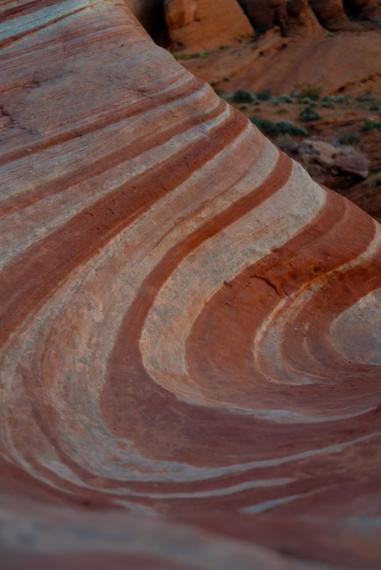
Moreover, many parking lots are set up along the road to let you make photo stops or set off on hikes to discover these fabulous viewpoints and many others, a summary list of which I have put together for you below:
- Scenic Drive;
- Mouse’s Tank;
- Rainbow Vista;
- Fire Canyon Arch;
- Fire Canyon Silica Dome;
- Crazy Hill Trail;
- Thunderstorm Arch;
- Fire Wave;
- White Domes.
Loop Road: a short 2 km road behind the campground that leads to other fascinating geological curiosities, such as:
- Atlatl Rock;
- Arch Rock;
- Piano Rock;
- Windstone Arch;
- Petrified Logs.
This brings our quick tour of the Valley of Fire to a close, which has managed to ignite my heart with indescribable emotions, move me to the core, and bewitch me like some sort of connection between my soul and the bowels of this native earth.
But before I let you go, I still have to warn you about one thing: the HEAT, which very often exceeds 40 °C! Even during our various visits in September and October, it was over 35 °C! So be careful, and be smarter than we were by packing a good tube of sunscreen and a hefty supply of water if you do not want to end up completely dried out and forced to down liters of beer at the nearby brewery in Boulder City just to try to rehydrate (my partner can tell you all about that)!
So, between the bright red rock formations blazing like a bonfire under the rays of the scorching sun and the sweltering heat reigning in this arid, desert region, it seems that the "Valley of Fire" definitely lives up to its name!

Just like its neighbor further west in California, only a 2 h 15 drive from Las Vegas, which takes its name from the poor souls it got the better of. Down there, the sun was a true "killer" on more than one occasion. As you have guessed, this is obviously "Death Valley", which I still want to introduce to you even if its name might "chill" more than a few people.
5/ Death Valley or "Death Valley"

While some see a particularly ominous connotation in that name, that is not the case for me. Because it is indeed in one of these places of surreal and staggering beauty that my soul truly comes back to life, that my entire body fills with infinite excitement and energy, in short, where I finally find meaning in my life...
Besides, I am not the only one who thinks of life when talking about Death Valley. Just go ask the more than 400 different animal species and over 1,000 plant species that have found refuge and a welcoming home in this most arid valley! In fact, Death Valley is teeming with life, and the coyotes, foxes, bobcats, pumas, and rattlesnakes certainly will not disagree with me!

And while its name might lead you to believe it is just a dead, barren expanse, limited to a plain, dry, uninteresting earth without any appeal, watch out, because Death Valley is actually packed with an incredible and surprising diversity of breathtaking landscapes, alternating between valleys, canyons, salt flats, sand dunes, and massive rock formations.

So, how can you remain unmoved by Death Valley, which is only "dead" in name!
Above all, before hitting the road, do not forget your water bottle, or rather your gallons of water, because here, in the place where the highest temperatures in the world are recorded (56,6 °C in the shade, in 1913), the motto is: "when driving, water is the only option" (I mean water of course...!).
On the other hand, my companion and I had to choose among the plethora of sites to see in this true open-air treasure trove, given our limited time.
This is why I am offering you not a complete list of the wonderful places contained within Death Valley, but rather a selection of the eight spots that struck us the most.
Death Valley must-sees
Furnace Creek
An artificial oasis right in the middle of the desert! You will find the Visitor Center, two hotels, shops, several campsites, a golf course, a post office, an airfield, the Borax Museum, and above all, a gas station! A place to keep firmly in mind just in case you get caught off guard!
Borax Museum
This museum was set up in Furnace Creek in the oldest house in Death Valley, but to tell you the truth, this house hasn't always had an easy time here. Indeed, built in 1883, this senior citizen of Death Valley was first born in the Twenty Mule Canyon mine before being moved in 1954 to Furnace Creek to preserve its old bones, or rather its old wooden planks, which face the test of time and heat, just like the rusted locomotive, creaking wagons, and old instruments on display outside.
The museum notably tells the story of Twenty Mule Canyon, which gets its name from how the borax mined in the region was transported: on wagons pulled by... 20 mules (as you might have guessed!).
Dante’s View
Here is the most spectacular and mind-blowing panorama you can get of Death Valley, climbing up to 1600m in height! You will have a breathtaking view of the Panamint Mountains in the distance and their Telescope Peak rising to 3 353 m, or even the Badwater Basin, the lowest point in the United States. At this altitude, treat yourself to a little breath of fresh air before rejoining the sweltering furnace of Death Valley.

Zabriskie Point
My friends, I now suggest we head back down in terms of altitude, but not at all emotionally, because the unprecedented and incredible beauty of this place left a mark on us...
Indeed, how can you not feel like you are getting closer to paradise before this lunar landscape entirely shaped by erosion, where you can see the different layers of sediment that accumulated over time to form these massive rock masses? Besides, you could compare them to giant feet or gigantic tree roots!

One thing is certain, no matter what they might make you think of, these monstrous blocks of rock make you feel deep inside the Herculean forces that animate planet Earth and make it anything but a stationary mass!

Artist’s Palette (Artist’s Drive)
Here, on this small 9 miles (14,4 km) paved one-way loop winding through massive rock formations 9,8 miles (15,7 km) south of Furnace Creek, art seems to have merged with nature like a painter placing colors on a palette and then blending them to ultimately obtain a true multicolored work of art worthy of the greatest artists.

Unlike the finest paintings you will ever gaze upon in your life, all the genius here lies in the fact that nobody had a say in it! Indeed, the surprising colors tinting the rocks of the badlands and hills in this region result from the oxidation of various minerals. Red, pink, and yellow come notably from iron salts, green from mica, and purple from manganese. In short, all these geologically unimaginable colors and shades offer every visitor a unique and unforgettable spectacle, especially in the late afternoon when the descending sun comes to enhance the colors of this simply breathtaking setting!

Devil’s Golf Course ou « parcours de golf du diable »
A rather ominous name, but one that so accurately reflects the scenery standing before your eyes: a huge, crusty, muddy terrain resulting from the drying up of a salt lake 3,000 years ago. The salt from this ancient lake crystallized over the years, forming halite (minerals with sharp edges) and such rugged terrain that a National Park Service writer noted in 1934 that « Only the devil could play golf on such a course »!

Badwater
Badwater... Yet another gloomy name, this time designating the lowest point in the United States, located 86 m below sea level as the sign at the entrance to the site indicates!

Like its neighbor Devil's Golf Course, this funnily named spot (« the bad waters ») is also what remains of a huge salt lake that covered the valley 3,000 years ago, giving way today to vast salt flats. Furthermore, a wooden boardwalk provides access to these immense, endless pools of salt that form the ground at Badwater and give it a completely surreal appearance that you simply must see once in your lifetime!

Mesquite Sand Dunes
Sand dunes right in the middle of a rocky desert! What a disturbing and baffling sight!

But how is that even possible?
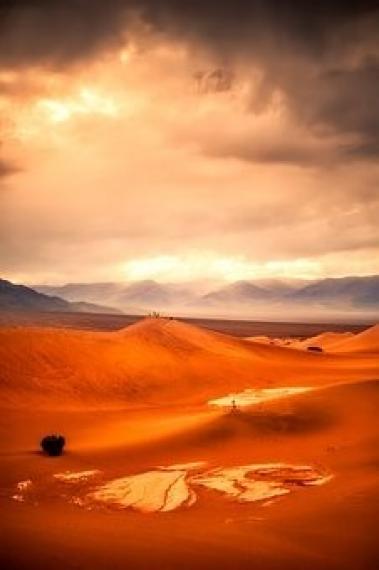
In reality, the dunes in this setting worthy of an Arabian Nights tale were shaped by the wind, which gradually transports, grain by grain, sand from the surrounding mountains (created by erosion) to this precise spot in the valley.
What is more, it is entirely possible to go plunge right in and have fun rolling down them, but I am warning you right now, if you feel the urge, it will be at your own risk. Do not forget that a certain punishing sun is watching you from its lookout post, reminding you that without water, even a short session of tumbling or walking in this irresistible playground can prove fatal!

So, my dear fellow readers, I will offer just one piece of advice: be smart and content yourselves with appreciating this exquisitely beautiful landscape from afar, as it is particularly photogenic at dawn, at dusk, or during full moon nights when it becomes simply poetic!
And so, on this somewhat sandy yet oh-so-magical note, our brief overview of Death Valley comes to an end, though we were unfortunately unable to explore all of its hidden treasures.
Could this be an invitation to a future trip...?
One thing is for sure: if this region proved ruthless to certain gold prospectors, it was unforgettable for us. I have a deep conviction that my love affair with this Death Valley is far from over, and that we will end up finding each other sooner or later like two magnetic soulmates, just like the rest of the American West, which, once you have experienced it, leaves you with a longing to return...


Comments (0)
No comments yet. Be the first!