
It’s the middle of August in the streets of Paris, the heat is absolutely stifling, and you’re looking for a way to cool off and escape the suffocating city air… Well, my dear readers, I have the perfect spot for you!
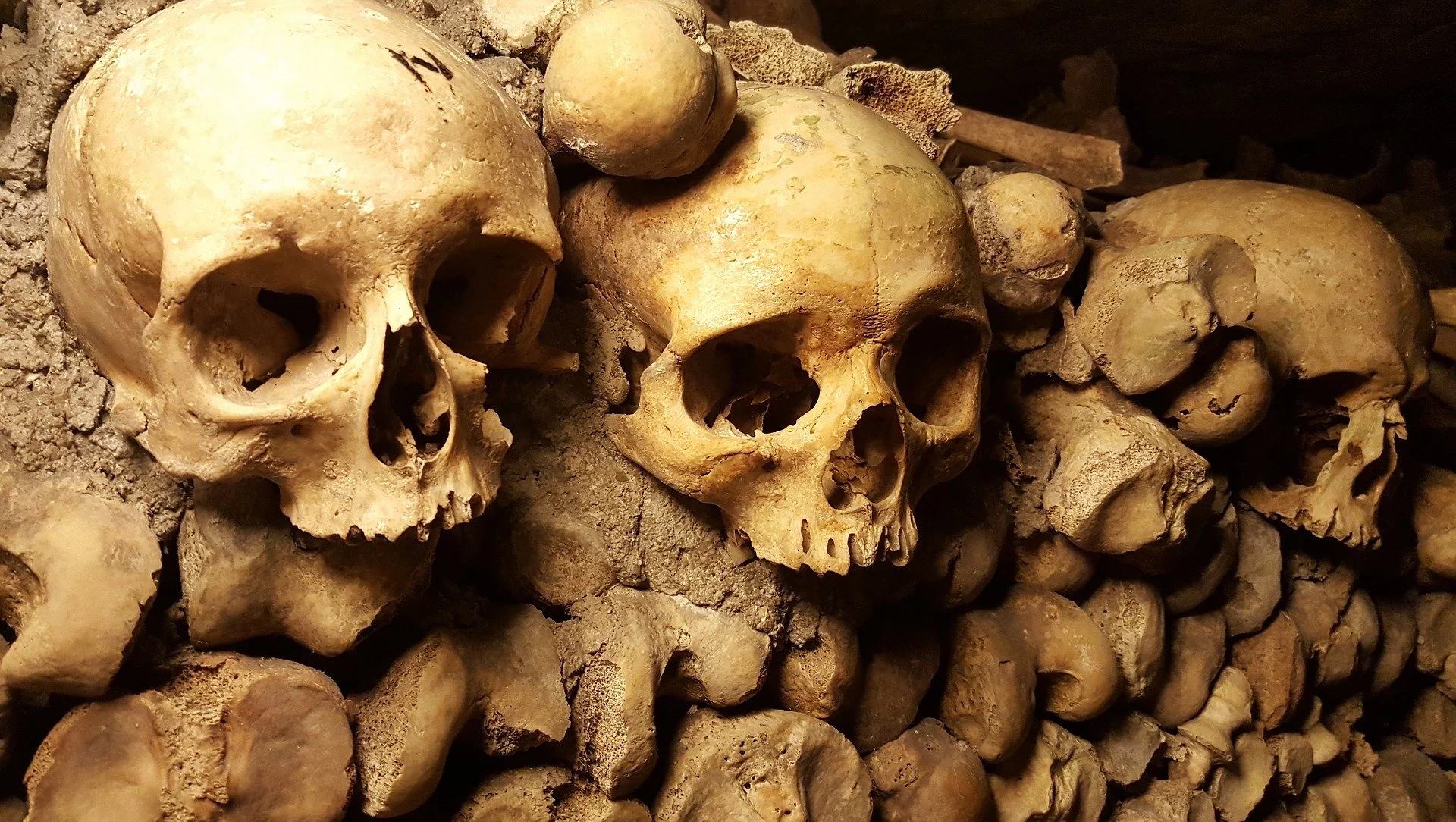
Now, don't go thinking I’m about to suggest the city’s trendiest swimming pools. Today, we’re talking skulls, tibias, and femurs galore with a chilling, disorienting tour of the Paris Catacombs. Located twenty meters underground with a constant temperature of 14°C (57°F), they offer a guaranteed "cool down", or perhaps just a "shiver" down your spine!

That said, if you’re faint of heart or prone to claustrophobia, it would be much wiser to sit this one out and enjoy a drink on the terrace of one of the many cafés nearby instead.
I mention August because I’ve explored the site several times during that month, but know that the Catacombs are just as fascinating the rest of the year, perhaps even more so around Halloween, when the shop window displays and the gray autumn sky plunge you directly into the atmosphere of what’s waiting for you underground!
So, ladies and gentlemen, if you’re ready for this unusual experience, follow me!
Practical Information
A few tips to fully enjoy your visit
First off, there’s no specific physical or dress code required for this tour, other than this: do not suffer from claustrophobia, heart conditions, or respiratory issues. Bring a light sweater if you get cold easily in the summer, or a warm jacket in winter. Most importantly, you’ll need STRONG CALVES to tackle the 131 steps down at the start and the 112 steps back up at the end, as there is unfortunately no elevator to reach the depths of this legendary, history-steeped site.
You’ll also need TIME to come face-to-face with the countless human bones that, don’t worry, will be waiting for you regardless! Why?
Because, first of all, if you haven’t booked your ticket in advance, you’ll often face a queue of over an hour just to get inside! (I know this from experience, having waited in that line at least 5 times!) This delay might be different now, as booking a time slot is currently mandatory following the COVID-19 pandemic, with tours scheduled every 15 minutes and limited to 100 visitors at a time (instead of 200 pre-COVID).
Secondly, because with 1.5 kilometers of walkable paths, you should plan for a good 45 minutes to see the light of day again at the other end of this true underground labyrinth!
By the way, where exactly are the entrance and exit to this massive ossuary located?
Addresses and access

To enter the abyssal depths of this kingdom of the dead, head to 1, avenue du Colonel Henri Rol-Tanguy, 75014 Paris. If all goes well, and God willing, you should emerge at: 21 bis, avenue René-Coty, 75014 Paris.
As for transportation, Metro lines 4 and 6 at Denfert-Rochereau will get you there, as will the RER B, or bus lines 38 and 68 (Denfert-Rochereau stop).
Finally, for those who prefer to drive, there is a paid parking garage at 83, bd Saint-Jacques, 75014 Paris.
And what about opening hours?
Hours
While the bones in this immense underground gallery may have lost track of time, you’ll need to keep an eye on your watch. The site is open Tuesday through Sunday, from 10:00 AM to 8:30 PM, with ticket offices closing at 7:30 PM.
Regarding public holidays, the Catacombs are open on July 14, August 15, November 1, and November 11, but be aware that they are closed on January 1, May 1, and December 25.
Now, let's talk about the unpleasant part: the price!
Rates
Ladies and gentlemen, everything has a price, especially this thrilling and surprising visit.
You have the option to buy an "advance ticket" online at www.billetterie-parismusees.paris.fr for 24 euros (full price), 22 euros (reduced), or 5 euros (child).
Alternatively, you can purchase a "last-minute ticket" online for the same day at 14 euros (full price), 12 euros (reduced), or 0 euros (child < 18 years).
Please note that this pricing policy was established after the health crisis; I cannot say what will happen in the future regarding ticket purchases or when on-site sales might resume.
One thing, however, is certain and won't be affected by the current situation: the history of the Catacombs.
We’ve covered the essential info for visiting this world-famous site, but what about its past? Who or what is responsible for this place, at once alluring and repulsive, around which so many myths and mysteries have been built?
History of the Paris Catacombs
Once upon a time, a stone quarry…

While the Paris Catacombs are a massive maze of underground galleries serving as a municipal ossuary containing an estimated 6 million bones from different eras, these tunnels weren't originally dug for that purpose. They were actually stone quarries carved out beneath what is now the 14th arrondissement, centuries before becoming an ossuary. They provided high-quality construction materials (Lutetian limestone) used to build many of the capital's houses and monuments, such as Notre-Dame de Paris.
The quarry beneath our famous Catacombs is the Tombe-Issoire Quarry, which is actually just a tiny part of a network of over 300 km of tunnels dug under the capital starting in the Middle Ages, known as the "Underground Quarries of Paris."
Over time, excavation was abandoned and officially banned by a decree on September 15, 1776, following a series of serious ground collapses in Paris. On April 4, 1777, Louis XVI established the General Inspection of the Quarries of Paris, tasked with monitoring and reinforcing these now-inactive tunnels.
But how did the current Catacombs transform from a simple quarry into one of the world's largest ossuaries?
From the Saints-Innocents Cemetery to the current ossuary…

The culprit: the Saints-Innocents Cemetery. You might not know it, but it was the ancestor of the current Place Joachim-du-Bellay in the Les Halles district, or, if you prefer, the ancestor of all those shops in Les Halles you’ve likely visited at least once. Something to keep in mind for your next shopping trip!
Joking aside, the Saints-Innocents Cemetery was a real problem at the time. Excessive use by about thirty Parisian parishes, combined with the constant influx of victims from wars, epidemics, and famines, meant the site quickly became overcrowded. The resulting pile-up of decomposing bodies posed a serious health risk. An 18th-century chronicler even noted that wine would turn to vinegar in less than a week and food would spoil within days in the neighborhood. Well water was also contaminated by putrid matter. By the end of the 18th century, the cemetery ground level was more than 2 meters above street level, further increasing the risk of disease and foul odors.
In 1780, a wall of the Saints-Innocents Cemetery collapsed under the weight of the bodies! The cellar of a neighboring restaurant was even flooded with human remains, a true nightmare scene. Following this tragedy, the decline of Paris's largest cemetery began. Louis XVI ordered its closure in 1780, but a new problem arose: what to do with all those piles of bones?

An original solution was proposed in 1782 via an anonymous project published in London and presented to Parisian authorities and clergy: following the example of ancient underground necropolises, they would use the reinforcements already built by the General Inspection of the Quarries to fill the 11,000 km² of abandoned tunnels in the Montrouge plain, specifically the Tombe-Issoire Quarry, with the remains. Thus began the Paris Catacombs, with the first transfers of bones from the Saints-Innocents Cemetery taking place from 1785 to 1787. They were moved in covered wagons at night to avoid hostile reactions from the Parisian population and the Church.
But once they arrived, how were these millions of bones transferred?
In a somewhat brutal and macabre fashion, I must admit: the bones were dumped into two service shafts of the quarry, then collected by quarry workers who loaded them into wheelbarrows or small wooden carts to be taken to their designated sections in the underground galleries, where they were "neatly" stacked. Enough to haunt you for the rest of your days!
A few figures

These initial transfers lasted 15 months and were renewed until 1814 due to the project's success, as parish cemeteries in central Paris, such as Saint-Eustache, Saint-Nicolas-des-Champs, and the Bernardins convent, were cleared. They resumed in 1840 during Louis-Philippe’s urban planning projects and again during the Haussmann renovations from 1859 to 1860.
From 1842 to 1860, no fewer than 800 wagons transported tons of bones to the Catacombs, emptying 17 cemeteries, 145 monasteries, convents, and religious communities, and 160 places of worship surrounded by their own burial grounds. The goal: permanently close all intra-muros Parisian cemeteries to solve sanitation issues.
These grim statistics led to the site’s consecration as the "Municipal Ossuary of Paris" on April 7, 1786, the date it also took on the legendary name "Catacombs." Since 1809, it has never ceased to attract curious visitors from all over the world!
Dear visitors, this is what awaits you if you undertake this descent into what could be called an XXL-sized tomb!
What you will see
The small exhibition rooms

While the idea of seeing the dead and piles of bones is what "excites" and "galvanizes" most visitors, you’ll need a bit of patience before finding what you came for: Death in its full glory!
Once you reach the gloomy depths twenty meters down, you don't immediately step into galleries of bones, but rather small rooms featuring information panels about the history of the site and temporary exhibitions. If you’re looking for a venue for your next photo exhibit, here’s an idea!
The first gallery leading to the site's depths
From these small rooms, a narrow, slightly unsettling gallery leads south, under Avenue René-Coty, where you can see the signage left by engineers of the time, allowing you to follow the chronology of the improvements.
The Arcueil Aqueduct

A bit further on, still in the heart of narrow reinforcement galleries, you’ll find inscriptions announcing the Arcueil Aqueduct, built between 1613 and 1623 by order of Marie de Médicis to bring water from the Rungis springs to Paris, and, more importantly, to supply the Queen's Luxembourg Palace.
These reinforcement galleries were built by Guillaumot following several collapses in March 1782 and May 1784, caused by water infiltration.
The Workshop
A little further, we emerge into a spot that has kept its original authenticity: the Workshop. This is a section of the limestone quarry that retains its raw appearance from the end of its operation, with many other galleries branching off, blocked by iron gates.
The "ceiling" of this quarry section is supported by "turned pillars" (masses of rock left in place after extracting the surrounding stone) and "arm pillars" (formed by large blocks of stone stacked by hand). Between them are "hagues" (small stone walls) containing the waste from the cutting process, known as backfill.
The Port-Mahon Gallery

Next, just as we’re trembling with anticipation to see the bones... nope, not yet! Instead, we arrive at a site that is equally impressive: the Port-Mahon Gallery, which owes its name to the stunning, ultra-detailed reproduction of the fortress in question, carved directly into the rock.
It was created between 1777 and 1782 by the quarry worker Décure, a former veteran of Louis XVI’s armies employed in the catacombs to help with reinforcement work. After discovering a small hidden quarry, he spent 5 years carving his works during his breaks.
But why Port-Mahon? Because it was in this fortress on Minorca, a Balearic island then occupied by the English, that Décure was imprisoned for several years. Sadly, in a tragic twist of fate, while trying to build a staircase leading to his works, he triggered a landslide that led to his demise.
The Quarrymen's Footbath

Not far from there, and just as surprising, we arrive at the Quarrymen's Footbath. It’s actually a small well (the first geological borehole made under Paris) containing a particularly clear pool of water once used by the quarry workers.
The Ossuary

An unexpected and impressive well, but we can't help but ask ourselves, like a child on a road trip: "Are we there yet?"
Well, just a minute, we’re getting closer. You can’t miss the entrance to the ossuary, with a message on the lintel that couldn’t be clearer: "STOP! THIS IS THE EMPIRE OF DEATH!"

Ladies and gentlemen, the tone is set, and you won’t be disappointed by the rest of the route, which involves an endless walk among millions of skulls, femurs, tibias, and other skeletal fragments.
You wanted bones? You’ve got them! But not just any bones. While the first remains were dumped haphazardly, in 1810, Héricart de Thury, Inspector General of the Paris Quarries, organized the site. Walls were constructed from long bones, usually tibias and femurs, interspersed with friezes of skulls at different heights, slightly protruding. They were even arranged in pretty patterns like crosses, arches, and hearts... a form of "romantico-macabre" decoration.
I must admit, the effect is quite successful, because as you walk through, this organized and rather "artistic" succession of bones almost makes you forget that you are wandering through the remains of once-living beings!
The Samaritaine Fountain
A perfect example is another well a few meters further along, called the Samaritaine Fountain. With the small circular room built around it and the aesthetic, harmonious arrangement of bones in warm colors, you might almost call the place "pretty"!
The Barrel
Just like the "Barrel" where the tour ends. The stack of skulls and tibias takes on this original barrel shape, hence the name!
As a side note, a famous concert took place here on the night of April 2, 1897, with over a hundred guests and a musical program featuring Chopin's "Funeral March" and Saint-Saëns' "Danse Macabre," making this spot one of the emblems of the Paris Catacombs.
And so, on this "aesthetic" note, our tour comes to an end, an experience that is exciting, fascinating, and disorienting, but also, paradoxically, chilling, sinister, and somewhat unnerving. I think it gives Disneyland’s Haunted Mansion a run for its money!
Legend and juicy facts
The legend of the Green Man
Like any place steeped in history, I couldn't leave without telling you about the legend of "The Green Man," which circulated around 1777 among the workers reinforcing the quarry. Some claimed to have seen a "green man" with a tail, horns, and goat hooves, leaping with agility through the galleries, always escaping his pursuers and bringing bad luck for the year to anyone who spotted him.
Believe it or not, it’s not uncommon, when wandering the galleries alone or in small groups, to feel a presence... but when you turn around, there’s nothing there.
Perhaps it’s simply the invisible presence of those curious and unexpected souls who haunt the place?
A place where figures of French history rest
You might not know it, but great historical figures you’ve likely heard of now rest in peace among all these bones: Rabelais, Racine, Blaise Pascal, Marat, Montesquieu, Danton, Camille Desmoulins, Lavoisier, Robespierre... and many others.
This proves that once we are dead, regardless of our actions during our existence, we are all ultimately in the same boat!


Cela serait mon conseil si jamais vous entreprenez la visite. Je m'excuse encore pour le retard.
Et aucun pbm pour le retard de réponse
D'ailleurs, désolé pour le retard du remerciement :)