
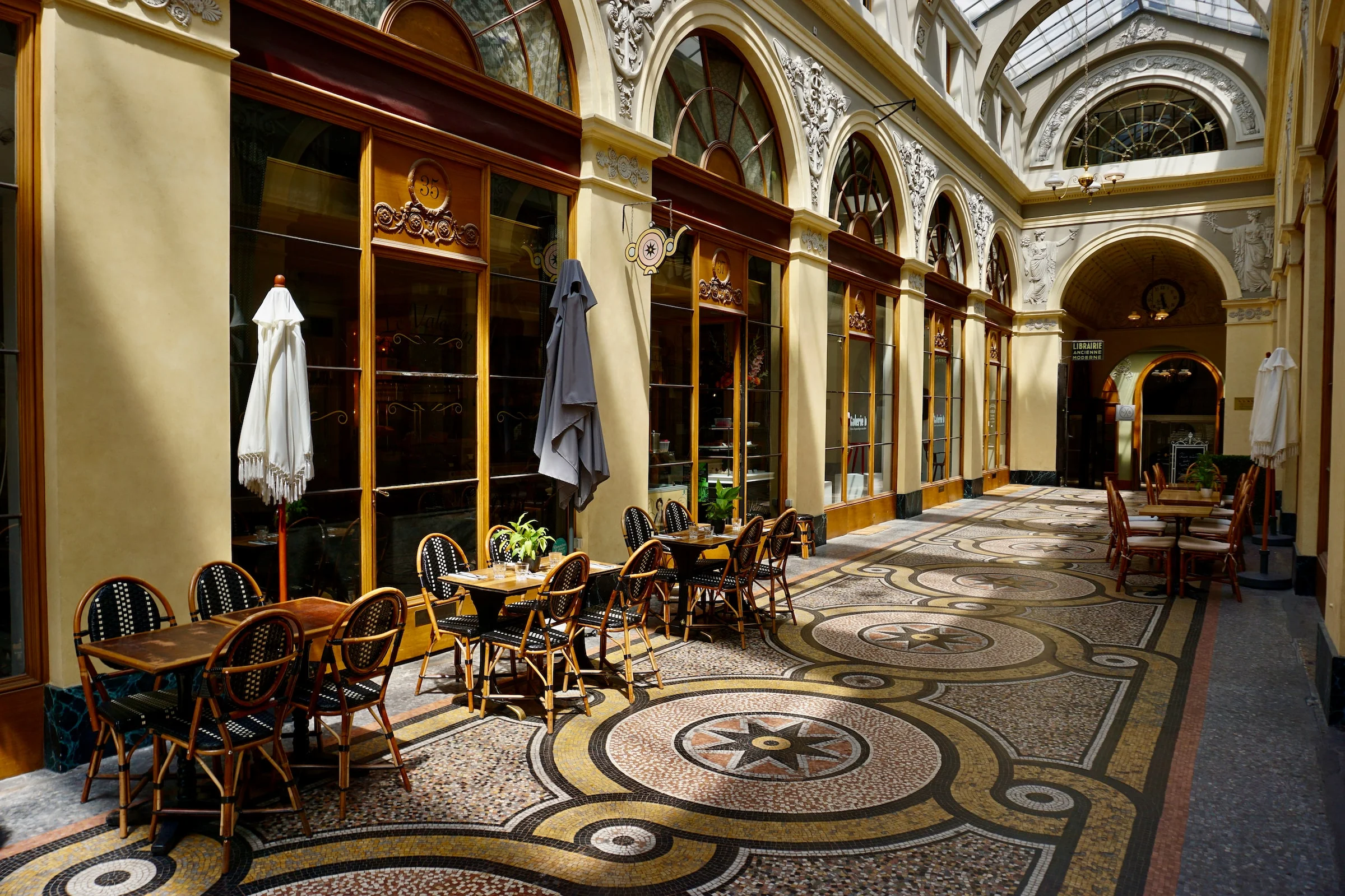
Paris and its Eiffel Tower, Paris and its Champs-Élysées, Paris and its Louvre Museum… That sounds so obvious to anyone wanting to set out and visit our beautiful romantic capital!
But did you think of Paris and its covered passages and unusual galleries?

Admittedly less known to the general public and hidden away in the small streets of Paris, these unlikely places are nonetheless true gems and will let you plunge right back into the heart of the 19th century, into the high-society atmosphere of grand corset dresses and a Paris emerging from the French Revolution, then undergoing a massive demographic, industrial, and urban transformation.
So, are you ready for this somewhat unconventional and less classic tour of Paris, but just as exciting and promising when it comes to surprises?
Trust me, close your eyes and let yourself be guided on a unique journey through time…
But before stepping onto the stone flags of these ancient remnants recalling the splendor and frivolity of an era rich in twists and turns, let's first look at their origin and discover how these history-filled places came to be.
The history of Parisian covered passages
Once upon a time, the covered passages and galleries of Paris…
1780s, the Duke of Orleans needs money
For this little look back, let's wind our clocks all the way back to the 1780s, when the Duke of Orleans, then owner of the Palais-Royal, found himself on the brink of bankruptcy. He thus found himself obliged to quickly find a solution to bail out his palace and cover his runaway expenses, and what better than a major real estate speculation project aimed at building shopping galleries at the foot of his building? At the time, the idea was notably to build buildings with arcades and ground-floor shops on all four sides of his palace to collect rent. It was a revolutionary and financially very promising idea, but it was quickly abandoned for lack of funds.
So what to do in the face of this bitter failure? No question of giving up! To reimburse himself for the undertaking, the Duke of Orleans found a backup plan by deciding to equip the then-unfinished site with temporary stalls housing three rows of shops served by two covered walkways. And the success was immediate! Indeed, with their eighty-eight shops bringing together fashion merchants, wigmakers, café-lemonade vendors, print sellers, reading rooms, bookstores, and other merchants, these "wooden galleries" of the Palais-Royal became the favorite attraction of Parisians and visitors alike, the place to see and be seen, stroll, do business, or even… live it up!
First half of the 19th century, the golden age of covered passages

And that is how the prototype of the covered passages and galleries of Paris was born, which would soon multiply at the initiative of savvy speculators who saw in the Duke of Orleans's idea of renting out shops and their apartments the most profitable investment of the time. And it was notably on vacant land confiscated from the nobility and clergy in the aftermath of the French Revolution that these speculators saw a prime location for building the first covered passages. Indeed, the space now available and well situated in the center of Paris was redeveloped; the new owners (or rather financiers!) of land, houses, and private mansions razed existing buildings and their gardens to rebuild one- or two-story buildings featuring genuine galleries in their center with at least one entrance and one exit to create a shortcut between two streets, thus facilitating access to the city's liveliest spots. And that is how some thirty covered passages would be built under the Restoration (1814, 1830) and the July Monarchy (1830, 1848), mainly on the Right Bank of the Seine, attracting the wealthy clientele of the era.
And while these passages enjoyed very heavy foot traffic from the very beginning, they experienced a true heyday in the 1850s when, fleeing a Paris still heavily marked by certain remnants of the Middle Ages, namely the lack of sidewalks, the absence of electricity, the presence of mud in streets with foul odors and deafening noise, strollers took shelter at all costs in these covered spots showcasing the technical prowess of the era to escape the capital's inconveniences. Indeed, what could be better than these covered, glass-roofed, heated, and gas-lit galleries to stroll with dry feet and window-shop away from the weather and the dangers of the city?
It was notably in this way that these sites very quickly became a favorite walking spot for the new, wealthy, and free-spending bourgeoisie, as well as a space for dancing, gallantry, meetings, and entertainment.
Late 19th century, the decline

But alas, like all good things that must come to an end, this success was only fleeting. The arrival of Haussmann's renovations (and with them, the sewers!) and the 20th century, the development of the railway, the massification of the economy, the rise of department stores (such as the Grands magasins du Printemps in 1865, the Samaritaine in 1870, or the Galeries Lafayette in 1894), and the growing importance of the automobile marked the gradual decline of these covered passages. They were increasingly abandoned by Parisians and tourists in search of wider spaces and mass-market goods. Notably, out of the 150 galleries that existed in Paris in 1850, only about twenty survive today, saved by the City of Paris, which, recognizing the value of this unique and exceptional architectural heritage, launched a renovation and conservation assistance program for these Parisian covered passages.
"Passage couvert" or "galerie"?
Ah, one moment please, I hear a question over here: “What is the difference between a passage and a gallery?”
Aside from the idea of aesthetic superiority (with larger dimensions and richer decoration) introduced by the term "gallery," there is no other difference between a gallery and a passage. Both designate a space generally located between two buildings, covered by a glass roof, and most often housing shops. Their function is to protect and facilitate pedestrian movement by connecting two streets, usually bustling ones, thereby offering a shortcut.
But let's stop chatting, because I have put together a selection of 5 must-see covered passages and galleries for you. Each one is more fabulous than the last and they are located relatively close to one another (in the 9th and 2nd arrondissements of Paris), so you can explore them all on foot in a single day. Let's take a closer look.
1, Passage Verdeau (or Passage des Antiquaires)

Let's start our walk at Passage Verdeau, beginning at 6 rue de la Grange-Batelière and ending at 31 rue du Faubourg-Montmartre, in the 9th arrondissement of Paris.
One detail immediately catches our eye: its remarkable, very high herringbone glass roof with clean neoclassical lines, making this spot one of the brightest, airiest, and most charming passages in Paris.
But who do we have to thank for this architectural masterpiece?
This passage, 75 metres long and 3.75 metres wide, was notably the work of the Passage Jouffroy company, which created it in 1846. Monsieur Verdeau, a major shareholder in the company at the time, gave his name to the passage. As a fun fact, Monsieur Verdeau is the man who invented the "linen rental" concept for hotels, restaurants, and other receptions.
While this covered passage was long less popular than its neighbors and relatively less prosperous financially because it did not connect two boulevards, the opening nearby in 1980 of the prestigious Hôtel des ventes Drouot (THE hub for the French and international art market) changed the game. It revitalized the passage, where many antique dealers set up shop and art lovers from around the world now flock. It's easy to understand why some people nickname it "Passage des Antiquaires" or "Passage Drouot"!
Antique dealers aren't the only masters of the house, though. You will also find fantastic bookstores and art galleries containing historical treasures, as well as restaurants like the famous "Bistrot Verdeau," which revives our grandmothers' mouth-watering recipes and lets you gaze at a magnificent, large clock right from your plate.
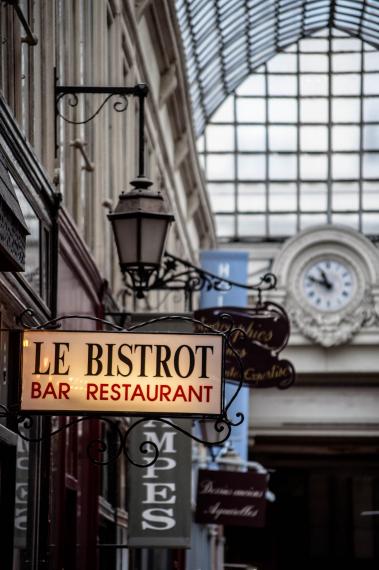
Now, what could this clock possibly be for? Is it there to rush you through your meal?
Certainly not! In reality, originally, many covered passages packed with shops were built near stagecoach stops. It was a very practical way for travelers back then to go shopping while waiting for their transport. This clock (just like the others you will encounter in certain passages) allowed this traveling clientele to keep an eye on the time while shopping so they wouldn't miss their stagecoach.
Speaking of time, you should know that this passage can be visited for free from Monday to Friday, from 7:30 AM to 9:00 PM, and on weekends, from 7:30 AM to 8:30 PM.
2, Passage Jouffroy (or the most modern passage).

Let us now leave the Passage Verdeau and head a few meters away to discover the Passage Jouffroy, stretching in its majesty from 9 rue de la Grange-Batelière to 10-12 boulevard Montmartre, still in the 9th arrondissement.
Serving as a junction between the Passage Verdeau and the Passage des Panoramas, this arcade was inaugurated in 1846 by Count Felix de Jouffroy-Gonsans and stood out at the time for its modernity and the technological and architectural advancements it showcased. Indeed, the Passage Jouffroy would be the first arcade in the capital built entirely of metal and glass and also the first to feature underfloor heating (surely much to the delight of the dainty ankles of our ladies of the era!).
Serving as undeniable proof of this is the magnificent self-supporting pointed glass roof, which lets in maximum light and bathes the precious marble tiling in a glow that has continuously been trodden upon throughout history by visitors discovering its wonderfully eclectic shops. These include a collector's cane vendor, a bookstore specializing in rare art books, a toy merchant that acts like a madeleine of Proust, and an original boutique featuring oriental goods, not to mention the iconic Hotel Chopin. Dating back to the opening of the arcade in 1846, it owes its name to the famous composer, who regularly walked through the passage from his home to visit the Pleyel piano demonstration rooms. That is the official version, the most politically wise and reasonable one provided at the time... But legend has it that our mischievous Chopin was actually meeting Georges Sand in this famous hotel! That, of course, remains to be verified...
While the variety and originality of the shops it houses would make this bustling arcade famous, the installation of the Grévin Museum nearby in 1882 also played a major role in its success. Indeed, with its exit located right inside the arcade, the museum, which has never stopped attracting crowds eager to admire those famous wax figures, made Jouffroy "the most frequented arcade of all, the most sought-after by merchants," according to the newspaper L'Égalité.

Perhaps this explains its more flexible hours, opening every day from 7:00 AM to 9:30 PM with free admission.
3, Passage des Panoramas (or the philatelists' arcade)

Let us now cross the street, or rather Boulevard Montmartre, to land directly in the Passage des Panoramas, which welcomes us at 11 Boulevard Montmartre and bids us farewell at 38 rue Vivienne, in Paris's 2nd arrondissement.
While this arcade, built in 1799, remains the oldest in the capital and the first to benefit from gas lighting in 1817, it also happens to be one of the most mythical and unique passages ever built of its time.
Unique first because of its name, which it owes to the two large towers (or rotundas) built on either side of its interior, where vast panoramic paintings were displayed. This was the brand-new attraction of the era, imported from London and drawing crowds of the curious. In fact, this novelty is largely the reason the arcade was opened in the first place: the main goal was to shelter the myriad onlookers who came to gaze at these intriguing panoramas from the rain and mud. But the frenzy and curiosity sparked by these two rotundas would soon give way to a certain weariness among the Parisian public, leading to the demise of these imposing structures in 1831.
Rest assured, however, that the arcade itself did not fade into oblivion. On the contrary, it continues to shimmer and shine to this day thanks to the light of its many unusual storefronts, including its fabulous and unexpected stamp and antique postcard shops, making this spot THE go-to landmark for all Parisian philatelists.

It is also a heavily frequented and coveted spot due to the presence of the Théâtre des Variétés, which attached itself to the passage in 1807 and ensures the arcade is never empty.
Where there is a popular arcade, there are particularly extended hours. Indeed, you can stroll for free through this wonderfully "stamp-crazy" spot all year round without interruption, from 6:00 AM until midnight.
4, Galerie Colbert (or the most cultural gallery).

Now let's step out of Passage des Panoramas onto rue Vivienne (still in the 2nd arrondissement) and walk a few yards to reach no. 4 on the same street, home to Galerie Colbert (built in 1823). To be fair, it isn't the first arcade that casual strollers rush to see!
Its lack of shops is certainly the reason for its low-key reputation compared to its big sister nearby, Galerie Vivienne. Even so, this arcade is well worth a look, if only to admire its magnificent rotunda topped with a breathtaking glass dome and its rows of marble columns with a rather exceptional style that matches its core feature: its cultural side.
Indeed, while each passage has its own unique character as we've seen so far, Galerie Colbert (owned by the National Library of France) aims to be the most cultural of them all, as shown by the institutions it houses, namely the National Institute of Art History (INHA) and the National Heritage Institute (INP).

The most cultural and certainly the most photogenic, because unlike its peers, this one at least has the privilege of regularly hitting the spotlight, notably thanks to the famous brasserie Le Grand Colbert with its Art Nouveau decor, classified as a historical monument, located right at the entrance and frequently used as a movie set.
So don't hesitate any longer, dare to make a detour to this arcade which, to top it off, welcomes you every day, without interruption.
5, Galerie Vivienne (or the most luxurious arcade)

Just a stone's throw from Galerie Colbert, or rather two street numbers away, let's find Galerie Vivienne waiting for us at 6 rue Vivienne, also in Paris's 2nd arrondissement.
Upon arriving at this immense arcade dating back to 1823, its wrought-iron sculpted entrance guarded by two imposing female sculptures with finely draped garments sets the tone: luxury and refinement are definitely on the agenda!

And mission accomplished the moment you step inside. Bathed in incredible natural light from the gigantic glass roof with its repeating arches, you can walk across the small tiles of a sumptuous mosaic floor with ochre, red, and purple patterns, the work of the famous Italian artist Giandomenico Facchina.

A sense of luxury also shows on the walls through objects symbolizing success (laurel wreaths), wealth (cornucopias), and commerce (Mercury's caduceus).
This delicate and polished decor has naturally led a good number of upscale shops and brands to set up shop here, such as Jean-Paul Gaultier, Wolff & Descourtis, and Yuki Tori. Kenzo even reportedly hosted its very first undercover fashion show here in 1970...
And as a fun fact, do you see that monumental staircase hidden at number 13 in the arcade? Its many steps actually lead to the former home of Vidocq, a famous French convict turned police chief and founder of the world's first private detective agency! According to legend, an underground tunnel connected Galerie Vivienne to the Palais Royal gardens, allowing this daring character to make a quick getaway in case of danger...
Only history knows for sure. For now, all that remains are the vestiges of this opulent and grandiose arcade where you can come shopping every day from 8:30 AM to 8:30 PM, provided you have a well-lined wallet!
Final thoughts
It is on this note of elegance that this brief overview of my 5 favorite covered passages in Paris comes to an end, but know that the capital hides a few others that are also well worth the detour. Here is a more comprehensive list of them if you ever feel like completing your tour of the passages and arcades of Paris:
- Galerie Véro-Dodat (19 rue Jean-Jacques Rousseau, Paris, 75001)
- Passage du Grand-Cerf (145 rue Saint-Denis, Paris, 75002)
- Passage Choiseul (40 rue des Petits Champs, Paris, 75002)
- Passage du Caire (2 place du Caire, Paris, 75002)
- Passage des Princes (5 boulevard des Italiens, Paris, 75002)
- Galerie de la Madeleine (9 place de la Madeleine, Paris, 75008)
- Passage du Havre (109 rue Saint-Lazare, Paris, 75009)
- Passage Brady (46 rue du Faubourg Saint-Denis, Paris, 75010)

Comments (0)
No comments yet. Be the first!