
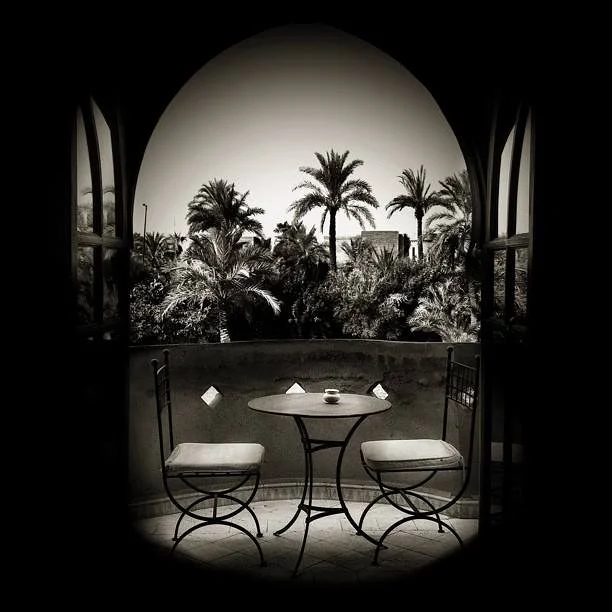
Is Morocco a country that makes you want to pack your bags, go on an adventure, explore, or perhaps even move abroad? You should know that it’s also a wonderful place to live. For my part, I lived there for 13 years. I arrived as a high school student, accompanying my parents who had decided to spend their retirement in Marrakech. I eventually returned to France 13 years later with my husband and children.

Here are a few tips I’d like to share based on that experience.
Why choose to live in Morocco and Marrakech?
Every departure is a new opportunity to discover a new culture, a new country, and a destination that might be entirely unknown to you.
Following a trip to Marrakech in December 2001, my parents literally fell in love with the "Red City" and its people. We were living in a village in Picardy, less than 100 kilometers from Paris, and had never moved before in our lives.
The plan matured quickly. They put our house and all their belongings up for sale to fully commit to this new adventure, 3,500 kilometers away from their home region. To this day, I still don't know the exact reasons for this move. With my dad being retired, they wanted to enjoy their best years ahead, far from the "rat race." He fell head over heels for Morocco, and Marrakech in particular. In fact, he still lives there today. Over the years, he’s become a true Marrakchi!
Before their big move, we stayed in Marrakech several times to scout the area and get comfortable with our new life under the palm trees. They left in March 2005 to invest in an apartment before we arrived in August. They had some reservations before leaving because I was still in high school and was supposed to start my senior year in September 2005. Personally, I didn't want to leave, to quit my life and my friends, but in the end, my love for Morocco proved stronger than anything!

For others, the decision to move to Morocco is also motivated by the cost of living, which is seemingly lower than in France, I’ll come back to that, as well as the sunnier climate. At the gateway to the desert, in the heart of Morocco, Marrakech enjoys an extremely sunny climate, regardless of the season. Even in winter, you will rarely see temperatures drop below 20°C during the day in the sun.
Another advantage to settling in the adopted city of Yves Saint-Laurent is the ease of access. Marrakech airport is connected by direct flights to several major French cities. There are several airlines that operate these routes, such as Air France and Royal Air Maroc, but also low-cost carriers like Ryanair and EasyJet. It is quite common to find round-trip flights for less than €200. The travel time remains manageable: a little over 3 hours from Paris.
Finally, for families with children to enroll in school, the presence of a French school and high school is reassuring. From kindergarten to the final year of high school (the BAC), children can continue to follow the French curriculum. I will also touch on this subject later.
What are the formalities for expats?
Unlike other countries in the world where moving abroad is complex, Morocco imposes few formalities on the French, especially retirees.
The essential prerequisite for obtaining a residency card is having a foreign currency bank account in Morocco to make transfers from your bank in France. To qualify for residency, my dad had to have his pension paid into a Moroccan account to support the family's needs.
As soon as we arrived, we went to the local prefecture in our district to apply for a residency card. It is issued for one year and is renewable for several years. After a few years, you can obtain a 10-year card.
You should also remember to register with the French Consulate in Marrakech to obtain a consular card. Registration allows you to vote in French elections and access all local services.
Studying in Morocco
Schooling in Morocco is a vast subject for all parents! It creates a lot of tension because it is very expensive, starting from kindergarten. When I arrived in Marrakech in 2005, I was in my final year of high school (terminale ES). I continued my studies at the Lycée Français Victor Hugo in Marrakech. The education was high quality, and the students had a level worthy of the best high schools in France. The teachers were seconded from France, which is no longer the case today. Since then, prices have increased by about 40%, if not more. Every year, tuition fees go up! A real headache for all parents.
For my higher education, I chose a Dietetics BTS degree through the CNED (National Center for Distance Education) so that my diploma would be recognized in France. I didn't really look into access to private universities or schools in Marrakech, which I regret now because, in hindsight, I could have studied law to become a lawyer, but destiny had other plans.
The level of students in Moroccan universities is very high because, since spots are limited, they only accept the best of the best! Generally speaking, Moroccan students have a better level in science and foreign languages than those in France. In recent years, they have also excelled in the fields of programming and software development.
Working in Morocco
When I started my career in Morocco, the job market was dynamic, particularly in the fields of communication and the web. I found a position by chance at one of the first communication agencies in the city, "Made In Marrakech." It was an interesting experience that allowed me to discover and learn a profession that I am still passionate about today.
The only downside to working in Morocco if you aren't a "true" expat (a worker sent abroad by their company) is the salary offered. Local wages are quite low, while the cost of living has risen sharply over the last ten years.
For an unskilled position, expect around 2,500 to 3,000 MAD (200 to 250 euros) per month. For more specialized roles, salaries vary between 6,000 and 8,000 MAD on average (550 to 750 euros). You can live comfortably on your salary in the big cities, but you won't be living lavishly every day.
Work weeks are 44 hours, and social security coverage is almost non-existent. To work in Morocco, you must adopt a Moroccan lifestyle and not make comparisons with France, as that doesn't make any sense.
The best option: expat status or starting your own business
To ensure a more comfortable income, the best thing to do is try to get hired by a French institution based in Morocco with expat status, or start your own business. In fact, a large number of French people go self-employed upon arriving in Morocco so they can develop their business as they wish.
Personally, I created an LLC (SARL) in 2013 to be self-employed, but primarily to declare the income paid by the agencies I worked with. I also tested the auto-entrepreneur status, which was brand new in 2016-2017. Business expenses are lower than in France, which allows for a much wider scope of action. To make your life easier, hire an accountant.
If you have an entrepreneurial spirit, a little money saved up, and a good idea, go for it!
Budget for living in Morocco
My family and I found countless advantages to living in Morocco. When we arrived in 2005, the craze for Marrakech was just beginning. Real estate prices were still very low, and our standard of living was very comfortable.
Real estate and housing
As an example, on the best avenue in Marrakech, Avenue Mohamed VI, a high-end apartment was selling for 10,000 MAD per square meter (about 800 euros). Prices have risen sharply since then.
I lived as a renter for a long time with my husband, and the rent for large apartments in very pleasant neighborhoods just a stone's throw from the city center was less than 250 euros (something you will never find in France). Rental conditions are very flexible. You visit, you sign, and you move in. Landlords or real estate agencies only ask for your ID, the upcoming month's rent, and a one-month security deposit: that's it!
Beware of false hopes, however. If you were hoping to buy a luxury riad with a few tens of thousands of euros, think again. You won't find one for less than €300,000, and the most beautiful ones exceed one million euros.

Daily life
Essential purchases (fruits, vegetables, meat, fish, etc.) are inexpensive. However, forget your favorite chocolate spread and all those little breakfast treats; these products are imported and heavily taxed, making them 25% more expensive than in France.
There are many small cafes and restaurants where you can have breakfast, lunch, and dinner for just a few euros. In Morocco, people eat out a lot; we sit at a cafe almost daily to share a convivial moment with family or friends. If you decide to go to slightly fancier restaurants, the prices are the same as in France.
Equipping your home
Furnishing your home is very simple. Many national and international brands, particularly Turkish ones, offer appliances at attractive prices. For
Comments (0)
No comments yet. Be the first!