
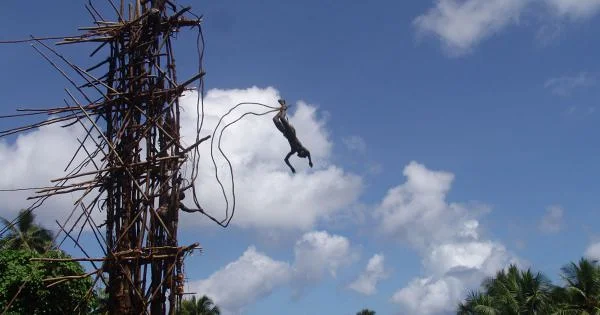
The Legend of Pentecost
We’re all familiar with bungee jumping as we know it today, but did you know that certain tribes in Vanuatu were practicing it long before it was "reinvented," and under much different conditions!

"On the island of Pentecost in Vanuatu, the story goes that a long time ago, a husband was chasing his wife after a domestic dispute. Not knowing how to escape him, she climbed to the very top of a banyan tree and jumped into the void... In desperation, the husband threw himself after her, not realizing that she had taken the precaution of tying vines around her ankles before jumping. She survived, but he did not."
Since that day, men have practiced what they call the "Naghol jump" (land diving) to prove to women that they wouldn't be fooled again and to reaffirm their virility.
Over time, the Naghol has become a mandatory ritual marking the passage into adulthood for young boys and a rise in status for men. It is also a sacrificial ceremony offered to the earth to ensure a good yam harvest.
So, what exactly is the "Naghol"?
It all starts with the construction of a wooden tower, usually between 20 and 30 meters high. Women are not allowed to participate in the construction, and access to it is strictly forbidden to them. The tower features several platforms from which the young men jump, starting from the lowest and working their way to the highest.
The men who have the honor of jumping must select and cut the vines that will serve as their bungee cords themselves. A well-cut vine is one that won't snap during the jump (it might seem obvious, but there are regular accidents where poorly chosen vines break), and, very importantly, it must be long enough so that the jumper's shoulders just graze the earth at the base of the tower.
While it has become increasingly touristy today, this ceremony really left an impression on me. The men and women wear traditional attire made of coconut leaves. They sing to accompany the jumpers. I also remember the gravity of the moment; after each jump, the crowd holds its breath until the jumper stands back up.







Enfin ils sont sensés avoir grandit dans cet environnement et utiliser la nature et notamment les lianes pour d'autres choses et notamment dans la construction donc avoir une bonne connaissance des lianes etc...
Ceci dit c'est vrai qu'il y a régulièrement des accidents notamment parce que les jeunes ne vivent plus forcément dans les tribus (et vont à la ville) et donc connaissent moins la nature, et aussi parce que comme c'est devenu une attraction touristique ils font parfois la cérémonie sans que ce soit la saison (consistance différente de la nature qui peut être entre autres plus sèche et donc plus cassante).