
Hello everyone.
A far cry from my usual travels and past contributions, today I’d like to talk to you about a destination that won’t require a time zone change or a mountain of passport paperwork, as it’s located just a few hours from Paris. I’m talking about the city of Bourges, in the Cher department.

I headed there with a fellow student for some job interviews, but I ended up extending my stay by two days just for the pleasure of exploring the city.
Understanding the history of Bourges
The city's Gallic origins
Formerly the capital of the Berry region before it was split in two (the Indre with Châteauroux and the Cher with Bourges), Bourges leveraged its close ties to the French royal court to beautify itself and become a major hub, particularly from the mid-14th to the mid-15th century.
Originally, the city was the capital of a Gallic tribe: the Bituriges. The city’s name is inherited from this tribe. Pottery from that era was discovered during various core samples taken throughout the city during major urban development projects.
The Roman presence
When Bourges was conquered by Caesar, it underwent major changes, becoming adorned with amphitheaters, thermal baths, aqueducts, and a Gallo-Roman wall that would serve as the foundation for many later structures. On that note, I was lucky enough to get a private tour of the ruins of a Roman fountain located in the basement of the General Council building, which was built on the site of the former ducal palace. Unfortunately, this visit was a stroke of luck and isn't open to the general public.
Bourges in the Middle Ages
Later evangelized by Saint Ursin, who campaigned throughout Gaul, the city eventually became the seat of an archbishopric. It was conquered by Charles Martel in 731 and later reconquered by Pepin the Short, who integrated it into the royal domain.
But it was in the 14th century that the city truly reached its peak, thanks in large part to the Dukes of Berry. The construction of the current cathedral dominated the city and cemented its power.
Visiting Bourges: The must-sees
Saint-Etienne Cathedral

A great way to start your discovery of Bourges and its history is to head to the small, free museum located in the tourist office right next to Saint-Etienne Cathedral. Through the history of the city's construction, you'll see all the centuries of civilization that unfolded before Bourges became the city you see today.
Of course, don't miss Saint-Etienne Cathedral itself. Well-maintained and visible from much of the city, this masterpiece of Gothic architecture is a UNESCO World Heritage site. The exterior, surrounded by the archbishop's garden, is imposing, especially the grand façade with its sculpted portals. You can enter for free, and I highly recommend it, as the ribbed vaults, original stained glass, and organ are truly majestic.
The Jacques-Coeur Palace

The other architectural masterpiece of Bourges is undoubtedly the Jacques-Coeur Palace. In the 15th century, an illustrious local figure, Jacques Coeur, built an absolutely stunning palace that can be visited today. It’s a private mansion, but Jacques Coeur’s wealth was such that, before it led to his downfall due to jealousy, he was able to build an architectural marvel described as one of the "most beautiful and sumptuous civil buildings of the Gothic era," now listed as a historical monument.
The façade work is superb and foreshadows the rise of the Renaissance palaces that would soon spread throughout the center of France and across the entire kingdom. It is still called a "palace" because, during the 19th century, it housed the courts and the court of appeals, effectively serving as the "courthouse."
Strolling through the old center of Bourges
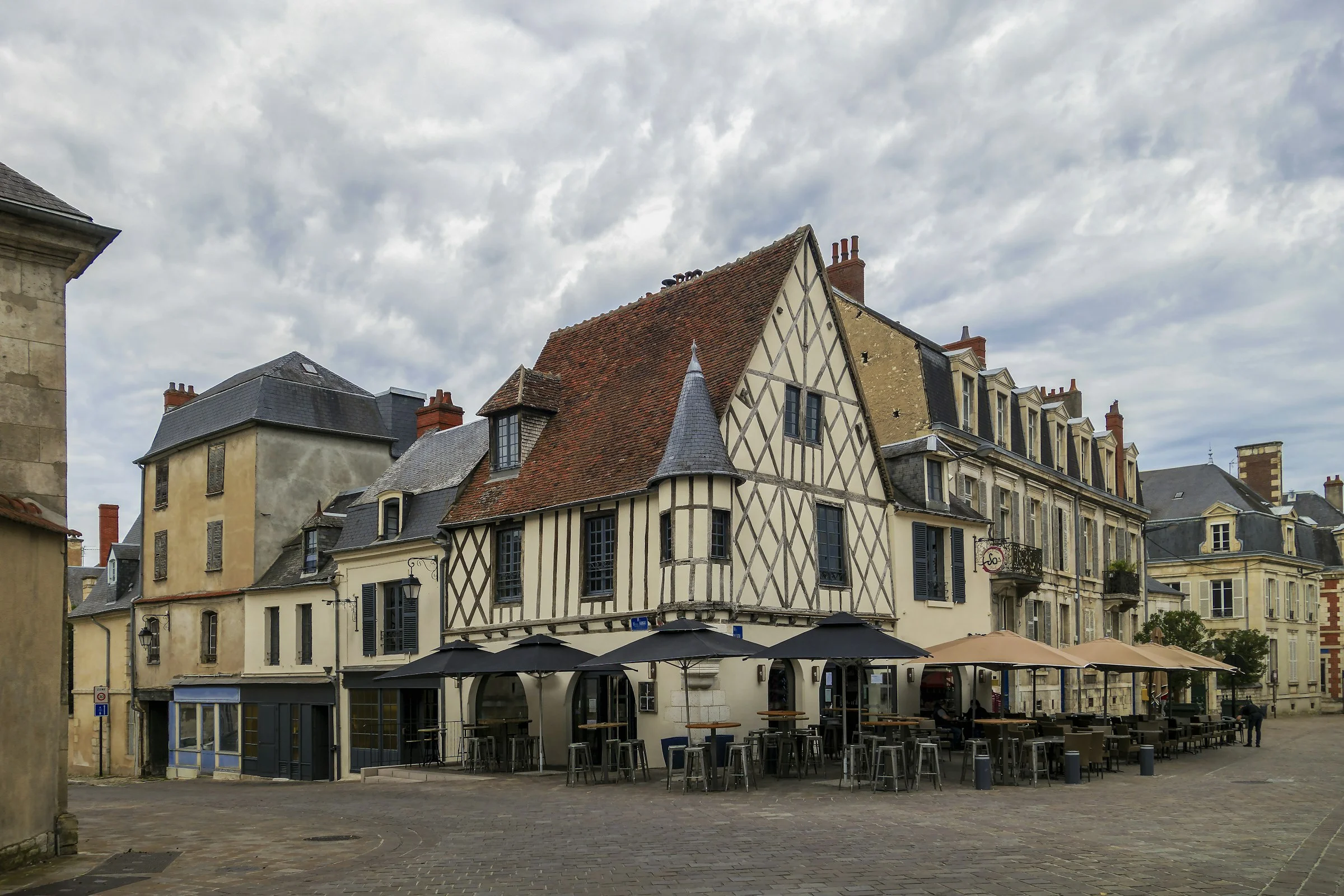
As you wander through the streets of the city center, you’ll quickly notice the timber-framed house façades. There are still quite a few of them, and they give Bourges a very special character.
To wrap up your history and culture tour, take a look at the Museum of the Best Craftsmen of France (Musée des Meilleurs Ouvriers de France), located on the cathedral square right next to a park, in the former archbishop's palace.
Where to eat
As for the rest, I looked for local specialties to try, and aside from the Forestine (which is actually a candy), I didn't find much. That said, some restaurants are definitely worth a try. Here are two spots I was recommended, which I tested and now recommend to you.
Restaurant Louis XI
A nice little restaurant that doesn't look like much from the outside. If it hadn't been highly recommended to me, I might have walked right past it. The menu is fairly simple, with meats, burgers, homemade fries, charcuterie boards, local wine, and so on. The prices are reasonable, the staff is welcoming, and I had a great meal.
11 rue porte jaune
La Suite
More upscale and pricier, I wanted to treat myself to this restaurant for my last day. It’s ideal if you’re a couple, but be sure to book in advance, as I’m not sure you could get a table otherwise. The dishes are more refined and the portions are smaller, but the quality and presentation are top-notch. It’s definitely a fine-dining experience.
50 rue Boubonnoux
Le Printemps de Bourges: The event of the year
Finally, you can’t leave Bourges without mentioning the famous "Printemps de Bourges" festival, which takes place in April. The whole city usually gets involved in these shows and concerts, which are renowned across Europe. On the program: dozens of shows featuring hundreds of artists, both up-and-coming and well-established, over the course of a week.
So, as you can see: I went for a simple day of interviews and ended up staying for 3 days in Bourges. That says it all! And that was even with it snowing; I imagine that under a beautiful sun, I could have stayed for a few more days...
See you soon, kisses to all.
Comments (0)
No comments yet. Be the first!