
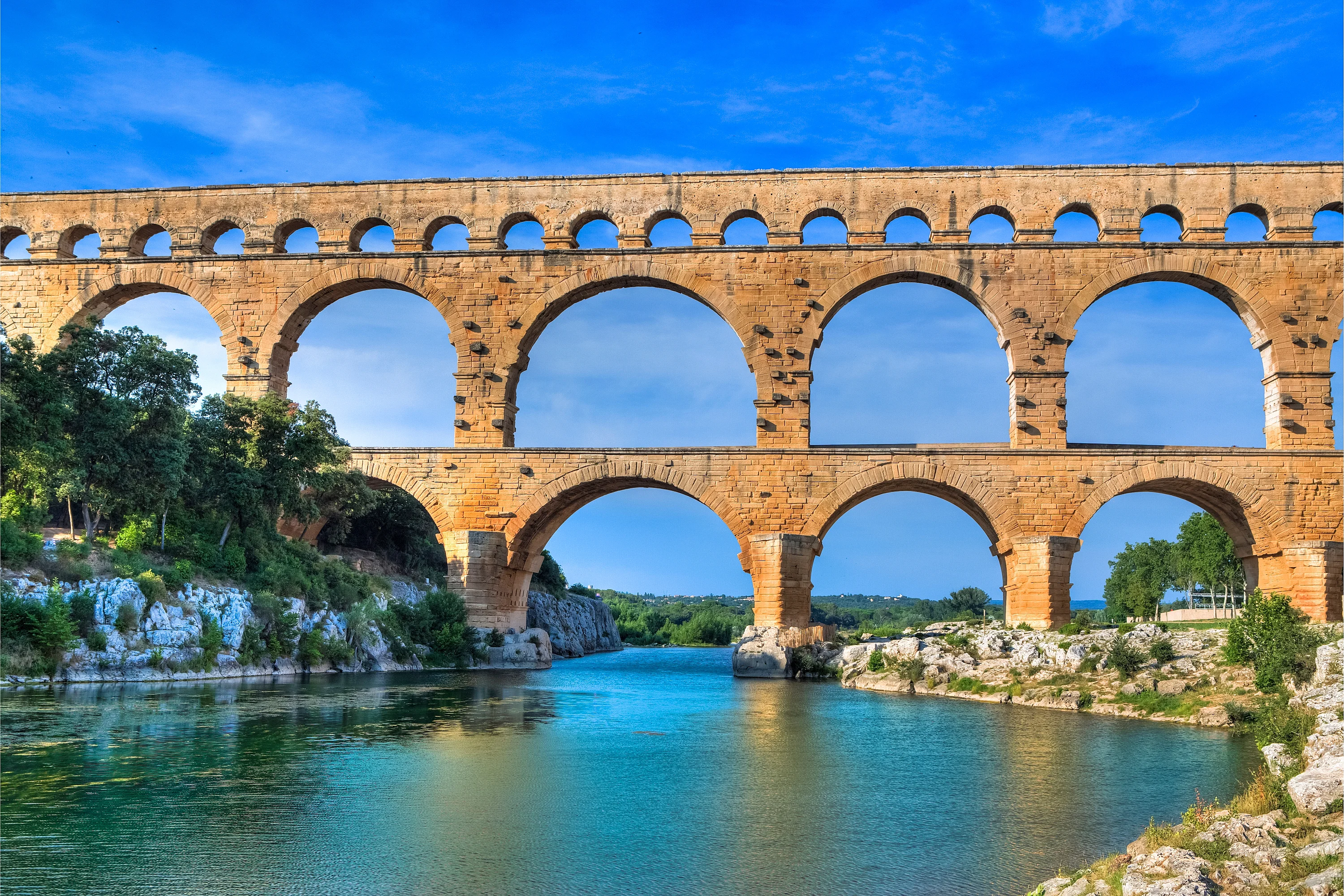
It was 2:30 PM, it was 97°F, and my six-year-old nephew sat down on the ground in the middle of a Roman site and calmly announced that he was done walking. Forever. Anywhere. His mom tried negotiating, I tried pistachio gelato, and we eventually headed back, defeated, with half our itinerary scrapped.
That day, I learned something that ten years of living in Nice should have taught me sooner: in the South during the summer, the question isn't what to do, but when to do it. That same Roman site at 9:00 AM is a wonder. At 2:30 PM, it’s a punishment.
I’m not from the Gard, I’ll say that right now: I’m from Nice, with family in Liguria. But a Mediterranean summer? That, I know by heart. And the Gard has enough to keep you busy for a week without ever getting bored.
Here are five activities I recommend, and most importantly, the time you should do them. But before we get to the activities, let’s talk about something nobody tells you: how the department is organized, and why that changes everything.
Gard with the family: what you need to know before you book
Where exactly is the Gard located?
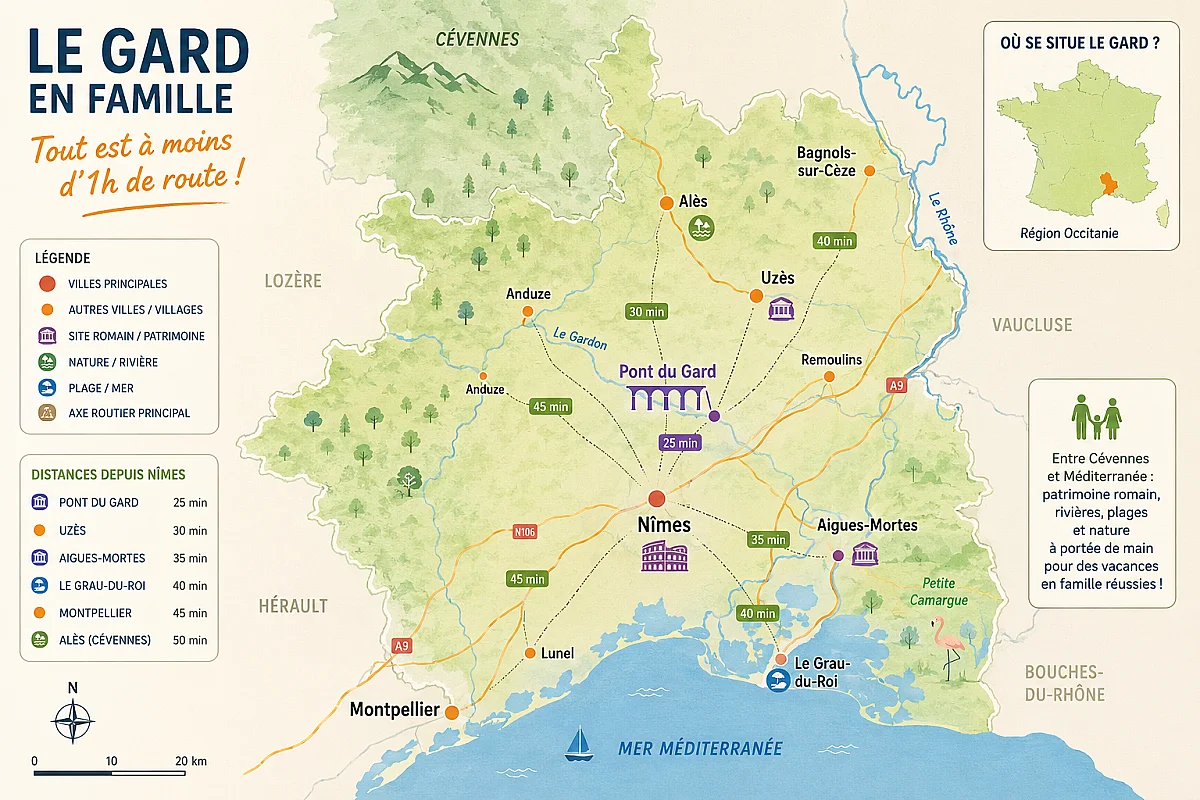 Map of the Gard
The Gard is a department in Occitanie, tucked between Provence to the east and Languedoc to the west. Its prefecture is Nîmes. The Rhône river borders it on one side, the Cévennes mountains close it off to the northwest, and it stretches all the way down to the Mediterranean via the Petite Camargue.
The main takeaway can be summed up in one sentence: everything is within a thirty-mile radius. Nîmes, the Pont du Gard, Uzès, Aigues-Mortes, the beaches, the garrigue. No drive takes longer than forty-five minutes if you're well-situated. That’s a rarity, and it’s precisely what makes this such a convenient destination for families.
Why take a vacation there with kids?
For a reason I read on a fellow blogger's site that sums it all up perfectly: here, you find Roman ruins on every street corner, but without the crowds of Rome.
In practical terms, the Gard combines four things that kids almost never find all in one place:
- Spectacular Roman ruins that you can grasp at a glance, not just foundations that require a vivid imagination.
- A swimmable river, the Gardon, featuring pebble beaches and canoeing
- The sea is just thirty minutes away, offering wild beaches rather than just rows of paid lounge chairs.
- Free admission: visitors under 18 get into the Pont du Gard discovery areas for free, and access to the site itself is completely open.
Where to stay in the Gard?
This is the real trade-off of your trip, and it’s more nuanced than it seems. There are four main options:
Staying in Nîmes. Convenient for city life, but you’ll be forty minutes from the sea and likely without a pool, in a white stone city that traps heat all day long. With kids in July, that’s a risky bet.
Heading up into the Cévennes. Cooler and stunning, but you’re cutting yourself off from the coast and the beach. That’s a whole different kind of trip.
Setting up on the coast. Le Grau-du-Roi, La Grande-Motte: the beach is right there, but in the summer, the area is packed and prices skyrocket.
Aiming for the Nîmes-Montpellier corridor. This is the compromise I recommend. You’re at the center of gravity for the whole region: the city on one side, the sea on the other, and the Pont du Gard just forty minutes away. Our choice: this 4-star campsite near Nîmes (Les Amandiers). To be more precise, it’s located in Gallargues-le-Montueux, halfway between Nîmes and Montpellier, twenty-five minutes from the arena, half an hour from the sea, and twenty-five minutes from Aigues-Mortes, with a pool area and kids' club on-site.
That last point isn't just brochure fluff. In a couple of minutes, you'll see why having a pool where you're staying in the Gard during the summer is a key piece of the puzzle, not just a nice-to-have.
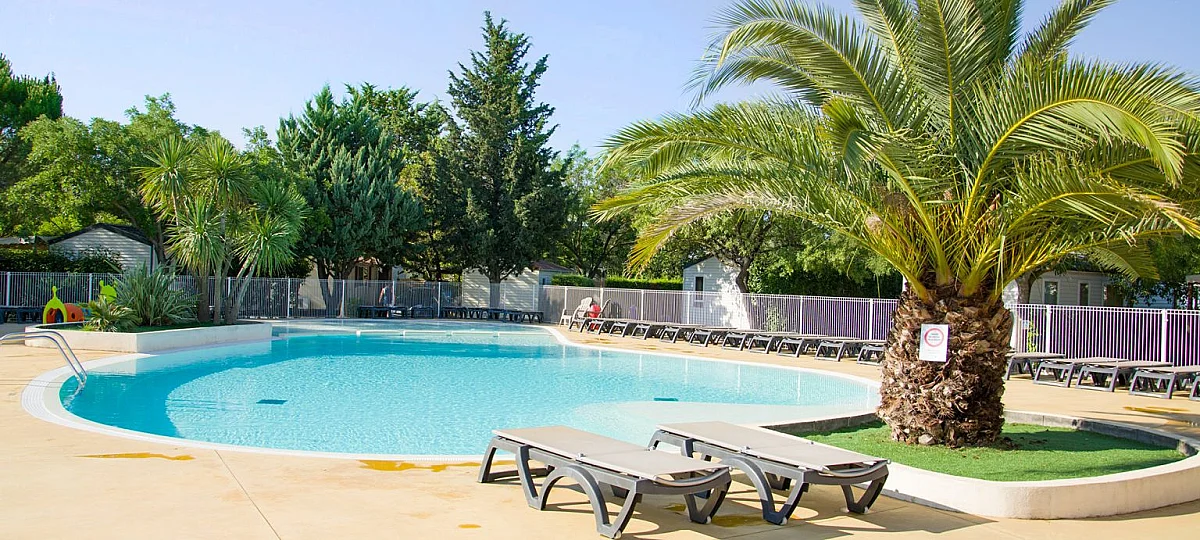 Our campsite pool
When to go?
If you have the flexibility, go for June or September. The temperatures are manageable, the crowds thin out, and prices are a bit friendlier. September even has an edge over June: the sea has soaked up all the summer heat.
If you don't have a choice because of school schedules, you'll be looking at July or August. And let's be real: summer averages often climb above 86°F, and spikes of 97°F or 99°F aren't exactly rare. But that’s no reason to cancel your plans. It’s just a reason to structure your days a little differently, which is exactly what this article is all about.
When is the best time to book?
Two types of bookings to keep in mind.
Accommodation: During French school holidays, families travel en masse, sites get packed, and prices climb significantly. For a trip to the Gard in July or August, booking as early as winter or early spring is the smart move. The longer you wait, the fewer options you’ll have for your dates, and it’s those exact dates that make the biggest difference in price.
Good to know
For the Pont du Gard, be sure to buy your tickets online. The ticket office closes thirty minutes before the cultural areas, and guided tours that head up to the top level have limited capacity. In high season, they sell out fast.
How to get to the Gard?
By train: The TGV gets you from Paris to Nîmes in 2h50. It’s the easiest way to travel, and the station is right in the city center.
By car: The A9 motorway runs right through the department. For the Pont du Gard, take exit 23 at Remoulins and follow signs for Uzès.
By plane: Nîmes and Montpellier airports both serve the area, though Montpellier has a much wider range of flight connections.
How to get around?
I usually travel without a car, as much out of principle as for comfort, and I even wrote an entire article on visiting Marseille without a vehicle. So, I might as well be honest: in the Gard with kids, a car is pretty much essential. The sites are scattered throughout the scrubland, and trying to hit five spots in a week without a vehicle is basically a contact sport.
That said, there are three real alternatives:
- The liO shuttle connects the Nîmes train station to the Pont du Gard roundabout. Tickets are available online, at the station, or on board.
- The Beaucaire-Uzès greenway, 32 km of fully secured bike paths, passes right by the Pont du Gard. It’s the longest one in the department.
- Nîmes is completely walkable. The Arena, Maison Carrée, museums, and the Jardins de la Fontaine are all within a stone's throw of each other.
1. The Nîmes Arena and the Museum of Romanity, but get there before 11 a.m.
Why arenas work so well with kids
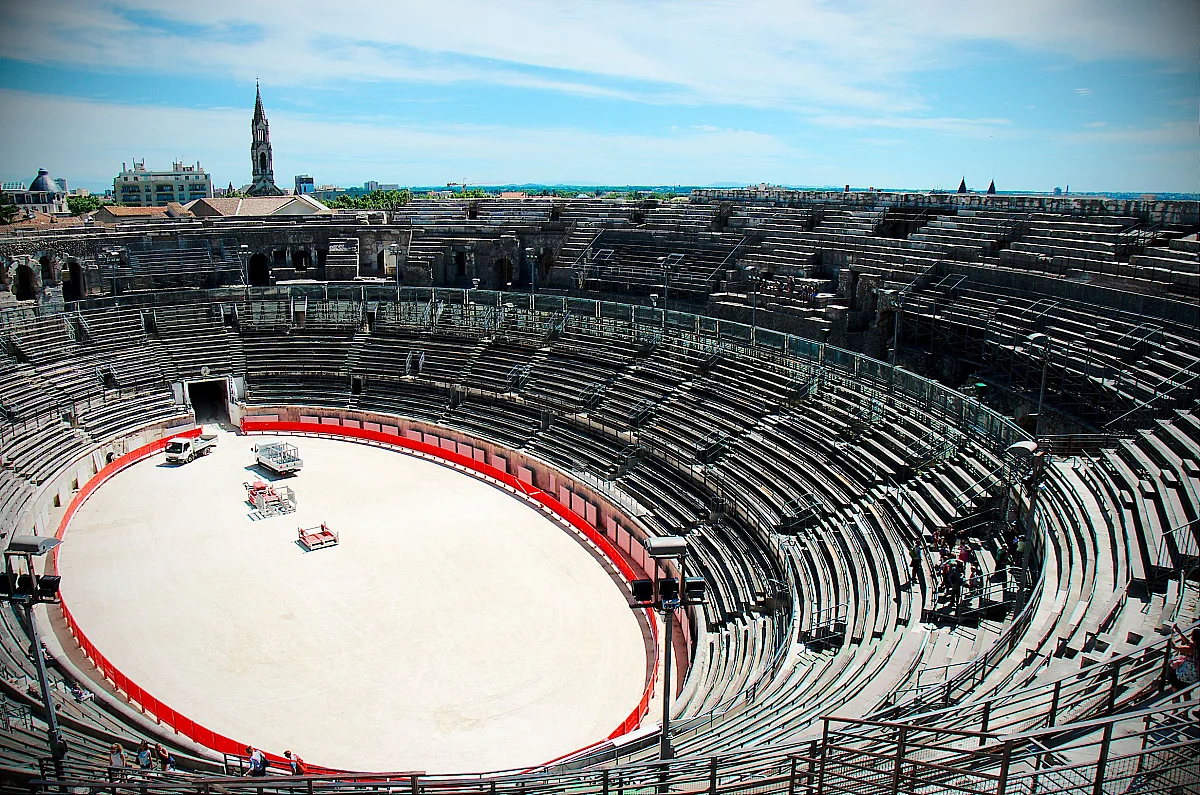 Inside the Nîmes Arena (© photo by Nicolas Buffler)
The Nîmes Arena is the best-preserved Roman amphitheater in the world. Built around the same time as the Colosseum in Rome, it once held 23,000 spectators and is still used today for concerts and ferias. A free audio guide is available in ten languages, which is super handy if you're traveling with international cousins.
For kids, the impact is visceral: you walk in, look up, and suddenly you understand exactly what a Roman city was like. No textbook can do that.
The museum that saves your late morning
Right across the way, the Musée de la Romanité is a genuine hidden gem. It’s earned the Môm'Art Trophy, a label that recognizes cultural spots truly designed with families in mind, and it really shows. Interactive stations let kids handle coin replicas, touch ancient fabrics, and play with models. There are games where they can cook like a Roman or dress up like one, plus a scavenger hunt available in several languages.
And then there’s the deciding factor when it’s 35°C outside: it’s air-conditioned. The rooftop terrace is free to visit and offers a stunning bird's-eye view of the arena.
How to spend your morning
So, should you choose the arena or the museum if you only have time for one? Both, but in that order. Hit the arena right at opening, while the stone is still cool and before the tour buses arrive. Then, head to the museum once the sun starts beating down. You'll be back at the campsite by 2:00 PM.
Distance from the campsite: about 25 km, roughly 25 minutes via the A9.
Pro tip: The city's discovery pass covers the arena, Maison Carrée, Tour Magne, and the museum. It pays for itself after just two sites.
Parking: The Halles parking garage is the easiest spot to leave your car and see everything on foot.
Heads up
Nîmes is a city of white stone located forty minutes from the sea, but without a cooling breeze to save it. In the summer, it’s an oven. It’s a destination for the morning, not the entire day. Don’t try to stick it out until 5 p.m., you’ll pay the price.
2. The Pont du Gard: the version nobody tells you about
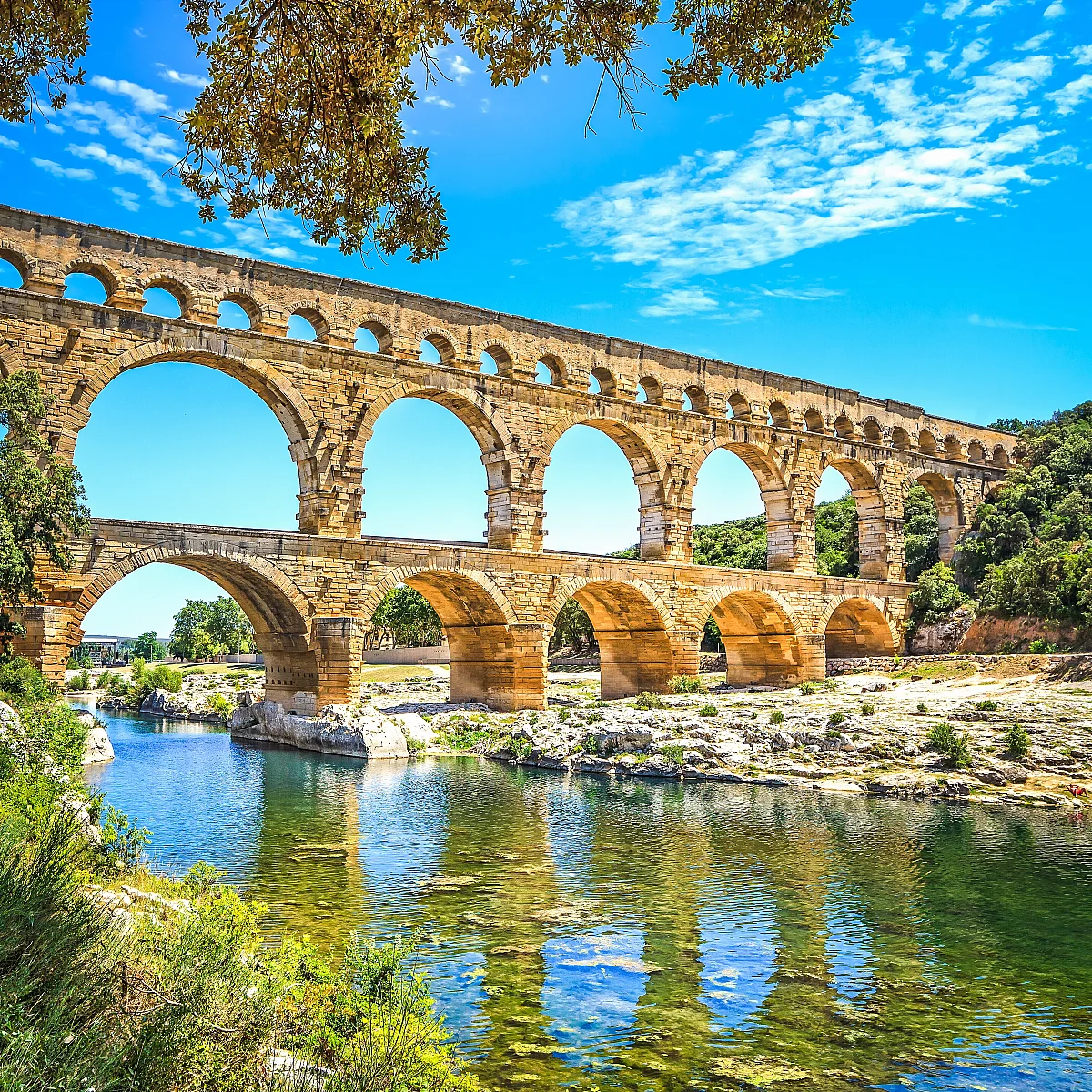 Pont du Gard
Everyone will tell you that the Pont du Gard is a 48-meter-tall Roman aqueduct, a UNESCO World Heritage site, and an absolute must-see. They’re right. The first time you stand before it, you understand why it draws over a million visitors a year. What people don't tell you nearly as often, however, is what follows.
What it really costs
First point of confusion, and it’s a big one: access to the site is free. It’s completely open to pedestrians and cyclists. The only thing you pay for is parking, which is 9 € per car, per day, regardless of how many passengers you have or how long you stay. As for the discovery areas (the 2,500 m² museum, cinema, and exhibits), it’s 8 € per adult, and free for anyone under 18 visiting with their family.
Do the math for a family of four with two kids: 9 € for parking, plus 16 € for the museum, coming out to 25 € for the entire day. It’s a far cry from what most guidebooks would have you believe.
The Espace Ludo, the family draw
Reserved for 5-12 year olds, this is the place you'll have to drag your kids away from. They can assemble a Roman mosaic, run a Gallo-Roman market stall, and learn how water was tamed over fifty kilometers with just a 25-centimeter drop per kilometer. Technical prowess becomes a game here.
The trick that changes everything: come in the evening
This is the advice I give to all my friends heading down this way. In the summer, the site stays open until midnight. Plus, a sound and light show is projected onto the arches at 10:30 PM for about twenty minutes.
In practical terms: instead of arriving at 2 PM in a packed parking lot in 97°F heat, you arrive in the late afternoon when things cool down. You can go for a swim, have a picnic on the riverbanks, it's allowed, and wrap up your evening facing a two-thousand-year-old aqueduct lit up against the night sky. Your parking ticket is valid for the whole day, so it won't cost you a penny extra.
No child ever forgets the Pont du Gard illuminated at 10:30 PM. Plenty of people forget the Pont du Gard at 2:00 PM, somewhere between two sips of lukewarm water.
Safety, and this info is missing everywhere
Heads up
Swimming at the Gardon river beaches is not lifeguarded. By municipal decree, you swim at your own risk. Jumping from the bridge and rocks is strictly prohibited, as is swimming directly under the monument. The rock is polished smooth by floods and is incredibly slippery, so water shoes are a must for the kids, and for you, too.
Distance from the campsite: about 45 km, 40 to 45 minutes.
3. A family-friendly canoe trip down the Gardon River
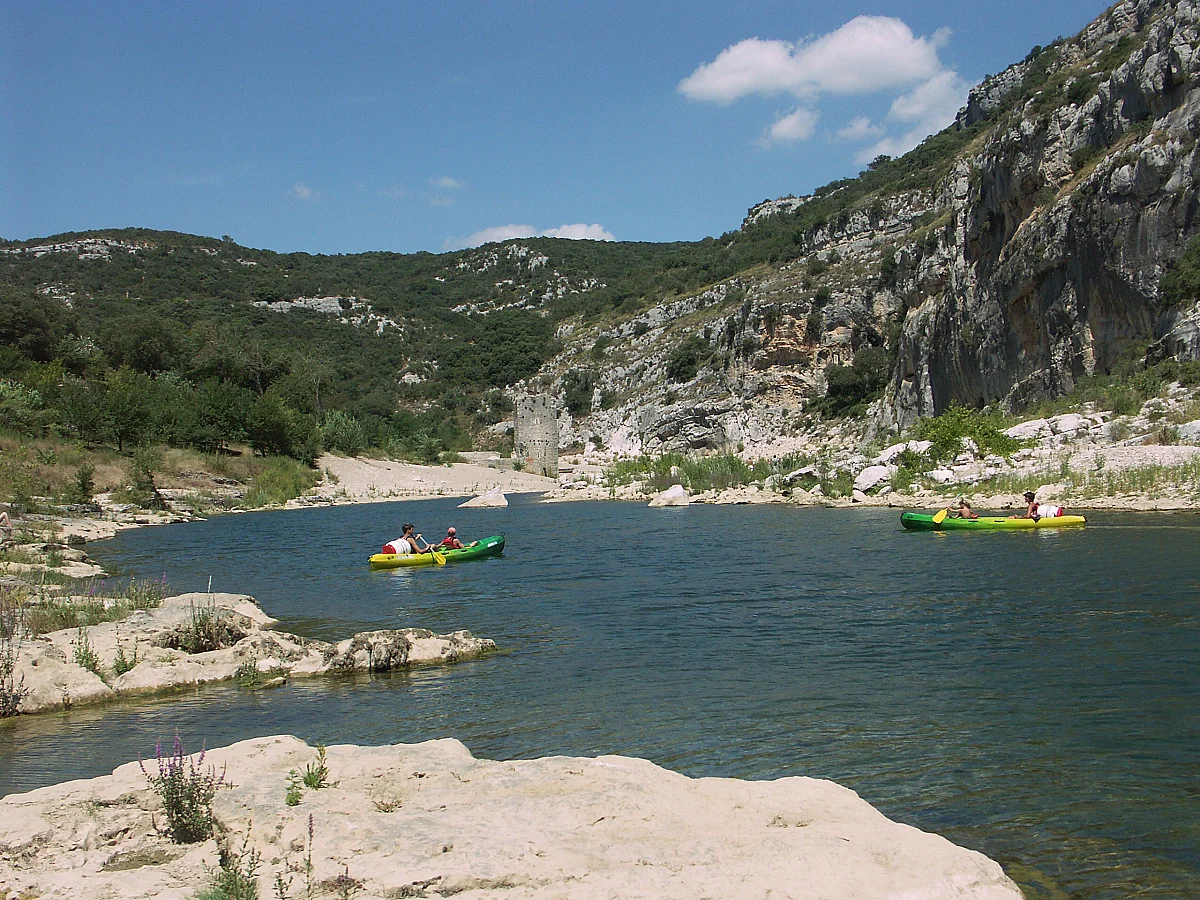 Canoeing on the Gardon from Collias (© photo by Mboesch)
Why this is my favorite activity on the list
For one simple reason: it’s the only place where the water is the activity. You don’t just endure the heat; you’re right in it.
Seeing the Pont du Gard from the water, looking up, offers a completely different perspective on the monument than viewing it from the overlook with four hundred people around you. It’s the same principle as everywhere else in the Mediterranean: the landscape changes entirely depending on where you’re standing.
Format and ages
The family-friendly routes start in Collias and take you right under the arches of the Pont du Gard. Expect to spend 2 to 3 hours on the water, including breaks, or about a half-day total once you factor in the shuttle and gear prep. It’s suitable for kids ages 6-7 and up, provided they know how to swim.
There are several rental companies operating in the Collias area: Kayak Vert, Canoë Collias, Cap Canoë, and Canoë le Tourbillon.
That said, let’s be honest about what really interests the kids: it’s not the Roman engineering. It’s spotting the biggest rock, jumping out of the canoe, and splashing their parents. You might as well accept it now, the day will go much smoother that way.
Pro Tip
Book a morning slot. By the afternoon, the Gardon is packed, and the sun reflecting off the water can be pretty intense for the little ones.
The cycling alternative, if canoeing isn't your thing
The 32 km greenway between Beaucaire and Uzès passes right by the Pont du Gard. Local rental shops offer electric mountain bikes with 20-inch wheels, suitable for kids as young as 6-8, as well as child seats and trailers for the little ones. Arriving at the Pont du Gard by bike, watching it grow larger on the horizon, is well worth skipping the parking lot.
4. The Seaquarium in Le Grau-du-Roi, for when the skies turn gray
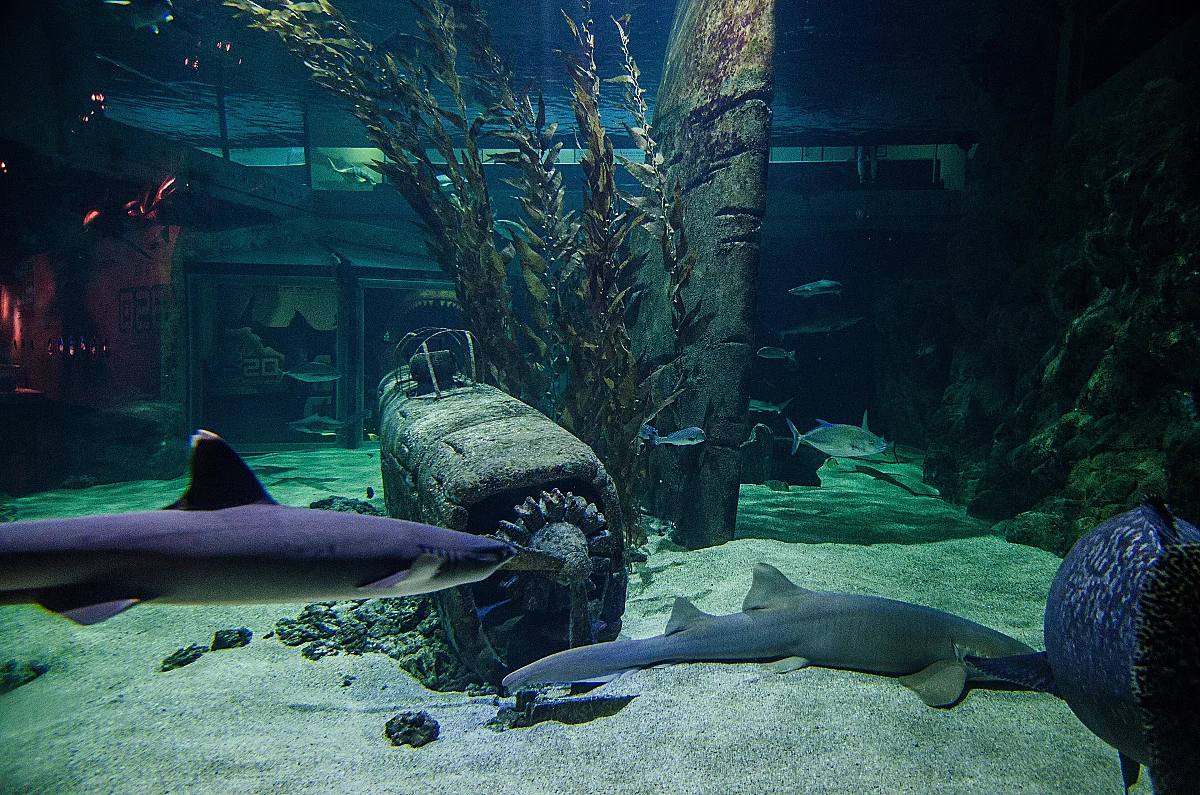 Shark tank at the Seaquarium in Le Grau-du-Roi
Not a must-see, but...
I'll be blunt: this isn't the most beautiful activity in the Gard. It is, however, the best card to play on a day with heavy mistral winds, rain, or a truly brutal heatwave.
What to see there
The Seaquarium is home to over 200 species of fish, a colony of seals, sea lions, and most impressively, more than 25 species of sharks that you can view from a tunnel with glass on both sides. It’s guaranteed to leave an eight-year-old wide-eyed. In total, there are nearly 1,800 animals to see, with an experience focused heavily on education and a touch pool that kids absolutely love.
The deciding factor is logistics
The aquarium is just a few meters from the beach. You can easily spend the morning at the aquarium and the afternoon at the beach without ever having to get back in the car. Nearby, there’s also Espiguette Beach: miles of wild sand and dunes, worlds away from those beaches packed with paid lounge chairs. It’s definitely the one I’d choose.
Distance from the campsite: about 30 to 35 km, 35 minutes.
Heads up
The Seaquarium is the go-to backup plan for every family in the area on rainy days. If it’s overcast in August, it’s packed by 11 a.m. Get there at opening time or skip it altogether.
5. Aigues-Mortes and the Petite Camargue, at the end of the day
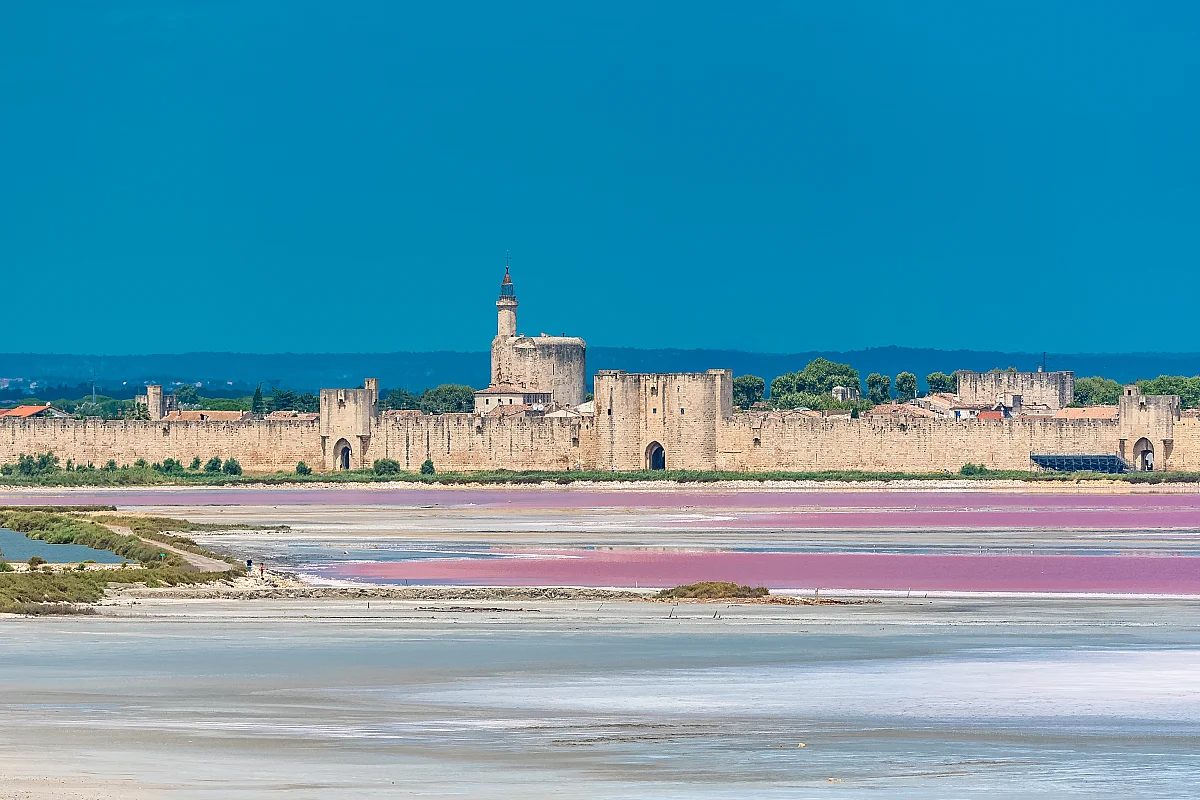 Aigues-Mortes, its ramparts and salt marshes
The spot
A fully fortified medieval city set right in the middle of the salt marshes. You can walk along the ramparts, explore the Tour de Constance, and soak up the lively, shaded atmosphere of the Place Saint-Louis. A small tourist train tours the salt pans in 1h30, including a stop to climb the "camelles", those massive salt mounds that turn pink at sunset, often with a bonus sighting of pink flamingos.
Timing is everything, and that’s where it all comes down to
Aigues-Mortes inside the city walls at 3 p.m. in August is pure torture. White stone everywhere, zero shade, and wall-to-wall crowds. The same town at 6:30 p.m. is unrecognizable: the light turns golden, the ramparts shift to an ochre hue, the terraces on the Place Saint-Louis fill up with families, and you can enjoy dinner outside in a completely different atmosphere.
It’s exactly what I noticed in Vernazza, in the Cinque Terre, when I visited off-season: same village, different time, opposite experience. It’s a universal rule across the Mediterranean.
The highlight that leaves a lasting impression on kids
Add the manades to your list: you'll get up close with Camargue bulls and horses, accompanied by a gardian, either in the morning or the evening. It’s the kind of experience they’ll still be talking about once school starts back up.
Distance from the campsite: about 25 km, or 25 minutes. It’s the closest spot to your home base, making it the perfect candidate for an evening outing that doesn't require much planning, ideal for when everyone is feeling refreshed.
Pro tip
Park a bit further out and head in on foot through one of the gates in the ramparts. Walking through a 13th-century wall really sets the mood. Parking in an intra-muros lot? Not so much.
My real advice: it’s about the pace, not the checklist
A solid one-day itinerary
If you only take one thing away from this article, it shouldn't be any of the five activities. It should be this:
- Before 11 a.m.: heritage, cities, and stone. Nîmes, the arena, the museums. The stone is still cool and the parking lots are empty
- 1 PM to 5 PM: water. Pool, river, sea. This isn't a suggestion, it's a rule. No visit survives this time slot in July and August.
- After 6 PM: the villages, the ramparts, the terraces, the light and sound show. It’s the best time of the day, and hardly anyone takes advantage of it.
Why the campground pool is no mere gimmick
This is precisely where a campsite with a real water park stops being just a marketing pitch and becomes the centerpiece of your vacation. At Les Amandiers, the pool and kids' club are exactly what make this pace sustainable: the kids burn off energy during the hottest hours while the parents recharge in the shade, and by 6 p.m., everyone is ready to tackle the ramparts of Aigues-Mortes.
A family trip to the Gard is all about five great experiences, timed just right, with plenty of water in the mix. Have a great trip, and don't forget your water shoes.



Comments (1)