
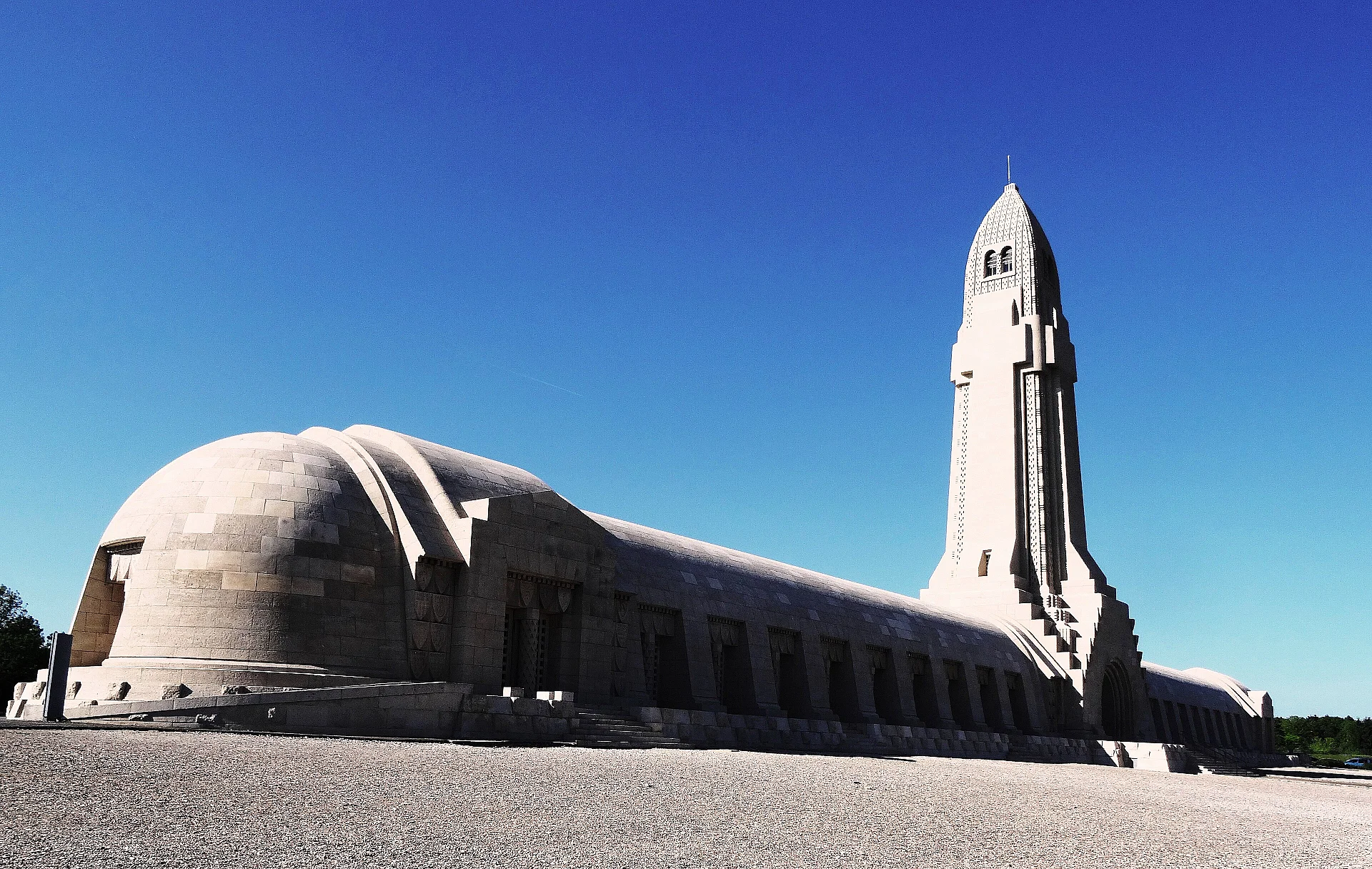
The cloister where 130,000 unknown soldiers of Verdun rest
A long building of light-colored stone, shaped like a sword planted in the ground, stretches out in front of rows of white crosses. Behind its walls, the cloister of the Douaumont Ossuary preserves the remains of 130,000 unknown soldiers, both French and German, who fell during the Battle of Verdun.
In front of the monument lies the Nécropole nationale de Douaumont (Douaumont National Cemetery), where more than 16,000 identified French soldiers are buried.
Why visit the ossuary
The monument grew out of a religious initiative championed by Mgr Ginisty, the Bishop of Verdun. The cornerstone was laid on August 20, 1920, by Marshal Pétain, honorary president of the Ossuary Committee. The building was inaugurated on August 7, 1932, by the President of the Republic.
The site also served as the backdrop for a historic political gesture: the handshake between François Mitterrand and Helmut Kohl on September 22, 1984, which became one of the enduring symbols of Franco-German reconciliation.
The cloister and its 22 alcoves
Measuring 137 meters long, the cloister forms the central core of the building. Visitors walk through it, flanked on either side by 22 alcoves, each representing one of the 46 combat sectors of the Battle of Verdun. Every alcove houses a tomb.
Outside, behind the rear of the alcoves, glass windows reveal the bones of the unknown soldiers, directly visible from the ground.
The tower, Lantern of the Dead
Donated by Americans, the tower was one of the first sections built, along with the chapel. Standing 46 meters tall, it is nicknamed the Lanterne des morts (Lantern of the Dead). Visitors climb a staircase to reach a small museum and, at the very top, a panoramic view over the former battlefield.
Friendly tip: the final entry to climb the tower generally stops one hour before the monument closes, and the site closes entirely for about a month every January for annual maintenance. It is best to check seasonal hours before planning your visit.
Opening hours
April to June and September: Monday through Friday from 9:00 AM to 6:00 PM, Saturdays, Sundays, and holidays from 10:00 AM to 6:00 PM.
July and August: daily until 6:30 PM.
October: Monday through Friday from 9:00 AM to 5:30 PM, weekends from 10:00 AM to 5:30 PM.
November to March: reduced hours with a lunch break.
Annual closure in January.
Closed on December 24 and 25.
How long for this activity
Allow 1.5 to 2 hours to walk through the cloister, view the alcoves, and climb to the top of the tower.

The Douaumont Ossuary is one of the must-see spots in the region. The visit is interesting and quite impressive. I would not necessarily recommend it for very young children, as the visible bones can be a bit surprising. A place for reflection.