
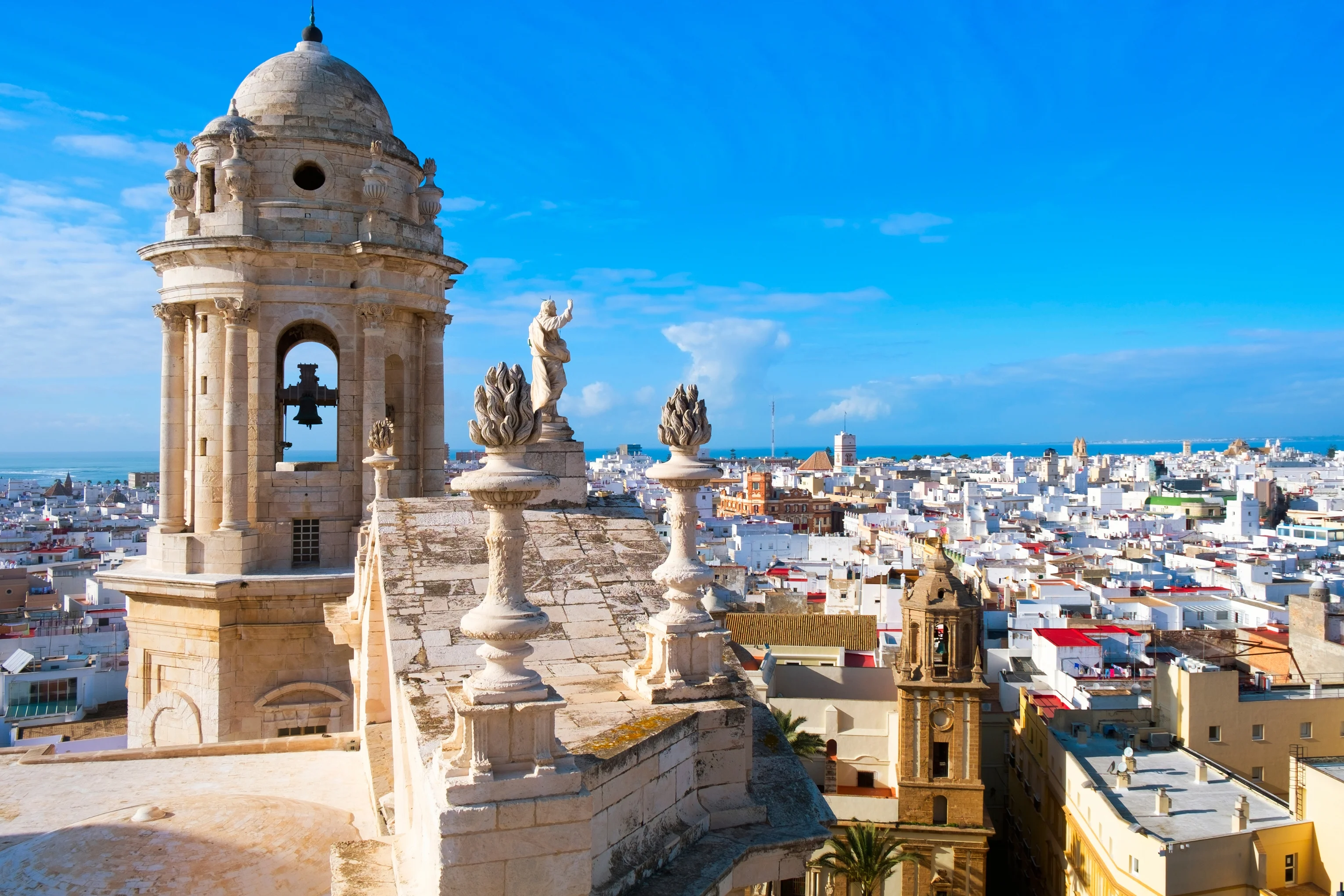
Cadiz, Three Thousand Years Facing the Atlantic
The Phoenicians founded it in 1100 BCE. Three millennia later, the golden dome of its cathedral still glimmers above the waves. This peninsula, hooked to Andalusia by a narrow strip of land, holds the title of the oldest continuously inhabited city in Western Europe. Locals call it the Tacita de Plata, or the little silver cup, and the nickname fits: bright, compact, and bathed in ocean light. You will not find grand Seville-style monuments here, but rather a salty atmosphere and narrow lanes where you can eat the finest fried fish on the continent.
A City for Travelers Seeking Andalusia Without the Crowds
Cadiz caters to visitors looking to escape mass tourism without sacrificing historic depth. You can walk across the city in a single day, but it rewards a two or three-night stay that lets you settle into its rhythm. Urban beachgoers will find fine sand and clear water here, minus the congestion of the Costa del Sol. The local seafood-driven food scene will delight anyone who takes eating seriously.
That said, travelers hunting for blockbuster sights or a high-octane nightlife scene might come away wanting more. The city moves at a relaxed pace, and evenings usually involve sitting at an outdoor terrace with a glass of fino sherry and a few tapas. Plan for the wind as well, since the exposed peninsula layout guarantees frequent gusts, even in the middle of summer.
An Easy Budget for Andalusia
Cadiz remains notably more affordable than Seville or Granada. Expect to pay $79 to $135* a night for a solid hotel in the historic center, and $17 to $29* for a generous meal at a traditional fried fish joint known as a freiduría. Admission to the cathedral costs $14*, and entry to the Torre Tavira is $9*.
The Ancient Core: From El Pópulo to the Cathedral
The Barrio del Pópulo stands as the oldest neighborhood in Europe's oldest city. You enter through three medieval arches: the Arco de la Rosa, the Arco de los Blancos, and the Arco del Pópulo, all survivors of the old fortified city walls. Those narrow alleys open onto tiny squares where laundry still hangs out to dry from upper-story windows.
The Roman theater, unearthed in 1980 beneath neighborhood residences, once seated 10,000 spectators and ranks as the second-largest in Spain. An interpretation center lets you peer directly at ongoing archaeological digs through large glass windows. A few hundred meters away, the cathedral asserts its baroque and neoclassical silhouette. Construction dragged on for 116 years, from 1722 to 1838, resulting in a mashup of styles dictated by the succession of architects.
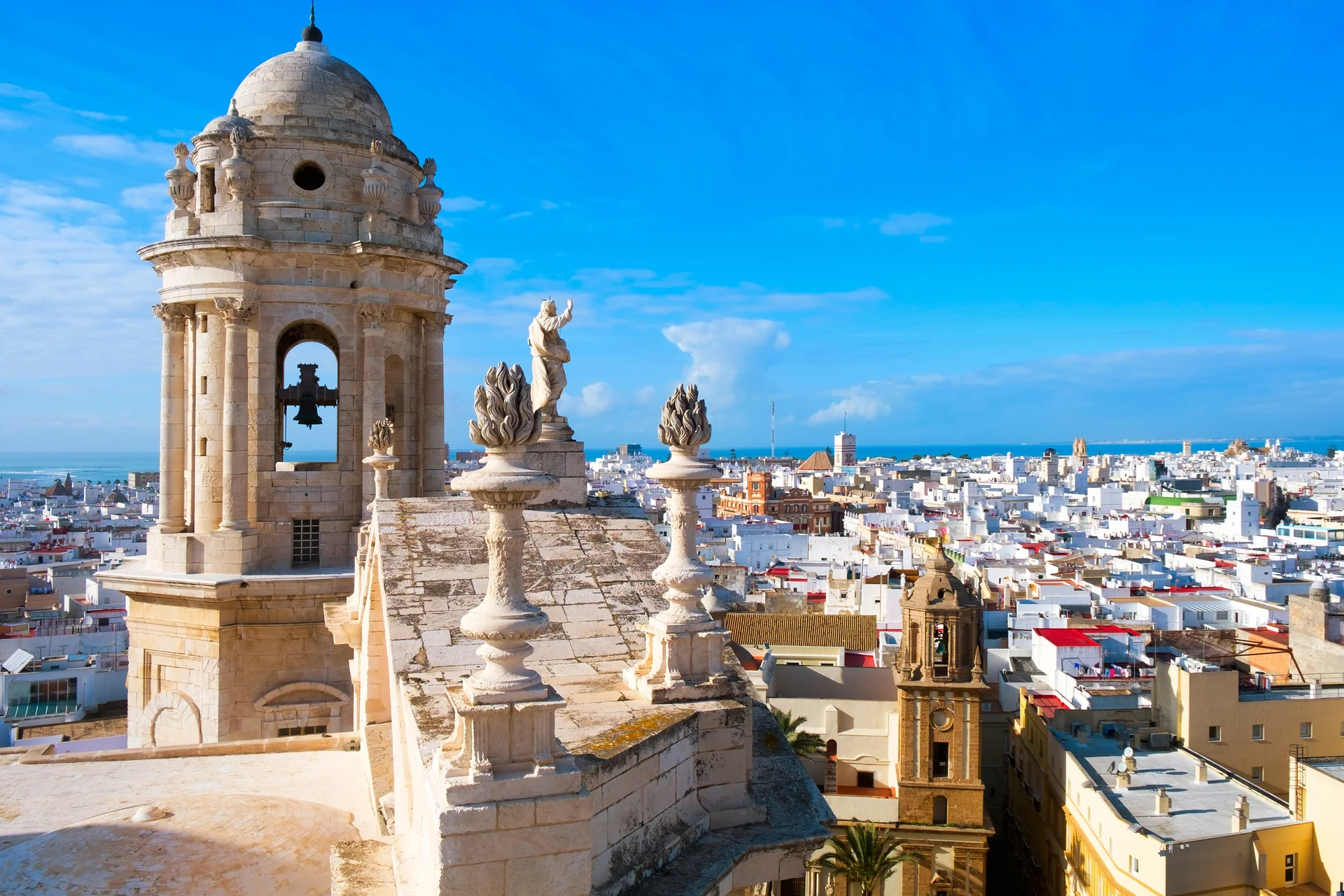
Friendly tip: Climb to the top of the Torre del Poniente, one of the cathedral bell towers. The 170 spiral steps deliver a 360-degree view across the white rooftops and the ocean, leaving the golden dome shining right beneath your feet.
The Torre Tavira and the Watchtowers
Back in the 18th century, local merchants needed to track the arrival of their ships laden with riches from the Americas, so they built 129 watchtowers across the city. Standing 45 meters high, the Torre Tavira served as the port's official lookout tower. Today, it houses a camera obscura that projects real-time images of the city onto a concave white screen.
The effect is mesmerizing as you watch pedestrians cross public squares completely unaware they are being watched. The guided tour takes about fifteen minutes and delivers a genuinely unique experience. The rooftop panorama alone makes the ticket worth it, particularly in the late afternoon when the low sun casts a golden glow over the facades.
La Caleta and the Coastal Fortresses
The Playa de la Caleta is the historic center's only beach, wedged snugly between two castles. Actress Halle Berry famously emerged from its waters in the James Bond film Die Another Day. The sand is fine, the water is transparent, and the setting is striking with the former La Palma spa building resting right on the sand like a Moorish pastry.
The star-shaped Castillo de Santa Catalina dates back to the 17th century, offering free admission and sweeping ocean views. On the opposite side of the bay, the Castillo de San Sebastián sits on a small island connected to the mainland by a long stone causeway. The walk out there, battered by wind and waves, remains a memorable highlight of any trip.
La Viña, the Neighborhood of the Gaditans
The Barrio de la Viña is the working-class heart of the city where locals actually dine out. The streets of San Félix and La Palma line up tapas bars where fried fish arrives piping hot wrapped in brown paper. This neighborhood is the birthplace of the Cadiz Carnival every February, featuring satirical singing groups known as chirigotas poking fun at politicians.
The nearby Parque Genovés provides an unexpected green escape. This 19th-century botanical garden features centuries-old ficus trees, sculpted cypress trees, and an artificial waterfall set amid faux-rock grottos. Benches facing the ocean encourage long stretches of reading or a quiet afternoon nap.
Where to Eat and Drink in Cadiz?
Pescaíto frito amounts to a local religion here. Pieces of fresh fish are simply dusted in flour and fried in olive oil, including options like chocos (cuttlefish), acedías (small sole), boquerones (anchovies), and puntillitas (baby squid). This apparent simplicity masks techniques handed down across generations, where success depends entirely on fish freshness, oil temperature, and the right flour grade.
The Bodeguita El Adobo on Calle Rosario is the go-to spot for purists, featuring no printed menu, just a chalkboard that changes based on the daily catch. Their morena en adobo (marinated moray eel) has achieved legendary status. Another institution is Los 12 Hijos de Juan, an unpretentious kiosk where locals queue up for paper cones overflowing with crispy fried seafood. The Freiduría Las Flores on the square of the same name leans a bit more tourist-heavy, but remains a reliable option.
Friendly tip: Do not leave without trying the tortillitas de camarones, which are ultra-thin, crispy fritters loaded with tiny shrimp. You will find the best ones at the bar inside the restaurant El Faro, costing a fraction of what you would pay in the formal dining room.
Where to Stay in Cadiz and Around?
The historic center holds the vast majority of accommodations and makes the most practical base. You can reach everything on foot and soak up the lively evening atmosphere in the plazas. The working-class La Viña neighborhood delivers an immersive local experience just steps from the sand.
The Parador de Cádiz is a modern, sea-facing hotel boasting a swimming pool that appears to drop off directly into the ocean. The Hotel Argantonio occupies an 18th-century mansion, offering character-filled rooms at reasonable rates. For tighter budgets, apartment rentals near Playa de la Victoria let you combine beach time with easy access to downtown.
How to Get to and Around Cadiz?
The train from Seville takes about 1 hour and 40 minutes and costs between $17 and $45* depending on the departure time. About a dozen daily runs service the Cadiz station, positioned a five-minute walk from the historic core. From Jerez, the ride takes 35 minutes. The Jerez Airport, located 40 kilometers away, handles budget flights from various European hubs.
From abroad, the easiest route involves flying into Seville or Jerez. Driving from Seville takes about 1 hour and 15 minutes via the highway. Parking in the city center is complicated and unnecessary since the peninsula is entirely walkable. Leave your vehicle in an outer perimeter parking lot if you arrive with a car.
When to Go?
The oceanic climate keeps temperatures mild year-round, with summers that feel far less stifling than the inland parts of Andalusia. Spring and autumn provide the most comfortable conditions for exploring on foot. The Carnaval in late February or early March turns the streets into a massive open-air party for eleven days, guaranteeing high energy alongside steep lodging rates and a strict requirement to book months ahead.

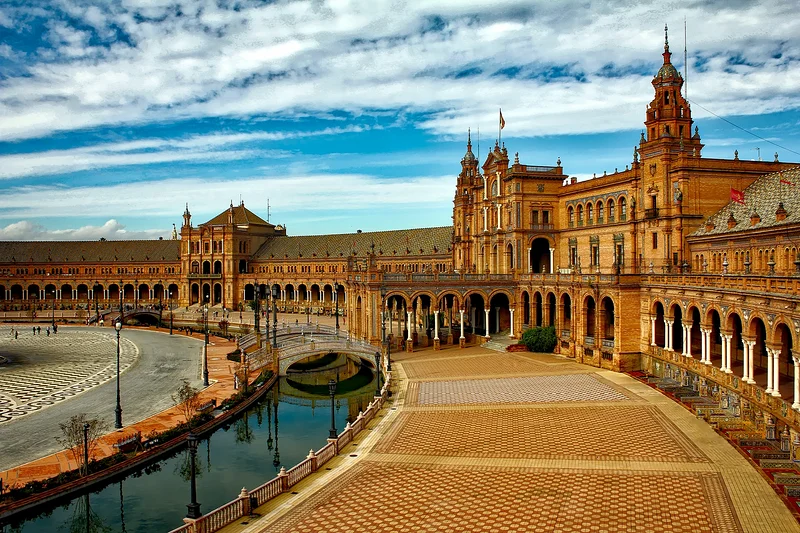
Cadiz is not easy to get a handle on, but this port city is definitely worth exploring for its old town.
For me, it was love at first sight. You feel so far away from everything on this peninsula, right at the foot of the massive cathedral.
Special shout-out to the towers that overlook the city. From their summits, the view of the city and its beaches is stunning.
The best part is that you can explore the old district on foot, just letting yourself be carried along by the sea breeze.