Visiting Chugoku
Chugoku is the western end of Japan's main island, between Kyoto and Kyushu. On the Inland Sea side, the shinkansen line links Hiroshima, the sacred island of Miyajima, Onomichi and Okayama. On the Sea of Japan side, the San'in holds on to a more rural Japan: original castles, ancient shrines, sand dunes.
Most travellers only make a return trip to Hiroshima from Kyoto. You'll gain a lot by staying: the region's finest moments come early in the morning or in the evening, once the tour groups have left.
You'll love it if
- You've already seen Tokyo and Kyoto and want a quieter Japan
- History, shrines and the islands of the Inland Sea appeal to you
- You enjoy cycling and trains
Look elsewhere if
- You only have one week for the whole of Japan
- You want a big city and nightlife
- You're counting on public transport for the whole of the San'in
The must-sees
-
1 The Shimanami Kaido by bike 70 kilometres
From Onomichi to Imabari, on the island of Shikoku, a cycle route crosses six islands by way of seven suspension bridges high above the Inland Sea. You rent a bike at an official station and drop it off at any other; e-bikes are available too. Allow one or two days, with a night on an island along the way.
-
2 The Bikan quarter, in Kurashiki Canals
Old rice warehouses with black and white walls line a canal where small boats glide past. Here you'll find the Ohara Museum, opened in 1930, Japan's first museum of Western art: El Greco, Monet, Gauguin. Come early in the morning or at nightfall, when the quarter lights up and the coaches have gone.
-
3 The Kintai Bridge, in Iwakuni 1673
Five wooden arches span the Nishiki River, fitted together without a single nail, over nearly two hundred metres. The bridge dates from 1673 and has been rebuilt identically. You cross it on foot for a few hundred yen, then ride the ropeway up to the castle. An easy stop between Hiroshima and Hagi.
-
4 The Tottori sand dunes San'in
Sixteen kilometres of sand facing the Sea of Japan, with ridges rising to around fifty metres: the largest dunes in the country. Climb to the top of the big dune to see the sea on the other side. Right next door, the Sand Museum displays sand sculptures on a new theme every year.
-
5 The month of the gods in Izumo Autumn
According to tradition, the gods of all Japan gather at Izumo Taisha during the tenth lunar month, which falls in November or December depending on the year. Elsewhere it is called "the month without gods"; here, "the month when the gods are present". Ceremonies welcome them on Inasa beach. Check the year's dates on the shrine's website.
The classic mistake
Doing Hiroshima and Miyajima in a single day from Kyoto. You spend more than four hours on trains and reach Miyajima just as the island is at its busiest. Stay at least one night in the area, ideally on the island, to see it in the evening and at dawn.
Our itineraries in Chugoku
| Length | Itinerary | What you see |
|---|---|---|
| 3 days | Hiroshima › Miyajima | Memorial, sacred island |
| 5 days | Okayama › Kurashiki › Onomichi › Hiroshima › Miyajima | Gardens, canals, Inland Sea |
| 10 days | Okayama › Matsue › Izumo › Hagi › Iwakuni › Miyajima | The San'in and the south coast |
The shinkansen line forms the backbone of the region: you can stay in Hiroshima or Okayama and explore by train. The San'in takes more time, as trains there are slower and less frequent. To combine the two, go through Okayama and take the Yakumo train, then head back down towards Hagi and the south coast.
When to visit Chugoku
| Rating | Season | Weather | Crowds and prices |
|---|---|---|---|
| SpringMarch to May | Cherry blossom in late March, mild | High | |
| Rainy seasonJune and July | Rain, humid heat | Low | |
| Late summerAug. and Sept. | Very hot, typhoons | Medium | |
| AutumnOct. and Nov. | Maples, clear skies | Medium |
Our advice
Aim for late October or November: you'll get the red maples of Miyajima, often clear skies, and the typhoon season behind you. Avoid Golden Week in early May and mid-August: the Japanese travel en masse, and trains and hotels are fully booked.
Getting to Chugoku
-
By air to Osaka or Tokyo No direct flight
No direct flight links Europe or North America to Chugoku. You land in Osaka, the closest gateway, or in Tokyo, from where the onward journey is longer. Hiroshima airport only receives international flights from elsewhere in Asia.
-
By shinkansen from Osaka or Kyoto The fastest
From Shin-Osaka, the high-speed train reaches Okayama in three quarters of an hour and Hiroshima in a little under an hour and a half. From Tokyo, allow four hours.
-
By train to the San'in The north coast
From Okayama, the Yakumo train crosses the mountains to Matsue and Izumo in three hours. Tottori can also be reached from Osaka, on a line that is partly privately run.
Travellers from Europe, North America and many other countries enter Japan visa-free for up to 90 days; check the rules for your passport before you go. Since 1 July 2026, Japan's departure tax has been 3,000 yen, included in your plane ticket. If you plan to travel a lot, compare the Japan Rail Pass, more expensive since 1 October 2026, with JR West's regional passes.
Getting around Chugoku
The train is all you need on the south coast: shinkansen, local trains and the Miyajima ferry, which is covered by the JR passes. In Hiroshima, the tram links the station to the Peace Park for a flat fare. In the San'in, trains are rare: a car will save you a lot of time.
Good to know
Japan only accepts international driving permits issued under the 1949 Geneva Convention. Licences from a few countries, including France, Germany, Switzerland and Belgium, need an official Japanese translation instead, issued by the JAF. Check the rules for your licence before booking a hire car.
What to eat in Chugoku
- Hiroshima okonomiyaki: a pancake built up in layers of cabbage, noodles and pork, cooked in front of you on a hotplate. Eat it at the counter, with the little spatula.
- Hiroshima oysters: the bay produces more than half of Japan's oysters, grilled or breaded in winter. The harvest suffered badly in autumn 2025.
- Anago-meshi: rice topped with grilled conger eel, the speciality of Miyajimaguchi, sold as a bento since the early 20th century.
- Momiji manju: a small maple-leaf-shaped cake filled with red bean paste, born on Miyajima.
- Izumo soba: dark buckwheat noodles, served cold in stacked lacquered boxes.
- Matsuba crab: the snow crab of the San'in, in season from early November to March, in Tottori and Sakaiminato.
In Hiroshima, head up one of the buildings devoted entirely to okonomiyaki, with a counter on every floor. And if you pass through Saijo, taste the sake from its breweries clustered around the station.
Where to stay in Chugoku
| Area | What it's for | Good to know |
|---|---|---|
| Hiroshima | Memorial, castle, tram | The most practical base |
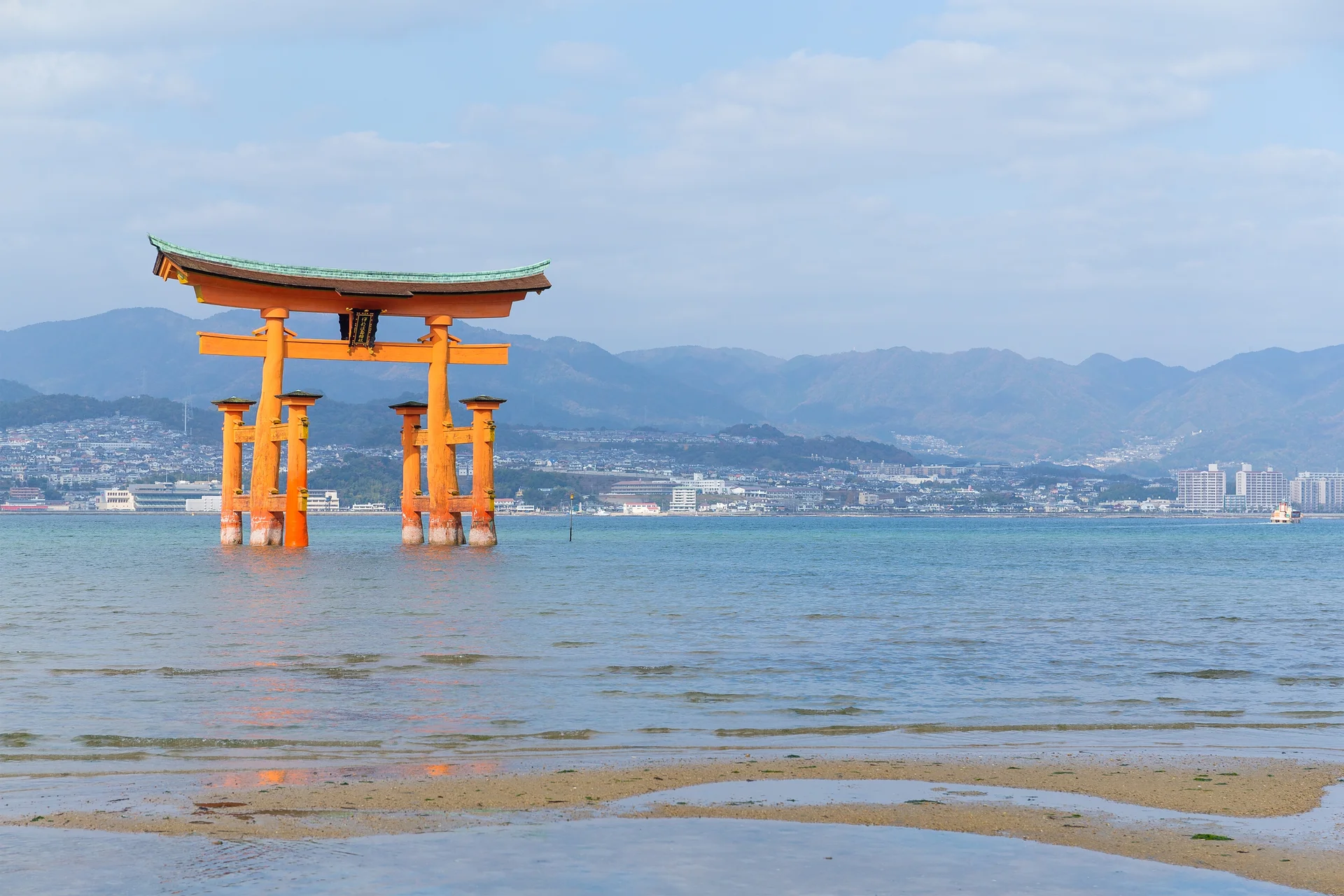
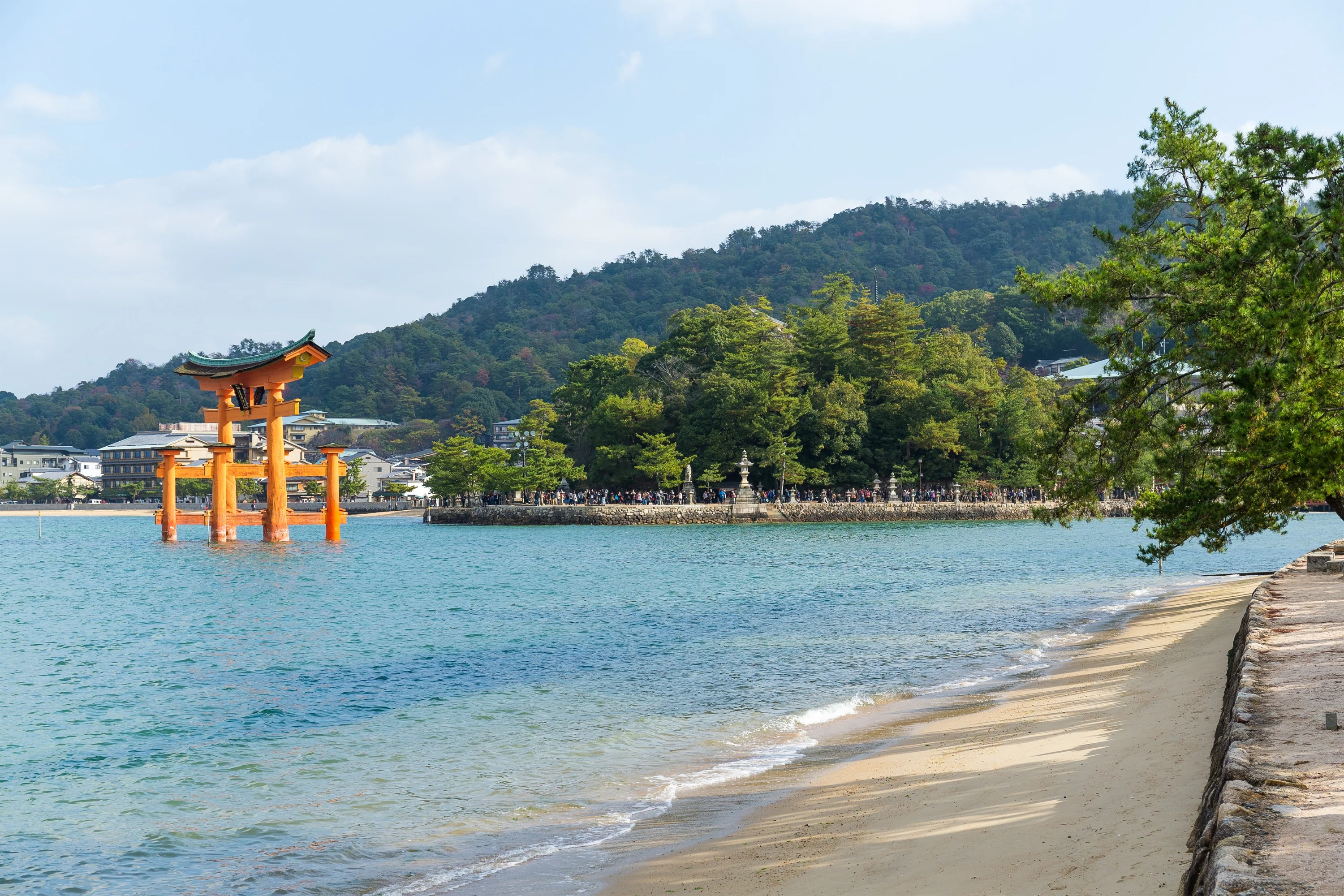
| Miyajima | The torii at dawn, Mount Misen | Quiet in the evening, expensive |
| Onomichi and the Inland Sea | Cycling, temples, islands | Small town, few large hotels |
| Okayama and Kurashiki | Gardens, canals, Ohara Museum | Good rail hub |
| San'in | Matsue, Izumo, Tottori dunes | Remote, infrequent trains |
| Yamaguchi | Hagi, Tsuwano, Kintai Bridge | Rural, a car helps |
How much does a trip in Chugoku cost?
| Trip | Length | Budget per person |
|---|---|---|
| Budget (hostels, local trains, okonomiyaki) | 7 days | 500 to 800 € |
| Comfort (business hotels, one night in a ryokan, regional pass) | 7 days | 1,000 to 1,600 € |
| Luxury (ryokan with dinner, car, fine dining) | 7 days | 2,200 to 3,500 € |
- Trains: a JR West regional pass, from 15,000 to 23,000 yen depending on the area, often works out cheaper than the national Japan Rail Pass if you stay in the west.
- Ryokan: a night with dinner and breakfast costs considerably more than a business hotel, but gives you the most memorable meal of the trip.
- Taxes: 100 yen to land on Miyajima, and 200 yen per person per night in accommodation in Hiroshima Prefecture priced above 6,000 yen.
- Admission: modest, from 200 yen for the Peace Museum to 2,000 yen for the Mount Misen ropeway return.
- Meals: an okonomiyaki or a bowl of soba fills you up for little; a kaiseki dinner quickly pushes the bill up.
Traditions and way of life in Chugoku
Hiroshima carries the memory of 6 August 1945. Every year on that day, a ceremony brings thousands of people together in the Peace Park, and a minute's silence is observed at 8:15, the time of the explosion. The Genbaku Dome, the ruin left standing, has been a UNESCO World Heritage Site since 1996, the same year as the Miyajima shrine.
Further north, the San'in keeps ancient traditions alive: Izumo Taisha, one of the oldest shrines in the country, and Matsue Castle, one of Japan's twelve original keeps.
Local etiquette
In the Peace Park, speak quietly and avoid laughing photos in front of the cenotaph. At shrines, purify your hands at the basin by the entrance, and don't feed the Miyajima deer: they eat maps and paper bags.