
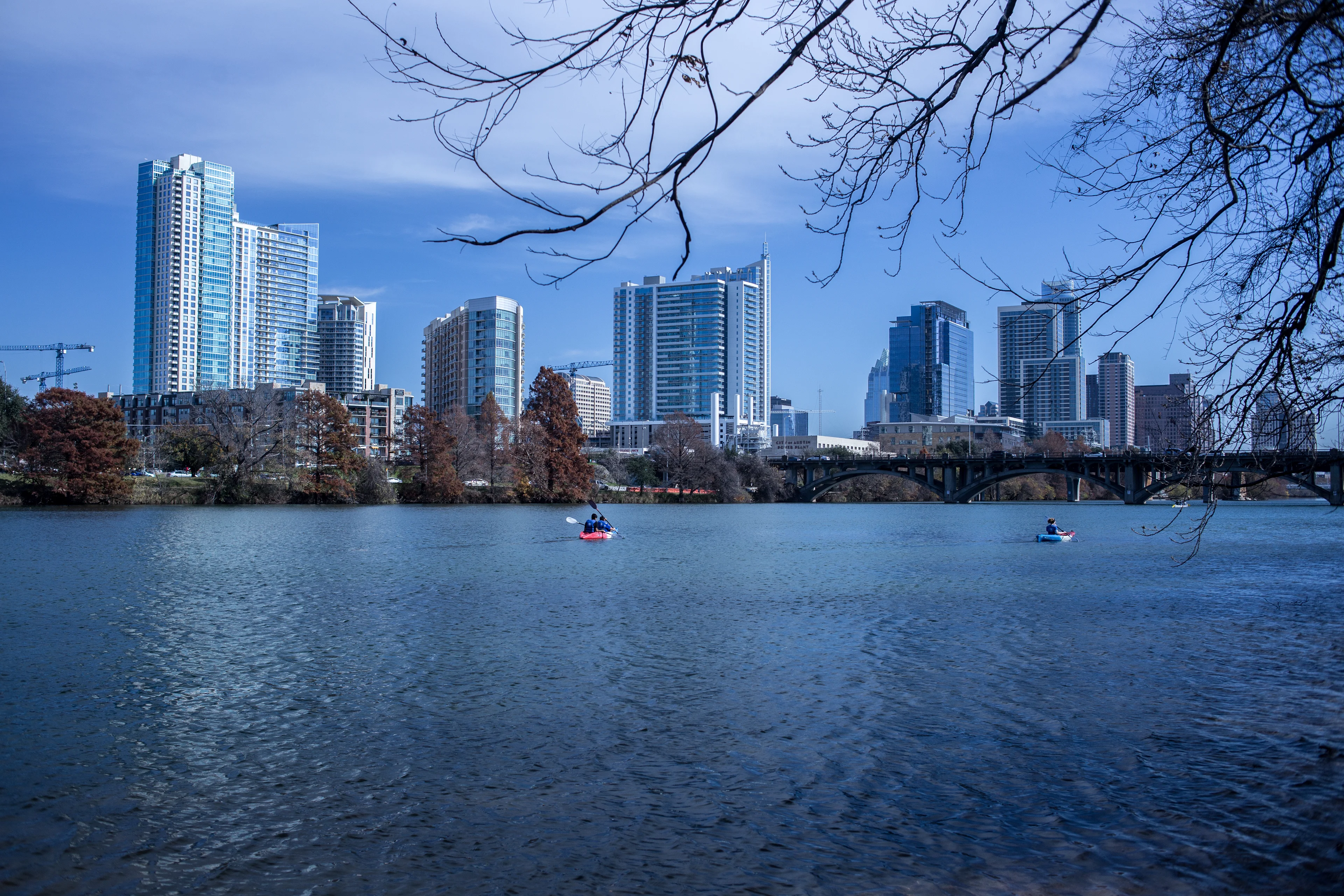
Where to stay in Austin: the 6 neighborhoods to know in 2026
Photo : Sebastien Poncelet
Austin sorts itself by the two banks of a river and by a calendar. North of Lady Bird Lake, downtown fits into forty-odd streets: the Texas Capitol, the clubs of Sixth Street, the music venues, and under one bridge the largest urban bat colony in North America. To the south, South Congress lines up thrift shops and taco trucks, and Zilker Park holds a spring-fed pool that stays between twenty and twenty-three degrees all year. East of the interstate, bars and kitchens have opened in former warehouses. And in the hills to the west, twenty minutes by car, you sleep with a view and a pool.
The neighborhood decides your evenings; the date decides the price, and by margins you rarely see elsewhere. SXSW in March, the two weekends of Austin City Limits in October, the United States Grand Prix at the end of the same month and every college football Saturday empty the city of its rooms. Outside those weeks, budget $62* at the bottom end, $136* for a three-star, $230* for a four-star, and more than $510* for the hill resorts. This guide covers six neighborhoods.
From the many night clubs on Sixth Street to the vintage shops in the SoCo shopping district, Austin is full of fun and vibrant people that personifies Austin's motto to "Keep Austin Weird".
Compare hotel prices in Austin
In a hurry? Find the best accommodation deals in 3 clicks.
Compare live deals from Booking, Expedia, Agoda and other partners.
At a glance: our picks by traveller type
Pick the profile that suits you to head straight to the recommended neighborhood.
The neighborhood map in Austin
Get your bearings on the neighborhoods and must-see sights before choosing where to drop your bags. Click a name to jump to its description.
Downtown, Sixth Street and the Capitol The Texas Capitol and its visitors center, the Governor's Mansion, the clubs of Sixth Street, the Moody Theater of Austin City Limits, the Paramount Theater, Esther's Follies, the Mexic-Arte Museum, the Stevie Ray Vaughan statue, the Congress Avenue bridge and its bats, the convention center, the central library, the Lady Bird Lake trails
for live music, for doing everything on foot, for a first visit
Forty streets are enough to understand the city. The Texas Capitol, built between 1882 and 1888, has a dome that stands four and a half metres higher than the one in Washington, and the tour is free. Six blocks down, Sixth Street closes to cars at weekends and lines up clubs with open doors, while the Moody Theater hosts the Austin City Limits taping sessions. And at the end of Congress Avenue, under the bridge, around a million and a half bats stream out at dusk from mid-March to November: it is free, it lasts twenty minutes, and the banks fill up an hour ahead.
We stayed at the Holiday Inn Town Lake, with an awesome view overlooking Lady Bird Lake.
Where to stay in this neighborhood
citizenM Austin Downtown Mid-range
The largest volume of reviews downtown, and a score that holds: 8.6 on close to two thousand reviews, with 9.4 for location, the best figure in the neighborhood. Very compact rooms, barely wider than the bed, but spotless, and a rooftop pool. You come here to be two blocks from Sixth Street and for the price, around $169*.
The Stephen F Austin Royal Sonesta Hotel Luxury
The historic address on Congress Avenue, facing the Capitol: 8.7 on close to three hundred reviews, with 9.5 for location and 9.1 for the staff. Wide rooms, a terrace over the street, breakfast served. One flaw the reviews repeat and you should know about: the wifi scores 6.9, the lowest figure in this guide.
Hotel Van Zandt Luxury
At the foot of Rainey Street, the strip of bars set in old wooden houses: 8.6 on six hundred and forty reviews, with 9.1 for cleanliness and the same for the staff. Rooftop pool, a music venue on the ground floor. The reviews flag two things, street noise and the price of parking: that is the cost of being here, around $230*.
Holiday Inn Austin - Town Lake Mid-range
This is the hotel our member mentions, and its score says why: 8.0 on close to a thousand reviews, with 8.6 for location and 8.7 for the staff. It sits on the lake shore, east of downtown, parking is free, which is rare here, and the upper rooms look onto the water. Around $169*.
Pros
- The venues, the bars and the Capitol within walking distance
- The bats and the lake trails at the end of the street
Cons
- Sixth Street is loud until two in the morning at weekends
- Hotel parking is charged separately, and it is expensive
South Congress, Zilker and Barton Springs The thrift shops and boutiques of South Congress Avenue, Zilker Park and its botanical garden, the spring-fed Barton Springs pool, the Umlauf sculpture garden and museum, the South Austin Museum of Popular Culture, the Zach Theatre, the Dougherty Arts Center, St. Edward's University, the taco trucks of South First
for swimming, for families, for second-hand shopping
Cross the bridge and the rhythm changes. South Congress Avenue runs straight uphill between the thrift shops, the record stores and the taco trucks, and it is the neighborhood locals point to when you ask them about the city's motto. To the west, Zilker Park takes up a bend in the river, with its botanical garden and above all Barton Springs, a large spring-fed pool that holds between twenty and twenty-three degrees in every season. This is where you sleep if the day matters as much as the evening.
Where to stay in this neighborhood
South Congress Hotel Luxury
Halfway up the avenue, so in the best spot in the neighborhood: 8.8 on a hundred and fifty-six reviews, and 9.7 for location, the highest score in this whole guide. Outdoor pool open year-round, three restaurants in the building, large rooms. The small volume of reviews needs saying, and so does the price: around $230*.
The Carpenter Hotel Mid-range
A former carpenters' union hall turned hotel, a kilometre from the park: 8.9 on close to five hundred reviews, with 9.3 for the staff and 9.3 for cleanliness. Courtyard with a pool, a cafe open to the street, plain rooms. It is the best value in the neighborhood and it books out early at weekends.
Pros
- The spring-fed pool and the big park ten minutes on foot
- The shops and the taco trucks along a single avenue
Cons
- Only two addresses, and both of them are expensive
- Downtown is walkable, but the way back at night is by car
East Austin, east of the interstate The bars and kitchens of East Sixth Street, the French Legation Museum, the George Washington Carver Museum, the Vortex theatre, the Off Center arts space, Huston-Tillotson University, Mabel Davis Park, the murals and studios in former warehouses
for the bars and the food, for a neighborhood on the move, for staying close to downtown
Interstate 35 cuts Austin in two, and it is on the far side that the city has changed fastest. East Sixth Street carries the club strip on for two kilometres, but in a lower key: terraces, neighborhood kitchens, bars in old garages, and murals on every corner. You also find two museums downtown does not have, the French Legation, the only embassy ever built in Texas, and the George Washington Carver museum, devoted to the city's Black history. Downtown is a quarter of an hour on foot from the bridge.
Where to stay in this neighborhood
East Austin Hotel Mid-range
On East Sixth, in the middle of the terraces: 8.1 on more than thirteen hundred reviews, the second volume in this guide, with 9.0 for location and 8.8 for the staff. Restaurant and bar on the ground floor, rooftop with a pool. The reviews say the same thing both ways: everything is downstairs, so everything can be heard a little.
ARRIVE Austin Luxury
Eight hundred metres further east, and the best score in the neighborhood: 8.9 on three hundred and fifty-seven reviews, with 9.4 for cleanliness and comfort and 8.9 for value, which is rare at this level. A low house around a courtyard, a cocktail bar, twenty-five rooms. Around $230*.
Pros
- The best terraces in the city, and downtown on foot
- Cheaper rooms than across the road, at the same distance
Cons
- Walking across the interstate is loud and unpleasant
- Few places open early in the morning on the residential streets
The university campus and Hyde Park The University of Texas and its tower, the Blanton Museum of Art, the Bob Bullock Texas State History Museum, the LBJ Presidential Library, the Harry Ransom Center, the Darrell K. Royal stadium of the Longhorns, the Bass Concert Hall, the Elisabet Ney Museum, the Hyde Park theatre, the Victorian wooden houses of Hyde Park
for the museums, for a Longhorns game, for paying less than downtown
North of the Capitol, the campus of the University of Texas forms a neighborhood in its own right, and that is where the museums are: the Blanton for painting, the Bob Bullock for the history of the state, the LBJ library for the archives of a presidency, the Harry Ransom Center for manuscripts. On autumn Saturdays, a hundred thousand people fill the Longhorns stadium and the city dresses in orange. Above it, Hyde Park is a neighborhood of wooden houses and cafes, quiet, twenty minutes by bus from downtown.
Where to stay in this neighborhood
Moxy Austin - University Mid-range
On the corner of the campus, and the best score in the neighborhood: 8.8 on close to five hundred reviews, with 9.3 for cleanliness and 9.2 for location as for the staff. Small, well-designed rooms, a bar that doubles as reception, an open rooftop. Budget $136*, and considerably more on a game Saturday.
AC Hotel by Marriott Austin-University Mid-range
Two streets away, on San Antonio Street: 8.2 on two hundred and thirteen reviews, with 8.9 for comfort, cleanliness and location. The rest of the table is lower and it needs saying: 7.7 for value and 7.0 for the wifi. This is the address for a quiet stay near the campus, not for falling in love.
Pros
- Four museums and a major concert hall in the same neighborhood
- Rates below downtown, two kilometres from the Capitol
Cons
- On a game Saturday the area is saturated and prices double
- Little going on in the evening outside term time
The Domain and the north The shopping and office district of The Domain, the Arboretum mall, North Cross Mall, the Norris conference centers, the Beverly S. Sheffield Northwest District Park, the Great Hills golf course, the Austin Art Space galleries
for a business trip, for a bigger room, for the shopping malls
Fifteen kilometres north of the Capitol, The Domain is a piece of city built all at once: pedestrian streets, brand-name stores, tech company offices, and new hotels that live off that custom. The area has nothing old about it and does not pretend otherwise; what it offers is space, free parking most of the time and bigger rooms than downtown for the same price. Downtown is half an hour by car, more at rush hour, and a commuter rail line runs down to the centre.
Where to stay in this neighborhood
Archer Hotel Austin Luxury
The best score in this guide: 9.3 on a hundred and ninety-one reviews, with 9.7 for comfort, location and wifi, and 9.6 for cleanliness. Rooftop pool, large rooms, service the reviews name person by person. The volume stays modest, and the area is not downtown: that is the price of those figures.
Aloft Austin at The Domain Mid-range
Right in the middle of the pedestrian streets: 8.5 on a hundred and eighty-two reviews, with 9.5 for location and 9.0 for comfort. Recent chain rooms, a pool, a bar open late. The wifi, at 8.0, is the low point of the table. Budget $136*.
Pros
- Wide rooms and parking, for the price of a small downtown room
- Restaurants and shops open late, on foot from the hotels
Cons
- Half an hour by car from downtown, double that at the end of the day
- No old quarter anywhere near: here, everything dates from the 2000s
The western hills, Lake Austin and Barton Creek The Mount Bonnell lookout and its 106 steps, the Pennybacker bridge over Lake Austin, the Laguna Gloria art museum, Mayfield Park and its peacocks, Red Bud Isle, the Wild Basin preserve, the Windy Point and Tom Hughes parks on Lake Travis, the Barton Creek golf courses, the One World Theatre
for the view, for the quiet, for a car and a pool
The west of the city climbs into the limestone hills, and the landscape stops being urban. Mount Bonnell is reached by a hundred and six steps and gives, at two hundred and thirty-six metres, the view everybody photographs: Lake Austin below, the houses on its banks, the steel arch of the Pennybacker bridge. Around it, Mayfield Park walks peacocks between its ponds, the Laguna Gloria museum shows its sculptures in a garden at the water's edge, and the Wild Basin preserve keeps trails twenty minutes from the Capitol. You sleep here for that, and with a car.
Where to stay in this neighborhood
Omni Barton Creek Resort and Spa Austin Luxury
An estate to the southwest, twenty minutes from downtown: 9.1 on a hundred and sixteen reviews only, and the figure has to be read knowing that, with 9.5 for cleanliness and 9.4 for comfort. Four golf courses, a spa, indoor and outdoor pools, and rooms that look onto the hillside. More than $510*.
Hotel Viata Luxury
On the hill road, on the Westlake side: 8.7 on four hundred and sixty-nine reviews, with 9.1 for cleanliness and 9.0 for location as for the staff. An Italian-inspired building, a pool, a restaurant the reviews mention often. This is the hills address that stays within reach of a budget, around $230*.
Pros
- The view, the trails and the water, twenty minutes from the Capitol
- The only real stay-put pools in this guide
Cons
- Without a car this neighborhood does not work
- Resort rates, and a downtown you cannot reach on foot
Our tips for booking the right place
- In Austin the date matters more than the neighborhood: This is the first thing to check, before even choosing a neighborhood. Four fixtures empty the city of its rooms and push every area up at the same time: the SXSW festival in March, the two weekends of Austin City Limits in October at Zilker, the United States Grand Prix at the end of the same month, and every college football Saturday in the autumn. On those dates a hotel at $136* ends up above $510* and free cancellation disappears. Conversely, January, February and high summer leave the whole choice open, at the lowest rates of the year.
- July and August: the heat reorganises the day: Our member says it plainly in her review, and it is the most useful advice in this guide: summer here is crushing. Afternoons regularly pass forty degrees and the city then lives in two pieces, early in the morning and after sundown. What that changes when choosing a neighborhood: a pool stops being a luxury, Barton Springs and its twenty to twenty-three degrees become the best plan in town, and a downtown hotel, where you walk in the shade of the buildings, holds up better than a hill hotel where you walk in full sun.
- The bats of the Congress Avenue bridge: This is the city's free appointment and it is easily missed. Around a million and a half bats live under the Congress Avenue bridge, the largest urban colony in North America, and they stream out in a column at dusk, from mid-March to November. Three things to know: there is nothing to see from November to February, the emergence depends on the day and can shift by half an hour, and the best spot is not on the bridge but below it, on the lawn on the east bank, where you see the column side-on.
- Getting around: on foot, by bike, and when a car becomes compulsory: Downtown, East Austin and South Congress form a triangle you can cover on foot and above all by bike, along the trail that follows both banks of Lady Bird Lake and over the bridges. For the campus, the city buses are enough. The western hills and The Domain, on the other hand, call for a car, and downtown makes you pay for it: budget 43 dollars a night in a downtown garage, sometimes more during a festival. If the plan fits inside the triangle, it is better not to rent one.
- Booking without having looked at the calendar: a week of SXSW or Austin City Limits multiplies rates across the whole city, and no neighborhood escapes it.
- Choosing a room on Sixth Street and hoping to sleep: the street is closed to cars and full until two in the morning at weekends. Two blocks away the noise drops and the walk does not change.
- Assuming the Circuit of the Americas is in town: it is twenty kilometres to the southeast, with no direct public transport, and on Grand Prix weekend the downtown hotels are everyone's starting point.
- Taking a car for a stay that fits between downtown, East Austin and South Congress: it costs its parking every night and only earns its keep if you drive up into the hills.
FAQ: where to stay in Austin
Which neighborhood should you stay in in Austin?
How much does a night in Austin cost?
When should you avoid coming to Austin?
What can you see in Austin in two days?
Do you need a car to visit Austin?
Where can you hear live music in Austin?
 Keep exploring
Things to do in Austin
Keep exploring
Things to do in Austin
Comments (0)
No comments yet. Be the first!