
Where to stay in Cartagena: the 5 neighborhoods to know in 2026
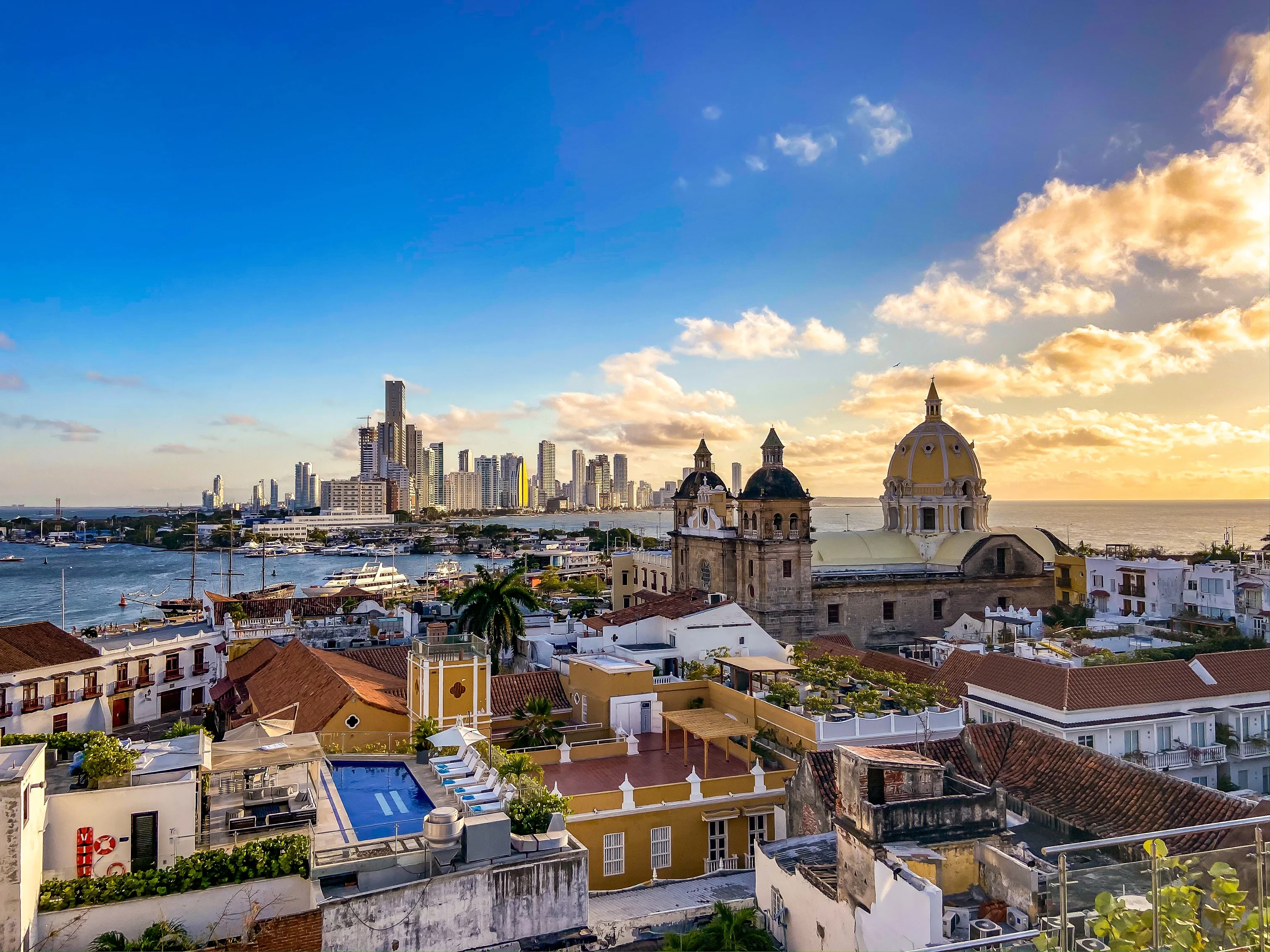
Eleven kilometres of ramparts, and everything else follows from them. Inside, Cartagena fits into a few dozen streets listed as World Heritage since 1984: wooden balconies, ochre and blue facades, squares people sit down in once night falls. Just behind the Clock Tower gate, Getsemaní is the old working and seafaring quarter, now the neighborhood of murals and terraces, and it costs half as much. Further south, Bocagrande lines up its towers and its beach along a spit of sand. Beyond the bridge, Manga sleeps among its republican houses, at the foot of the castle that guards the city.
What changes from one street to the next here is the price AND the temperature of the evening: inside the walls you pay for sixteenth-century stone, three hundred metres away you pay half that and sleep above the party. Budget $29* at the bottom end, $85* for three stars, $124* for four and $300* for five. And one thing is settled before the neighborhood: the heat, which never really drops, and which makes air conditioning and a pool less optional than elsewhere. This guide covers five neighborhoods.
It is a city with a tropical climate (very hot) that feels halfway between the craziness of Miami and the historical beauty of Avignon with its ramparts.
Compare hotel prices in Cartagena
In a hurry? Find the best accommodation deals in 3 clicks.
Compare live deals from Booking, Expedia, Agoda and other partners.
At a glance: our picks by traveller type
Pick the profile that suits you to head straight to the recommended neighborhood.
The neighborhood map in Cartagena
Get your bearings on the neighborhoods and must-see sights before choosing where to drop your bags. Click a name to jump to its description.
The walled city: Centro and San Diego The eleven kilometres of ramparts and the wall walk, the cathedral and Plaza Bolívar, the old Palace of the Inquisition, the Zenú Gold Museum, Plaza Santo Domingo and Botero's Reclining Woman, the church and cloister of San Pedro Claver, the Clock Tower gate, the vaults of Las Bóvedas, Plaza de San Diego and its terraces, the Heredia theatre
for a first visit, for the stone and the balconies, for doing everything on foot
This is the postcard, and it has to be earned: prices here are the highest in the city, because what you are renting is a piece of the sixteenth century. The wall walk runs right around the neighborhood and is best taken late in the day, when the stone gives its heat back. Inside, everything fits into a quarter of an hour on foot: the cathedral and Plaza Bolívar, the Zenú Gold Museum, Plaza Santo Domingo where Botero's Reclining Woman serves as the meeting point, the vaults of Las Bóvedas cut into the rampart. To the north, San Diego is the same material in a quieter key: the same balconies, fewer shops, terraces that serve late.
Where to stay in this neighborhood
Hotel Casa San Agustin Luxury
The best score in this guide, by some distance: 9.7 on a hundred and eighty-three reviews, with 9.9 for cleanliness, comfort and location. Three seventeenth-century colonial houses, exposed beams and stone, a pool between the walls, breakfast included. The volume of reviews is small and the price is a five-star one: $300* and up.
Sofitel Legend Santa Clara Cartagena Luxury
The former Santa Clara convent, in San Diego, and the second score in this guide: 9.1 on four hundred and ninety-nine reviews, with 9.7 for location and 9.4 for the staff. Cloister, large pool, spa. The reviews also state the reservation: 8.4 for value, the lowest figure on its page.
Hotel Boutique Las Carretas Mid-range
The best compromise inside the walls: 8.7 on more than twelve hundred reviews, with 9.6 for the staff and 9.3 for location. A small colonial house, a patio, air-conditioned rooms, a breakfast the reviews mention often. This is the address to aim for if you want to sleep inside without paying $300*.
República Hostel Cartagena Budget
The bottom end of the centre, and its figures hold: 8.3 on close to two thousand reviews, with 9.5 for location and 8.5 for value. Dorms and private rooms around a pool, in an old house. The wifi, at 7.8, is the low point. From $29*.
Pros
- All the city's heritage within walking distance
- The ramparts and the sunset at the end of the street
Cons
- The highest prices in the city, by a factor of two
- Street vendors on the squares, from morning to night
Getsemaní Plaza de la Trinidad and its church, the murals and hanging parasols of the lanes, the Ciudad Móvil cultural centre, the San Roque church, the convention centre on the water, the bars of Calle del Arsenal, the evening market on the square
for the evenings, for the prices, for the street life
Three hundred metres separate Getsemaní from the Clock Tower gate, and two worlds. This was the quarter of labourers, sailors and freed slaves; today it is where you come to sleep when you want the city without the city's price. In the evening, Plaza de la Trinidad fills up all at once: arepa sellers, groups sitting on the church steps, music until late. The lanes around it are covered in murals and hanging parasols, and it is the only neighborhood in the city where you still meet residents in their doorways.
The nights there are wild, and its little alleyways are easy to explore on foot.
Where to stay in this neighborhood
Patio de Getsemani Mid-range
The best score in the neighborhood: 9.1 on six hundred and forty-six reviews, with 9.8 for the staff, the highest figure in this whole guide, and 9.5 for location. A low house around a patio, a rooftop terrace, plain cool rooms. The reviews all mention the same thing: you are next to the party without being in it.
Viajero Cartagena - Getsemani Hostel Budget
Three hundred metres from the ramparts: 9.0 on three hundred and thirty reviews, with 9.7 for location and 9.6 for the staff. Dorms and rooms, a pool, a roof terrace the reviews mention one by one. It is the bottom end of the neighborhood, and the most social: avoid it if you are after quiet.
Pros
- The same streets on foot, for half the price of inside the walls
- Plaza de la Trinidad in the evening, which is the real local night out
Cons
- Music plays late: pick a room on the patio side
- Little air conditioning in the cheapest addresses
Bocagrande and Castillo Grande Bocagrande beach and its parasols, the quieter tip at Castillo Grande, the residential towers and the big hotels, the shopping centres of Avenida San Martín, the casino, the fish restaurants along the seafront
for the beach, for the big hotels, for families
A three-kilometre spit of sand lined with towers: Bocagrande looks more like Miami than colonial Colombia, and that is exactly why people come. The beach is urban, grey and busy, with its fruit sellers and parasols rented by the day; at the far end, Castillo Grande is quieter, more residential, and the view carries over the bay to the ramparts in the distance. The neighborhood has what the historic centre does not: large hotels with pools, family rooms, and prices that drop out of season.
Where to stay in this neighborhood
Oz Hotel Cartagena Mid-range
The largest volume of reviews in this guide, and a score that does not weaken: 9.2 on more than three thousand seven hundred reviews, with 9.6 for the staff, 9.5 for cleanliness and 9.3 for value. Wide rooms, a pool, two streets from the beach. It is the address that strikes the best balance in the whole city: budget $124*.
Hotel Caribe by Faranda Grand Luxury
The grand old hotel of Bocagrande, opened in 1945: 8.7 on close to eighteen hundred reviews, with 9.1 for location and the same for the staff. A planted park where sloths and macaws live, several pools, direct access to the beach. The reviews flag two things, crowded pools and wifi scored 7.9.
Pros
- The beach and the pool, with the centre ten minutes by taxi
- Family rooms and large hotels, rare inside the walls
Cons
- No colonial charm at all: towers from the 1980s and the 2000s
- An urban beach, where you are approached all day long
Manga, San Felipe and La Popa The castle of San Felipe de Barajas and its tunnels, the Zapatos Viejos monument, Cerro de la Popa and its convent of 1607, the republican houses on the island of Manga, the Pastelillo fort and its fishing club, the cruise port
for paying less, for the castle, for the view over the city
Cross the bridge and the prices fall. Manga is a residential island of republican houses, ten minutes by taxi from the ramparts, and it is the best value in the city for anyone willing not to walk out in the evening. Above it, the castle of San Felipe de Barajas is the largest fortification Spain built in the Americas: a whole hill covered in walls and pierced with tunnels, to be visited early in the morning. And higher still, Cerro de la Popa, the highest natural point in the city at a hundred and forty metres, carries a convent from 1607 and the only view that shows everything: the walls, the bay, the towers and the lagoon.
Where to stay in this neighborhood
Hotel El Marqués De Manga Mid-range
The best score in the neighborhood: 8.8 on more than fourteen hundred reviews, with 9.4 for the staff and 9.2 for cleanliness. An old house taken over, a pool, breakfast included, cool rooms. The only low figure is the one for location, 8.7, and it tells the truth about the area: you need a taxi.
Holiday Inn Express Cartagena Manga Mid-range
On the island, facing the marina: 8.6 on six hundred and eighty-three reviews, with 9.4 for the staff and 9.2 for cleanliness as for comfort. Chain rooms with no surprises, breakfast included, a rooftop pool. The location scores 7.9, the frankest figure on its page: the centre is reached by car.
Pros
- The lowest prices in this guide for new, air-conditioned hotels
- The castle and the La Popa viewpoint within taxi reach
Cons
- Nothing is walkable from here, neither the centre nor the beach
- A residential neighborhood: almost nothing open in the evening
The north: Marbella, El Cabrero and La Boquilla Marbella beach at the foot of the ramparts, the Rafael Núñez house museum in El Cabrero, the long beach of La Boquilla and its fishing village, Manzanillo beach, the Karibana golf course, the Las Américas convention centre, the Virgen lagoon and its mangroves
for a beach without the crowd, for the big resorts, for an early flight
North of the walls the city stretches along the water for fifteen kilometres. Close by, Marbella is the locals' beach, with no rented parasol and no vendor, and El Cabrero lines its houses around the lagoon and the Rafael Núñez house museum. Further out begins La Boquilla, a fishing village turned into the city's seaside front, with its mangroves behind and its big hotel complexes in front. This is where people sleep who want the sea rather than the stone, and those with an early flight: the airport is minutes away.
Must do: the flight of birds at sunset in the fishing community, east of the city center.
Where to stay in this neighborhood
Hotel Las Americas Casa de Playa Mid-range
A seafront complex to the north, minutes from the airport: 8.4 on close to nineteen hundred reviews, with 8.9 for location and the same for the staff. Pools at several depths, a water slide, a kids' club: the reviews are written by families and say so. Value for money, at 8.0, is the low point.
Sonesta Hotel Cartagena Mid-range
The second volume of reviews in this guide: 8.1 on more than three thousand four hundred reviews, with 8.8 for the staff and 8.5 for cleanliness as for comfort. A modern tower on the Morros side, pools, shops at the foot. You come for the space and the price, accepting 7.9 for value and a historic centre twenty minutes away.
Pros
- Real beaches, pools and the airport minutes away
- Family resorts with everything on site
Cons
- Fifteen to thirty minutes by taxi from the historic centre
- Outside the hotels, little to do in the evening
Our tips for booking the right place
- The same stay costs twice as much depending on the neighborhood: This is what is particular about this city, and it plays out over three hundred metres. In the walled city you rent a colonial house and you pay for it: decent bottom-end rates start well above $85*. In Getsemaní, just behind the Clock Tower gate, the same streets are walkable for half that. In Manga, across the bridge, you go lower still, but you need a taxi for everything. The right trade-off is not the price alone: it is the price against the number of taxis you will take each day.
- The heat does not drop, and it changes what you should book: Our member writes it in brackets, and it is the most useful bracket in his review: the climate is tropical, so very hot, and it is hot all year. Two practical consequences. First, air conditioning stops being a detail: in the cheapest addresses in Getsemaní it is missing, and a night at thirty degrees is paid for the next day. Second, a pool changes a stay more here than elsewhere, which gives a real advantage to Bocagrande and to the north. For sightseeing, the local rhythm beats bravery: the walls early in the morning, a siesta in the dead hours, the squares once night falls.
- The islands, the castle, the hill: the order that works: Three outings leave the centre, and each has its hour. The Rosario Islands are reached by boat, forty-five minutes to an hour of crossing for a day of eight to nine hours: that is a full day, not half of one. The castle of San Felipe de Barajas is visited at opening time, before the stone heats up, and its inner tunnels are walked with a phone torch. Cerro de la Popa is saved for the end of the day: at a hundred and forty metres it is the only place that shows the whole city, and the climb is done by taxi or shuttle, not on foot.
- What the walled city does not say about itself: Two things, and both come as a surprise on arrival. The first: inside the walls, you are offered something every two minutes, hats, sunglasses, massages, excursions. It is not aggressive insistence, it is the trade of the neighborhood, and a smiling no is enough. The second: the walled city is magnificent and it is seen in a day. Three nights inside the walls are often one night too many; two inside and two in Getsemaní or by the water make a better stay for the same budget.
- Booking inside the walls for the whole stay without having looked at Getsemaní: three hundred metres from the same gate, the same comfort often costs half as much.
- Choosing the cheapest room in Getsemaní without checking two lines: the air conditioning and which side of the patio it is on. The music stops late on Plaza de la Trinidad, and the heat does not stop at all.
- Coming to Bocagrande expecting a postcard beach: the sand is grey, the water is cloudy near the shore and the crowd is dense. The clear beaches are on the islands, an hour away by boat.
- Taking a room in Manga or in the north for a two-night stay: what you save on the room goes back out in taxis, and you lose the two evenings that make this city.
FAQ: where to stay in Cartagena
Which neighborhood should you stay in in Cartagena?
How much does a night in Cartagena cost?
Is Getsemaní a safe neighborhood to sleep in?
Should you sleep by the sea in Cartagena?
How many nights should you plan in Cartagena?
What is the best time to come?
 Keep exploring
Things to do in Cartagena
Keep exploring
Things to do in Cartagena
Comments (0)
No comments yet. Be the first!