
Every cloud has a silver lining...
In that sense, the recent health crisis at least had the benefit of teaching us to travel differently, staying closer to home, yet visiting destinations just as breathtaking. Take the Cyclades, for instance: a Greek treasure tucked away in the southern Aegean Sea. The mere mention of the name often sparks a flurry of questions for the uninitiated: What are the Cyclades? Where are they? What do they have to do with Greece?...
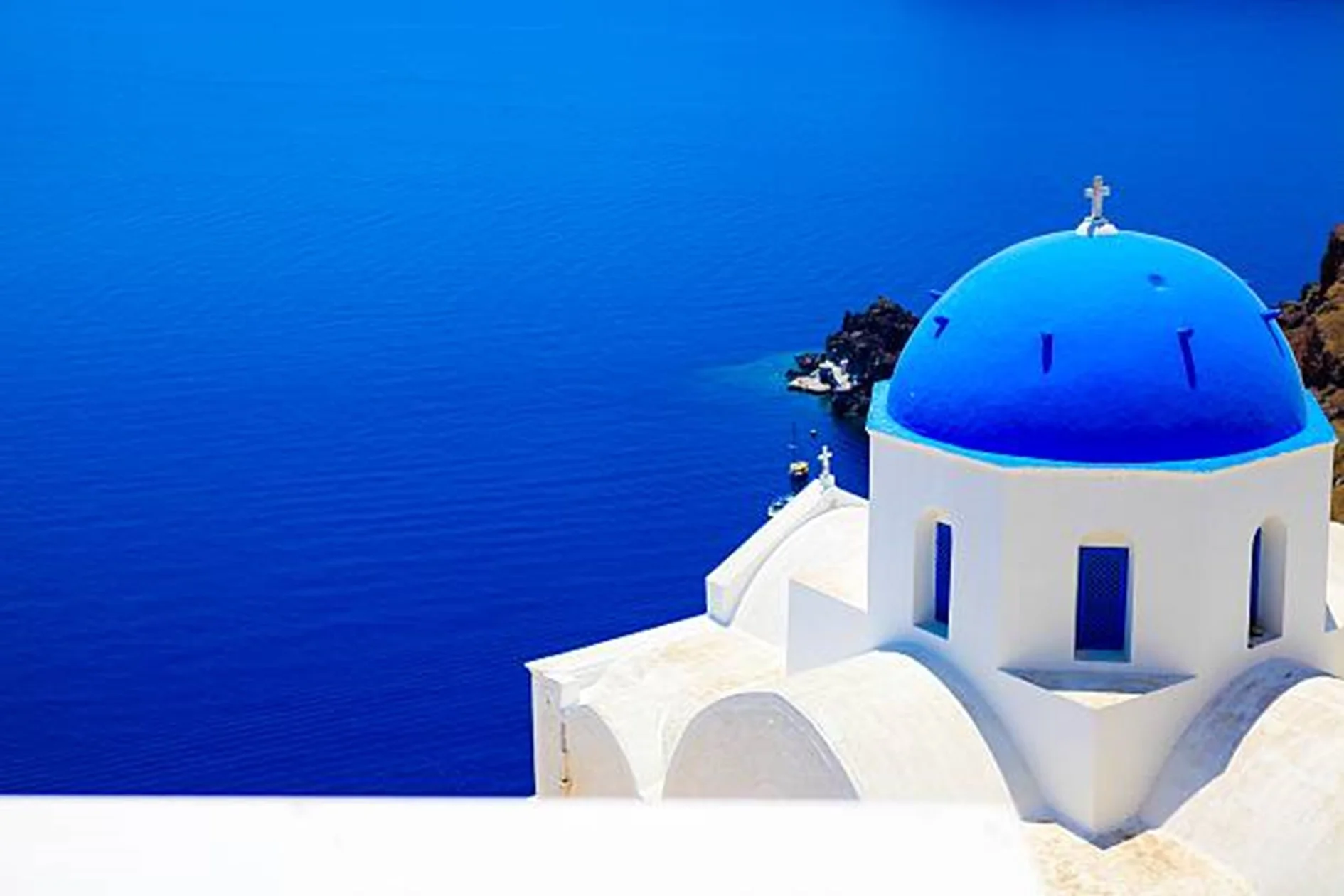
In short, you only need to drop a few famous names like Santorini or Mykonos for people to say, "Oh, I know those!" and instantly picture those iconic, pristine white cubic houses with blue shutters, churches with blue domes, windmills spinning in the meltemi wind, or villages with narrow alleys and endless staircases where donkeys work and cats lounge under a near-constant sun...
Because that is exactly what the Cyclades are: picturesque, postcard-perfect villages with unparalleled authenticity. More officially, it’s an archipelago located 75 kilometers southeast of mainland Greece, comprising 24 inhabited islands scattered across the infinite blue of the Aegean, circling the sacred islet of Delos, the mythological birthplace of the gods Apollo and Artemis.
Mythology or fact? One thing is certain: the stunning beauty and exquisite charm of this constellation of paradise islands is no myth. A visit here is guaranteed to offer you a complete change of scenery!

But with only about ten days to spare, how do you choose which islands to visit among the many that make up the Cyclades?
For a trip of that length, if it’s your first time in the Cyclades, I find that visiting three islands is the perfect number to discover each gem without feeling rushed. As for the destination, what could be better than Santorini and Mykonos, with a stop in Paros along the way? These three islands perfectly capture everything that makes this archipelago one of today’s most sought-after destinations: relaxation, romance, nightlife, authenticity, and dream beaches.
In short, these are dreamy words, but they only become reality once you’ve answered the big question: how do you get to the Cyclades?
This is where my role comes in, to give you some practical advice on how to reach this idyllic destination and help you discover its finest treasures.
How to get to the Cyclades?
You have two main options:
By plane
Most of the Cycladic islands now have their own airports, including the three we're focusing on: Mykonos, Santorini, and Paros. During the summer, several charter airlines (such as EasyJet, Olympic Air, etc.) offer direct flights from Paris, often at very attractive prices!

By ferry
The ferry is by far the most economical way to reach the islands. But where do you catch it? Everything happens at the port of Piraeus. If you arrive at the Athens airport, just take the metro to Piraeus. If you’ve decided, like my friends and me, to bring your own vehicle from France, you simply drive to the port of Piraeus, where Blue Star Ferries and many others (Seajets, Golden Star Ferries, Hellenic Seaways, etc.) provide daily connections between Athens and the Cyclades. But be warned: while the ferry is the cheapest option, keep in mind it’s also the slowest! To give you an idea, here are some travel times and price examples:
Crossing from Athens (Piraeus port) to Paros:
- With Blue Star Ferries, allow 4 hours, with ticket prices ranging from €20 to €100;
- With Golden Star Ferries, allow 3 hours, with ticket prices ranging from €48 to €58;
- With Seajets, allow 2 hours 50 minutes, with ticket prices ranging from €49 to €65.
Crossing from Athens (Piraeus port) to Santorini:
- With Blue Star Ferries, allow 5 hours 30 minutes, with ticket prices ranging from €20 to €115;
- With Golden Star Ferries, allow 5 hours 20 minutes, with ticket prices generally around €70;
- With Seajets, allow 4 hours 30 minutes, with ticket prices ranging from €70 to €90.
Of course, these times and prices are just for illustration. For a more concrete idea and to actually make a booking, simply head to the websites FerryHopper or DirectFerries to compare and book available ferries between islands.

But again, don't overlook the flight option, which can save you a huge amount of time without breaking the bank! After all, a 1-hour flight to Santorini is much nicer than 5 hours on a boat!
Now that the question of getting to the Cyclades is settled, we need to know how to get around between the islands.
How to get around the Cycladic islands?
Unsurprisingly, the answer is the FERRY. It remains THE preferred mode of transport in the Cyclades, and you can book online in advance or buy tickets on-site directly from the various companies we just mentioned.
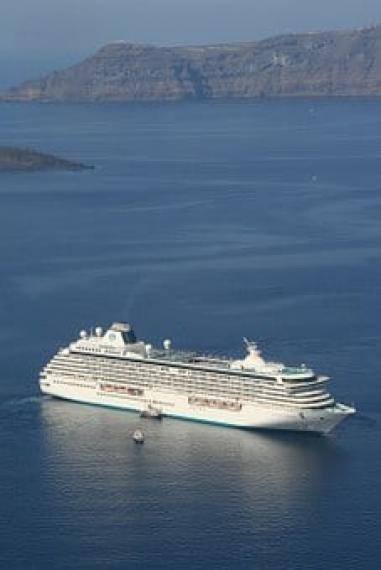
However, be careful: if you book your tickets online, you MUST pick up your boarding passes at the company's counter, so have your confirmation email ready. It’s up to you...
Regardless, whether you book online or buy on-site, you’ll have no trouble finding the offices of the various companies in the "downtown" areas of each island.
Oh, and one more thing! Before we close this chapter (even if it seems obvious to some), know that you can bring a vehicle on many ferries (though the ticket will be more expensive!). I mention this in case you decide to rent a car locally or if, like me, you are traveling with your own vehicle from France.
Finally, if your own two feet are your only means of transport, I must remind you that you only have 15 minutes before the ferry's departure time to board. Given the somewhat chaotic organization on the ferry docks with crowds and cars waiting for different boats, my advice: try to be on time and keep a close eye on the incoming ships so you don't miss yours!
With those formalities out of the way, grab your best camera to capture the treasures I’ve told you about, starting our journey in Santorini, an island blessed by the gods, perched on the rim of a submerged but still active volcano...
1/ Santorini

Everyone will agree, and I personally confirm, that arriving in Santorini by boat is one of the highlights, I would even say THE highlight, of a trip to Greece. Watching the strange, jagged silhouette of this island emerge feels like something straight out of a sci-fi movie. For my part, my first encounter with what the Phoenicians aptly nicknamed "kallisté" (or "the most beautiful") was a total shock. Only adjectives like "unreal," "spectacular," "magical," "unique," "apocalyptic," and "fascinating" came to mind to describe the panorama unfolding before my eyes... At the same time, what other words could I have used when arriving at the foot of this massive, hundreds-of-meters-high cliff of red-brown, black, and gray pumice, rising like a fortress from the waves? What words could describe this enormous dark rock crowned with a white crest of tiny houses, plunging into a sea of intense blue?


Believe me, the magic of this somewhat mystical place takes hold the moment you arrive by boat, even before you step ashore, and it continues long after... Especially when you disembark and are dropped off at the foot of the staircase carved into the rock that leads up to Firá (the capital of Santorini), either on foot or by donkey, just like in the old days. A dizzying and breathtaking climb awaits, leaving you thinking: what supernatural world have I stepped into? Fortunately, a cable car is now available for those in a hurry or feeling a bit lazy, but even by that method, ascending the ridges of this volcano remains an extraordinary and moving experience...

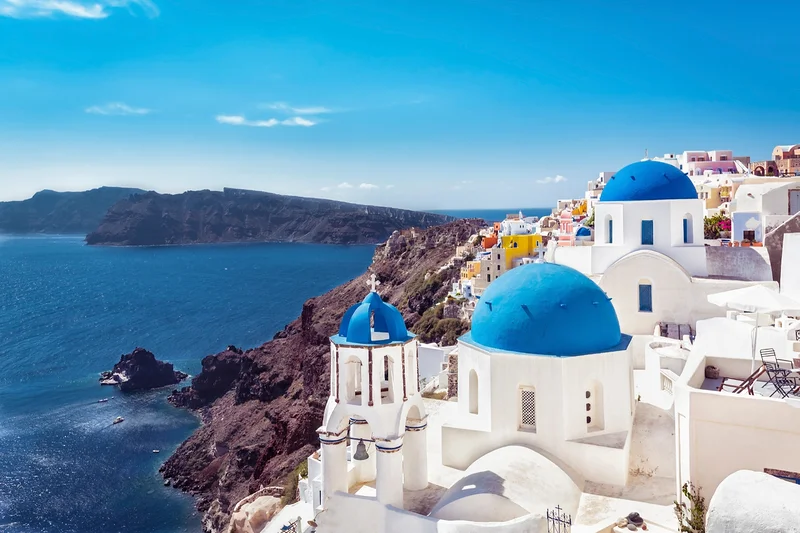
Because yes, Santorini isn't just a random stretch of land emerging from the water. It is actually an island formed by the collapse of a volcano's crater (commonly called a "caldera") following a massive eruption at the end of the 16th century BC. The central part of the volcano collapsed, allowing the sea to rush into the crater, which explains the crescent shape we see today. It is composed of steep cliffs of brown rock and black ash, upon which several small towns stand like sentinels, including Firá and Oía, two absolute must-sees in Santorini.

Firá and Oía, the Santorini postcard...

While the first, clinging to the edge of the cliff and dotted with pastel-colored houses, offers an exceptional panorama of the caldera, the second, Oía, which you can reach on foot from Firá via a stunning 2-hour walk, offers everything you expect from a Cycladic village: whitewashed cave houses and small Orthodox churches with blue domes, all tucked into a maze of alleys. It’s not rare to still see people using donkeys for work and public services that are impossible to perform by car (like trash collection!). It is simply wonderful to wander through these streets without a goal, just to appreciate the beauty of the place and its unique colors. I’m thinking particularly of that intense white contrasting with the vibrant blue of the house shutters, or the flamboyant fuchsia of the bougainvillea, without which Oía just wouldn't be Oía...
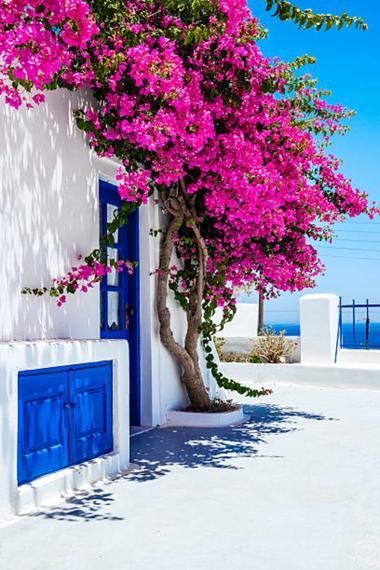
And Oía wouldn't be the paradise everyone has seen in photographs at least once without its unique and very romantic sunset, for which the whole island seems to gather every evening to admire the sky tinted with pink and water colored like a sublime watercolor.


But like any self-respecting paradise, this one is a victim of its own success, especially in summer when millions of tourists and couples celebrating their unions flock in, competing for the best hotel rooms or the best tables at restaurants that don't hesitate to hike their prices once the tourist season hits! But, after all, aren't those just the rules of the tourism game?

One thing is certain: to escape this massive flow of visitors and the price hikes, there's nothing like choosing the off-season to enjoy Firá, Oía, and many other villages, because Santorini isn't just these two iconic towns. It is also:
- A land of vineyards that you can discover by climbing up to the village of Pyrgos, where numerous wineries are scattered, offering tastings of the famous Vinsanto, a globally renowned sweet wine;
- An archaeological site that is among the most interesting on the island and in all of Greece, which you can visit in the prehistoric city of Akrotiri. Dating back to the Minoan era (2700 to 1200 BC), it has been preserved in an almost impeccable state thanks to the volcanic eruption that buried it in a layer of ash and pumice, acting as a "preservative" over the centuries;
- Exceptional beaches with volcanic sand that is sometimes black (Perissa Beach, Perivolos Beach, etc.), sometimes red (Kokkini Ammos or Red Beach), or sometimes white (White Beach in Firá);
- Good fresh fish tavernas where you can go directly into the kitchen to choose your catch for lunch in the small port of Amoudi at the foot of Oía;
- And finally, a volcano with black volcanic rock (Nea Kameni National Geological Park), which you can reach from the old port of Firá or Athinios in 30 minutes (expect to pay €30 to €50 per person depending on the boat). It stands as a testament to the island's volcanic origin, which, despite appearances, is anything but dormant... Proof of this: between January 2011 and the spring of 2012, 10 million cubic meters of magma were added to the magma chamber, and the island rose by a few centimeters, raising fears of an eruption in the medium term... Besides, if the monster were to wake up for even 30 seconds, it's estimated that the entire island of Santorini would disappear! But after the many eruptions that have struck it over the years, it's a safe bet that Santorini would manage to rise from its ashes, as it always has...

Well, rather than hurting ourselves by imagining the worst and speculating on the compromised future of this island, how about we resume our itinerary, this time heading toward Paros, an island with many facets that never fails to leave its visitors moved...
2/ Paros:

While the first glimpse of Paros from afar is certainly less spectacular and impressive than the discovery of Santorini, the arrival by ferry into the small port of Parikiá, the island's main port, has that certain captivating charm that makes this destination a #1 favorite for travelers visiting the Cyclades.

It’s a favorite, first, because of the multitude of landscapes the island offers. Indeed, between its lush plains, valleys dotted with vineyards and olive groves, mountains, and its precious pure white marble, which has made it famous since antiquity, its superb beaches with crystal-clear waters, not to mention its small picturesque villages and ports tinted in blue and white, Paros is a winning combination of everything the Cyclades have to offer.


It’s a favorite, second, because of the countless activities to do there. If you’re into water sports, diving (Monastiri Beach), surfing (Santa Maria Beach), kitesurfing (Punta Beach), and windsurfing (Golden Beach) are all on the program, thanks to the meltemi, the famous wind that blows over the Aegean Sea in summer.
Now, if you prefer land-based activities, Paros has plenty to satisfy you with its multiple hikes, including the Byzantine Trail that connects the village of Lefkés to Prodromos, which remains one of the most renowned. It takes about 1 hour, but if you want more walking, I have the perfect place for you: Paros Park, located at the northern tip of the island. This 80-hectare park allows you to walk along the seaside on 3 different marked trails, which have the advantage of offering a superb view of the coast and taking you past the lovely Paros Lighthouse. While these hikes don't require any special expert-level skills, they will take some time, about 2 hours to walk around the park. But between us, what are 2 hours for the promise of a breathtaking walk...!

It’s a favorite, third, because of the magnificent beaches that Paros abounds with, which is why it attracts more and more tourists every summer who are somewhat overwhelmed by the wide range of beaches punctuating the island's perimeter. Indeed, it’s easy to be disoriented when you know that Paros has no fewer than 15 beaches along its coastline! But this high number of beaches at least has the merit of offering something for everyone: from large stretches of fine sand for families to small, secluded coves for those who love tranquility, everyone can find their spot. Let me give you a quick summary list describing the character of each of these legendary beaches:
- Kolymbithres, with its large boulders reminiscent of the Seychelles;
- Lageri Beach, with its fine sand and clear water, quite quiet and laid-back;
- Monastiri (Paros Park), where you’ll find a restaurant and can practice water sports;
- Naoussa Beach, the closest to the seaside resort of the same name;
- Santa Maria, a very long sandy beach with a private section. Ideal for surfing and windsurfing;
- Pisso Livadi Beach, known for its family-friendly atmosphere;
- Logaras, also frequented by families;
- Punda, with its club playing music for a younger crowd;
- Messada, a beach for naturists;
- Golden Beach, one of the largest beaches on Paros, which hosts international windsurfing championships;
- New Golden Beach, for surfing and windsurfing enthusiasts;
- Faragas, a pretty, semi-private beach. Shallow water and very popular;
- Lividia Beach, the closest to Parikiá;
- Parasporos, where you can rent lounge chairs and umbrellas;
- Agia Irini, a quiet beach because it is only accessible by a dirt track;
- Pounta, where kitesurfers come to train; not really made for swimming.


It’s a favorite, finally, because of its two seaside resorts, Parikiá and Naoussa, which are almost mandatory stops for travelers visiting Paros, at least for those whose vacations are all about enjoying the beach and partying. That is precisely the case in Parikiá, where there is no shortage of souvenir shops, tavernas of varying degrees of authenticity, and countless bars, pubs, and nightclubs entirely geared toward tourism.

As for Naoussa, some French visitors go as far as calling it the "Saint-Tropez" of Paros because of the sheer number of restaurants, trendy bars, and luxury boutiques flooding the small town. But in both cases, despite their tourist development, the two small fishing ports have fortunately managed to preserve part of their soul and traditions, as evidenced by the picturesque cobblestone alleys, old churches (Basilica of Panagia Ekatontapyliani in Parikiá), old ruins (the Kastro, the Byzantine Museum, the Archaeological Museum, and the ancient necropolis in Parikiá), blue shutters, or those typical white houses, the ultimate heritage of the Cyclades and proof that nothing can shake the authenticity of this archipelago! In any case, if you have any doubts, the warm and friendly welcome of the locals, as well as their simplicity, will always bring you back to reality and prove that tourism hasn't gotten the better of the natural spirit of these islands.
And Mykonos certainly won't tell you otherwise!


3/ Mykonos:

It’s no secret to anyone anymore: Mykonos is the trendiest and most festive of the Greek islands, where DJs from all over the world perform and millions of visitors from all walks of life, countries, social statuses, and sexual orientations flock every year, making Mykonos one of the most cosmopolitan and open islands in Greece!
But while one might think it has become "artificial" due to its frantic and exuberant nightlife and high tourist density, considered the highest in Greece, you have to get lost in the labyrinth of winding alleys, built to confuse the pirates who threatened the island in the 18th and 19th centuries, to understand the fascination Mykonos exerts on visitors. You'll realize that the island nicknamed the "Greek Ibiza" for its jet-set side hasn't lost any of its legendary charm!

Proof of this can be found in the row of five windmills (at Kato Myli) standing watch over the harbor, the small white cubic houses adorned with balconies and blue shutters, the small churches, including Panagia Paraportiani (considered the supreme expression of Cycladic architecture), the small ports, or the picturesque neighborhoods like Alefkandra, nicknamed "Little Venice" because of its wooden houses built on stilts that plunge into the sea. These all show that Mykonos has inexorably managed to preserve its authentic and typical character, remaining one of the most beautiful islands in the Cyclades, but also one of the most photographed, just like the famous pelican "Petros" (now deceased but replaced by three other pelicans), the mascot and inseparable symbol of Mykonos, without which it wouldn't be the delicious and fascinating island that visitors clamor for at any cost.

But like any hyper-frequented island, Mykonos promises hefty bills and a lot of hustle and bustle during the summer season!


So, in summary, Mykonos is truly the best if you can visit off-season, if you’re going there to party, and if you have a substantial budget!
Otherwise, consider setting sail for other islands that are just as attractive and captivating but much quieter and more financially accessible. Knowing that there is no shortage of them in the Cyclades archipelago, which, due to the very diverse profiles of its islands, could be compared to a giant open-air catalog of havens of peace, where every page deserves to be torn out for a unique journey to the heart of each one!

Comments (0)
No comments yet. Be the first!