
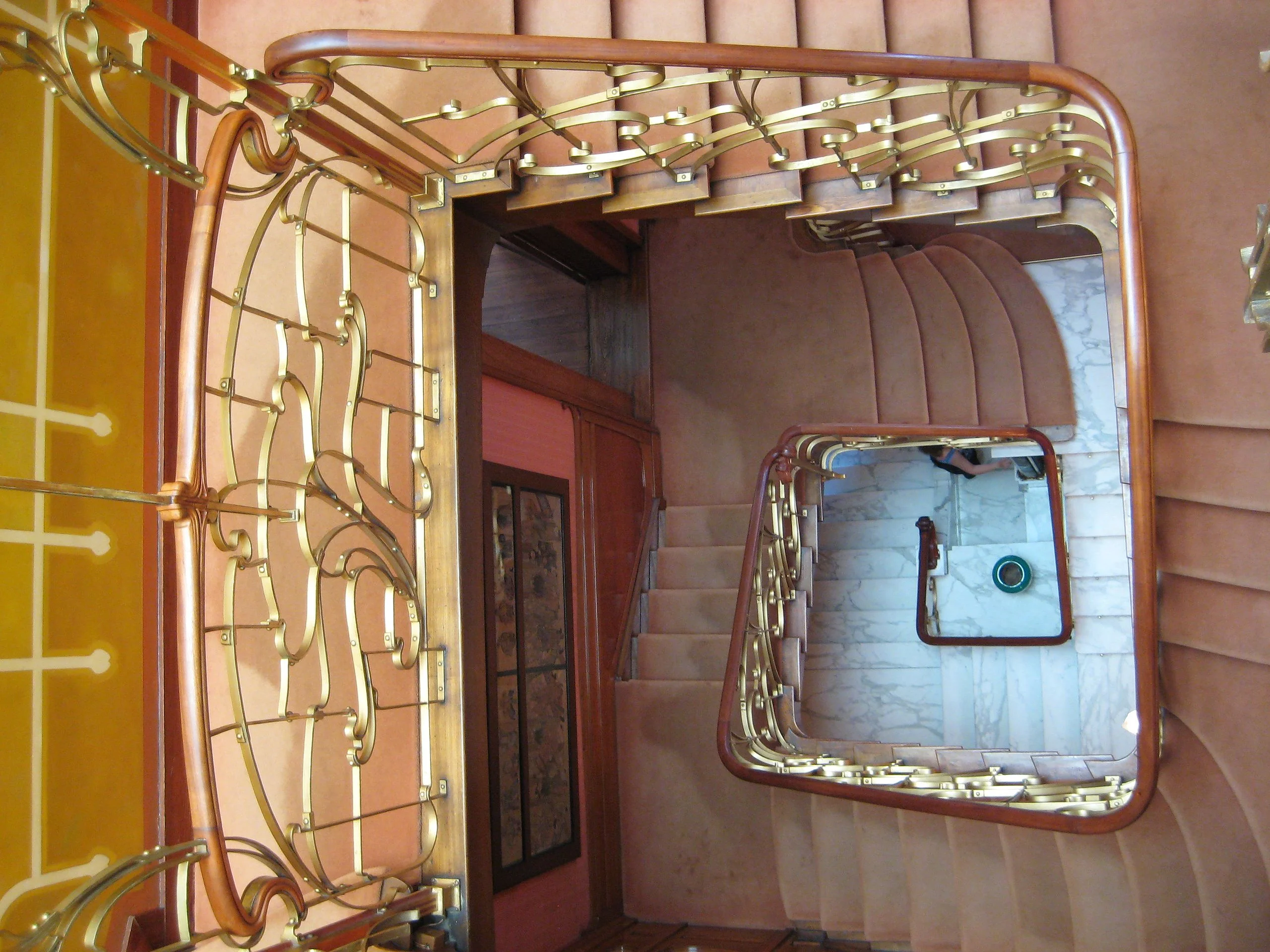
Brussels has a huge advantage in my eyes: it perfectly marries two of my passions. I find a very strong expression of Art Nouveau style here, and Brussels is also home to the Comic Strip Museum, with the Hergé Museum, dedicated to the creator of the Tintin adventures, located nearby.
If, like me, you appreciate both, or even just one of the two, the Belgian capital is a real feast for the eyes!
For everyone else, here’s a quick refresher, starting with the architecture before we dive into the "9th Art": the Art Nouveau architectural movement emerged in the late 19th century (around 1890) and lasted until about 1920, when it gave way to what would become known as Art Deco. Art Nouveau is characterized by a rejection of industrialization and the perceived "soullessness" of simply reproducing old styles rather than creating something living. Architects (as well as glassmakers, cabinetmakers, jewelers, etc.) favored curved lines that echoed Nature, bringing it back into the heart of the city to create a truly immersive environment for its inhabitants. In Paris, the best examples, aside from certain private mansions and many brasseries, remain the metro entrances designed by Hector Guimard, even if they weren't created during the very peak of the movement.
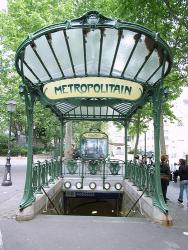
Several schools of thought emerged around the world, and even in France (notably in Nancy). Distinct expressions of this movement appeared across Europe, particularly in Vienna, Glasgow, Barcelona, and... Brussels.
In Brussels, it was the Belgian architect Victor Horta who kicked off the movement, notably by creating the Hôtel Tassel at 6 Rue Faider starting in 1892. It was named a UNESCO World Heritage site in 2000, symbolizing the "first global synthesis in architecture." Unfortunately, it isn't open to visitors, but you can at least dream while admiring the facade.
Rest assured: a Horta Museum does exist! It is housed in the architect's personal home and studio at 23/25 Rue Américaine. Victor Horta was followed by other Belgian architects, including Paul Hankar, Henry Van de Velde, Paul Cochie, Philippe Wolfers, and Privat Livemont.
For enthusiasts, some tour operators now offer an Art Nouveau tour of Brussels. But if you don't mind walking a bit, or grabbing a bike-share (similar to the Vélib model) for areas less accessible by public transport, you’ll have plenty of time to create your own itinerary. Just take a look online to get an overview of the buildings from that era. You’ll just need to plan on heading slightly outside the Brussels city center, as some are located in the near suburbs. But honestly, it’s worth the trip. Keep in mind that many of these houses aren't open for tours, but nothing stops you from stopping in front of the facades; the locals are used to it.
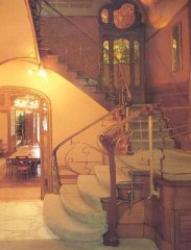
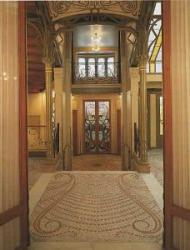
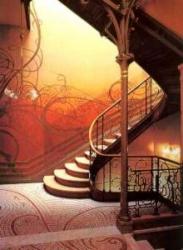
Brussels offers quite a few Art Nouveau monuments that you may or may not be able to visit. Here is what I managed to see during my wanderings, though many others exist:
- The Maison de Roosenboom, located near the Hôtel Tassel at 83 Rue Faider,
- The Hôtel Solvay at 224 Avenue Louise,
- The Hôtel van Eetvelde at 4 Avenue Palmerston,
- The Hôtel Hannon at 1 Avenue de la Jonction,
- The Niguet store at 13 Rue Royale,
- The Old England department store, located at the corner of Place Royale and Rue Montagne de la Cour, which is now the Musical Instruments Museum with a lovely terrace view,
- The Hôtel Otlet at 48 Rue de Livourne,
- The Hôtel Deprez-Van de Velde at 3 Avenue Palmerston,
- The Paul Hankar house at 71 Rue Defacqz,
- The Paul Cauchie house near Parc du Cinquantenaire at 5 Avenue des Francs in Etterbeek (now a museum, accessible to the public on the first weekend of each month or by appointment for groups),
- The Saint-Cyr private mansion at 11 Square Ambiorix,
- The Maison Les Hiboux at 55 Avenue Brugmann and the sculptor Dubois’ studio at 80 on the same avenue,
- The Waucquez department store, now the Belgian Comic Strip Center, located at 20 Rue des Sables, which features a space dedicated to Victor Horta on the ground floor.
I’m certainly forgetting some... You just need to walk with your eyes wide open to stumble upon one of these homes by chance. Unfortunately, once the craze for Art Nouveau faded, many of these works were simply torn down. Today, the City of Brussels and various residents' associations defend this heritage, especially against real estate developers.
And that’s the perfect transition for me: the Belgian Comic Strip Center houses a collection dedicated to Hergé, the creator of Tintin!
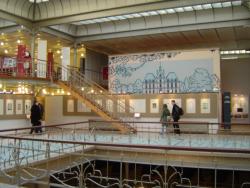
Alright, another quick summary: Hergé, whose real name was Georges Rémi, was born in 1907 in Etterbeek, a municipality near Brussels. He showed a talent for drawing early on and, in 1929, created the character of Tintin, a reporter for "Le Vingtième Siècle", in the pages of the children's illustrated supplement "Le Petit Vingtième." As the inventor of the "clear line" style, his success was rapid, and the character with the iconic quiff quickly became a sensation. His fame soon crossed Belgian borders. The father of Tintin is even considered the person who introduced the comic strip to Europe. He was later followed by other authors he influenced, who cemented the reputation of the Belgian school. Many consider that Hergé brought the comic strip into the realm of art (the "9th Art," as they say), giving it prestige. Hergé published 23 Tintin adventures, plus one unfinished posthumous work: Tintin and Alph-Art. He also participated in many projects and created other adventures (Jo, Zette and Jocko or Quick and Flupke). He ventured into cinema with varying degrees of success, authorizing or participating in adaptations of some of his works. His fame was such that General de Gaulle once told André Malraux: "My only international rival is Tintin." Hergé passed away from leukemia in 1983 and received a heartfelt tribute from the entire international community.
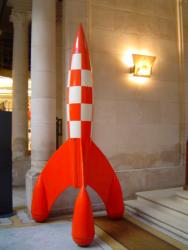
Back to the Belgian Comic Strip Center. You’ll find fun rooms dedicated to Hergé’s work, the famous moon rocket replica, and plenty of ways to relive scenes from Tintin's adventures.
Once your visit is finished, head to the Tintin shop located at 13 Rue de la Colline, very close to the Grand Place. You’ll find all the must-have items (figurines, games, clothing) as well as the albums. There are even some exclusives that aren't sold anywhere else! For example, I picked up the square-format France Loisirs editions for Moulinsart, which today can only be found online for completely unreasonable prices.
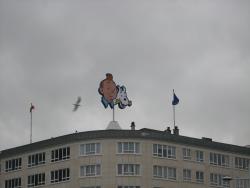
With your arms full of new treasures, you can take another tour of Brussels, following in Tintin's footsteps. For that, do a little surfing online and you'll find enough to put together a nice walk that will let you dive back into some of Hergé's albums (for example, at the following addresses: http://maps.google.be/maps/user?uid=201677403464380647352&hl=fr&gl=be&ptab=2 or http://www.bruxelles-tourisme.be/contenus/parcours_tintin_a_bruxelles/fr/3801.html). For instance, if you go to the cultural and artistic center in the Uccle municipality, you’ll find a bronze statue of Tintin and Snowy that was previously in Wolvendael Park. It’s also possible to walk past hotel facades or streets that were reproduced in the albums and served as inspiration for the author. Similarly, you can wander past the former headquarters of Editions du Lombard and the Journal de Tintin at 55 Rue du Lombard. And if you continue your walk, you can find the Tintin building near Place Bara, where the sign featuring the hero and his faithful Snowy still stands.
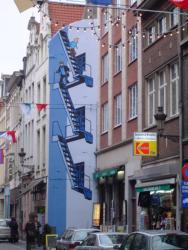
But that’s not all; in the Rue de l’Etuve, you’ll have the pleasure of stumbling upon a mural depicting the adventures of the famous reporter:
In short, you’ll find plenty to spice up your routes.
For those who are true fans and motivated by Hergé’s work, you can’t leave Belgium without paying a visit to the brand-new Hergé Museum built in Louvain-la-Neuve, in the Brussels suburbs. A building with an exceptional design, it has been open to the public year-round since June 2009, from Tuesday to Sunday, with hours varying by day. You can, of course, find information on the museum's official website: http://www.museeherge.com/
For those who, like me, don't have a car and don't want to rent one, don't panic! The museum and the city of Brussels have partnered to provide a paid shuttle for Tintin enthusiasts. It handles the connection between Brussels and Louvain. It is also possible to get there by train, but it involves transfers that are quite off-putting, I must confess...
Regardless, the space housing Hergé’s work is simply magnificent! It took years to get off the ground, but the result is up to the task. It’s educational enough for everyone, young and old, fans or not of the adventures of Tintin and Snowy, to have fun and spend half a day there. Those in a bit of a rush could finish the tour in 2 hours, I think. It should also be noted that the visit can be done with an audio guide, which is very well made and, I hope, still free! A rare enough fact to be worth noting... While the character of Tintin is omnipresent, he isn't the only one represented, as you can see almost all of Hergé’s productions.
A restaurant with decor themed after a newspaper like Le Petit Vingtième, complete with excerpts of its covers, offers a nice gourmet break. And, of course, you can't leave without stopping by the shop, which offers almost everything there is on Hergé’s work. Purists might have hoped to find rare books, but they’ll have to keep hunting for deals on the Web or at official auctions if their wallet allows: the bookshop mainly offers the most modern publications. That said, it’s still possible to find obscure books dealing with his work or its interpretation, unknown even to the seasoned Tintinophile I thought I was!
However, regarding logistics, I have to be honest: if you are making the trip just for the museum and want to spend the night nearby, be careful: the only two hotels (perhaps there are others by now) located nearby are, it seems to me, expensive relative to the comfort they offer. It must be said that the museum can host conferences and congresses, so the hotels might have a nasty tendency to hike up their prices. Furthermore, two days of visiting seems a bit too long for what is presented.
After my visit, I headed back to the Belgian capital where, I must admit, a gourmet break was mandatory. And in that regard, Brussels is ideal for satisfying a craving. I stuffed myself with speculoos cookies featuring the face of... Tintin. It just goes to show, business is everywhere!
In conclusion, who wins in Brussels: Tintin or Horta? My heart is still torn. The two activities go together so well, much like the Belgian Comic Strip Center, that it seems useless to choose!
NB: For those who are interested, check out my other post on Brussels...

Comments (0)
No comments yet. Be the first!