
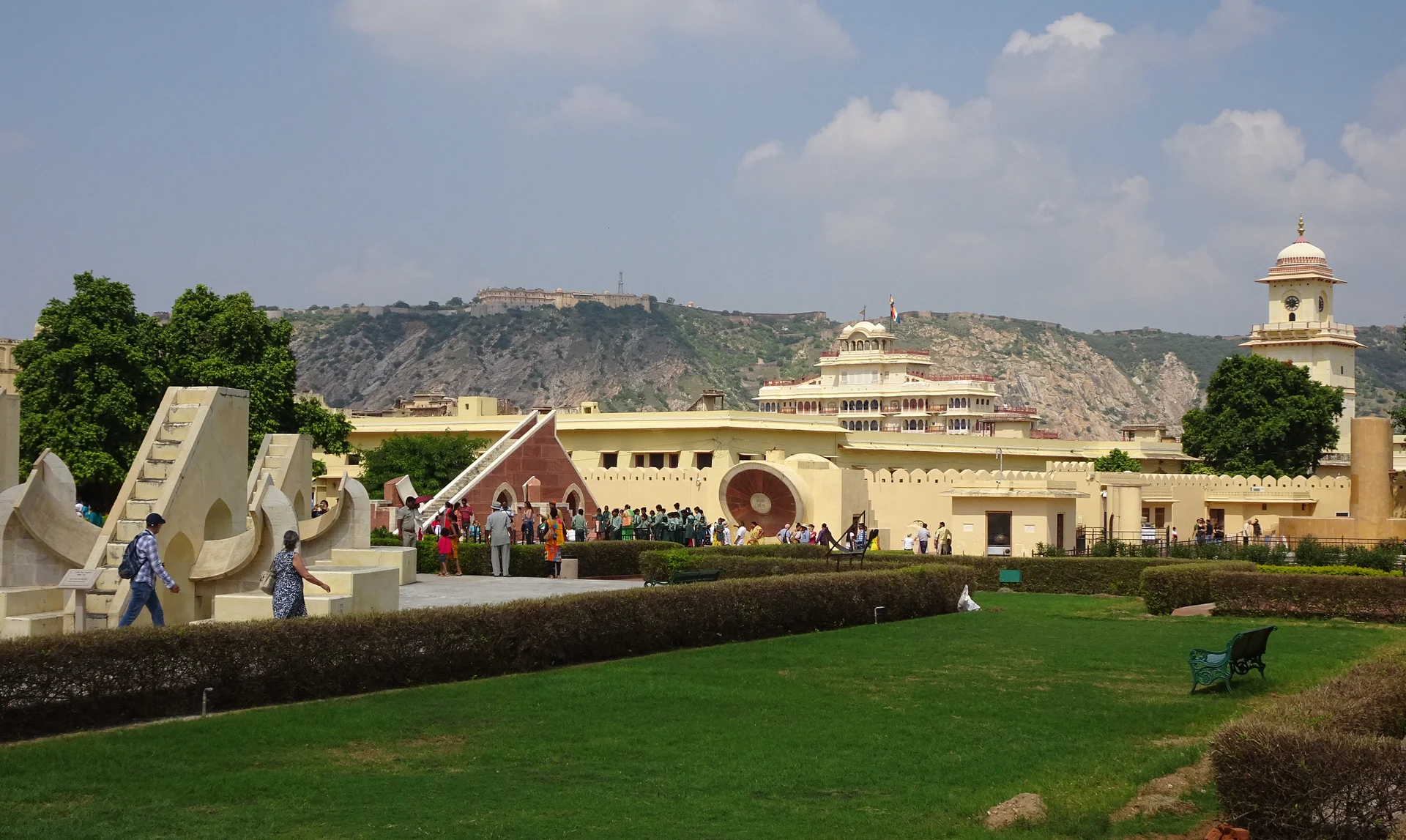
A life-sized stone observatory
Giant sundials, staircases climbing toward the sky with nowhere to go, marble arches aligned to the exact degree with the movement of the stars: in Jaipur, Jantar Mantar first looks like an abstract playground. It is actually one of the most precise astronomical observatories ever built without optical instruments.
Why visit Jantar Mantar?
The site was built between 1728 and 1734 by order of Maharaja Jai Singh II, founder of Jaipur and an astronomy enthusiast. Fascinated by science, the ruler had five similar observatories built in northern India (in Delhi, Ujjain, Mathura, and Varanasi), but the one in Jaipur remains the largest and best-preserved of them all.
Each instrument was designed to measure time, predict eclipses, or track the path of planets with remarkable precision for the era. The complex was designated a UNESCO World Heritage Site in 2010, recognized as an exceptional testament to pre-modern observational astronomy.
The Samrat Yantra, star of the site
You cannot miss it: the Samrat Yantra (supreme instrument) is the world's largest stone sundial, towering at about 27 meters. Its triangular gnomon casts a shadow that moves nearly 4 meters per hour, making it possible to read local time with a margin of error of barely two seconds.
Nearby, the Jai Prakash Yantra and Rama Yantra calculate the position of the sun and stars in the sky, while the Rashivalayas, a set of twelve dials, each correspond to a zodiac sign.
Exploring the instruments without a map
Without a guide, the place can feel like a simple garden of geometric sculptures. Yet every structure serves a precise astronomical function, often explained on small plaques, but whose logic remains hard to crack on your own.
Friendly tip: hire a local guide or visit in the late morning when the sun is high, because the shadows cast on the dials become legible and the whole site suddenly makes sense.
Great for
- Fans of science, history, and unusual architecture
- A short visit to combine with the nearby City Palace
Less ideal for
- Rushed visits without explanation, which risk staying purely surface level
- The hottest hours of the day, as there is very little shade on site
Opening hours
Every day: 9:00 AM to 5:00 PM.
Closed on Holi.
How long for this activity
Plan on spending about 1.5 to 2 hours exploring all the astronomical instruments. Give yourself half a day if you want to watch the sun dials operate at solar noon with a guide.
*Information subject to change

This park is home to many astronomy instruments. There are sundials for telling time with the sun or an instrument for calculating altitude. The explanatory signs are very well done, and there are even some in English which is super helpful.