


Hawa Mahal, the sandstone lace that defies gravity
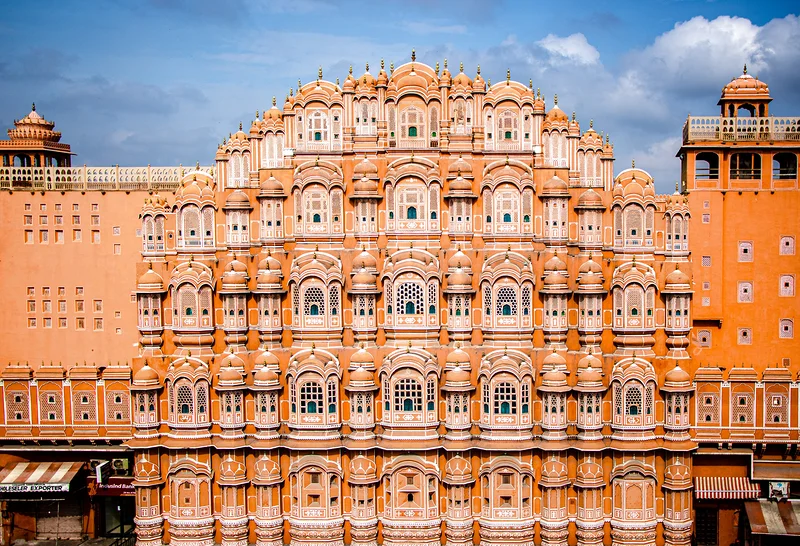
Nine hundred and fifty-three carved windows create a cascade of pink stone. The Hawa Mahal stands in the heart of Jaipur, an immense architectural screen fifteen meters high that appears to float without a foundation. This is not a palace for living, but a spectacular facade concealing courtly secrets and avant-garde climate engineering. Behind every latticed screen, generations of royal women observed the world outside, invisible yet present.
A palace to see without being seen
In 1799, Maharaja Sawai Pratap Singh commissioned his architect Lal Chand Ustad to build a bold extension to the City Palace. Inspired by the Khetri Mahal, he aimed for something even more ambitious. The purdah system required strict seclusion for royal women. The challenge was how to offer them a window onto the lively city, the religious processions moving along the main avenue, and the festivities in the Johari Bazaar, without breaking social codes.
The architectural answer was revolutionary. It is a pyramidal screen wall rising five stories, with every level pierced by hundreds of finely chiseled jharokhas (projecting balconies). The maharaja's wives and concubines could sit in the small chambers behind the trellis, converse, watch, and participate in city life by proxy. From the street, no one could distinguish them.
A technical feat defying the laws of physics
Building without a foundation
The Hawa Mahal has stood for over two centuries without a traditional foundation. This pink and red sandstone facade, tilted at an 87-degree angle, remains stable thanks to its pyramidal shape that redistributes weight. The top three floors are only one room deep. Only the two lower levels feature patios. The structure resembles the crown of the god Krishna, a spiritual reference woven into every decorative detail.
Climate control via the Venturi effect
In Hindi, hawa means wind and mahal means palace. The name is not metaphorical. The 953 openings create a constant airflow through the Venturi effect. When air passes through a narrow opening, its speed increases while pressure drops. The result is a permanent breeze that cools the rooms even during the scorching Rajasthan summers where temperatures climb above 104 degrees Fahrenheit (40 degrees Celsius). Fountains placed in the center of each room amplified this natural cooling.
Modern irony has taken its toll. During recent renovations, glass windows were installed behind the latticework, completely canceling out this ancient ventilation system. The Palace of Winds no longer has a breeze.
A masterful architectural fusion
The Hawa Mahal elegantly blends Rajput and Mughal architecture. The domes, fluted pillars, and floral and lotus motifs evoke the Rajput style. The arches and inlaid stone filigree recall Mughal art, with an obvious kinship to the Panch Mahal in Fatehpur Sikri. This synthesis reflects the cultural influences that have shaped Rajasthan.
The pink sandstone used for construction breathes with the daylight. At dawn, golden rays ignite the facade, making it seem to come alive. At dusk, the pink shifts to a deep purple. This shade is no accident. In 1876, to welcome the Prince of Wales, Maharaja Ram Singh had the entire city painted pink, the color of hospitality. A law has since prohibited modifying this color palette, which earned Jaipur its nickname as the Pink City.
Exploring the palace: a disorienting experience
The first surprise for visitors is that the entrance is not facing the imposing facade. You must go around the building and enter through an imperial gate located on the City Palace side. A vast patio decorated with fountains, surrounded by two-story buildings, precedes the Hawa Mahal itself.
Ramps, not stairs, connect the upper floors. They were designed for palanquins carried by servants. Each level houses a temple. The archaeological museum on the ground floor displays painted miniatures and ceremonial relics that recount the royal past of Rajasthan.
On the second floor, the Ratan Mahal dazzles with its colored stained glass. When light passes through, the room illuminates like a giant kaleidoscope. From the upper floors, the view takes in the City Palace, the Jantar Mantar, and the Sireh Deori Bazaar.
Friendly tip: arrive early in the morning, right at opening time at 9:00 AM. Not only will you avoid the crowds that surge around 11:00 AM, but you will benefit from the low-angle light of the rising sun that truly makes the facade sing. Photographers know this is the magic hour to capture the interplay of shadow and light on the carved screens.
Opening hours
| Monday | Closed |
|---|---|
| Tuesday | Closed |
| Wednesday | Closed |
| Thursday | Closed |
| Friday | Closed |
| Saturday | Closed |
| Sunday | 09:00-18:30 |
Hours data: © OpenStreetMap contributors
*Information subject to change

This palace is truly magnificent. The facade is incredible, and you can spend hours just looking at it. The interior is also open to visitors, but I was pretty disappointed. It is a bit neglected, and you will just see a series of empty rooms. It is not worth it.