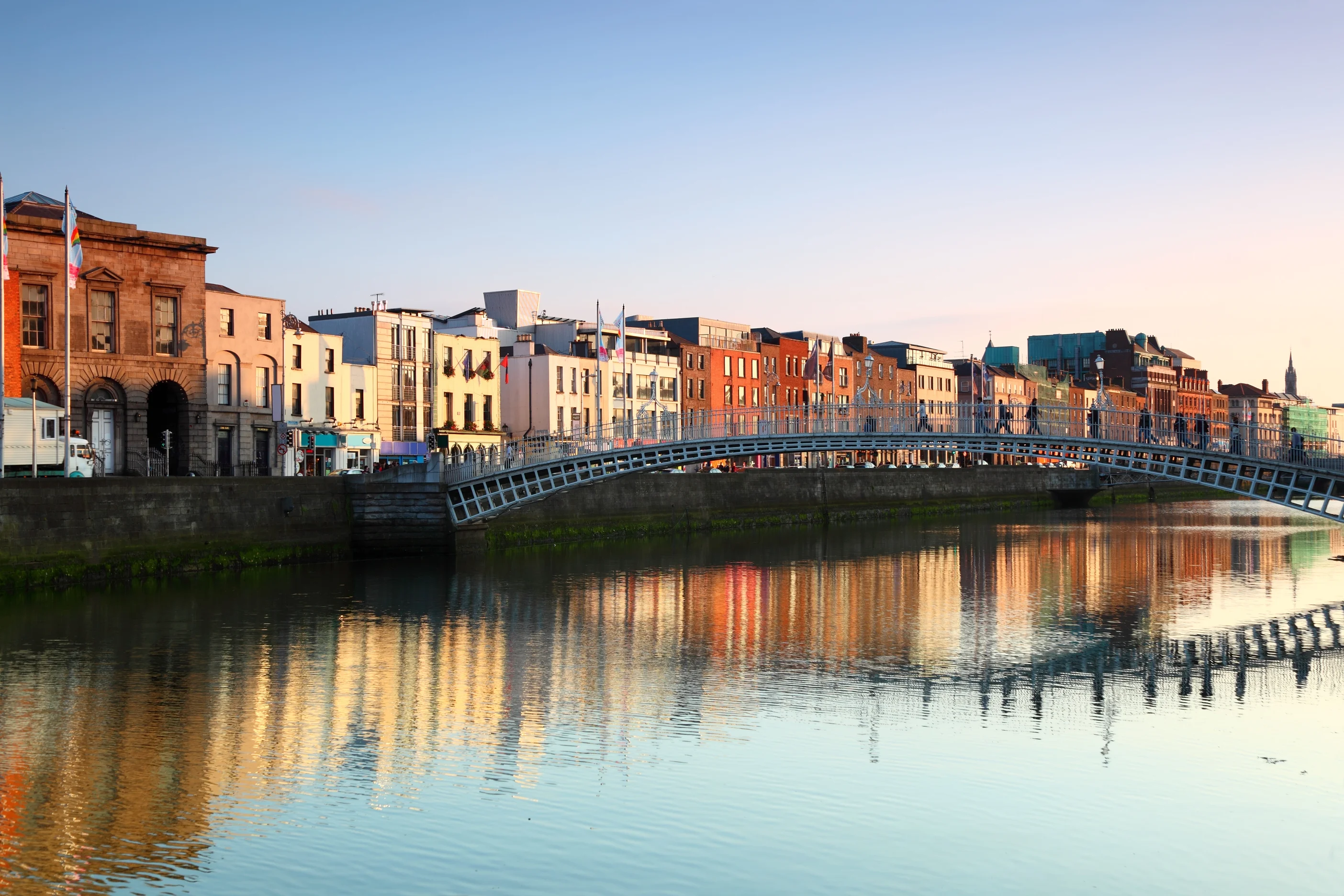
Ha'penny Bridge de Dublin

Top 6 most beautiful cities in Ireland to visit2026 ranking

Discover our members' favourite cities in Ireland. Feel free to publish your own reviews to take part in this collaborative ranking.

Favourite cities in Ireland among our members, approved by the editors

#1 Dublin +45 recs

Dublin balances thousand-year-old history with a nightlife scene that feels as social as a neighborhood tavern in Boston. You can walk the entire city in a few days, moving from the pubs of Temple Bar to the historic collections at Trinity College. Be prepared for high costs, with a pint of beer often running €7-9, and bring a reliable raincoat for the persistent drizzle. The local character makes the damp weather and the tab worth it.

Must-sees

#2 Cork +12 recs

Cork is the second-largest city in Ireland after Dublin. The city owes its growth to a natural harbor, often cited as one of the largest in the world behind Sydney. The historic center sits on an island carved out by the Lee River. This is home to St Patrick’s Street, the city's main artery lined with shops, restaurants, and entertainment venues. Nearby, you will find the English Market, a covered food hall operating since 1788 that feels like a more intimate, European version of Seattle's Pike Place Market. While downtown, check out the Crawford Art Gallery, which holds a collection ranging from the 17th century to the present.

Between Modernity and Tradition

Cork balances its layer of history with modern landmarks like its opera house and the Lewis Glucksman Gallery. This contemporary art space is located just steps from the University College Cork campus, founded in 1845 by Queen Victoria. Nearby stand the three spires of St Fin Barre’s Cathedral. Consecrated in 1870, it sits on a site that has been sacred to the Christian community since the 7th century. Spend time examining its Gothic Revival architecture and its 19th-century carvings before heading inside to see the stained glass.

A short walk away, you will find Elizabeth Fort, a former military fortification that now houses a museum. If you are interested in local history, visit the Cork City Gaol, a former women's prison open for tours. Finally, head toward Blackrock Castle, a short distance from the center. The castle has been repurposed into an observatory dedicated to astronomy and space exploration.

The Rebel City

For a more local feel, head to the north side of the city to the Shandon neighborhood. This former industrial area is defined by narrow, terraced houses and is home to several independent cafes and antique shops. It is also the site of Saint Anne’s Church, built in 1722. It is locally nicknamed the Four-Faced Liar because its four clock faces often show slightly different times. You can climb the 132 steps for a view of the city and the harbor. While in the area, stop by the Cork Butter Museum to learn about the city’s historic butter trade.

Cork has long been known as the Rebel City, a title earned after the local population stood against Henry VII in the 15th century. If you have time to explore the surroundings, visit Blarney Castle to kiss the famous stone of eloquence, though the steep climb is not for the faint of heart.

When to go

The best time to visit Cork is during the warmer months, specifically in the spring and early summer.

How to get there

You can fly into Cork, though many international travelers find it easier to connect through Dublin. From Dublin, the most convenient way to reach Cork is by train or bus.

#3 Galway +12 recs

Galway is the third-largest urban area in Ireland and sits firmly on the country's west coast. The city grew from its roots in the fishing and peat harvesting industries. You can still see the influence of these trades in the famous hookers, small black-hulled boats with distinctive red sails used for centuries. Some of these vessels are displayed at the Galway City Museum. Located right in the city center, the museum details the evolution of local traditions, housing, and rural life in and around Galway.

A city to explore in Ireland

The name Galway has deep roots. It comes from the medieval Gaelic expression Dún Bhun na Gaillimhe, which translates to "the fort at the mouth of the Corrib." Starting in the 12th century, Anglo-Norman troops occupied the city and pushed Gaelic-speaking residents to the margins. The new merchant class built a citadel and turned the settlement into a major commercial port. At the time, the city was governed by an oligarchy of 14 families, and only two were Irish. A former city gate, the Spanish Arch, was built in 1584 and still stands today. It marks the start of the Long Walk, a path that follows the Corrib river.

Continue your walk to Nimmo's Pier for a view of the colorful old-town houses lining the port. You are now near Claddagh, the former hub of the fish markets and the place where the Claddagh ring, a quintessential piece of Irish jewelry, was invented.

The Irish West in all its glory

In the heart of Galway's old town, a few Catholic religious buildings survived the assaults of Cromwell's Protestant troops. This includes the Saint Nicholas Collegiate Church, the largest medieval church in Ireland still in use, with construction dating back to 1320. The imposing Cathedral of Our Lady was built much later, in 1965. You can see it from the other side of the Salmon Weir Bridge, a spot known for watching salmon swim upstream during the warmer months. While wandering the streets, keep an eye out for Lynch's Castle, a former fortified townhouse.

When the weather is nice, take the scenic walk through Salthill, which features several beaches. On your way, you can visit the Atlantaquaria aquarium. Right across the street, stop by the Micil Distillery, opened in 2016 to revive a family poitín recipe that goes back 170 years. The staff can walk you through the distillation process, and they offer tastings of their gin, whiskey, and poitín.

Galway is also an ideal base for exploring the natural wonders of the Irish West, including Connemara National Park and the Kylemore Abbey. Other popular day trips from Galway include the Cliffs of Moher to the south or the traditional Aran Islands.

When to go

Visit Galway during the warmer months of spring and early summer. Autumn is generally avoided as the city experiences heavy rainfall during that season.

How to get there

Galway sits at the intersection of the N17 from the north, the N6 from the east, and the N18 from the south. From North America, Shannon Airport is the closest gateway, 90 km south of Galway with direct transatlantic flights. Otherwise fly into Dublin and catch a bus or train across the country.

Must-see

#4 Letterfrack +10 recs

Letterfrack is a small village founded in the mid-19th century by a couple of quakers, a Protestant religious community. During the height of the Great Famine, James and Mary Ellis built a shop, a dispensary, a school, and a few workshops in the middle of these desolate lands to help the local population survive. Letterfrack is a key stop when traveling through Ireland. As the gateway to the Connemara National Park, it also looks out over the Renvyle Peninsula and its striking white sand beaches.


The gateway to Connemara

Letterfrack is home to the Connemara National Park Visitor Centre, which functions as both a tourist office and an exhibition space, featuring extensive information on how peat bogs formed and their environmental importance for local flora and fauna. Several trails into the Connemara National Park start right from Letterfrack, including the hike up Diamond Hill, a distinctive 445-meter peak whose light color and shape recall the cut of a diamond. From the summit, you get sweeping views over the park with the waters of Ballynakill Bay in the background. Not far from the village in the heart of Connemara you will also find Ireland's only fjord, Killary Fjord.

Make time during your stop in Letterfrack to visit the striking Kylemore Castle, tucked into the greenery right on the edge of the lake of the same name. The estate belonged to Mitchell Henry, a wealthy English merchant who lost his wife during a trip to Egypt and built a neo-Gothic church in her memory, essentially a miniature cathedral. Located a few hundred yards from the castle, it features magnificent stained glass windows and columns built from several varieties of marble. The estate was later bought by Benedictine nuns who established a boarding school there. Visiting the site includes access to the Victorian walled gardens. Note that tours of the interior are limited to four rooms out of a total of 66, with the rest remaining private for the community, and the boarding school closed its doors in 2010.


The Renvyle Peninsula

North of Letterfrack lies another natural wonder of the Irish coast: the Renvyle Peninsula, home to wild beaches like Lettergesh, White Strand, and Glassilaun, where scuba diving and snorkeling are popular options.

If you want a workout, climb Mount Tully for views of the coastline on one side and the Connemara mountains, known as the Twelve Bens, on the other.


When to go

To steer clear of persistent rain and gray skies, the best time to visit Letterfrack and the Connemara National Park is during spring and summer when daylight hours are longest, though autumn brings striking russet tones to the boglands.


How to get there

Letterfrack sits right along the N59 national road that loops around the Connemara National Park. Renting a car is the easiest way to get around, though you can also catch a bus from Galway.

Must-see

#5 Bray +7 recs

Bray is a coastal town in Ireland, located just south of Dublin in County Wicklow, right on the Irish Sea. Back in the Middle Ages, Bray was part of the Pale, a narrow strip of land extending about 30 kilometers around Dublin that was under direct English monarchical rule. By the mid-19th century, the arrival of the railway turned the quiet village into a fashionable getaway for Dublin's upper class, establishing a local culture centered on seaside leisure and promenades. While international travel patterns shifted in the late 20th century, the town remains a classic destination.

A seaside escape in Ireland

Bray is built for recreation, featuring a mile-long beach anchored by a wide esplanade perfect for long walks. You can try your hand at water sports like diving, fishing, and water skiing, or stick to land-based favorites like golf and tennis.

For a closer look at local marine life, visit National Sea Life. This aquarium showcases the diverse ecosystems found in the Irish Sea and the wider Atlantic. Once you are back in town, you will find plenty of local pubs and restaurants to fill your evening.

Hiking around Bray

Beyond the water, Bray serves as a jumping-off point for some excellent trails. The Cliff Walk is a 7-kilometer route that starts at the base of Bray Head and hugs the coastline and its cliffs. The path leads toward the traditional harbor of Greystones, running alongside the rail tracks for a portion of the way. Keep an eye out for seals and swan colonies along the shoreline.

The town is tucked against the slopes of Bray Head. It is worth the climb to the 241-meter summit for the views over the bay and the Wicklow Mountains in the interior. You will find a large cross at the top, which still remains the site of processions during the Easter holiday.

To experience a slice of local history, head to Killruddery House, an Elizabethan-style mansion dating back to 1820. You can tour parts of the house to see the original period furnishings. The estate is surrounded by extensive French-style gardens and includes a working farm and a cafe on the property.

When to go

Plan your trip for the warmer months to make the most of the outdoor activities and sea swimming. If you head there in summer, you can catch the Bray Summerfest, which features a mix of fireworks, live music, and open-air markets.

How to get there

The town is a quick hop from Dublin via the DART commuter rail, with the trip taking about 40 minutes. If you prefer taking the bus, look for the 145 or 155 lines.

#6 Malahide +1 rec

Fifteen minutes by train from Dublin, this coastal village moves to the rhythm of its marina and the gulls circling fishing nets. Its castle stayed in the same family for eight centuries and overlooks a 250-hectare park you can explore without crowds or lines.

It is ideal for long walks in the salt air and seafood with a view of the water, though less suited for anyone looking for nightlife.

Find the best travel deals in Ireland

Hotels and stays Flights Car rentals Custom trips

Latest reviews

A Home Away From Home

Malahide, Ireland is such a cozy stay. It was at the end of our (me and my best friend) very busy Europe trip, and it felt like going home before going home. We were able to find an AirBnB and the hos…

211

The perfect city trip!

A dream destination for a weekend with friends, between the lively streets, the exceptional little shops, the architecture of the Irish pubs, and without forgetting the incredible hospitality of the I…

145

Cosmopolitan and complete

Dublin is the cosmopolitan city par excellence. Here, all cultures blend harmoniously, creating a unique richness in conversations and in the variety of dining and services. The streets are lively eve…

73

Must-see architecture

The city of Cork is a must-see during your trip to Ireland. I especially enjoyed the city center and the historic old town. The architecture of the buildings is quite impressive. It is a lively and fe…

34

Very lively city

I really loved my visit to the city of Galway. While the city center is quite small, it is very lively. It is a fairly touristy and very vibrant town. You will find pubs with a festive atmosphere and…

27

Rankings by travellers, for travellers

Our rankings are powered by thousands of reviews from travelers like you, not the arbitrary pick of a single editor. Every positive review you publish raises the destination’s score.

1 positive review = +1 reco

Your voice matters!

Have you travelled and discovered amazing places? Share your experience and help the community rank the most beautiful destinations! Sign up for free to post reviews and make your voice heard.