
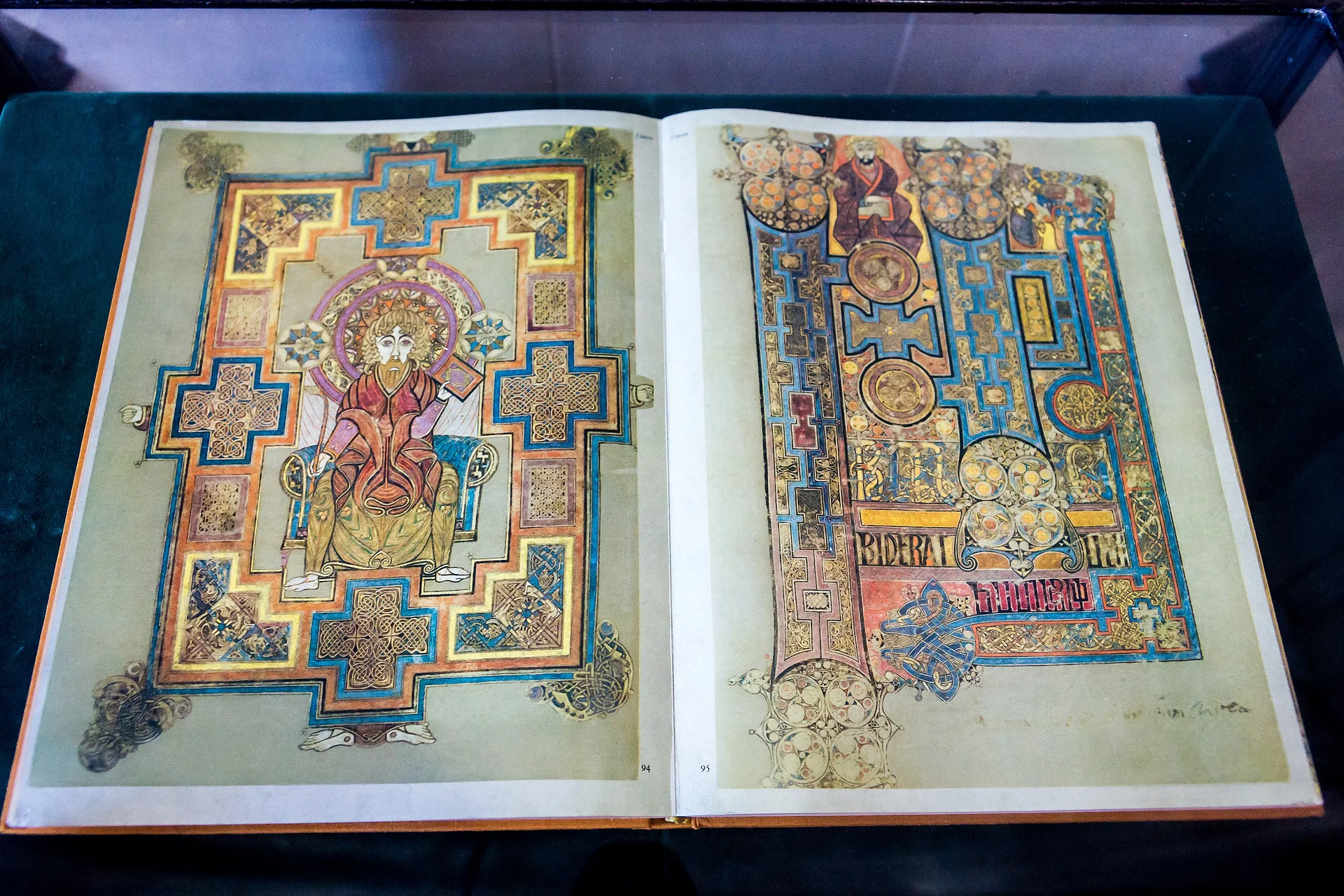
Book of Kells: seeing 1,200-year-old hand-painted artistry for yourself
The room is dimly lit. At the center, a thick glass case protects a manuscript displayed open to two folios. The pigments, derived from plants and minerals, have barely faded in twelve centuries. You are looking at something traced by hand on calf vellum by Celtic monks around the year 800. It is a sobering realization.
Why visit the Book of Kells?
Likely created by Irish monks on the Isle of Iona in Scotland and finished at the monastery of Kells following a Viking raid, this illuminated manuscript contains the four Gospels of the New Testament in Latin. It stands as one of the finest surviving examples of early Celtic Christian art.
Its ornamental complexity surpasses any other manuscript from that era. Every folio holds interlacing patterns, fantastical creatures, and initials decorated with a precision that defies the imagination regarding how long the work took to complete.
The manuscript has been kept at Trinity College Dublin since 1661, when it was given to the university by the Bishop of Meath to protect it during civil wars. It has since become the primary cultural attraction in Dublin, drawing up to one million visitors in a single year.
What to expect during your visit
The Treasury: facing the manuscript
The tour starts in an introductory room that outlines the history of the book. You learn that its 340 folios were made on tanned vellum and that the pigments include lapis lazuli from Afghanistan and yellow orpiment of mineral origin.
Then comes the Treasury, a dark room with a single display case holding the book. Two pages are visible at any time. These pages change several times a year for conservation reasons, with no advance notice. The specific page you see is one that no other visitor will have viewed that same semester.
The Long Room: a dizzying library
Your ticket also grants access to the Long Room, a Victorian library 65 meters long. Its barrel-vaulted ceiling was raised in 1860 to accommodate an upper gallery. The oak shelves once held 200,000 volumes.
Since 2023, the books have been removed one by one for cleaning and electronic cataloging as part of a massive restoration project for the 18th-century building. The room remains open, and it is spectacular even when empty, perhaps even easier to appreciate architecturally without the books.
Among the items still on display is the Trinity College Harp, dating from the 14th or 15th century. It is the oldest harp in Ireland and the country's national emblem. You can find it on Irish euro coins and Guinness bottles.
The Red Pavilion: an immersive digital experience
Since January 2024, a temporary red building called the Red Pavilion has rounded out the visit with three digital spaces. These include a 360-degree animated reconstruction of the Book of Kells, an exploration of the library's secret collections, and a look at how the Long Room will appear after its renovation. While we were initially skeptical of this kind of digital installation, our reservations were unfounded. The 360-degree room is genuinely impressive.
Friendly tip: Booking online is essential, as time slots fill up days in advance during the high season. The Long Room is open until the end of 2027 before it closes for renovation. If you are planning a trip to Dublin, there is no reason to delay.
Why it is worth it
- Coming face to face with a 1,200-year-old manuscript in its original setting is a unique experience in Dublin.
- The Red Pavilion, opened in 2024, provides context and presentation that the old exhibit lacked.
- The Long Room remains accessible until the end of 2027, making this the right time to see it before it closes for restoration.
- You can explore the Trinity College campus freely around your visit at no extra cost.
Things to consider before booking
- The Long Room is currently almost entirely emptied of its books, which have been placed in storage for restoration.
- You only see two pages of the manuscript behind glass in a dimly lit room, leading some visitors to feel disappointed by the brevity of the experience.
- The ticket price is high for what some visitors perceive as a short tour.
- Crowds are very heavy in the summer, though the 9:00 a.m. slots are the quietest.
Ticket price guide
| Category | Estimated price |
|---|---|
| Adult | ~$21 to $29* |
| Student / senior (with ID) | Reduced rate |
| Child | Reduced rate or free depending on age |
| Trinity College students and staff | Free (pre-booking required) |
Prices are subject to change.
Opening hours
In the off-season (October to April):
- Mon-Sat 9:30 AM-5:00 PM
- Sun 12:00 PM-4:30 PM.
In the peak season (May to September):
- Mon-Fri 9:00 AM-6:00 PM
- weekends 9:30 AM-6:00 PM
How long for this activity
*Information subject to change

While the Book of Kells is very well preserved, I was a little bit disappointed by it. I found the entry price to be quite high. However, it is possible to get in for free. Actually, university students can potentially get you in with them. If you are friendly, there is a good chance they will agree.