
Visiting the Costa Smeralda
Some fifty kilometres of jagged coast in north-east Sardinia, between Olbia and the La Maddalena archipelago. In the 1960s, a consortium led by the Aga Khan bought this shepherds' land and had villages built in a Sardinian style, with ochre render and tiled roofs, banning tower blocks. Porto Cervo is its heart, with its marina and its yachts.
All around, Gallura keeps its pink granite, its cork oaks and its isolated farms. To the north, Palau looks out onto the islands of La Maddalena, a national park of crystal-clear water. You come for the beaches, the sailing and the evening light on the rocks, not for monuments.
You will love it if
- You are after some of the clearest water in the Mediterranean
- You love boat trips between the islands
- You want discreet luxury with still-wild coves next door
Give it a miss if
- Your budget is tight in August: prices here are among the highest in Italy
- You travel without a car: the beaches lie at the end of small roads
- You come in winter: most hotels close from October to April
The must-sees
-
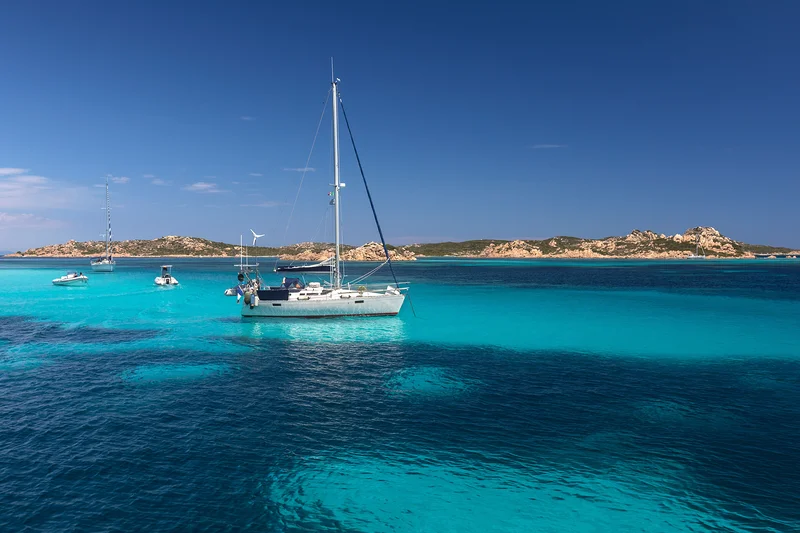
1 The La Maddalena archipelago
Seven large granite islands and a scattering of islets, twenty minutes by ferry from Palau. Boat trips tour the coves, pass the Pink Beach of Budelli, admired from the water, and stop for swims. For Cala Coticcio, on Caprera, access must be booked in summer.
-
Three small coves of white sand separated by rounded rocks, shaded by junipers, ten minutes from Porto Cervo. The water stays calm even when the mistral blows. Arrive before ten in August: the car park fills fast.
-
3 The Porto Cervo piazzetta Village
In the evening, the whole coast meets on the little square of Porto Cervo, between the boutiques and the marina where the big sailing yachts are moored. Then climb to the all-white Stella Maris church to watch the harbour light up. The aperitif is pricey; the stroll is free.
-
4 The Bronze Age giants Archaeology
Around Arzachena, the nuraghe builders left stone towers and giants' tombs, long burial chambers closed by a great stele. You can see them in half a day, among the olive trees, far from the beach crowds.
-
5 The September regattas Regattas
In early September, the world's biggest racing yachts gather off Porto Cervo. From the headlands, you can watch their sails pass between the islands. It is also the best time to come: the sea is warm and the crowds have gone home.
The classic trap
Booking in August without a car, in the middle of Porto Cervo. You will pay top price for a room, and every beach will cost you a taxi. Come in June or September, hire a car in Olbia, and stay in an inland village such as San Pantaleo.
Our itineraries in the Costa Smeralda
| Length | Itinerary | What you see |
|---|---|---|
| 3 days | Porto Cervo › Capriccioli › Cala di Volpe | The finest beaches on the coast and the piazzetta in the evening |
| 5 days | Porto Rotondo › Porto Cervo › Palau › La Maddalena | The coast, the archipelago by boat, Bear Rock |
| 1 week | From Olbia to Santa Teresa Gallura, via Arzachena and San Pantaleo | The whole coast, the nuraghic sites and the granite hinterland |
Start with the Arzachena coast: the beaches of Capriccioli and the Prince, then an evening on the piazzetta in Porto Cervo. The next day, head up to Palau for a day's boat trip around the La Maddalena archipelago. Got a week? Add the giants' tombs of Arzachena, the San Pantaleo market and dinner in Porto Rotondo.
When to visit the Costa Smeralda
| Interest | Season | Temperatures | The highlight | Crowds and prices |
|---|---|---|---|---|
| WinterNov. to Mar. | 7 to 15°C | Empty villages and green maquis | Low | |
| SpringApr. to June | 12 to 27°C | Maquis in bloom and quiet beaches | Medium | |
| SummerJuly and Aug. | 20 to 31°C | Swimming and Porto Cervo nights | High | |
| AutumnSept. and Oct. | 15 to 27°C | Warm sea and regattas | Medium |
Our advice
Come in June or September: the sea is already above twenty degrees, the beaches have room, and hotel prices often drop by half compared with August. Keep an eye on the mistral, which can blow for several days: it makes some beaches rough and boat trips uncertain.
Getting to the Costa Smeralda
-
By plane to Olbia The simplest
Direct flights link London, Manchester and other UK airports to Olbia in about two and a half hours, mainly from April to October. The airport is twenty-five minutes from Porto Rotondo and forty from Porto Cervo.
-
By ferry from mainland Italy With your own car
Ferries link Genoa, Livorno and Civitavecchia to Olbia and Golfo Aranci, by day or overnight. Book the crossing early for summer.
-
By ferry from Corsica Via Bonifacio
If you are in Corsica, a ferry links Bonifacio to Santa Teresa Gallura in about an hour. Porto Cervo is then three quarters of an hour by road.
Hire a car at Olbia airport: the beaches and villages are scattered, and buses do not serve the coves. Book it in winter for the summer, as the island runs short in August.
Getting around the Costa Smeralda
A car is essential: the coast is explored on small winding roads, and each cove has its own car park. For the archipelago, leave it in Palau and take the ferry to La Maddalena, or a day-long boat trip. In summer, renting a scooter or a small licence-free boat is a lovely way to hop from beach to beach.
Good to know
In August, the car parks at the famous beaches charge and are full by late morning. Set off early and keep some change. A UK licence is accepted for driving in Italy, where you drive on the right; for a boat under forty horsepower you need no licence at all.
What to eat in the Costa Smeralda
- Zuppa gallurese: Gallura's 'soup', in fact a bake of bread, cheese and broth.
- Porceddu: suckling pig slow-roasted on a spit, the dish of feast days and farm restaurants.
- Seadas: a fried pastry filled with fresh cheese and drizzled with bitter honey.
- Vermentino di Gallura: the white wine of the granite, the only wine on the island with Italy's highest designation.
- Bottarga and seafood: dried mullet roe and sea urchins, over pasta in the harbour restaurants.
- Mirto: myrtle berry liqueur, served ice-cold at the end of the meal.
To eat like the locals, leave the coast and find yourself an agriturismo in the hills of Arzachena or San Pantaleo: the set menu runs from cured meats to homemade pasta and porceddu. At Olbia harbour, you will pay far less for the catch of the day than in Porto Cervo.
Where to stay in the Costa Smeralda
| Area | What for | Good to know |
|---|---|---|
| Porto Cervo and Cala di Volpe | Beaches, marina, nightlife | The most luxurious |
| Baja Sardinia and Cannigione | Family beaches, boat departures | The most practical |
| San Pantaleo and the hinterland | Granite villages, agriturismi | The most authentic |
| Palau and La Maddalena | The archipelago, islands by boat | The most seafaring |
| Olbia and Porto Rotondo | Airport, ferries, lively harbour | The cheapest |
How much does a trip in the Costa Smeralda cost?
| Trip | Length | Budget per person |
|---|---|---|
| Budget (room in Olbia, shared car, picnics) | 5 days | €500 to €800 |
| Comfort (hotel near the beaches, car, boat trip) | 5 days | €1,200 to €2,000 |
| Luxury (grand hotel, private boat, fine dining) | 5 days | €4,000 to €8,000 |
- The season: in June and September you often pay half the August price for the same room.
- The beaches: they are public and free; only car parks and beach-club loungers charge.
- Boat trips: a shared day in the archipelago costs far less than a private boat, and stops at the same coves.
- Meals: an inland agriturismo feeds you generously for a fraction of a marina restaurant's price.
- The national park: access to some archipelago beaches is charged and limited in summer; book online.
Traditions and way of life in the Costa Smeralda
For a long time Gallura was a land of shepherds, cork oaks and stazzi, granite farmhouses isolated in the maquis. A dialect close to Corsican is still spoken, and inland villages such as Luras and Tempio keep their festivals and songs. Long before them, the nuraghe people had covered the island with stone towers.
In 1962, the Aga Khan and his partners founded the Costa Smeralda and entrusted the villages to architects who invented an idealised Sardinian style, all curves and render. Just opposite, the island of Caprera keeps the house where Garibaldi, the hero of Italian unification, spent his last years. Heading to La Maddalena? Cross the bridge to Caprera: his farm is open to visitors, among the pines.


