Visiting the Dolomites
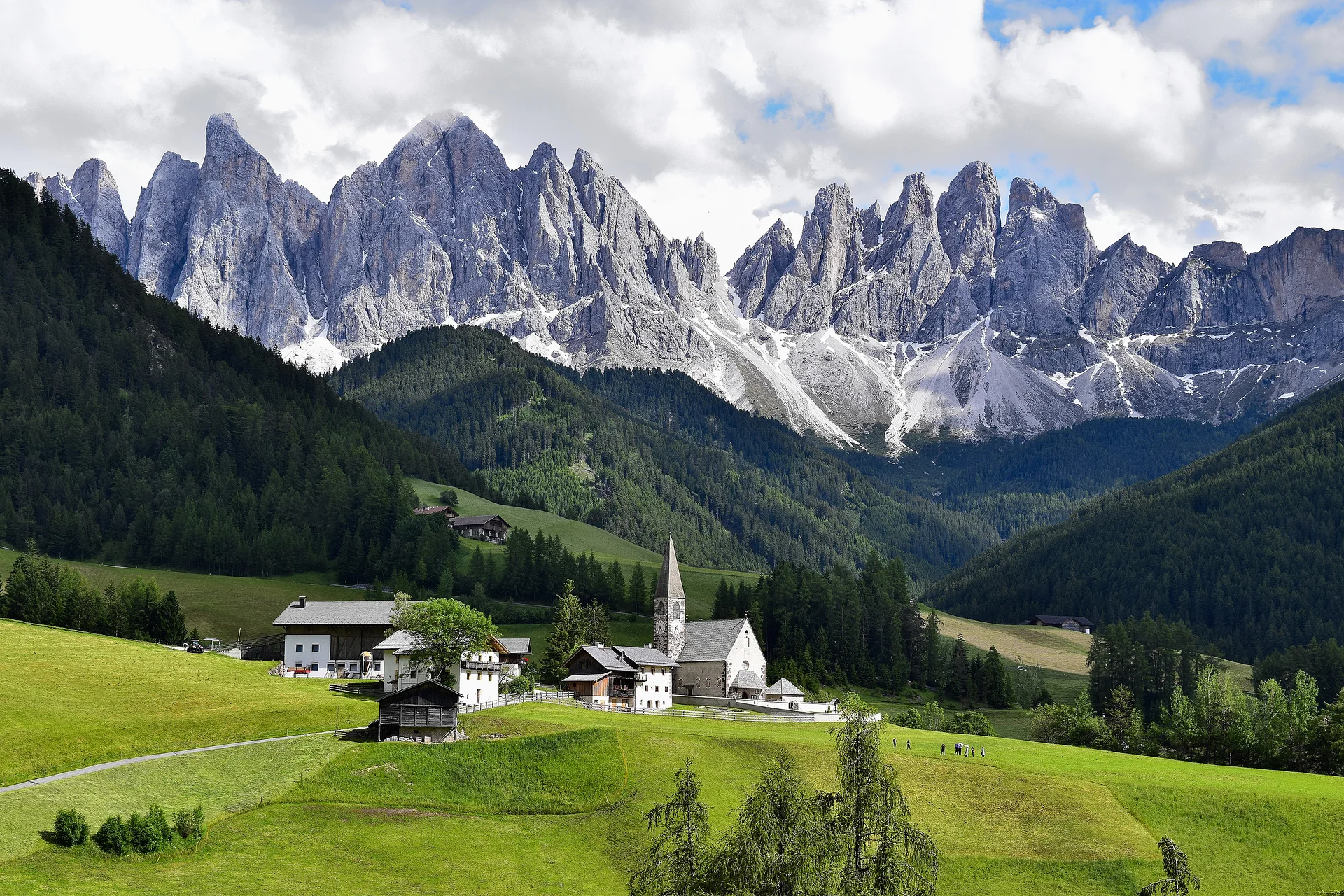
A range of pale peaks set between South Tyrol, Trentino and the Veneto, a UNESCO World Heritage Site since 2009. The rock is an ancient coral reef, pushed up and then carved into towers, needles and walls. At sunset it takes on a pink glow that locals call the enrosadira.
Each valley has its own character. In Val Gardena and Alta Badia, people speak Ladin, German and Italian, and the villages live off the mountains all year round. Cortina d'Ampezzo plays the chic resort, host of the 2026 Winter Games. Further south, around Belluno, the valleys empty out and so do the trails. You come here to hike, ski or drive the passes, rarely for a city.
You will love it if
- You want to walk from hut to hut without being a climber
- A plate of canederli facing the peaks appeals to you more than a museum
- You like skiing or driving from one pass to the next
Give it a miss if
- You want neither to drive in the mountains nor to rely on buses
- You can only travel in May or November, when almost everything is closed
- You want quiet famous spots in August: they are overrun
The must-sees
-
1 Tre Cime di Lavaredo Hike
The most photographed limestone towers in the range. The full loop via the Lavaredo and Locatelli huts takes three to four hours, with no technical difficulty. In 2026, the toll road from Misurina must be booked online: 40 euros per car. The bus from Cortina avoids the booking.
-
2 Seceda
A grassy ridge that drops away to the needles of the Odle, above Ortisei. The cable car takes you to the top in twenty minutes. On the ridge path, farmers have installed a 5-euro turnstile: the trail just below avoids it and keeps the same view.
-
3 Lago di Braies Lake
Emerald water at the foot of a wall more than a thousand metres high, and a path that loops around it in an hour. From 1 July to 15 September, the road is closed from 9 am to 4 pm without a booking: take the bus from Monguelfo, or arrive before 9.
-
4 Dolomiti Bellunesi National Park +5 recs
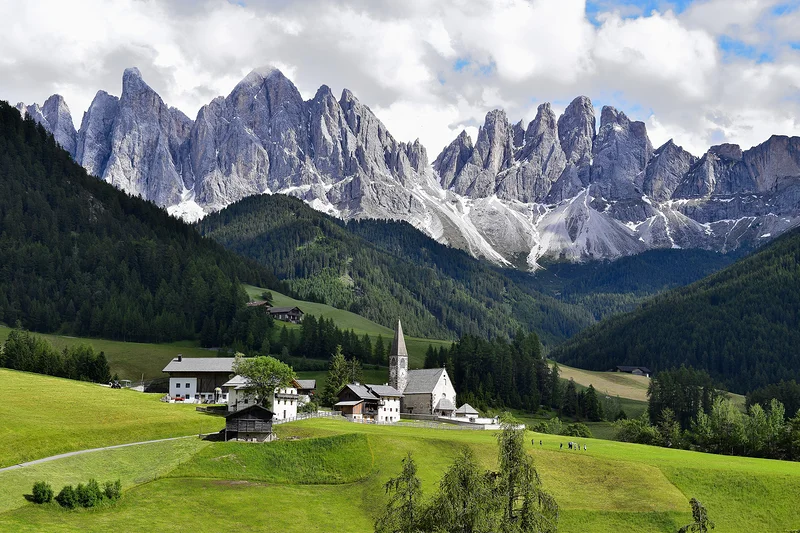
The southern side, around Belluno and Feltre, with no cable cars and no crowds. Trails through forests and pastures, chamois and marmots. This is where you will find peace when the big valleys are full.
-
5 The Sella loop Ski or bike
Four passes around the Sella massif: Gardena, Sella, Pordoi and Campolongo. In winter, the Sellaronda is skied in a day, from lift to lift. In summer, by bike or by car, in half a day, with a stop at the Pordoi for the view of the Marmolada.
The classic trap
Turning up at 11 am in August at the Tre Cime, Lago di Braies or Seceda. The car parks are full, the cable cars have an hour's wait and the trail looks like a queue. Set off before 8 am, or keep these spots for June and September. And in the mountains, summer storms often break in the afternoon: be back down before 3 pm.
Our itineraries in the Dolomites
| Length | Itinerary | What you see |
|---|---|---|
| 4 days | Val Gardena › Seceda › Sella loop › Alta Badia | The Odle needles, the passes, the Ladin villages |
| 1 week | Val Gardena › Alta Badia › Cortina › Tre Cime › Lago di Braies | The heart of the range, from the west to the Pustertal |
| 2 weeks | Val di Fassa, Val Gardena, Cortina, the Pustertal, then the Brenta | The whole range, on both sides of the Adige |
Start in the west, in Val Gardena, and work east: Alta Badia over the Gardena Pass, then Cortina, then the Tre Cime and Lago di Braies, less than an hour away. Got two weeks? Keep the Brenta, around Madonna di Campiglio and Molveno, for the end: it lies on the other side of the Adige, two and a half hours' drive away.
When to visit the Dolomites
| Appeal | Season | Temperatures | What is open | Crowds and prices |
|---|---|---|---|---|
| WinterDec. to Mar. | -8 to 3 °C | Slopes and lifts | High | |
| SpringApr. and May | 0 to 15 °C | Almost nothing up high | Low | |
| SummerJun. to Sep. | 8 to 24 °C | Huts, lifts, trails | High | |
| AutumnOct. and Nov. | 0 to 14 °C | Until mid-October | Medium |
Our advice
For hiking, aim for late June or September: the huts and lifts are open, and the trails are quieter than in August. Avoid the week of 15 August, when all of Italy heads for the mountains. For skiing, January and March are calmer than the Christmas and February holidays.
Getting to the Dolomites
-
By plane to Venice or Verona The simplest
Venice has direct flights from London and, in season, from New York; Verona and Innsbruck are other gateways. From Venice, allow two and a half hours by road to Cortina; from Verona, two hours to Bolzano and Val Gardena. Munich serves the northern approach.
-
By train to Bolzano No car needed
Via Milan, Verona or Munich, the train brings you to Bolzano, Bressanone or Brunico. From there, buses climb into Val Gardena, Alta Badia and the Pustertal.
-
By bus to Cortina From Venice
Direct buses link Venice airport with Cortina d'Ampezzo in just over two hours, all year round. In summer, book your seat the day before.
Choose your airport according to your first base: Venice for Cortina and the Cadore, Verona or Bolzano for Val Gardena and Val di Fassa, Innsbruck for the Pustertal. Pick up a car on arrival: the passes and valleys are only really workable with one.
Getting around the Dolomites
A car remains the freest way to move from one valley to the next: the passes take twenty minutes to cross, but on tight hairpins. Buses are far more useful here than in most mountains, especially in South Tyrol: many hotels give you a card that makes them free. Once there, cable cars do the rest. For the Tre Cime and Lago di Braies in summer, the bus avoids the bookings.
Good to know
A UK or EU licence is enough; with a US or other non-EU licence, Italy asks for an International Driving Permit. From 15 November to 15 April, winter tyres or chains on board are compulsory on most mountain roads. In summer, you share the passes with cyclists and motorbikes: allow twice the time your satnav shows.
What to eat in the Dolomites
- Canederli: large bread dumplings with speck or cheese, served in broth or with melted butter.
- Speck: South Tyrol's smoked cured ham, cut in thick slices on a wooden board.
- Schlutzkrapfen: half-moons of pasta filled with spinach and curd cheese, topped with butter and parmesan.
- Casunziei: Cortina's ravioli, filled with beetroot and sprinkled with poppy seeds.
- Polenta: served with mushrooms, sausage or melted cheese, the dish of the mountain huts.
- Kaiserschmarrn: a thick pancake torn into pieces, with lingonberry jam, which you will order at the hut after the climb.
To eat like a local, climb to the hut or to the malga, the summer pasture farm: barley soup, a board of speck and a glass of lagrein, South Tyrol's red wine. In the evening, down in the valley, you will find the same food in wood-panelled Stuben, served later.
Where to stay in the Dolomites
| Area | What for | Good to know |
|---|---|---|
| Val Gardena and Alpe di Siusi | Seceda, pastures, Sella | The most in demand |
| Alta Badia | Ladin villages, Sellaronda, food | Pricey in winter |
| Val di Fassa and Fiemme | Marmolada, Latemar, families | More affordable |
| Cortina and the Cadore | Cinque Torri, Lagazuoi, Tre Cime | The most chic |
| Pustertal | Lago di Braies, Tre Cime, Sesto | The furthest east |
| Brenta | Madonna di Campiglio, Molveno | On the other side of the Adige |
How much does a trip in the Dolomites cost?
| Trip | Length | Budget per person |
|---|---|---|
| Budget (guesthouse, buses, huts) | 7 days | €700 to €1,000 |
| Comfort (valley hotel on half board, car, lifts) | 7 days | €1,400 to €2,200 |
| Luxury (spa hotel, skiing or a guide) | 7 days | €3,000 to €5,000 |
- The season: Christmas, February and August are the most expensive weeks. If you can choose, late June and September remain the best compromise.
- Half board: most hotels offer it, and it often works out cheaper than a restaurant every evening.
- Lifts: in summer, a multi-day pass costs less than single rides if you take two a day.
- Paid access: 40 euros for the Tre Cime road, 25 euros for the booked car park at Lago di Braies in summer.
- The ski pass: the biggest item of a winter trip: buy it online in advance if you want to pay less.
Traditions and way of life in the Dolomites
South Tyrol was Austrian until 1919: German is spoken here, and the villages have kept their onion-domed bell towers. In five valleys around the Sella, the older generation still speaks Ladin, a Romance language of its own. During the First World War, the front ran along the ridges: at the Lagazuoi, you will walk through tunnels the soldiers dug into the rock.
In Val Gardena, Ortisei has carved wood for three centuries, and its workshops still fill the windows of the main street. Cortina hosted the Winter Olympics in 1956, then again in 2026. In the evening, wait for the enrosadira: a few minutes when the peaks turn from grey to pink, then to violet.