
Where to stay in Singapore: the 6 neighborhoods to know in 2026
In Singapore, you still pick your hotel on the plan of 1822: three years after founding the trading post, Raffles sorted the town by community, the Chinese south of the river, the Malays and Arabs to the east, the Indians to the north, the Europeans in between, and those four quarters are still there, with their temples, their mosque and their shophouses. Added since are the towers of Marina Bay, the malls of Orchard Road, the island of Sentosa and, to the east, the Peranakan houses of Katong all the way to the airport. The metro links everything in under an hour, so the choice of neighborhood does not settle what you will visit: it settles what you find under your window when you get back.
A capsule bed costs $32 to $48*, a three or four-star hotel $135 to $260*, and the grand establishments of the bay, Orchard or Sentosa go beyond $340*, often $570*. Eighteen addresses whose listing is still open, and the words of three members out of the four reviews the city has, including one traveler the Gardens by the Bay failed to convince: you get them as they are, with the username, because no brochure would have written them.
Here is a tropical archipelago that has turned into a megacity, with skyscrapers, lush plantations, ocean air, heat, and humidity. It is surprising!
Compare hotel prices in Singapore
In a hurry? Find the best accommodation deals in 3 clicks.
Compare live deals from Booking, Expedia, Agoda and other partners.
At a glance: our picks by traveller type
Pick the profile that suits you to head straight to the recommended neighborhood.
The neighborhood map in Singapore
Get your bearings on the neighborhoods and must-see sights before choosing where to drop your bags. Click a name to jump to its description.
Marina Bay and the Civic District Center: Marina Bay Sands, Gardens by the Bay, Merlion, Esplanade, Padang, cathedral, National Museum, Fort Canning, Suntec
for the bay at night, the museums and postcard Singapore
The Civic District is the European town of the 1822 plan: the Padang, a cricket lawn lined by St Andrew's Cathedral and the old City Hall, now a museum; the columns of Parliament and the Victoria Theatre on the riverbank; Fort Canning, the hill where the first governor had his house built; the Raffles, the arcades of CHIJMES, the National Museum under its dome of 1887. Across the water, on land reclaimed from the sea, Marina Bay: the three towers of Marina Bay Sands with their boat perched on the 57th floor, the Merlion spouting into the bay, the shells of the Esplanade, the big wheel, and the Gardens by the Bay with their fifty-meter Supertrees, lit every evening at a quarter to eight. The walk around the bay is three and a half kilometers, on foot, after sunset, when the heat drops. The downside: the most expensive hotels in the city, and nothing of a neighborhood where people live. A member says what he thinks of the gardens, and he does not agree with everyone.
Not sold on the style of this artificial forest...
Where to stay in this neighborhood
Marina Bay Sands Luxury
The three towers and the infinity pool on the 57th floor, above the bay: nineteen thousand reviews at 9.4, which mention the pool and the view of the gardens before the room. The most expensive in this guide, and the only one where you sleep inside the postcard.
Swissôtel The Stamford Mid-range
Above City Hall station: a tower of seventy floors, two pools, a spa, the bar on the 70th, and 8.6 on two thousand reviews, 9.5 for location. Linked underground to the malls and the metro, you can sit out a whole downpour without getting wet.
Wyndham Singapore Hotel Budget
On Coleman Street, behind the cathedral: two outdoor pools, rooms larger than the city average, as the reviews keep saying, and 8.4 on fourteen hundred reviews. The cheapest within walking distance of the bay.
Pros
- The Gardens by the Bay and the Merlion on foot, the museums when it rains
- Three metro stations and the air-conditioned underpasses
Cons
- The most expensive rooms in the city, and few cheap ones
- A district of offices and conventions, empty on Sunday evening
Chinatown, Tanjong Pagar and the quays South of the river: Chinatown, Telok Ayer, Ann Siang Hill, Club Street, Duxton, Boat Quay, Clarke Quay, Robertson Quay
for the shophouses, the hawkers and the evening bars
Chinatown is the Chinese quarter of the 1822 plan, and it has kept its rows of shophouses with colored shutters, the Hindu temple of Sri Mariamman from 1827 planted in the middle, the Jamae mosque two streets on, the Thian Hock Keng of Telok Ayer, which faced the sea before the land fill, and the Buddha Tooth Relic Temple, brand new and all red. You eat at the Chinatown Complex and at Maxwell, on a plastic stool, for five dollars. In the evening, Ann Siang Hill and Club Street put their tables out on the road, Duxton Hill pours its cocktails, and the quays of the river, Boat Quay under the towers, Clarke Quay under the neon, Robertson Quay quieter, keep going until two in the morning. The downside: shophouse rooms are small and have no window on the street, and Clarke Quay on a Saturday night can be heard from afar.
Where to stay in this neighborhood
The Fullerton Hotel Singapore Luxury
The old post office of 1928 at the mouth of the river, Doric columns and an infinity pool on the quay: 8.8 on fifteen hundred reviews, 9.6 for location, Raffles Place five minutes away. Boat Quay is across the bridge.
AMOY by Far East Hospitality Mid-range
Thirty-seven rooms in the shophouses of Telok Ayer, the entrance through a former temple, exit D of the metro opposite: 8.9, and reviews that mention staff who call everyone by name. The bars of the neighborhood are downstairs.
Jyu Capsule Hotel Budget
On the upper floors of a shophouse on Smith Street, adults-only capsules, washing machines, and 8.7 on twelve hundred reviews. The hawkers of the Chinatown Complex are at the end of the street.
Pros
- The temples, the hawkers and the bars on foot, Marina Bay a twenty-minute walk away
- The shophouse hotels, the cheapest in the center after the capsules
Cons
- Small rooms, often windowless, in the shophouses
- Clarke Quay and Boat Quay noisy until two on weekends
Orchard Road, the Botanic Gardens and the green north North-west of the center: Orchard Road, Tanglin, Botanic Gardens, Istana, Novena, and beyond them Mandai Zoo, MacRitchie, Bukit Timah, Jurong
for the malls, the gardens and families heading to the zoo
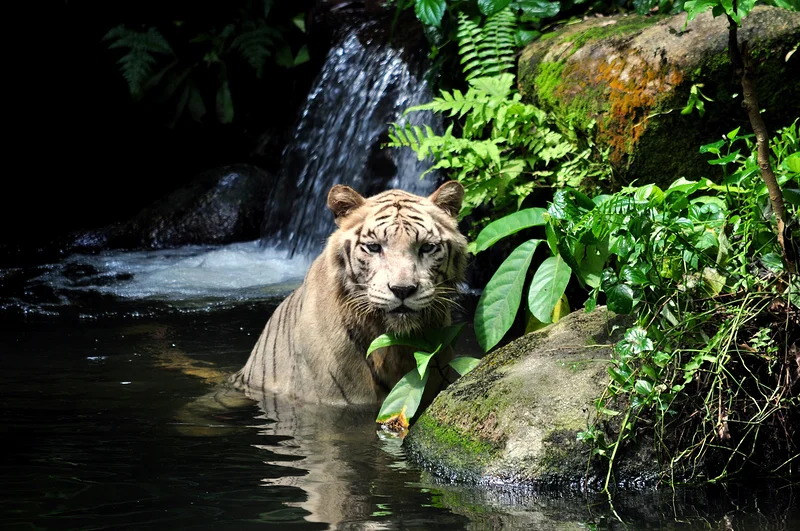
Orchard Road used to be a road through nutmeg plantations; today it is two kilometers of malls, ION, Ngee Ann City, Paragon, linked by air-conditioned walkways, with the Istana, the president's palace, behind its gates at the end of the street. To the west, the Botanic Gardens, open from five in the morning to midnight and free, sixty-four hectares of lawns, lakes and primary forest, with the paying orchid garden in the middle. Orchard's hotels are the most numerous in the city, from the grand hotel in its park to the cabin with an adjustable bed. It is also from here that the road north begins: the zoo and the Night Safari at Mandai thirty minutes away, the treetop walkway of MacRitchie, the hill of Bukit Timah, and Jurong to the west for the Science Centre. The downside: a street made for shopping, which goes dark at ten. A member says what the zoo is worth.
Set in lush vegetation, a tropical forest that works really well with the local climate, the Singapore Zoo is splendid. There are quite a few enclosures that are open and spacious.
What to see & do in the neighborhood
Where to stay in this neighborhood
Shangri-La Singapore Luxury
Six hectares of tropical gardens on Orange Grove Road, behind Orchard: three wings, two tennis courts, the Chi spa, and 9 on twenty-one hundred reviews. Orchard's grand hotel since 1971, for half the price of the bay.
JEN Singapore Orchardgateway by Shangri-La Mid-range
Above Somerset station and the Orchardgateway mall: a rooftop pool with the city all around, a buffet that sixty-four hundred reviews mention, and 8.8. The best score on the street for the price of a four-star.
YOTEL Singapore Orchard Road Budget
At 366 Orchard Road: compact cabins with an adjustable bed, a pool, a bar, check-in at a kiosk, and 8.4 on fifty-three hundred reviews. The soft price on the street of malls.
Pros
- The widest choice of hotels in the city, at every price
- The Botanic Gardens on foot, the zoo thirty minutes away
Cons
- A street of malls, dark after ten in the evening
- Marina Bay and Chinatown fifteen minutes away by metro, not on foot
Kampong Glam, Bugis and Little India North-east of the center: Sultan Mosque, Arab Street, Haji Lane, Bugis Street, Serangoon Road, Mustafa, Jalan Besar
for the lanes, the capsules and the Singapore that smells of incense and curry
The 1822 plan put the Malays and the Arabs around the Sultan Mosque, and Kampong Glam has stayed that village: the golden dome at the end of Bussorah Street, the fabric merchants of Arab Street, the painted walls and the shops of Haji Lane, the Turkish cafés and the kebabs in the evening. Next door, Bugis, its covered market open twenty-four hours and its malls, then, across the railway line, Little India: Serangoon Road, the jasmine garlands, the temple of Sri Veeramakaliamman, the Tekka Centre for biryani, and the Mustafa Centre, open day and night, where you find everything. This is the district of capsules and small hotels, the cheapest in the center, two stations from the bay. The downside: tiny rooms, and Serangoon Road packed on Sunday, the workers' day off.
Where to stay in this neighborhood
Andaz Singapore Luxury
Above Bugis station, in the Duo tower: rooms designed by André Fu, a complimentary minibar, the Mr Stork bar on the roof with the city at 360 degrees, and 9 on nine hundred reviews. The Sultan Mosque is three hundred meters away.
Mercure Singapore Bugis Mid-range
On Middle Road: a rooftop infinity pool with a hot tub, rooms the reviews find tiny, and 7.9 on thirteen hundred reviews, 9.1 for location. You sleep here for the street, not for the room.
The Pod at Beach Road Boutique Capsule Hotel Budget
On Beach Road, ten minutes from Bugis Junction: capsules with cotton sheets, a floor reserved for women, and 8.4 on nine hundred reviews, 9.2 for location. Haji Lane is around the corner.
Pros
- The capsules and the small hotels, the cheapest in the center
- Haji Lane, the mosque and Little India on foot, the bay two stations away
Cons
- Tiny rooms, the price of the street
- Serangoon Road packed on Sunday
Sentosa and HarbourFront South: Sentosa island, Siloso, Palawan and Tanjong beaches, Universal Studios, Fort Siloso, VivoCity, HarbourFront, Mount Faber
for the beaches, the theme parks and children
Sentosa is an island of five square kilometers linked to the city by a bridge, a monorail leaving from the VivoCity mall and a cable car leaving from Mount Faber. You come for the beaches of imported sand, Siloso, Palawan, Tanjong, lined with bars and coconut palms, with the cargo ships at anchor as a backdrop; for Universal Studios and the oceanarium on the Resorts World side; for Fort Siloso, the British guns of 1942 and the walkway through the trees. The hotels range from the beach resort to villas in the forest, and all of them have a pool. Opposite, on the mainland, HarbourFront, its metro station and VivoCity, the largest mall on the island, with the ferries to Kusu Island and Haw Par Villa, the park of Tiger Balm statues, ten minutes to the west. The downside: island prices, and Chinatown twenty minutes away by metro.
Where to stay in this neighborhood
Capella Singapore Luxury
In the forest of Sentosa, a fifteen-minute walk from Universal Studios: colonial buildings of 1880 linked by a curve by Norman Foster, three pools, the Auriga spa, and 9.1 on nearly three hundred reviews. The most expensive on the island.
Shangri-La Rasa Sentosa Mid-range
At the end of Siloso beach, the only hotel in the city with its feet in the sand: rooms with balconies, two pools, a slide for the children, four restaurants, and 8.6 on nearly three thousand reviews. Made for families.
Travelodge Harbourfront Singapore Budget
On Telok Blangah Road, five minutes from HarbourFront station and VivoCity, Sentosa twenty minutes on foot across the bridge: a pool, and 7.6 on sixteen hundred reviews, for the location more than for the rooms. The soft price within reach of the island.
Pros
- The beaches and Universal Studios on foot, a pool in every hotel
- The monorail and the cable car, more fun than the metro
Cons
- Island prices, and no hawker centre on site
- Chinatown twenty minutes away by metro, Marina Bay thirty
Katong, East Coast and Changi East: Joo Chiat, Katong, Geylang Serai, East Coast Park, Changi Village, Jewel and the airport
for a dawn flight, the beach and the Singapore of its residents
The east is the Singapore where people live: Katong and Joo Chiat, their Peranakan shophouses with pastel tiles on Koon Seng Road, the laksa of East Coast Road, the kueh shops; Geylang Serai and its Malay market; East Coast Park, fifteen kilometers of beach planted with casuarinas, cycle paths and barbecues, with the cargo ships on the horizon. At the far end, Changi: the village and its hawkers facing the Pulau Ubin jetty, the museum of the prisoners of 1942, and the airport, with the forty-meter waterfall of the Jewel under its glass roof. You sleep here for a dawn flight, for the beach, or to pay a third less for your room than in town. The downside: the bay forty-five minutes away by metro, and none of the historic quarters on foot.
Where to stay in this neighborhood
Crowne Plaza Changi Airport Luxury
In Terminal 3, linked to the Jewel by a covered walkway: a pool in a garden, an Italian restaurant, 8.7, and 9.5 for location. You sleep at the airport without seeing it, the hotel is built around its planted courtyards.
Hotel Indigo Singapore Katong Mid-range
At 86 East Coast Road, among the shophouses of Joo Chiat: rooms with Peranakan tiles and full-height windows, a rooftop infinity pool, the Baba Chews restaurant, and 9 on six hundred reviews. The beach is ten minutes away.
Village Hotel Changi Budget
In Changi Village, at the end of the island, facing the Pulau Ubin jetty: a pool, the hawkers downstairs, a free shuttle to the airport every two hours, and 7.8 on twenty-five hundred reviews. For a dawn flight, far from the towers.
Pros
- The airport ten minutes away, rooms cheaper than in town
- East Coast beach and the shophouses of Katong, without the tourists
Cons
- Marina Bay forty-five minutes away by metro
- None of the quarters of 1822 on foot
Our tips for booking the right place
- The metro settles the question of the neighborhood: Six lines, trains every three minutes from half past five to midnight, and a contactless bank card that works at the gates: a ride costs between one and two Singapore dollars, and none of the six neighborhoods in this guide is more than forty-five minutes from another. So choose your neighborhood for what you will have under your window, not for what you will go and see. Taxis and Grab are honest and metered, double after midnight.
- An expensive hotel and five-dollar meals: The room is what costs, the meal costs nothing: in a hawker centre, Maxwell, Lau Pa Sat, Tekka, the Chinatown Complex, a chicken rice or a laksa is worth four to six Singapore dollars, on a stool, under a fan. A capsule bed in Chinatown and two hawker meals a day cost less than the breakfast of a grand hotel on the bay. The tap water is drinkable.
- Book early, and look at the calendar: Rooms are small and expensive all year round, and they double in price on three dates: the Formula 1 Grand Prix, in September, which closes the streets of the bay; Chinese New Year, in January or February; and the big trade fairs at Suntec and the Sands. A room in Katong or Changi costs a third less than in Orchard, forty minutes away by metro: that is the price of distance.
- It is thirty degrees, and it rains every month: Singapore sits one degree from the equator: thirty degrees by day, twenty-six at night, eighty percent humidity, and a downpour almost every afternoon, longer from November to January. You visit in the morning, you wait out the rain in a mall or a museum, you go out again after sunset, at seven in the evening all year round. A pool is not a luxury, it is what you do at three in the afternoon.
- The fines are real: No chewing gum on sale, no cigarettes outside the marked areas, no food or drink in the metro, no durian either, and a fine that lands for a piece of paper dropped on the ground. The city is clean because it is enforced. Hotels, for their part, ask for a deposit on arrival and your passport at check-in.
- An airport hotel for anything other than a stopover or a dawn flight: the bay is forty-five minutes away by metro, and Katong does the same job with a beach.
- The lorongs of Geylang, behind Geylang Serai: hotels by the hour, a tolerated red-light district, noisy all night. The prices draw people in, the reviews keep coming back to it.
- The towers of Jurong or Woodlands, to the west and north: industrial-park hotels, an hour from everything you came to see.
FAQ: where to stay in Singapore
Which neighborhood should you stay in for a first time in Singapore?
Where to stay cheaply in Singapore?
How many nights should you plan in Singapore?
Where to stay in Singapore with children?
How do you get to the center from Changi airport?
How much does a night in Singapore cost?
 Keep exploring
Things to do in Singapore
Keep exploring
Things to do in Singapore
Comments (0)
No comments yet. Be the first!