
Where to stay in Kuala Lumpur: the 5 neighborhoods to know in 2026
In Kuala Lumpur, the neighborhood is chosen on what you can reach without sweating. Thirty-three degrees and eighty percent humidity all year round, one downpour per afternoon, and a city that answered by building over the street: 1.2 kilometers of air-conditioned walkway link Suria KLCC to Pavilion in fifteen minutes without going outside, the malls open straight into the stations, and the sidewalks, for their part, stop dead in the middle of a junction. Around the Petronas Towers, four hundred and fifty-two meters of offices and a park with its fountain, the business district and the grand hotels; ten minutes along the walkway, Bukit Bintang, the malls and the food stalls of Jalan Alor; to the west, the old center of Merdeka Square, the temples of Chinatown and the KL Tower; to the south, KL Sentral, the station that leads to the airport, the museums and the lake gardens; to the north, Chow Kit, its market, and at the end of the train line the Batu Caves and their two hundred and seventy-two steps. Between two neighborhoods, the metro costs less than a euro and the four city-center bus lines are free.
TravelVince, who wrote the longest of our reviews of the city, names the heat from the first steps and recommends air-conditioned breaks: the addresses here are therefore sorted by how far they stand from a station and a walkway. Reckon $9.10* for a capsule or a dorm place, $16* at the very top; reckon $40 to $68* for a mid-range room; a four-star with a rooftop pool asks $79*, $124* at the top end; the grand hotels of KLCC and Bukit Bintang range from $147 to $280*, and no other city in this series gives as much for the price. Five neighborhoods follow, with three addresses in each.
First off, the humid heat of Malaysia and its capital hits you from the moment you take your first steps in the city.
Compare hotel prices in Kuala Lumpur
In a hurry? Find the best accommodation deals in 3 clicks.
Compare live deals from Booking, Expedia, Agoda and other partners.
At a glance: our picks by traveller type
Pick the profile that suits you to head straight to the recommended neighborhood.
The neighborhood map in Kuala Lumpur
Get your bearings on the neighborhoods and must-see sights before choosing where to drop your bags. Click a name to jump to its description.
KLCC, the Petronas Towers and Kampung Baru The Petronas Towers and the Skybridge, Suria KLCC and the philharmonic hall, KLCC Park and its fountain, the aquarium and the Petrosains center, the convention center, the traditional Rumah Penghulu house, the Karyaneka craft center, the Taman U-Thant garden, Ampang Park; across the river, the Malay village of Kampung Baru and its mosque
for the towers on foot, the air-conditioned walkway, the grand hotels, the park on waking
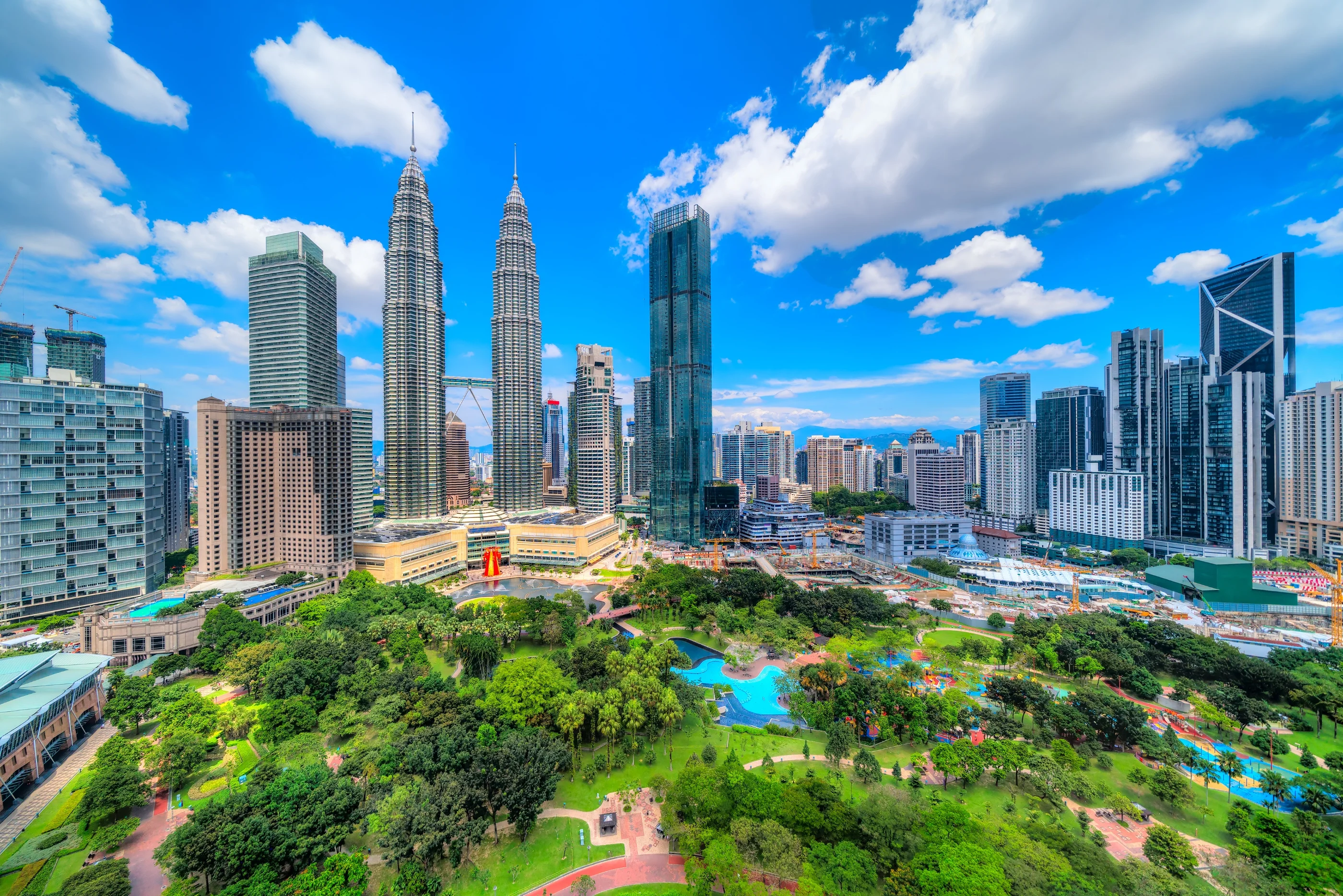
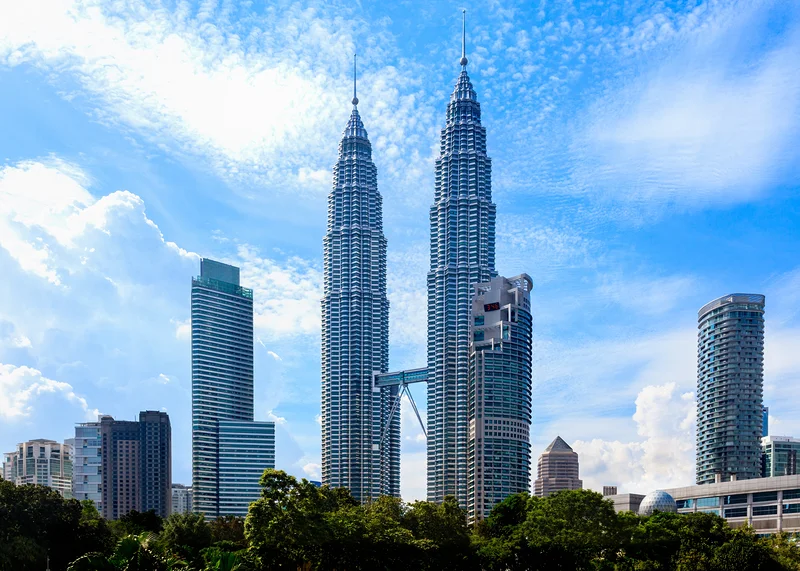
The Petronas Towers stand four hundred and fifty-two meters tall, eighty-eight floors, and remain the tallest twin towers in the world: you go up to the Skybridge, the walkway joining them on the forty-first floor, then to the observation deck on the eighty-sixth, with dated tickets and time slots to book. At their feet, Suria KLCC and its philharmonic hall, the twenty-hectare KLCC Park designed by Roberto Burle Marx, with its children's pool and its fountain that plays at eight in the evening, the aquarium and the Petrosains science center for rainy days. The air-conditioned walkway leaves from the mall and leads to Bukit Bintang in a quarter of an hour. Just north, across the Klang river, Kampung Baru is a Malay village from 1900 left whole in the middle of the towers: wooden houses on stilts, a neighborhood mosque, nasi lemak restaurants open at night, and the most photographed contrast in the city. You stay here for the towers from your window, for the walkway and for the grand hotels. The downside: the highest prices in the guide, and sidewalks that force detours.
The palm trees at the bottom, 2 twin towers over 450m at the top, the sight is "shocking" (in a good way) when you get close to them.
What to see & do in the neighborhood
Where to stay in this neighborhood
Grand Hyatt Kuala Lumpur Luxury
Against the convention center, five minutes from the towers: the corner rooms look onto the Petronas, pool and spa on the thirty-eighth floor, a breakfast the reviews mention first, and a 9.0 on two thousand eight hundred and fifty reviews, 9.5 for location. Value for money drops to 8.7: that is the price of the view.
Impiana KLCC Hotel Mid-range
Facing KLCC Park, connected to the walkway: rooms the reviews call spacious and a little dated, a rooftop pool, a wide-choice morning buffet, and an 8.0 on three thousand seven hundred and ninety-four reviews, 9.3 for location. The same reviews mention avenue noise: ask for a high floor.
Legasi Kampung Baru Guest House Budget
In Kampung Baru, twelve minutes on foot from the towers: a village house with a kitchen, a garden, an infinity plunge pool and an open-air bath, the Petronas straight ahead with nothing in between, and an 8.3 on a hundred and twenty-five reviews, 9.6 for location. You sleep in a wooden village and have lunch under the skyscrapers.
Pros
- The towers and KLCC Park on foot, the air-conditioned walkway to Bukit Bintang
- Kampung Baru and its wooden houses ten minutes away, nasi lemak at night
Cons
- The highest prices in the guide
- Sidewalks that stop dead and force detours
Bukit Bintang and Jalan Alor: the malls and the evening stalls Pavilion Kuala Lumpur, Starhill Gallery, Fahrenheit 88, Lot 10 and Sungei Wang Plaza, Low Yat Plaza and Bukit Bintang Plaza, Berjaya Times Square, the stall street of Jalan Alor, Changkat Bukit Bintang and its bars, the Bukit Bintang monorail station, HELP College
for restaurants and bars on foot, the malls, the monorail, going out at night
Bukit Bintang is the neighborhood that does not close. Over eight hundred meters, six malls touch one another, from Pavilion and its brands to Low Yat Plaza, the electronics mall where you get a phone repaired at midnight, by way of Berjaya Times Square, which has an indoor amusement park inside it. In the middle, Jalan Alor lays out a hundred meters of plastic tables and kitchens on wheels every evening, satay, grilled fish, durians and cane juice, and the parallel street of Changkat lines up the bars and rooftops. The air-conditioned walkway arrives from KLCC, the monorail station is in the middle, the MRT two steps away. This is the neighborhood where you stay in order to take no transport at all in the evening, and where half the city's hotels are. The downside: noise until two in the morning around Changkat, the massage touts, and a neighborhood with no monument at all.
Where to stay in this neighborhood
EQ Kuala Lumpur Luxury
On Jalan Sultan Ismail, on the site of the former Equatorial: an infinity pool on the twenty-ninth floor facing the Petronas, a spa, rooms rated 9.5 for comfort and cleanliness, and a 9.0 on two thousand and eighty-six reviews, 9.4 for location. The reviews note somewhat thin doors between rooms.
Mercure Kuala Lumpur Shaw Parade Mid-range
At Shaw Parade, five to seven minutes from Times Square and the Hang Tuah station: a pool, rooms rated 9.0 for cleanliness with a city view, a breakfast the reviews put forward, and an 8.4 on one thousand two hundred and eleven reviews. The four-star at a mid-range price, away from the Changkat noise.
Paper Plane Hostel Budget
In Jalan Sin Chew Kee, a street of old houses ten minutes from Jalan Alor: an adults-only hostel with a garden, a terrace and free coffee, cleanliness rated 9.7, staff rated 9.8, and a 9.3 on three hundred and sixty reviews. The best rated in the guide, and the Hang Tuah station is at the end of the street.
Pros
- Jalan Alor and its street kitchens, Changkat and its bars, everything on foot at night
- Six malls touching each other, the monorail in the middle and the walkway to KLCC
Cons
- Noise until two in the morning around Changkat
- No monument in the neighborhood, and massage touts on the avenue
Merdeka, Chinatown, Little India and the KL Tower Merdeka Square and the Sultan Abdul Samad building, the Jamek mosque at the confluence of the two rivers, Petaling Street and the Central Market, the Sri Mahamariamman temple, St John's cathedral, the Dayabumi complex, the city gallery and the numismatic museum, the DBKL theater, the Merdeka and Negara stadiums, the Kuala Lumpur Tower and the Bukit Nanas forest, Maju Junction and Capital Square
for the monuments on foot, the temples, the markets, the view from the tower
This is where the city began, at the confluence of the Klang and Gombak rivers that gave it its name, muddy and still visible beneath the Jamek mosque of 1909. Around it, the colonial quarter: Merdeka Square, the former cricket ground where independence was proclaimed on 31 August 1957, bordered by the Sultan Abdul Samad building and its clock, a Moorish building from 1897 that became the country's postcard. Two streets south, Chinatown: Petaling Street under its green roof, the counterfeit stalls and the old medicine shops, the Central Market of 1888 for crafts, the Hindu temple Sri Mahamariamman of 1873 with its carved gods above the door, a hundred meters from a Chinese temple and a mosque. Above it all, on the hill of Bukit Nanas and its nine hectares of primary forest protected since 1906, the Kuala Lumpur Tower, four hundred and twenty-one meters, its deck and its revolving restaurant. You stay here to visit everything on foot and for two metro and MRT stations. The downside: noisy, treeless streets, and old hotels next to new ones.
We also went up the KL Tower, or Menara KL, and had a great meal there in the panoramic restaurant nearly 300 meters up. It was an all-you-can-eat buffet, and we had no idea the restaurant rotated.
Where to stay in this neighborhood
Else Kuala Lumpur Luxury
At 145 Jalan Tun H S Lee, in the former Lee Rubber building facing the Chinese temple: forty-nine rooms, an infinity pool, a rooftop bar, cleanliness and comfort rated 9.7, staff rated 9.7, and a 9.3 on five hundred and ninety-six reviews. The finest house in the guide, in the middle of Chinatown.
Four Points by Sheraton Kuala Lumpur, Chinatown Mid-range
Two minutes from Pasar Seni station, metro and MRT: an outdoor pool, a gym, a morning buffet the reviews call varied, rooms rated 9.3 for comfort, and an 8.9 on one thousand six hundred and sixteen reviews, 9.4 for location. A few reviews mention temperamental lifts.
BackHome Kuala Lumpur Budget
Behind the Jamek mosque, five minutes from Petaling Street: a hostel with character set around a courtyard, a café on the ground floor, dorms and private rooms, and scores of 9.2 and 9.3 in every category on eight hundred and eighty reviews. The reviews call it the best hostel they have known in Asia.
Pros
- Merdeka Square, the temples, the markets and the KL Tower on foot
- Two metro stations and the Pasar Seni MRT, the best rated hotels downtown
Cons
- Noisy, treeless streets, and counterfeit stalls on Petaling Street
- A few old hotels next door to the new ones: check the score before booking
KL Sentral, Lake Gardens, Brickfields and Bangsar KL Sentral station and the airport train, the Perdana lake gardens, the national mosque, the Islamic arts museum and the national museum, the aviary and the butterfly park, the national monument, Parliament and the national palace, the Thean Hou temple, Little India in Brickfields, Bangsar and its two shopping villages, Mid Valley, the University of Malaya, Bukit Gasing hill
for the airport train, the museums and the parks, families, the Bangsar restaurants
KL Sentral is the station that holds it all together: the direct airport train in twenty-eight minutes, two metro lines, the MRT, the monorail and the commuter trains, with a mall above the platforms. To the north open the Perdana lake gardens, ninety-one hectares of lawns and lakes holding the largest free-flight aviary in the world, a butterfly park, a deer park and an orchid garden; on their edge, the national mosque of 1965 and its sixteen concrete points, the Islamic arts museum, the largest in Southeast Asia, and the national museum. South of the station, Brickfields is the city's Little India, garlands over the street and banana leaf rice restaurants; to the west, Bangsar lines up its tree-lined streets, its two shopping villages and the tables where the KL middle class dines, and Mid Valley its two malls. You stay here for an early flight, for the museums and the parks, for families. The downside: a neighborhood of slabs and walkways with no street life, and twenty minutes of transport to the towers.
Where to stay in this neighborhood
Hilton Kuala Lumpur Luxury
Attached to KL Sentral, a covered walkway to the platforms: nine restaurants, a pool the reviews call the finest they have seen, a morning buffet likewise, rooms rated 9.2, and an 8.7 on two thousand seven hundred and twelve reviews, 9.2 for location. The airport train leaves beneath the hotel.
Aloft Kuala Lumpur Sentral Mid-range
Above the Nu Sentral mall, connected to the station: a rooftop pool, a bar on the fifth floor, rooms rated 9.1 for comfort, and an 8.7 on four thousand three hundred and forty-three reviews, 9.5 for location. The best rated in the neighborhood, on the largest number of reviews in the guide.
Space Hotel KL Sentral Budget
Five minutes from the station, in Brickfields: a capsule hotel, a shared kitchen, washing machines, free water and tea, cleanliness rated 9.1 and value for money rated 9.1, and an 8.8 on seven hundred and fifty-five reviews. The reviews warn: the walls are plastic and move when your neighbor turns over.
Pros
- The airport train in twenty-eight minutes and five lines under one roof
- The lake gardens, the aviary, the two great museums and the tables of Bangsar
Cons
- A neighborhood of slabs and walkways, with no street life around the station
- Twenty minutes of transport to the towers and Bukit Bintang
The north: Chow Kit, Titiwangsa and the Batu Caves The Chow Kit market, the Putra World Trade Centre and its mall, the federal territory mosque, the national art gallery and the palace of culture, Lake Titiwangsa and its view of the skyline, the technology university; at the end of the train line, the Batu Caves and, to the east, the national zoo
for the Batu Caves on waking, the market, the low prices, the view from the lake
Two kilometers north of the old center, Chow Kit holds the largest covered market in the city, a maze of fish, spices and fruit that opens at six and closes at nightfall, and around it a working-class neighborhood that recent hotels are beginning to edge. Higher up, the Putra World Trade Centre and its mall, the federal territory mosque and its twenty-two domes, the national art gallery and the palace of culture, then Lake Titiwangsa, whose southern shore gives the classic photograph of the city: the line of towers behind the water and the rowing boats. Thirteen kilometers further on, at the end of the commuter line, the Batu Caves open their staircase of two hundred and seventy-two steps repainted in colors beneath a gilded statue forty-three meters tall, with the monkeys and, in January or February, the Thaipusam pilgrims in their hundreds of thousands. You stay here for the caves on waking, for the lowest prices downtown and for a neighborhood that lives without tourists. The downside: charmless streets at night, and twenty minutes by metro to the towers.
Where to stay in this neighborhood
Hotel Stripes Kuala Lumpur Luxury
At 25 Jalan Kamunting, between Little India and Chow Kit: a rooftop pool and bar with the line of towers facing you, rooms rated 9.2 for cleanliness and comfort, staff rated 9.0, and an 8.6 overall. The neighborhood is not pretty, the hotel is.
Sunway Putra Hotel Kuala Lumpur Mid-range
Facing the Putra World Trade Centre, connected to its mall: a pool, a gym, a morning buffet mixing local, Arab, Chinese and Indian cooking, staff rated 9.0, and an 8.5 on five thousand eight hundred and fifty-two reviews, the largest number in the guide. The PWTC station is across the road.
The Chow Kit - an Ormond Hotel Mid-range
On Jalan Chow Kit, two kilometers from Suria KLCC: a 1950s house redone as a design hotel, a restaurant the reviews mention for its own sake, staff they call attentive, and an 8.4 on one thousand two hundred reviews. The Medan Tuanku monorail is five minutes away.
Pros
- The Batu Caves at the end of the train line, the Chow Kit market at dawn
- Lake Titiwangsa and its view of the skyline, the lowest prices downtown
Cons
- Charmless streets at night, and few restaurants open late
- Twenty minutes by metro to the towers and Bukit Bintang
Our tips for booking the right place
- The walkway, the four free buses and the card that does everything: The network is the simplest in Southeast Asia and the worst signposted. A Touch 'n Go card, bought in any station, works on the metro, the MRT, the monorail, the commuter trains and the buses, and spares you the machine queue; a trip costs between $0.34 and $1.20*. The four GoKL bus lines are free and cover downtown, KLCC, Bukit Bintang, Chinatown and KL Sentral, every ten minutes. Between KLCC and Bukit Bintang, the 1.2-kilometer covered, air-conditioned walkway does the trip in a quarter of an hour under shelter, and it is the only comfortable pedestrian route in the area. For the rest, ride-hailing apps cost $2.30 to $5.70* a trip in town, and less than a metered taxi.
- No dry season: one downpour per afternoon, all year round: Kuala Lumpur sits three degrees from the equator and its climate does not change: thirty-two to thirty-four degrees every day, nights at twenty-four, humidity that never drops below seventy-five percent, and a violent downpour in the afternoon or early evening, more frequent from March to April and from October to November. So there is no good season, only good planning: outdoor visits before eleven, museums and malls between one and four, terraces after seven. From June to September, the haze blown in from neighboring fires can veil the city for days and erase the view from the top of the towers: buy those tickets on the morning of the day itself when you can.
- The towers' bridge must be booked, the KL Tower need not: The Petronas Towers are visited by time slot, with a dated ticket, and the three thousand daily places go several days ahead in high season: the ticket gives you the Skybridge on the forty-first floor then the deck on the eighty-sixth, for about forty minutes in all, and the counters open at nine. The Kuala Lumpur Tower, on its hill, can be done without booking, reaches higher in altitude and has an outdoor platform and a revolving restaurant. For a photograph of both towers whole, KLCC Park at sunset, Lake Titiwangsa or a rooftop bar in Bukit Bintang do better than the summit, where you are inside.
- The hawker centre, the kopitiam and what can be done in a day: You eat everywhere and for next to nothing: a dish at a hawker centre or a kopitiam costs $2.30 to $4.60*, a morning nasi lemak less still, and the country's three cuisines sit side by side on the same street, Malay, Chinese and South Indian. Jalan Alor for the evening, Brickfields for banana leaf rice, Kampung Baru for nasi lemak at night, Chow Kit for the market. Alcohol is taxed and expensive, $6.80 to $12* for a beer on a terrace. Day trips from the city: the Batu Caves by commuter train, thirty minutes; Putrajaya and its administrative buildings, thirty minutes by train; Genting Highlands and its cable car, an hour by coach and ten degrees cooler; the Sunway Lagoon theme park, forty minutes. None is worth sleeping at.
- A room on Changkat Bukit Bintang or above a bar on Jalan Alor if you sleep with the window open: the street lives until two in the morning, seven nights a week, and the local hotels know it without always saying so.
- A hotel near the airport, fifty-five kilometers to the south: the train from KL Sentral takes twenty-eight minutes and starts at five in the morning, which makes a night at the airport pointless except for a flight before seven.
- The lower floors of the apartment towers rented by the night around Bukit Bintang, booked on a photo of a pool: the pool exists, the reception is a counter, the housekeeping is erratic, and the scores of these addresses often fall below 7.0.
FAQ: where to stay in Kuala Lumpur
Which neighborhood should you stay in for a first time in Kuala Lumpur?
Where can you stay cheaply in Kuala Lumpur?
How many nights should you plan in Kuala Lumpur?
Is Kuala Lumpur safe for a traveler?
How do you get downtown from the airport?
What does a night in Kuala Lumpur cost?
 Keep exploring
Things to do in Kuala Lumpur
Keep exploring
Things to do in Kuala Lumpur
Comments (0)
No comments yet. Be the first!