
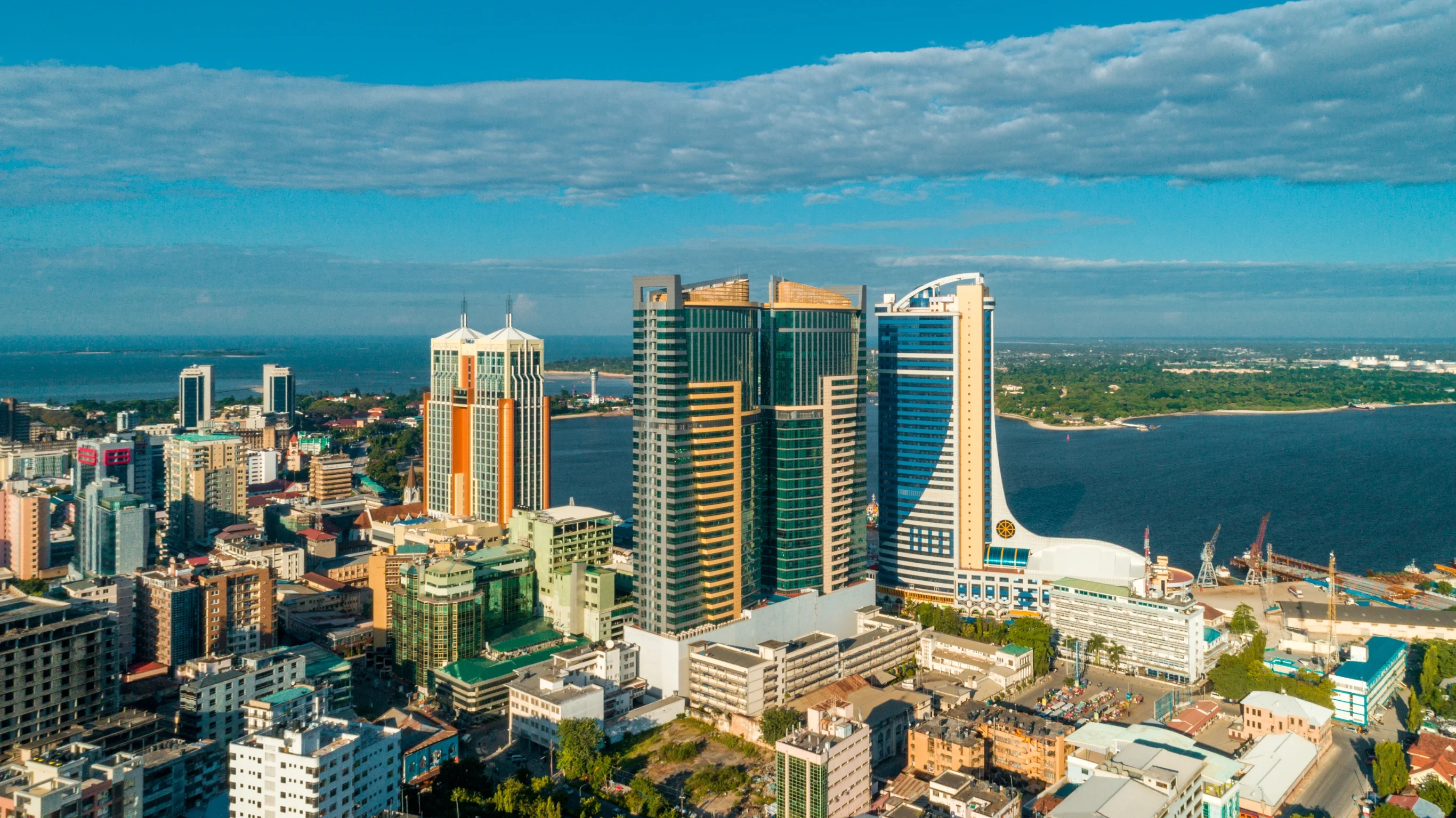
Where to stay in Dar es Salaam: the 4 neighborhoods to know in 2026
In Dar es Salaam, everything is counted in crossings. The Zanzibar ferry leaves from the Kivukoni quay, two hours at sea, and decides where you sleep the night before; the Kigamboni ferry takes five minutes to cross the inlet that separates the center from the southern beaches; the dhows of Msasani bay take you in thirty minutes to Bongoyo island. Between these three landings, the city: the German grid of the center with its markets, the peninsula of embassies and restaurants, and to the north, twenty kilometers of beaches lined with resorts. For most travelers, Dar is a gateway, one night before Zanzibar or the train to Dodoma. You choose your neighborhood by what you are taking the next day.
A banda on the beach or a guesthouse room costs between $29 and $62*, three or four stars run from $85 to $135*, the grand hotels of the seafront between $169 and $320*. Twelve addresses whose listing is open, and four reviews from a single member, Johanna, who saw everything in two days of June 2025 and says what is worth the detour and what is not: two are quoted, with her username, because no brochure talks like that.
It is a good starting point if you want to better grasp the local context before heading out to explore Tanzania.
Compare hotel prices in Dar es Salaam
In a hurry? Find the best accommodation deals in 3 clicks.
Compare live deals from Booking, Expedia, Agoda and other partners.
At a glance: our picks by traveller type
Pick the profile that suits you to head straight to the recommended neighborhood.
The neighborhood map in Dar es Salaam
Get your bearings on the neighborhoods and must-see sights before choosing where to drop your bags. Click a name to jump to its description.
The center: Kivukoni, Posta and Kariakoo Center: Kivukoni, ferry quay, Posta, Kisutu, Upanga, Kariakoo, Ilala
for a night before the Zanzibar ferry, the museum and the markets
The center fits inside the grid the Germans laid out in 1891 between the harbor and the ocean: St Joseph's Cathedral and the Azania Front Lutheran church, both their work, facing the quay; the Askari Monument at the Samora Avenue crossroads; the National Museum and, opposite, the botanical gardens of 1893, the only patch of shade in the center. At the tip of the point, the Kivukoni fish market: the dhows unload at daybreak, the fish is auctioned on the sand, and next door, the ferry terminal for Zanzibar. Behind, Kisutu and its Indian restaurants, Posta and its buses, then Kariakoo, the largest market in East Africa, where you find everything and keep your bag in front of you. The hotels are most numerous here, from the seafront towers to the rooms of Kisutu five minutes from the ferry. The downside: the streets empty at nightfall, and you do not walk them after eight in the evening. A member says what she saw at the fish market.
The atmosphere is super authentic, and the fishermen arrive with their boats and unload their catch right before our eyes.
Where to stay in this neighborhood
Hyatt Regency Dar es Salaam, The Kilimanjaro Luxury
On Kivukoni Front, facing the harbor entrance: the Kilimanjaro of 1965, rebuilt as a glass tower, a pool, a rooftop bar from which you watch the ferries leave, and 8.6 on six hundred reviews, the highest score in the city. The Zanzibar quay is three minutes away.
Harbour View Suites Mid-range
On Samora Avenue, in a tower that also houses a shopping mall and a casino: suites with a living room and kitchen, a terrace pool, the harbor under the windows, and 8.2. For anyone staying more than two nights.
Tanzanite Executive Suites Budget
In Kisutu, on Morogoro Road, a three-minute walk from the ferry quay: a recent building, rooms that are large for the price, parking, and 7.8 on four hundred and fifty reviews, 8.9 for the staff. The address for a night before Zanzibar.
Pros
- The Zanzibar ferry, the museum and the fish market on foot
- The widest choice of hotels in the city, at every price
Cons
- Streets that are empty and not advisable on foot after eight in the evening
- No beach, and the morning traffic jams to get out
The peninsula: Oyster Bay, Masaki and Msasani North of the center: Oyster Bay, Coco Beach, Masaki, Toure Drive, Msasani, The Slipway
for the restaurants, Coco Beach and the dhows to Bongoyo
The Msasani peninsula juts into the ocean six kilometers from the center, and this is where the wealthy city lives: the embassies and villas of Masaki under the flame trees, the restaurants and bars of Haile Selassie Road, the corniche of Toure Drive above the rocks. On the east side, Coco Beach, the beach of Oyster Bay, where the whole city comes on Sunday to eat grilled corn and skewers without swimming, the water is too shallow; on the west side, Msasani bay, the fishing village, and The Slipway, the old shipyard turned into a quay of restaurants, from which the boats leave for Bongoyo island, thirty minutes at sea, a reef and a beach. The hotels are few and expensive for what they give, but you can walk here in the evening, which the center does not allow. The downside: the museum and the ferry thirty minutes away by taxi in the traffic.
Where to stay in this neighborhood
Sea Cliff Hotel Luxury
At the end of Toure Drive, on the cliff above the ocean: a pool facing the open sea, two restaurants, a casino, and 7.9 on two hundred reviews, 9 for location. You come for the view at breakfast, not for the rooms.
Hotel Slipway Mid-range
In the old shipyard of Msasani bay, among the restaurants and shops of the quay: two pools, rooms on the sea to ask for, the boats to Bongoyo at your feet, and 7.9 on three hundred reviews, 9.1 for location. The reviews of a woman traveling alone call it safe.
Triniti Oysterbay Budget
On Msasani Road, a nine-minute walk from Coco Beach: a guesthouse with a garden, a bar, bikes for hire, rooms with balconies, and 7.7 on seventy-six reviews, 9.1 for the staff. The only soft price on the peninsula.
Pros
- The restaurants, the bars and Coco Beach on foot, in the evening too
- The boats to Bongoyo from The Slipway
Cons
- Hotels that are expensive for their score, few rooms under $85*
- The center and the ferry thirty minutes away by taxi at rush hour
The north: Mikocheni, Mwenge and the beaches of Mbezi and Kunduchi North: Mikocheni, Mwenge, Kawe, Mbezi Beach, Jangwani Beach, Kunduchi, and the Bagamoyo road
for a beach resort, the Mwenge carvers and the islands
Past the peninsula, the city runs north along the Bagamoyo road: Mikocheni and Mwenge, where the Makonde carvers work ebony under their awnings, the Makumbusho village museum with its houses from every region, the Mlimani City mall; then, from Kawe to Kunduchi, twenty kilometers of beaches where the resorts have settled, with the islands of Bongoyo and Mbudya offshore, a reef, a boat from every hotel. The sea is warm, the sand is sometimes dirty after rain, and the hotels know it: you come for the pool, the garden and the quiet. Further on, the Kunduchi water park, and seventy kilometers away, Bagamoyo and the Kaole ruins, a thirteenth-century mosque among the baobabs. The downside: nothing to see on foot, and the center an hour away when the Bagamoyo road is jammed, which is to say every morning.
Where to stay in this neighborhood
Best Western Jangwani Sea Breeze Resort Luxury
On Mbezi Beach: three pools, a spa, two bars, rooms that seven hundred reviews rate 8.3, with 9.1 for the staff. The same reviews speak of a poorly cleaned beach: you come for the pools.
Ramada Resort By Wyndham Dar es Salaam Mid-range
On Jangwani Beach, in Kunduchi: a private beach, a pool, a gym, rooms on the sea or the garden, and 7.7 on three hundred reviews. The water park is eight kilometers away, the airport twenty-one.
Mediterraneo Boutique Hotel Budget
In Kawe, the closest to town: a large garden on the sea, a pool, Italian cooking and music in the evening, and 8.3 on nearly a thousand reviews. The cheapest of the three, and the best rated. The beach in front is not for swimming, the reviews say so.
Pros
- The beach, a pool and a garden, the islands by boat
- The Mwenge carvers and the village museum on the way
Cons
- The center an hour away every morning on the Bagamoyo road
- Sand that is sometimes dirty after rain, as the reviews point out
The south: Kigamboni, the beaches and the airport road South: Kigamboni ferry, Nyerere bridge, Mjimwema, South Beach, Kutani, and across the harbor, the airport and Pugu
for the beach without leaving the city, the weekend, and a dawn flight
Kigamboni is on the other side of the inlet, five minutes by ferry from Kivukoni or across the Nyerere bridge, six hundred and eighty meters above the water: another world, coconut palms, villages, and ten kilometers further the southern beaches, Mjimwema, South Beach, Kipepeo, white sand, bandas and beach bars where the city comes on Saturday. Further still, Kutani and Amani Beach, an empty bay forty kilometers away. The city zoo is in Kigamboni too. On the other side of the harbor, to the south-west, Julius Nyerere airport, twelve kilometers from the center, and behind it the Pugu hills and their forest, the only hike within reach of the city. The downside: the center and the peninsula an hour away, ferry and traffic included, and beach hotels that live off the weekend.
Where to stay in this neighborhood
Amani Beach Resort Luxury
In Kutani, forty kilometers south, on an empty bay: huge rooms in Swahili-style buildings, a pool above the beach, and 7.9 on forty-six reviews. The wifi does not work and the reviews say so: you come here to do nothing.
South Beach Resort Mid-range
On the beach at Kigamboni: a large pool under the palms, a sandy beach, a restaurant the reviews find good and expensive, and 7.3 on a hundred reviews, 8.4 for the staff. Far from everything, which is what you come for.
Kipepeo Beach and Village Budget
In Mjimwema, wooden bandas on the sand, a beach bar, simple and cheap food, and 8.2 on nearly four hundred reviews, 9.1 for location. The cheapest banda in this guide, on a beach that reviews call the most beautiful in the country.
Pros
- The beach and the bandas twenty minutes from the center by ferry
- The softest prices in the city, and quiet on weekdays
Cons
- The center an hour away, ferry included, and nothing to do in the evening
- Hotels that fill up at the weekend and empty during the week
Our tips for booking the right place
- The Zanzibar ferry gets booked, and it leaves from Kivukoni: The fast boats to Stone Town leave from the Kivukoni terminal, four times a day, two hours at sea, and the morning seats go the day before: book on the company's website, not with the touts on the quay, who sell overpriced or fake tickets. Sleeping in the center the night before saves crossing the city at dawn; from the peninsula or the north, allow an hour by taxi at seven in the morning. The plane does the same trip in twenty minutes.
- The traffic jams decide the schedule: Dar es Salaam has one road north and one road south, and they are full from seven to ten and from four to eight. A twenty-minute trip takes sixty at those hours, including to the airport, twelve kilometers from the center. You visit the center in the morning, the peninsula in the evening, and you do not change neighborhoods in between. The ride-hailing apps work, the three-wheeled bajaj slip between the cars.
- Mosquito net, repellent, and no tap water: The coast is a malaria zone all year round: a mosquito net or air conditioning at night, repellent from five in the afternoon, especially in gardens and on beaches, and preventive treatment to discuss with a doctor before leaving. The tap water is not drinkable, hotels provide bottles. The power still goes out some evenings: the big hotels have a generator, the guesthouses not always.
- Two rainy seasons, and a center you do not cross at night: It rains hard from March to May, less hard in November and December; from June to September the air is dry and the sea calm, that is the season. In the center, the streets empty at nightfall and bag snatching exists: a taxi after eight in the evening, phone and bag out of sight, nothing flashy. On the peninsula, you walk in the evening without thinking about it.
- A hotel in Kariakoo or Ilala for the price: the market streets are the liveliest in the city by day and the least safe at night, and Kisutu costs the same five minutes from the ferry.
- A resort in the north for a single night before the ferry: the Bagamoyo road is jammed at the hour the boat leaves.
- The airport hotels, in Kipawa, for anything other than a stopover: rooms on the road, far from everything, and the center thirty minutes away without traffic, an hour with it.
FAQ: where to stay in Dar es Salaam
Which neighborhood should you stay in for a first time in Dar es Salaam?
Where to stay cheaply in Dar es Salaam?
How many nights should you plan in Dar es Salaam?
Is Dar es Salaam safe for a traveler?
How do you get to the center from the airport?
How much does a night in Dar es Salaam cost?
 Keep exploring
Things to do in Dar es Salaam
Keep exploring
Things to do in Dar es Salaam
Comments (0)
No comments yet. Be the first!