
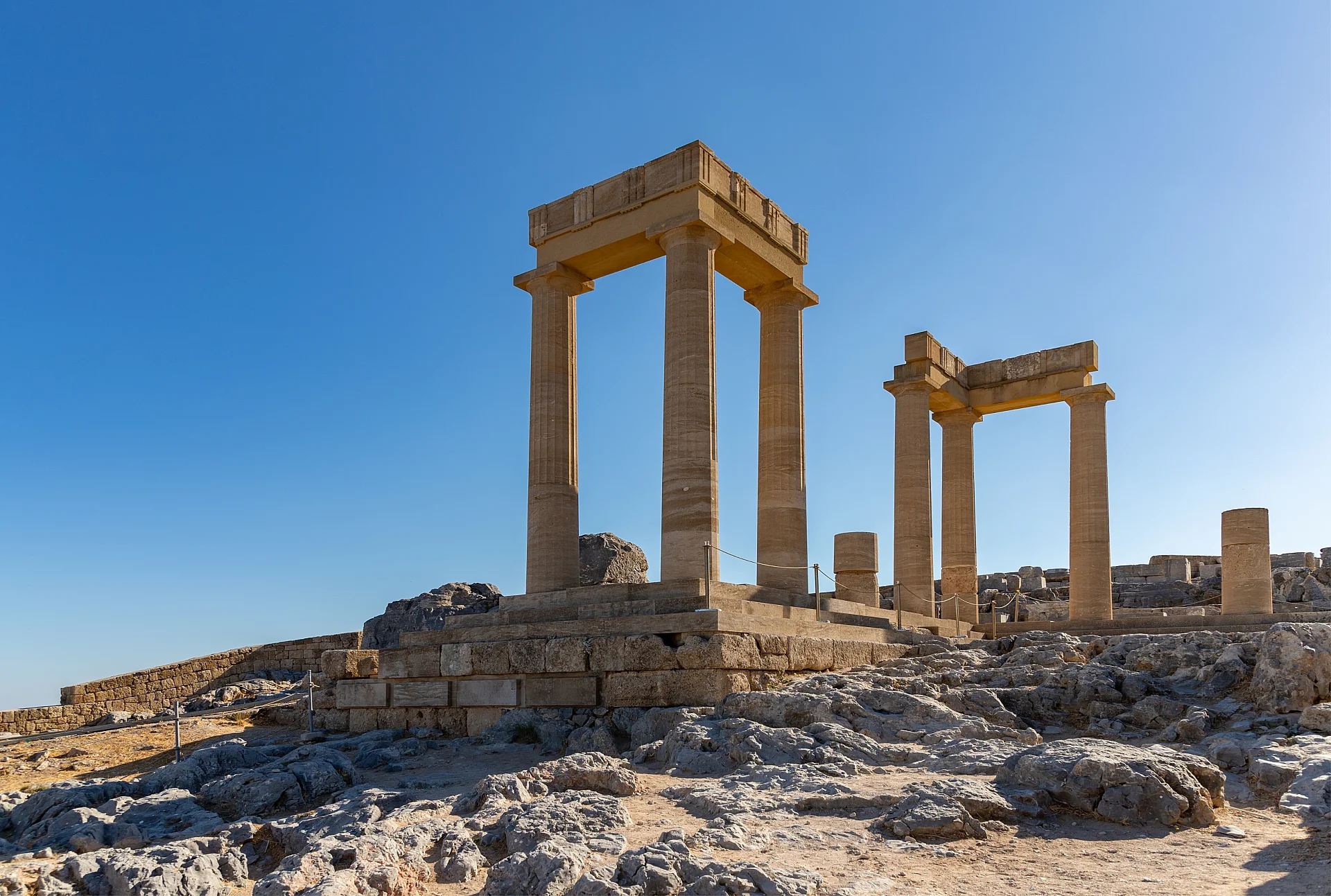
An unfortified acropolis open to the Aegean Sea
Atop the hill of Monte Smith, the partial Doric columns of the Temple of Pythian Apollo rise directly against the open sky. From the higher points of the site, views stretch across the modern city of Rhodes, the medieval old town, and the Aegean Sea.
Further down, the ancient stadium curves in a horseshoe shape, carved directly into the bedrock.
Why visit the Acropolis of Rhodes
What stands out here is the complete lack of fortifications. Unlike most Greek acropolises, the one in Rhodes was never designed as a defensive refuge. Instead, it brought together sanctuaries, a stadium, and an odeion meant to be seen and experienced rather than hidden behind walls.
The site has experienced a more turbulent recent history. The Temple of Pythian Apollo suffered damage from bombing during World War II before undergoing restoration work in the 1960s and 1970s. The first excavations were carried out by the Scuola archeologica italiana di Atene (Italian Archaeological School at Athens), which worked on the grounds until 1945.
The stadium, the odeion, and ongoing excavations
Dating back to the 2nd century BC, the ancient stadium has been fully restored. Right next to it, the white marble Roman odeion could seat about 800 spectators. Its tiers occasionally host performances today, letting visitors sit just as ancient spectators once did.
The quieter remains of the Temple of Athena Polias and Zeus Polieus complete the complex. A protected archaeological zone of 12,500 square meters remains off limits to any new construction, and excavations continue today, which explains why parts of the site are still revealing their outlines.
Best for
- A quick visit with no ticketing needed, easily fitted into a packed day
- Travelers looking for sweeping views over the old town and the sea
Less suited for
- Anyone looking for intact structures or a blockbuster monument like the Acropolis of Athens
- Visits during peak heat, since there is virtually no shade on site
Friendly tip: The entire site is outdoors and lacks natural shade. A hat and water make a big difference, especially in summer, for a visit that typically takes under an hour.
How long for this activity
Allow 45 minutes to 1 hour to explore the entire archaeological site of the Acropolis of Rhodes.

The Acropolis of Rhodes is interesting to visit. This ancient site is actually still undergoing archaeological excavations. The most impressive part is the reconstruction of the stadium that was carried out. Even though the visit is fairly quick, it is still worth the trip.