
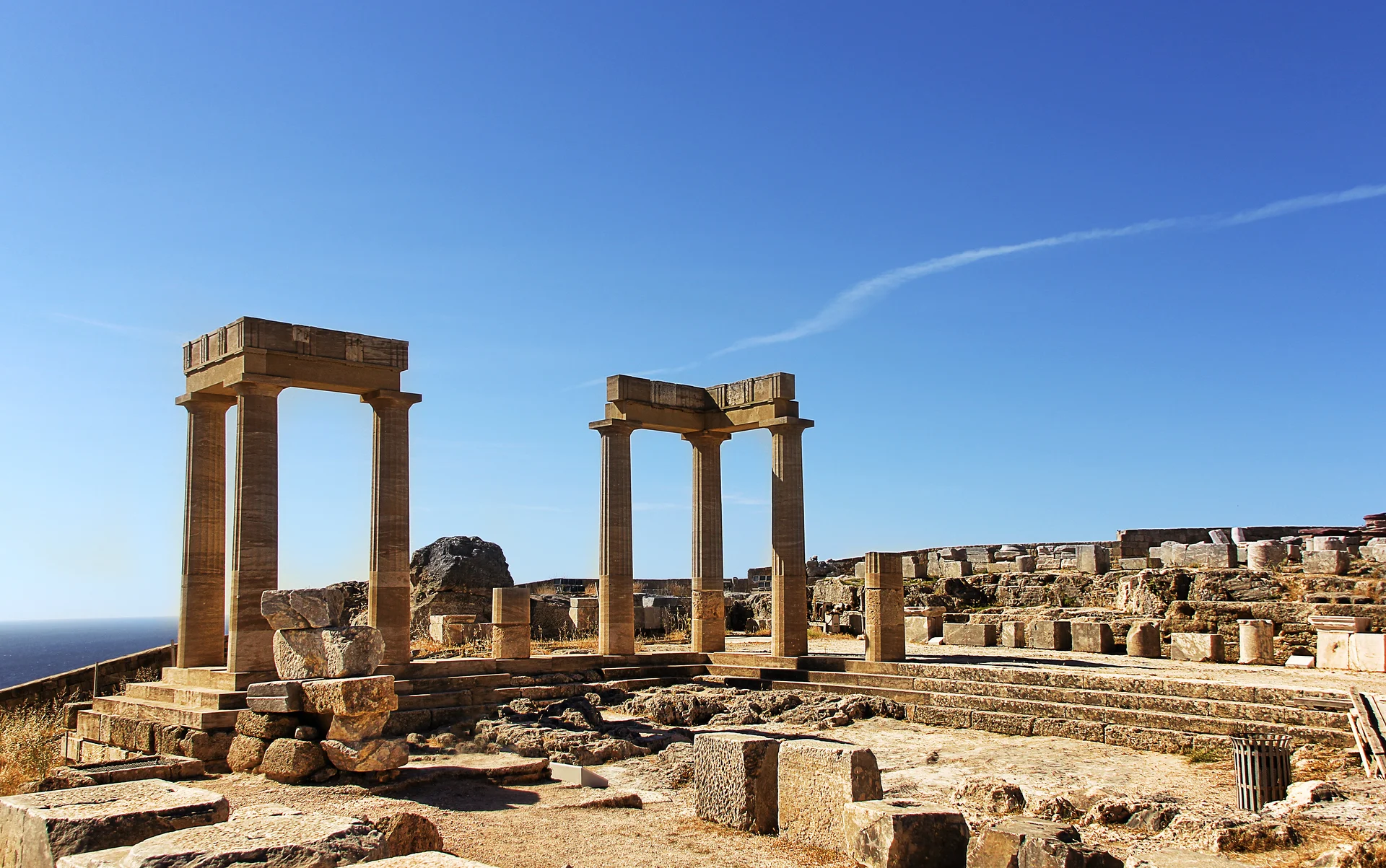
The Temple of Athena Lindia, the crown jewel of the Acropolis of Lindos
The wind whistles through the Doric columns as the sea glimmers one hundred sixteen meters below. On this rugged cliff in Lindos, worshippers have honored Athena since the Bronze Age, long before the Greeks built their first stone sanctuary here. You need to climb the final flight of stairs for the full panorama of Saint Paul's Bay to come into view.
Why visit the Temple of Athena Lindia?
The structure you see today, a Doric temple dedicated to Athena Lindia, dates back to the 4th century BC. It was rebuilt after a fire destroyed the archaic sanctuary in 342 BC. Religious use of the site goes back much further, however, as Mycenaean offerings prove that a cult was active here as early as the 10th century BC. This makes it one of the oldest and most continuously used sites of devotion in the Aegean Sea.
Centuries of history layered on a single rock
The temple is just one layer of the story. The Hellenistic Propylaea, a vast colonnaded gateway built in the 3rd century BC, was designed to frame the visitor's approach through a carefully planned monumental staircase. Later, Byzantine monks built a small church dedicated to Saint John, and the Knights of Saint John fortified the summit in the 14th century, reusing ancient blocks to construct a defensive castle.
This layering makes the visit feel dense despite the site's modest size. You move from a medieval rampart to a Greek temple in just a few dozen yards.
The relief of the Rhodian ship, carved into the rock
Before you even reach the main staircase, one detail stops you in your tracks: a trireme (ancient warship) carved directly into the cliff. It dates to the 2nd century BC and is attributed to Pythokritos, the sculptor also associated with the Winged Victory of Samothrace. This relief served as the base for a statue, likely representing an admiral or a local priest honored by the city.
Friendly tip: The trail from the village is fully exposed to the sun with zero shade. Donkeys wait at the base of the climb for those who prefer not to walk, but nothing beats arriving before 10am to enjoy the site without the heat or the cruise ship crowds.
Best for
- History buffs interested in millennia of human activity
- Hikers comfortable with a short but steep incline
Less suitable for
- Visitors with limited mobility, as the terrain is uneven and difficult
- Travelers sensitive to heat during the middle of the day
Opening hours
April to October: daily from 8:00 AM to 8:00 PM.
November to March: daily from 8:30 AM to 3:30 PM.
The site is closed on January 1st, March 25th, May 1st, Orthodox Easter Sunday, December 25th, and December 26th. Last admission is generally 30 minutes before closing.
How long for this activity
Plan on 1 hour 30 minutes to 2 hours to explore the entire archaeological site, including the time required to hike up the steep path from the village.
*Information subject to change

I highly recommend visiting the Acropolis of Lindos. This ancient site sits about 300 feet above the town and the sea. The view is truly magnificent. You can walk up or take a donkey ride for a more unique experience.