
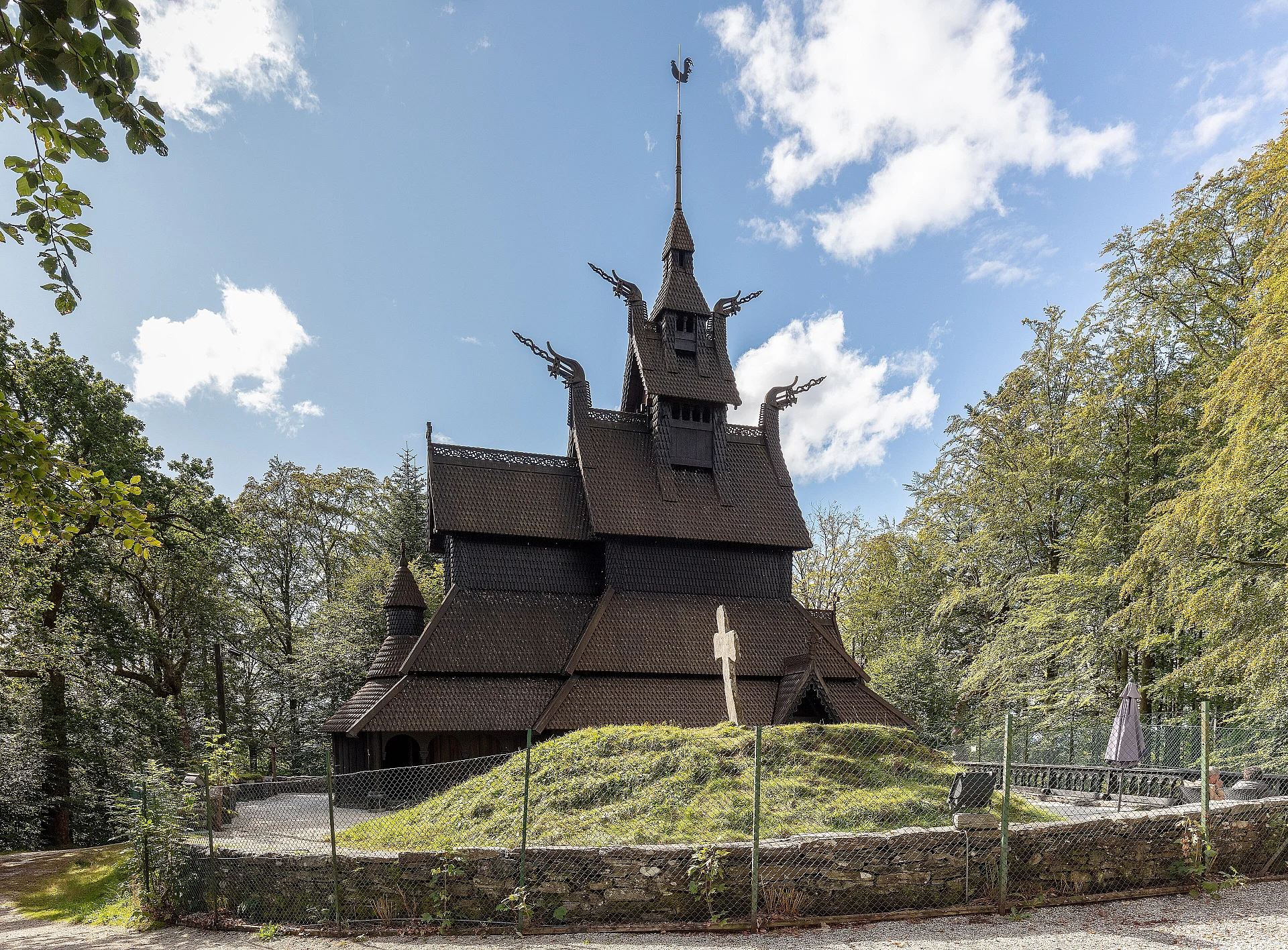
The stave church that burned and rose from its ashes
A scent of pine tar still lingers around its dark shingles. Perched on a forested hill south of Bergen, this stave church tells a striking story: a medieval structure moved from its original home, lost to arson, and rebuilt to look exactly as it did before.
Why visit Fantoft Stave Church?
The original structure was built around 1150 in Fortun, within the Sognefjord region. In 1883, a Bergen merchant named Fredrik Georg Gade had it dismantled and transported to Fantoft to save it from destruction. This was a common practice at the time, as many of these thousand-year-old churches were falling into disrepair or being replaced by modern construction.
On June 6, 1992, the building was reduced to ash in an act of arson. The case made national headlines, as it was linked to the Norwegian black metal scene of the era, a dark chapter in the country's cultural history. The church was reconstructed to match the original design a few years later, using the same traditional carpentry techniques.
The architecture of stave churches
The silhouette is unmistakable: overlapping roofs made of dark wooden scales, gables carved with dragon heads that echo the prows of Viking ships, and a structure supported entirely by vertical wooden posts (the stav that gives these churches their name). This construction method, unique to medieval Scandinavia, allowed builders to create structures without using a single nail or any cement.
A cemetery surrounds the chapel, nestled among the fir trees. Light filtering through the branches gives the site an almost surreal quality, especially late in the day when the sun skims across the shingled roofs.
What to know before you go
The church is primarily visited from the outside, as the interior is generally not open to the public except for specific occasions. The visit focuses on the exterior architecture and the natural setting, which limits the time needed on site to about thirty minutes.
Friendly tip: arrive in the late morning or early afternoon to take advantage of the light filtering through the surrounding trees. The site is quiet compared to the major stave churches of Norway, giving you space to observe it without being rushed.
Pros
- Easy access from central Bergen
- Quiet, photogenic wooded setting
- Rare architectural style outside of Scandinavia
Cons
- Interior rarely accessible
- Short visit, best combined with other stops
Opening hours
May 15 to August 31: daily from 10:30 AM to 6:00 PM.
September 1 to September 14: daily from 10:30 AM to 2:00 PM.
Closed to the public the rest of the year.
Friendly tip: hours may change for private ceremonies or special events. Remember to check the official website of Fortidsminneforeningen (National Trust of Norway) before heading out from the center of Bergen.
How long for this activity
Plan on about 1 hour for your visit, which covers the commute from downtown Bergen and enough time to take in the architecture of the interior and exterior.
*Information subject to change

This church, located a little bit outside of the Bergen city center, is an absolute must-see. It is a very picturesque, typical Norwegian wooden church. It is set in a truly enchanting spot, right in the heart of nature. I highly recommend taking a detour to visit it.