
Catacombs of Domitilla, the Largest Christian Labyrinth of Underground Rome
Seventeen kilometers of tunnels wind beneath the Via Ardeatina, spanning four levels where 150,000 people were laid to rest. Cool, damp air rises from the depths, early Christian frescoes emerge from the tuff stone walls, and at the heart of the maze, a unique underground basilica defies expectations. These catacombs are among the oldest and most extensive in Rome, dating back to the 2nd century.
The Story of a Converted Imperial Family
The catacombs stretch across the land once owned by Flavia Domitilla, the niece of Flavius Clemens. He was a consul in 95 AD who had married a niece of the Emperor Domitian. This branch of the imperial family held Christian sympathies, which led Domitian to execute Flavius Clemens for religious reasons, while his wife and niece were exiled to the Pontine Islands.
Before her exile, the consul's niece opened her Via Ardeatina property to the Christian community, allowing for the creation of Rome's largest underground Christian cemetery. Inscriptions found on the site mention concessions made "e beneficio" and "ex indulgentia Flaviae Domitillae," honoring the generosity of Flavia Domitilla.
The Underground Basilica of Saints Nereus and Achilleus
These catacombs are the only ones in Rome to house an underground basilica dedicated to the martyrs Nereus and Achilleus. These two soldiers were likely victims of the persecution under Diocletian in 304 AD. Pope Damasus transformed their crypt into a small basilica between 366 and 384, which was later expanded by Pope Siricius between 390 and 395.
The basilica consists of a narthex, three naves separated by two rows of four columns, and an apse. A column by the high altar features a scene depicting the beheading of Achilleus. Behind the apse, a fresco illustrates Saint Petronilla, celebrated as the daughter of Saint Peter, whose cult attracted numerous pilgrims during the Middle Ages.
The Frescoes: A Treasure of Early Christian Art
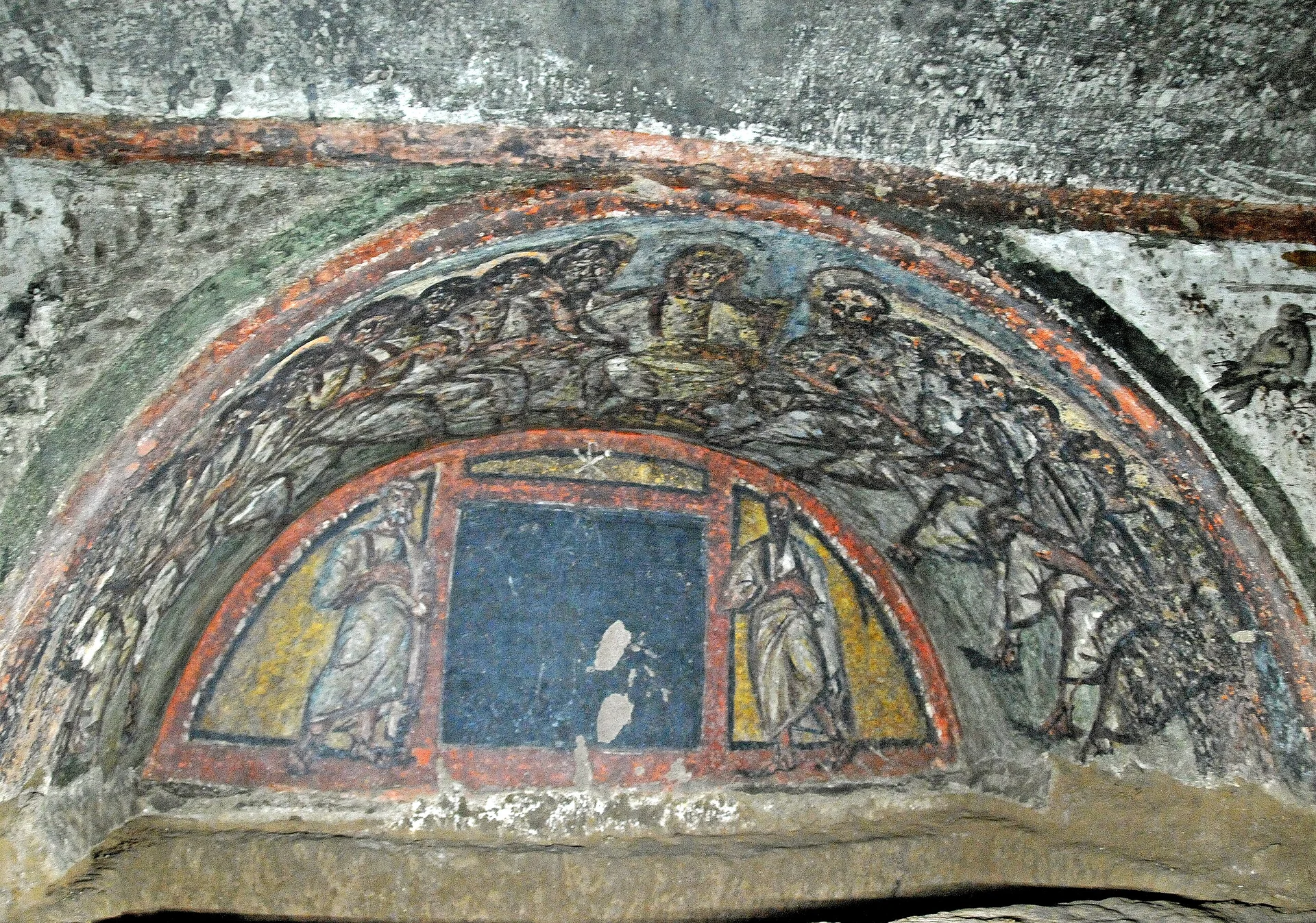
With about 80 painted tombs, the Catacombs of Domitilla house one of the largest collections of underground funerary paintings. The galleries reveal a fascinating mix of pagan and Christian iconography, documenting the spiritual transition of that era.
The Cubiculum of Ampliatus and the Hypogeum of the Flavii
The Cubiculum of Ampliatus, considered one of the oldest Roman Christian burial chambers, displays frescoes with pagan themes. The Hypogeum of the Flavii, composed of a wide gallery with four large niches containing the sarcophagi of the family's most prominent members, represents the oldest part of the complex, dating from the late 2nd century.
The Good Shepherd and the Adoration of the Magi
On the lower level, a notable 3rd-century fresco illustrates Christ as the Good Shepherd. The section known as the "Madonna" area contains several frescoes from the 3rd and 4th centuries, including an Epiphany scene that stands out for the depiction of four Magi approaching the Virgin and Child, a rare piece of iconography that continues to intrigue art historians.
Friendly tip: Guided tours are mandatory and last about 45 minutes. Underground temperatures hover around 15°C (59°F) year-round, so bring a jacket even in the summer. Tours are available in several languages, so check availability when booking to get the most out of the detailed explanations regarding these exceptional frescoes.
A Unique Experience in Underground Rome
The catacombs are currently managed by the Societas Verbi Divini (Society of the Divine Word), a missionary congregation founded in 1875 by Saint Arnold Janssen. These religious members ensure the preservation of the site and share the complex history of this early Christian cemetery with passion.
Images revealed by restoration work reflect daily life: bakers at work, lush vineyards, Jesus surrounded by the apostles, Noah's Ark, and Daniel in the lions' den. Each fresco tells a fragment of the faith held by the first Roman Christians.
Opening hours
| Monday | 09:00-12:00, 14:00-17:00 |
|---|---|
| Tuesday | Closed |
| Wednesday | 09:00-12:00, 14:00-17:00 |
| Thursday | 09:00-12:00, 14:00-17:00 |
| Friday | 09:00-12:00, 14:00-17:00 |
| Saturday | 09:00-12:00, 14:00-17:00 |
| Sunday | 09:00-12:00, 14:00-17:00 |
The last guided tour starts 20 minutes before closing time.
*Information subject to change

I really enjoyed visiting these catacombs. It was a great discovery. The place isn't scary at all, quite the opposite. The frescoes are beautiful and very well preserved. This site is less known than the major sights in Rome, which is really nice when you're visiting.