
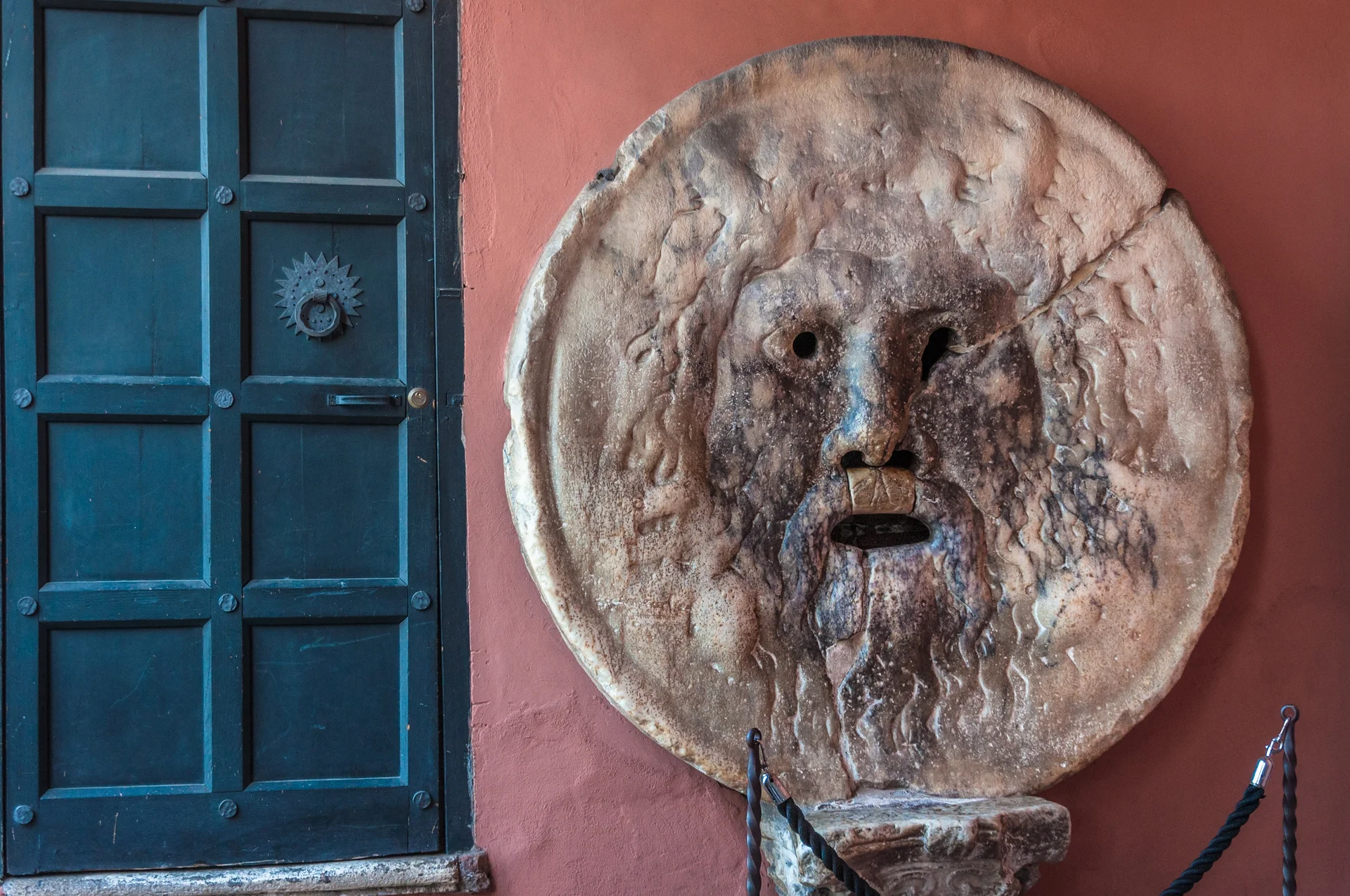
Bocca della Verità: an ancient mask turned movie star
The marble feels cold under your palm. The stone eyes stare back, and the gaping mouth waits. Behind you, the line stretches along the portico of the Santa Maria in Cosmedin church. Everyone is here to test their sincerity against this 1,300 kg face that, according to legend, bites off the hands of liars. This ritual has been repeated hundreds of times a day since Gregory Peck pretended to lose his hand in front of a terrified Audrey Hepburn in 1953.
Why visit the Bocca della Verità?
This pavonazzetto marble disk, with a 1.75 meter diameter, dates back to the 1st century AD. Its original function remains a subject of debate among historians, though it was likely a manhole cover for the Cloaca Maxima, the great Roman sewer system that emptied into the Tiber River just a few meters away. The bearded face with its pierced eyes, nose, and mouth is thought to represent Oceanus, the titan god of the sea.
The name appears for the first time in 1485. Placed under the current portico in 1632 by order of Pope Urban VIII, this mask has survived through the centuries by accumulating myths and legends. The film Roman Holiday propelled it to the status of a global curiosity. The frightened reaction of Audrey Hepburn in the iconic scene was improvised, as Peck had not warned her about his gag.
The legend of the lie detector
During the Middle Ages, the Mouth served as a tool during trials. The accused had to slide their hand inside while swearing their innocence. Some accounts mention an executioner hidden behind the wall, ready to cut off the limb if a guilty verdict had already been decided. Truth sometimes helped fate. Another version tells of a woman accused of adultery who tricked the Mouth with a clever logical maneuver, proving that even stone can be outsmarted.
Friendly tip: Arrive right at opening time at 9:30 AM or in the late afternoon after 4:00 PM. The line can exceed an hour during high season. Do not just stop for the photo, as the church and its crypt are worth a visit that most tourists skip.
Santa Maria in Cosmedin: the overlooked treasure
Built in the 6th century on the remains of the Temple of Hercules and the ancient Statio Annonae (a grain distribution center), this basilica deserves much more than a quick selfie. Its name comes from the Greek word kosmidion, which means adorned. The Greek community of Rome managed it for a long period.
The 12th century Cosmatesque floor features intricate inlaid polychrome marble. The seven-story Romanesque bell tower rises 34 meters and stands as one of the most elegant in Rome. Under the altar, the Crypt of Hadrian I preserves the tuff blocks of the ancient Ara Maxima dedicated to Hercules. In a glass reliquary rests a skull attributed to Saint Valentine, the patron saint of lovers.
The Forum Boarium neighborhood
The Piazza della Bocca della Verità is home to several remarkable ruins. The Temple of Hercules Victor, circular and nearly intact, dates to the 2nd century BC. Next door, the Temple of Portunus showcases Ionic architecture dedicated to the god of ports. The Fountain of the Tritons by Carlo Bizzaccheri has adorned the center of the square since 1715. The Arch of Janus, a four-faced structure and the only quadrifrons arch preserved in Rome, closes the perspective toward the Velabrum.
In short, the monuments to see nearby include:
- Temple of Hercules Victor: one of the best-preserved sacred buildings of ancient Rome
- Temple of Portunus: a testament to the commercial activity of the river port
- Arch of Janus: 16 meters tall, built in the 4th century
- Crypt of Hadrian: accessible on certain days, ask about availability on site

Look, it is just a mask-shaped sculpture. Yes, it was made famous by a movie and there are a few legends about it, but it is certainly not worth the trip on its own. And even less worth waiting in line for. The church it is attached to is actually much more interesting.