
Where to stay in Birmingham: the 6 neighborhoods to know in 2026
Two travellers have left a review of Birmingham with us, and they say the same thing in different words: it feels like a small town here, because there are almost no tall buildings once you leave the square of the centre, and because there is green everywhere. Therein lies the key to England's second city, and it changes the way you book. From Victoria Square to the Bullring, the centre is crossed in twenty minutes on foot, and it holds three stations. Everything else is a string of villages: jewellers' workshops to the north, brick warehouses to the east, a campus and glasshouses to the south-west, exhibition halls thirteen kilometres to the east. And in between, kilometres of towpaths along the canals, inherited from industry, walked today between villages without ever meeting a car.
The neighborhood is therefore not decided by how far away the monuments are, since every one of them fits inside the same square. What decides is what you want to see through the window in the morning: a canal basin and narrowboats, a square of concert halls, a theatre, a workshop street silent on Sundays, a park with a boating lake, or an exhibition hall and an aeroplane. Hence the six parts of this guide. Now the rates. In a dorm, a bed is yours for $29*, and $40* is the ceiling. A plain double in the centre starts at $57*. The standard four-star runs from $102* and tops out around $158*. And the five-star on Colmore Row opens at $152*. One single mechanism blows these figures up, and you need to know it before fixing a date: on trade fair evenings at the exhibition park and concert nights in the big halls, the whole city doubles its prices, hostels included.
In Birmingham, it feels like a small town because there are no high-rises (unless you are really in the center) and there is a lot of greenery and parks. However, it still remains a big city with all the advantages that come with it.
Compare hotel prices in Birmingham
In a hurry? Find the best accommodation deals in 3 clicks.
Compare live deals from Booking, Expedia, Agoda and other partners.
At a glance: our picks by traveller type
Pick the profile that suits you to head straight to the recommended neighborhood.
The neighborhood map in Birmingham
Get your bearings on the neighborhoods and must-see sights before choosing where to drop your bags. Click a name to jump to its description.
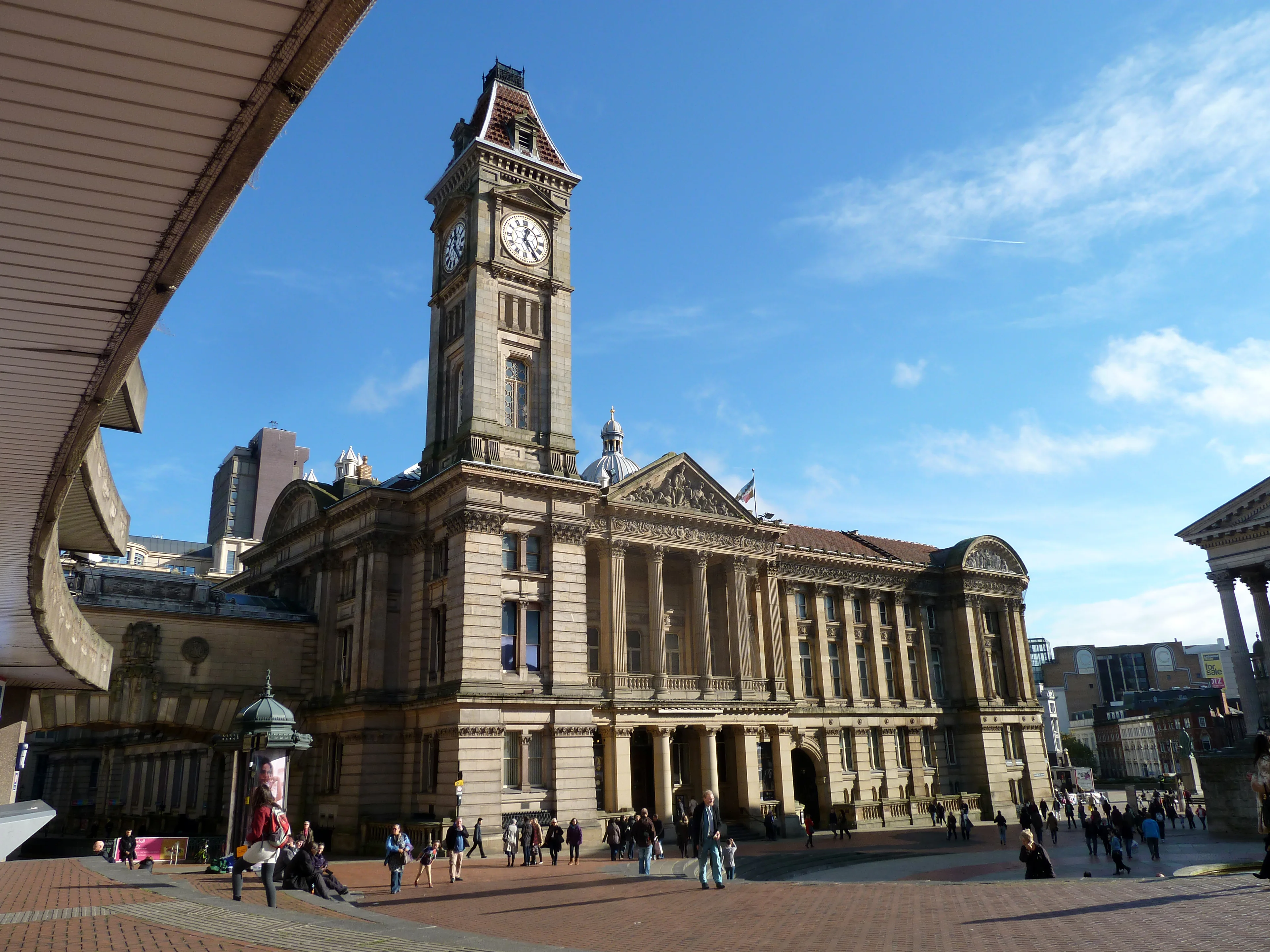
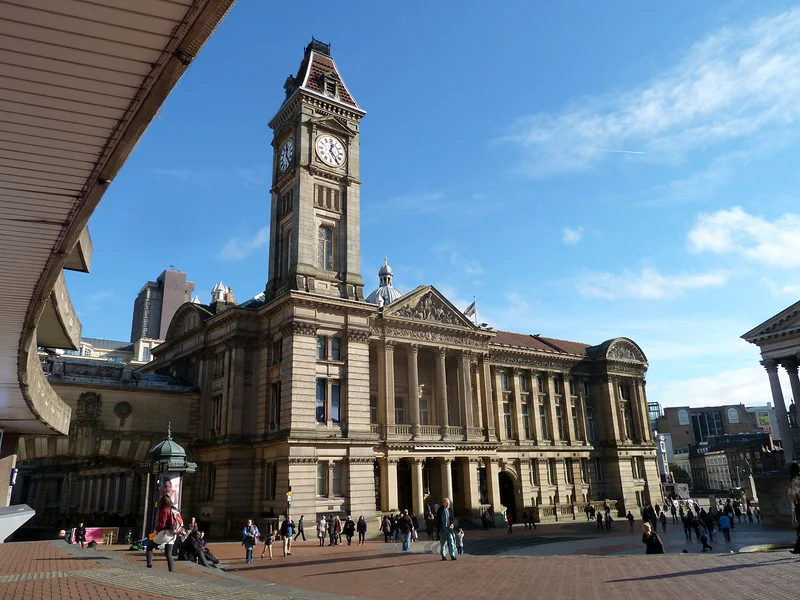
The centre: Victoria Square, Colmore Row and the Bullring Victoria Square and its stepped fountain, Chamberlain Square, the city museum and its art gallery, the columned town hall, the Council House, St Philip's cathedral and its Burne-Jones windows, the Bullring and its facade of aluminium discs, St Martin's church at the foot of the shopping centre, Big Brum, High Street, Old Square, the Victorian banks of Colmore Row
for a first visit, for arriving by train, for taking no transport at all
Everything you come to see on a first visit is here, and New Street surfaces in the middle of it, under a shopping arcade. You climb the steps of Victoria Square to the big fountain where the people of Birmingham sit at midday, and where the reclining statue has earned a nickname everyone here knows. Behind it, the columned town hall and the Council House make a set worthy of an industrial capital. Two hundred metres away, St Philip's cathedral sits in a square of plane trees where office workers have lunch, with four windows by Burne-Jones, who was born in this city. And the other end of the square is the Bullring: a facade covered with thousands of aluminium discs, and right underneath it, pressed against it, the medieval church of St Martin. You sleep here so as to need nothing but your legs. The downside is paid on Friday and Saturday night, when the streets around the station fill up until two in the morning.
Housed in a beautiful, bright building, this museum was a nice surprise. It is free and relatively unknown internationally, so I wasn't expecting much.
What to see & do in the neighborhood
Where to stay in this neighborhood
The Grand Hotel Birmingham Luxury
The dearest address in this guide, in a Victorian building on Colmore Row, fifty metres from the cathedral: carved facade, listed ballroom, two restaurants and a terrace. Rated 8.9 on more than three thousand seven hundred reviews, with 9.6 for location, the best location score recorded in the city. From $152* a night.
Staying Cool At Rotunda Mid-range
Apartments with a fitted kitchen on floors 16 to 20 of the Rotunda, the cylindrical nineteen-sixties tower that closes the Bullring: floor-to-ceiling windows, the whole city below, and three minutes on foot to New Street. Rated 8.7 on more than one thousand four hundred reviews, with 9.5 for location and 9.0 for comfort. This is the right choice for several nights as a couple, when you want to be able to cook a meal at home.
Clayton Hotel Birmingham Mid-range
A recent four-star on Albert Street, behind the Bullring, the biggest volume of reviews in the neighborhood: 8.2 on more than six thousand, with 8.8 for cleanliness and the same for comfort. What the reviews cite most often, and what counts in this neighborhood, is the soundproofing: you hear neither the traffic nor the roadworks outside. Restaurant on site, wide rooms.
easyHotel Birmingham Budget
The cheapest double room in the centre, three minutes from New Street, from $57*. Rated 8.1 on nearly five thousand reviews, with 9.4 for location and 8.6 for cleanliness: it is clean, it is central, and that is all. The reviews are unanimous on what you give up: the rooms are very small, some have no window, and there is no kettle. Book it knowing that, not hoping for something else.
Pros
- Three stations in the neighborhood, including the one for London trains
- The city museum, the cathedral and the Bullring under ten minutes on foot
Cons
- Street noise on Friday and Saturday until two in the morning
- An office neighborhood: it empties on Sunday evening
Broad Street, Centenary Square and the canals Centenary Square and the library with its filigree rings, the big concert hall of the convention centre, the Repertory Theatre, the symphony orchestra's own centre, the Ikon gallery in a Victorian school, the aquarium at the canal's edge, the indoor arena on King Edwards Road, Brindleyplace and its terraces, Gas Street Basin and its narrowboats, the Mailbox, the Five Ways clock, St Thomas' church and its garden
for a concert, for families, for a night out without a taxi
The canal reaches the heart of the city, and it is the finest surprise of Birmingham. At Gas Street Basin, lived-in narrowboats are moored below street level, behind a door you miss unless you look for it. From there a towpath runs up to Brindleyplace between converted warehouses, and passes under the bridges at water level, two minutes from the noise without hearing it. At the end, the open space of Centenary Square lines up the library with its rings of gilded metal, whose top terrace is free and open to all, the big concert hall and the theatre. And then there is Broad Street itself, which is the other thing: the night-out street of the whole region, loud, stag parties included, from Friday to Sunday morning. The three addresses of the neighborhood stand back from that street, though not always far enough.
Where to stay in this neighborhood
Hyatt Regency Birmingham Luxury
The glass tower on Broad Street, linked to the convention centre by a footbridge: a sixteen-metre pool, a gym, rooms that are wide for a city-centre hotel. It is the biggest volume of reviews in this guide, more than seven thousand, for 8.3 with 9.2 for location and 9.0 for comfort, and the reviews all cite the same thing: the concert hall, the library and the canal bars on foot. Two complaints come back, scarce parking around it and an expensive breakfast. From $181*.
The Cube Hotel Birmingham Mid-range
Inside the Cube, the building with the perforated facade set at the canal's edge behind the Mailbox, with a restaurant on the top floor and the basin under the windows. More than three thousand eight hundred reviews, and a position nothing replaces: you are on the water and six minutes from New Street at once. No rate was displayed on the day of the survey, which happens with this address: compare it on the day you book.
Park Regis Birmingham Mid-range
The tower at Five Ways, at the far end of Broad Street, two hundred and fifty-three rooms and a bar high up: rated 8.2 on more than six thousand six hundred reviews, with 8.9 for the staff and 8.8 for location. It is the right compromise for anyone who wants the concert square ten minutes away and a room away from the din. Two reservations from the reviews: narrow rooms with little light on the courtyard side, and the traffic noise of Hagley Road on the lower floors.
Pros
- The concert halls and the aquarium on foot, no transport in the evening
- The towpath to walk early in the morning, in peace
Cons
- Broad Street is loud from Friday to Sunday morning
- Almost no food shops: it is all bars and restaurants
Southside, Chinatown and Digbeth The Hippodrome and the Royal Ballet company, the Alexandra Theatre, the Old Rep on Station Street, the courtyard of the Arcadian, the supermarkets and restaurants of Chinatown, the warehouses and murals of Digbeth, Millennium Point and its science museum, Aston University and its science park, St Andrew's stadium, the Tyseley railway museum
for the budget, for a show, for leaving by coach
Two steps south of the Bullring, the city changes material: you go from banks to bricks. Southside puts side by side the Hippodrome, which is the home of the Royal Ballet, the courtyard of the Arcadian and the restaurants of Chinatown, where people eat after the performance, late, in full rooms. A little further, Digbeth lines up brick warehouses under railway viaducts: the former custard factory has become a set of studios and music venues, and the murals on the walls change from one season to the next. This is also where the coaches leave from, and where the site of the future high-speed station is being dug, behind hoardings that eat the pavements. This neighborhood gives the cheapest beds in the city. In exchange it asks you to accept poorly lit streets, deserted once the shows are over.
Where to stay in this neighborhood
Radisson Blu Hotel, Birmingham Mid-range
The tower at Holloway Circus, exactly between New Street and the Hippodrome: rated 8.2 on more than six thousand three hundred reviews, with 9.0 for location and 8.8 for comfort, and high rooms the reviews cite for their view. Two things to know before booking: there is no restaurant in the evening, only room service, and the air conditioning in the rooms is noisy, to the point that the hotel provides earplugs.
Birmingham Central Backpackers Budget
The hostel of Digbeth, next to the coach station: dorms from $29*, private rooms, and a breakfast of toast and coffee included. Rated 8.2 on more than three thousand six hundred reviews, with 8.9 for the team and 8.4 for value for money. The reviews all flag the same point, and it is fair: the street is dark in the evening as far as the main roads, and you would rather walk it with company on the way back from a concert.
Pros
- The cheapest beds in the city, ten minutes from the centre
- The Hippodrome, Chinatown and the coach station on the spot
Cons
- Dark and empty streets once the venues have closed
- The high-speed station site: hoardings, dust, detours
The Jewellery Quarter and the north The museum of the jewellery quarter, the Chamberlain clock at the Vyse Street crossroads, St Paul's Square and its Georgian church, the Red Palace, Pugin's St Chad's cathedral, the telecom tower, Aston Hall and its Jacobean manor, Villa Park stadium and its club, the Alexander Stadium of the Commonwealth Games, the motor circuit, StarCity, Sutton Park
for quiet streets ten minutes from the centre, for a match, for a long stay
Ten minutes on foot from the city museum, over the ring road, begins a quarter of workshops that still works. In the Jewellery Quarter, the shopfronts are wholesalers' windows, the carriage doors open onto yards, and the quarter's museum is in fact a workshop left as it was the day its owners shut it in 1981: the tools are on the benches, the cups beside them. Around it, St Paul's Square and its eighteenth-century church form the only Georgian square in the city, with two or three bars and some benches. On Sunday everything is closed and it is very quiet. A tram runs down from there to the centre in four minutes, and the trains of Snow Hill leave for the north: the Jacobean manor of Aston Hall and the two big stadiums are less than ten minutes by rail, and Sutton Park, nine hundred hectares of heath and lakes, twenty.
Where to stay in this neighborhood
Saint Pauls House Mid-range
A town house on St Paul's Square, a bar on the ground floor and wide rooms above: it is the only address with character in the quarter, and the reviews say so in those terms, comparing it with the chain hotels. Rated 8.1 on nearly one thousand five hundred reviews, with 9.2 for location and 8.5 for comfort. One complaint comes back, with a figure: parking is charged at more than twenty pounds a night.
Hampton by Hilton Birmingham Jewellery Quarter Mid-range
The other address in the quarter, beside a tram stop, with breakfast included in the rate, which changes the sum over four nights with a family. Rated 8.1 on more than four thousand reviews, with 8.7 for cleanliness, 8.9 for the staff and 8.5 for value for money. The reservation in the reviews is constant: the partition walls are thin, you hear the neighbours.
Pros
- Silent nights ten minutes on foot from the centre
- The tram at the door and the Snow Hill trains to the stadiums
Cons
- Almost everything closes on Sunday, restaurants included
- The ring road to cross to reach the centre on foot
Edgbaston, the university and the green south The botanical garden and its glasshouses, Cannon Hill Park and its lake, the house and garden of Winterbourne, the Edgbaston cricket ground, the university and its clock tower, the Barber Institute and its paintings, the Lapworth geology museum, Perrott's Folly and the waterworks tower, the peace pagoda, Edgbaston Reservoir, the central mosque, the central synagogue, Cadbury World at Bournville, Sarehole Mill, the Lickey Hills, Woodgate Valley
for the parks, for the cricket, for a long family stay
This is the Birmingham our two members write about: villas, trees, and a park every five hundred metres. Cannon Hill Park has a boating lake and bowling greens; the botanical garden, opened in 1832, keeps four glasshouses in a row, from palm house to desert; Winterbourne is an Arts and Crafts house with its garden intact. On the neighbouring campus, the hundred-metre clock tower can be seen from the train, and the Barber Institute holds a short, dense collection. Two details are worth the trip: Perrott's Folly, a brick tower of 1758, and the waterworks tower right next to it, watched throughout his childhood by a boy of this neighborhood named Tolkien, whose Sarehole Mill stands four kilometres to the south-east. Further out still, Bournville is a model village built by chocolate makers around their factory. You sleep here for the silence and for the children. In exchange you accept taking the tram, the train or the bus for everything.
Lots of greenery in this big British city. The distances to get from one visit to another can be a bit long, but they are pleasant to walk!
Where to stay in this neighborhood
Edgbaston Park Hotel Birmingham Mid-range
On the university campus, in a park, with a large free car park and charging points: it is the best score in this guide outside the high end, 8.4 on nearly four thousand five hundred reviews. What the reviews cite most is exactly what you come here for: no sirens at night. Two honest reservations, repeated: the rooms are small and there is no fridge.
ibis Styles Birmingham Hagley Road Budget
The cheap bed on the Hagley Road axis, a quarter of an hour by bus from the centre, useful when the centre is full or dear. It is also the lowest score in this guide, 7.3 on more than three thousand reviews, and the two complaints are always the same: no air conditioning and the noise of the road. The staff, for their part, are rated 8.4. Book it for the price and the location, not for the night itself.
Pros
- Parks everywhere and nights without street noise
- The tram to the centre, and hotels with free parking
Cons
- Fifteen to twenty-five minutes of transport for anything in the centre
- Hagley Road is a traffic artery: noise on the lower floors
The NEC, the airport and the east The halls of the exhibition park, the park's concert hall, the neighbouring complex of shops and cinemas, the Belfry and Maxstoke Park golf courses, the baroque gardens of Castle Bromwich Hall, the timber-framed manor of Blakesley Hall, St Edburgha's church at Yardley, the ecological park
for a trade fair, a concert at the exhibition park, an early flight
Thirteen kilometres east of the centre, another Birmingham fits inside a single complex: the halls of the exhibition park, the big concert hall, a complex of shops and cinemas, the airport and a station, all linked on foot or by a suspended shuttle that takes ninety seconds between the terminal and the platforms. From that station the train drops you at New Street in about ten minutes. This is the right neighborhood for three situations and three only: you are exhibiting in a hall, you are going to a concert, you take off at six. On the way back towards the city, two stops are worth the detour and almost nobody makes them: the baroque gardens of Castle Bromwich, redrawn from their original plan, and the timber-framed manor of Blakesley Hall, furnished as it was in 1684. The rest of the time there is nothing to do here in the evening, and the hotel rates follow the trade fair calendar rather than the tourist one.
Where to stay in this neighborhood
Hilton Birmingham Metropole Hotel Mid-range
The big hotel attached to the exhibition halls, seven hundred rooms, pool and gym: you go there for one reason, to be five minutes on foot from your stand. Rated 7.7 on more than six thousand three hundred reviews, with 8.9 for location, and it is indeed the location that carries the score. The complaints are constant and worth knowing: very expensive parking, hard beds, an evening restaurant that is criticised.
Genting Hotel & Spa at Resorts World Birmingham city.oudormir_tier_haut
The best score in this guide, 8.8 on more than four thousand reviews, with 9.2 for cleanliness and the same for comfort and 9.3 for location: a recent hotel set inside the shopping complex, with a spa the reviews cite as the best they have seen in a hotel. You are on foot from the concert hall and the halls. Two reservations: the lifts at peak times, and rates that climb hard on big event nights.
Pros
- The halls and the concert hall on foot, the airport in ninety seconds
- The train to the centre in ten minutes, all day long
Cons
- Nothing around in the evening outside the complex
- Rates double on trade fair and concert days
Our tips for booking the right place
- The trade fair calendar makes the price, not the season: This is the particularity of this city, and it is worth more than any advice about seasons: in Birmingham, the price of a room is decided by the calendar of the exhibition halls and the concert venues. One large fair to the east or one concert by the canal fills the entire city in a single night, centre included, and the rates can double, hostels among them. The useful reflex: before fixing your dates, look at what is playing that evening in the two big halls and at the exhibition park, then shift by a day if you can. Conversely, a Sunday or a Monday outside the fair season is the cheapest moment of the year in this city, because its hotel trade lives first of all on business travel.
- The train to arrive, the tram and the towpath to get around: Three stations serve the centre and they do not go to the same places: New Street is the one for London and the main lines, Moor Street serves the east and south-east, Snow Hill leaves for the north. All three are less than ten minutes apart on foot. To get around afterwards, the tram crosses the centre and links the Jewellery Quarter on one side and Edgbaston on the other, and the buses do the rest with a contactless card. But the best way to go from one neighborhood to the next is still the towpath: it links Gas Street Basin to Brindleyplace and beyond, flat, with no cars. Renting a bike for it is pointless: the locks are crossed on foot.
- What is free, and the museum whose rooms you must check: The two finest things to do here cost nothing. The top terrace of the library, on Centenary Square, is open to all and looks out over the whole city. And entry to the city museum is free, as it is at the Barber Institute on the campus and the Ikon gallery by the canal. One indispensable precision about the museum, and it is the only reservation in this guide: it has reopened in stages after heavy works on its electrical installation, and not all of its rooms are necessarily accessible. This cannot be guessed on the spot: you have to check what is open on the day of your visit before crossing the city for one particular room.
- Eating in the evening: Chinatown, the balti and the Sunday question: Two cuisines are this city's signature. Chinatown, south of the Bullring, feeds you late and after the shows, in rooms that do not close at ten. And the balti, that curry served in its metal dish, was born in the Pakistani restaurants of this city: the historic addresses are to the south-east, twenty minutes by bus from the centre, and many serve no alcohol but let you bring your own. Two timetable traps to know: the shops close early on Sunday, and in the jewellery quarter almost every restaurant is shut that day. The centre and Chinatown, for their part, stay open.
- The hotels of the exhibition park taken as a base for visiting the city: they are perfect for a stand or an early flight, and they are next to nothing the rest of the time. Thirteen kilometres, a train to catch, and no street to go out in at night.
- A room on Broad Street itself, on a Friday or a Saturday: it is the night-out street of the whole region, and the noise lasts until the small hours. The addresses in the same neighborhood on the canal side or the Five Ways side solve the problem without changing the price.
- The windowless rooms in the centre booked without having read it: the cheapest address offers them, it says so, and the reviews repeat it. At $57* that is a bargain you accept, not a nasty surprise.
- Counting on a car in the centre: the stacked roundabouts, the urban motorways and the expensive parking make it the worst choice. If you do come by car, Edgbaston and the campus offer free parking twenty minutes away by tram.
FAQ: where to stay in Birmingham
Which neighborhood should you stay in in Birmingham for a first visit?
How much does a night in Birmingham cost?
Should you sleep near the exhibition park for a trade fair?
Is Birmingham a city where you walk?
Where should you stay for a match at Villa Park or St Andrew's?
Which neighborhood should you choose with children?
 Keep exploring
Things to do in Birmingham
Keep exploring
Things to do in Birmingham
Comments (0)
No comments yet. Be the first!