
Where to stay in Tbilisi: the 5 neighborhoods to know in 2026
One traveller wrote to us about Tbilisi, and her first sentence says almost everything while hiding the rest: the city is human-sized. That is true on the flat, and that is exactly where you should look at a relief map. The sights line up along three kilometres of street, from the old town lying at the bottom of the river gorge to Rustaveli Avenue, but above that ribbon the city climbs: the Narikala citadel looms over the roofs, the Mtatsminda plateau tops out at seven hundred and seventy metres, and Turtle Lake occupies another one at six hundred and eighty. So the district settles a single question, how much slope you will walk each day and what it costs: the Narikala cable car is 2.5 GEL, the Turtle Lake one is 1 GEL, and the Mtatsminda funicular is 12 GEL each way.
The budget, for its part, is good news. You can have a dorm bed for $9.10* in a city that counts dozens of them; a three-star runs about $57*; a four-star asks closer to $102*; and the two design addresses in this guide, housed in the same former printing works, top out around $197*. This guide is arranged in five districts, ordered by altitude: the baths at the bottom of the gorge, the avenue on the flat, the left-bank cliff, the north bank with its cafés, then the residential west and its lake up top.
Tbilisi is sized just right, and its scale makes it really pleasant to visit.
Compare hotel prices in Tbilisi
In a hurry? Find the best accommodation deals in 3 clicks.
Compare live deals from Booking, Expedia, Agoda and other partners.
At a glance: our picks by traveller type
Pick the profile that suits you to head straight to the recommended neighborhood.
The neighborhood map in Tbilisi
Get your bearings on the neighborhoods and must-see sights before choosing where to drop your bags. Click a name to jump to its description.
Abanotubani, Meidan and the old town The sulphur baths of Abanotubani and the blue-tiled facade of the Chreli-Abano, the Leghvtakhevi gorge and its waterfall, Sioni cathedral, the Anchiskhati basilica, the Narikala citadel above and the cable car from Rike park, the botanical gardens behind the fortress, Meidan square and the lanes of Shardeni, the Bridge of Peace
for a first visit, for the baths, to do everything on foot
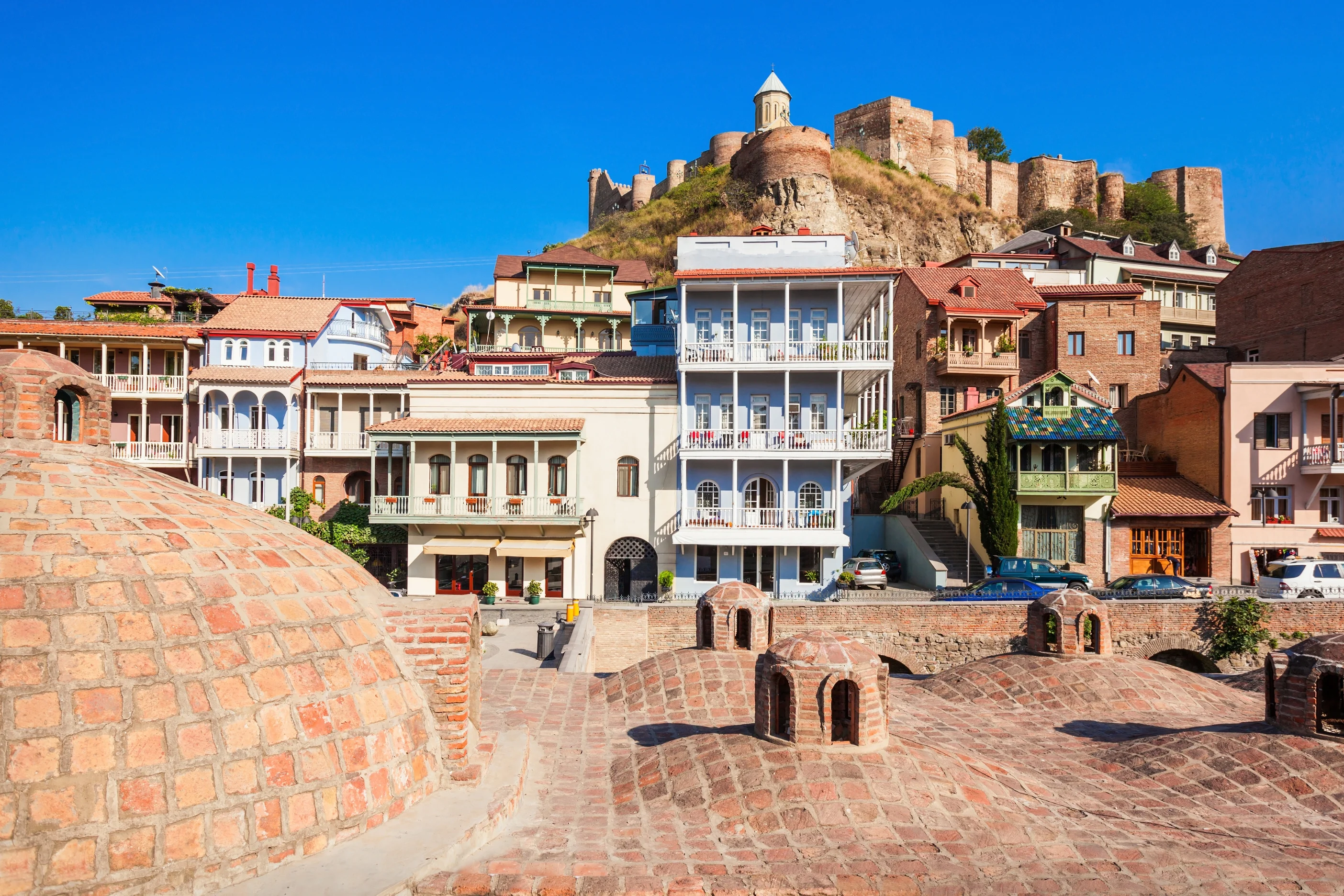
This is where the city began, and hot water is the reason: the sulphur springs of Abanotubani gave Tbilisi its name, and the brick domes breaking through at street level are the roofs of the baths. You push the door open by the hour, in a private room, for 70 to 200 GEL depending on the house, and the most photographed of them, the Chreli-Abano, is the one with the blue-tiled facade. Five minutes higher up, the Leghvtakhevi gorge hides a waterfall in the middle of the city. Above it, the Narikala citadel is reached by a 2.5 GEL cable car from Rike park, and you walk back down through the botanical gardens. The flip side is simple: this district is made of cobbles and hills, and the bars in the lanes of Shardeni run until two in the morning.
the baths that were at the origin of the city's founding (a small waterfall and a canyon are hidden right in the heart of the city...)
Where to stay in this neighborhood
Ambassadori Tbilisi Hotel Luxury
The best address in the old town, in volume as in score: 9.0 on more than one thousand six hundred reviews, with 9.6 for location, 9.2 for comfort, 9.1 for cleanliness and the same for the staff. The reviews cite three things, the position on the edge of the old centre, the pool and the breakfast. Value for money holds at 8.8, which is rare at this price level.
Vinotel Boutique Hotel Luxury
A fifteen-room house behind Sioni, with a Georgian wine cellar downstairs: 9.3, the best score in this guide, but on fewer than three hundred reviews, and that is worth knowing before you compare. In detail, 9.6 for cleanliness, for comfort and for the staff, 9.2 for value for money. Location, 9.1, is the only figure that dips: the lane climbs.
Mercure Tbilisi Old Town Mid-range
The safe choice in the district, a few steps from Meidan: 8.9 on four hundred and forty-two reviews, with 9.5 for location, 9.2 for cleanliness and the same for comfort, and 9.1 for the staff. The only score that dips is value for money, at 8.4, and the reviews say why: you are paying for the address. The upper rooms look at the citadel.
Envoy Hostel and Tours Budget
The best-placed hostel in the city, right in old Tbilisi: 8.4 on two hundred and eighty-two reviews, with 9.6 for location, the best figure in this guide, and 8.4 for cleanliness. Dorms of four to eight beds, private rooms, and a rooftop terrace that the reviews mention before anything else. This is the city's entry price, at $9.10* a bed.
Pros
- The baths, the waterfall and the citadel cable car at the door
- The whole old town on foot, without ever taking transport
Cons
- Cobbles and steep slopes: a wheeled suitcase suffers here
- The bars of Shardeni on a Friday night, until two in the morning
Rustaveli, Freedom Square and Sololaki Rustaveli Avenue and its metro station, the Opera and Ballet Theatre, the Parliament, Kashveti church, the Georgian National Museum and its floor on the Soviet occupation, the Art Museum of Georgia, Freedom Square and the city hall, the carved doors and painted stairwells of Sololaki, the Mtatsminda funicular and its pantheon, the television antenna above
for the museums, for the avenue, to sleep on the flat
This is the only flat kilometre in Tbilisi, and it carries nearly every museum. Rustaveli Avenue links Freedom Square to its own metro station, and along it stand, one after another, the Opera, the Parliament, Kashveti church, the Art Museum of Georgia and the National Museum, where an entire floor tells the story of the Soviet occupation. Behind the avenue, Sololaki climbs towards the ridge: streets of houses with carved doors, painted stairwells, and at the top the statue of Mother Georgia. To reach the Mtatsminda plateau there are two lifts and two prices: the historic funicular from Chonkadze street, 12 GEL each way plus a 2 GEL park card, and a cable car opened in October 2024 from the avenue, at the same price for visitors.
the heights of the city and their incredible view of the valley (special shout-out to Qartlis Deda, an imposing statue of a woman representing the symbol of Georgia)
Where to stay in this neighborhood
Radisson Blu Iveria Hotel Luxury
The tower on Rose Revolution Square, and the biggest volume of reviews in this district: 8.8 on more than two thousand one hundred reviews, with 9.3 for location, 9.1 for comfort, 9.0 for cleanliness and 8.8 for the staff. What the reviews mention first is the eighteenth floor: two pools and a spa looking out over the city. Value for money drops to 8.3.
Tbilisi Marriott Hotel Luxury
The historic address on the avenue, at number 13: 8.5 on more than eight hundred reviews, with 9.4 for location, 8.9 for comfort, 8.8 for cleanliness and the same for the staff. The reviews talk mostly about the welcome and the position, with everything on foot. The value-for-money score, 8.0, is the lowest in the district: that is the price of the address.
ibis Styles Tbilisi Center Mid-range
One street from Freedom Square, and that is the whole point: 9.7 for location, the best figure in this guide, for 8.8 on more than one thousand five hundred reviews, with 9.1 for comfort and the same for the staff, and 9.0 for cleanliness. Small rooms and a simple breakfast, the reviews say so plainly, but value for money holds at 8.6.
About Sololaki Mid-range
In the old streets behind the avenue: 8.9 on more than one thousand four hundred reviews, with 9.3 for comfort and the same for the staff, 9.2 for cleanliness and 9.0 for value for money, the best in this district. Location, 8.2, says the only thing you need to know: it is five minutes from Freedom Square, but five minutes uphill.
Betsy's Hotel Mid-range
Clinging to the Sololaki slope, with a pool and a terrace that look out over the whole valley: 8.5 on more than one thousand one hundred reviews, with 8.9 for cleanliness, 8.7 for the staff and 8.4 for comfort. Location, 8.2, and value for money, 8.2, tell the same story: the view is paid for in vertical metres, and it is better to walk down and take a taxi back up.
Pros
- Every museum on one flat avenue, and two metro stations
- Sololaki behind, to walk home through streets of old houses
Cons
- The avenue is a main road: on the street side, nights are noisy
- The moment you leave the avenue, Sololaki turns into stairs
Avlabari and the left bank Metekhi church on its cliff above the river, the Holy Trinity cathedral consecrated in 2004, Rike park and the lower cable car station, the Bridge of Peace, Avlabari metro station, the presidential palace, the bakeries of the old Armenian quarter
for the view of the citadel, for the metro, to pay less
The left bank stands high, on the edge of a cliff, and that is what makes it a district apart. Metekhi church sits where the royal palace once stood, directly above the river, and the view from its forecourt takes in the citadel, the roofs of the baths and the whole of old Tbilisi. A kilometre higher stands the Holy Trinity cathedral, the largest church in the country, consecrated in 2004 and visible from almost everywhere. Avlabari, the old Armenian quarter, has what the old town does not: a metro station, and distinctly lower prices. Down below, Rike park and the Bridge of Peace put you back on the other bank in a ten-minute walk.
Where to stay in this neighborhood
Hotel Avlabari Terrace Mid-range
The best value for money in this entire guide, by a wide margin: 9.4 on more than five hundred reviews, with 9.6 for the staff and the same for cleanliness, 9.5 for comfort and 9.5 for value for money, 9.3 for location. The reviews cite two things, the terrace with its view and the welcome, where the team members are thanked by name. Five to ten minutes on foot from the river.
Log Inn Boutique Hotel Mid-range
Three hundred metres from Avlabari metro: 9.0, but on eighty-six reviews only, and the figure should be read knowing that. In detail, 9.6 for the staff, 9.3 for value for money, 9.0 for cleanliness and the same for location. The reviews talk about being near the metro before anything else: two stops and you are on the avenue.
Pros
- A metro station at the door, which old Tbilisi does not have
- The views of the citadel from the Metekhi forecourt, and lower prices
Cons
- The way back from the river is uphill, always
- Few tables in the evening: you walk back down to dine
Marjanishvili, Chughureti and Aghmashenebeli Avenue The restored pedestrian Aghmashenebeli Avenue, the Marjanishvili theatre and metro station, Fabrika and its courtyard, the Boris Paichadze stadium, the Dry Bridge flea market on the other side of the river, the Armenian and Catholic churches of the district, the cafés of Ninoshvili street
for the cafés and the bars, to eat well, for low prices
North of the river the city flattens out again, and this is the district where people go out. Aghmashenebeli Avenue, lined with nineteenth-century houses, has been given back to pedestrians over several hundred metres and lines up terraces and shopfronts. Two streets away, a former Soviet sewing factory has become Fabrika: an inner courtyard with bars, workshops and a hostel, which has turned into one of the busiest places in the city. The Marjanishvili metro is in the middle, the football stadium ten minutes away, and old Tbilisi is a quarter of an hour on foot along the river. This is where you eat and sleep for the least money without leaving the centre.
Where to stay in this neighborhood
Fabrika Hostel & Suites Budget
The biggest volume of reviews in this guide, more than five thousand, for 8.6 with 8.7 for location and the same for value for money, 8.6 for cleanliness, for comfort and for facilities, 8.4 for the staff. The former factory holds the dorms and private rooms around its courtyard, and it is the address people also come to for the courtyard itself. Dorms from $9.10*.
New Tiflis Hotel Mid-range
On the pedestrian avenue itself, at number 75: 8.3 on more than eight hundred reviews, with 9.1 for location. It is the lowest overall score in this guide, and the reviews say where it is lost, in the soundproofing on the avenue side and in rooms that vary from one floor to the next. You come here for the address and the price, asking for a room at the back.
TownHouse Tbilisi Boutique Hotel Mid-range
Further up the same avenue, at number 114: 9.0 on two hundred and fifteen reviews, a small house and a small volume, to be read as such. The reviews describe a quiet, well-kept address five minutes from Marjanishvili metro, and that is the district's trade-off: the noise of the avenue fades as you move away from it, and the walk to the river grows by the same amount.
Pros
- Flat, with a metro in the middle and the best terraces in the city
- The lowest prices in the centre, hostel included
Cons
- The Fabrika courtyard can be heard late in summer
- Streets still under works in places, between two restored houses
Vera, Vake and Turtle Lake Kostava street and the slopes of Vera, Tbilisi university, Vake park and its ropeway up to Turtle Lake, the open-air museum of ethnography above the lake, the Mikheil Meskhi stadium, the sports palace, the Bagebi ropeway included in the transport ticket
for a long stay, for quiet, for large rooms
West of the centre the city spreads into residential avenues, and that is where its two design addresses are: Rooms and Stamba occupy the same former printing works on Kostava street, a ten-minute walk from Rustaveli Avenue. Further out, Vake lines up its park, its cafés and the university, and from the park a ropeway climbs to Turtle Lake for 1 GEL, that is to say the price of a metro ride. At the top, the open-air museum of ethnography has reassembled, beam by beam, wooden houses brought from all over Georgia. You sleep here for the quiet and the size of the rooms, accepting a twenty to thirty minute walk down to the baths.
Where to stay in this neighborhood
Stamba Hotel Luxury
The former state printing works turned into a hotel, with its seven-metre ceilings and its presses left in place: 9.1 on more than one thousand two hundred reviews, with 9.5 for comfort and the same for location, 9.4 for cleanliness and 9.0 for the staff. It is the most expensive night in this guide, around $197*, and value for money, 8.8, is still the best in this bracket.
Rooms Hotel Tbilisi Luxury
In the same building, the address that launched the district: 8.6 on more than one thousand four hundred reviews, with 9.4 for location, 9.1 for comfort and 8.8 for cleanliness. The rooftop bar and the Georgian breakfast come back in almost every review; the staff and value for money, 8.4 for both, are the two figures that dip.
Pros
- The two finest addresses in the city, in the same former printing works
- The lake ropeway for the price of a ticket, and the park below
Cons
- Twenty to thirty minutes on foot from old Tbilisi, or a taxi
- Only two addresses, and they are the most expensive in this guide
Our tips for booking the right place
- One lari a ride, with two cable cars inside it: A transport ticket in Tbilisi costs 1 GEL and is good for ninety minutes, transfers included, across the metro, municipal buses and minibuses: you load it onto a Metromoney card, bought at a station window. Two mountain lifts belong to that system and change the way you visit: the Rike park cable car up to Narikala, at 2.5 GEL and payable by that card only, and the one from Vake park up to Turtle Lake, at 1 GEL. The Bagebi ropeway, which climbs to the university, is even included in the fare. The exception is the Mtatsminda funicular, at 12 GEL each way plus a 2 GEL park card: that one is an outing, not transport.
- The baths: how it works, and how much: You do not go to the baths of Abanotubani the way you go to a swimming pool: you rent a private room by the hour, for yourself or for your group, and that is what explains the prices. Count on 70 to 200 GEL an hour depending on the house: the most expensive is the Chreli-Abano, the one with the blue-tiled facade, and the cabins in the Leghvtakhevi gorge go a good deal lower. The communal halls, for their part, cost a few lari. Two practical tips: book the day before for an evening slot, which goes fast, and expect the smell of sulphur to stay on your skin for a few hours. The scrub with a mitt is paid for separately, and it is agreed at the entrance.
- The slope, the stairs and the suitcase: This is the detail that spoils the most arrivals here. Old Tbilisi has no metro station at all: the two nearest ones are Freedom Square and Avlabari, on the other side of the river. Its lanes are cobbled, often steep, and many old houses have no lift. Before booking, ask the hotel two things: which floor the room is on, and how many steps separate it from the street. The rest of the time, ride-hailing apps cost little and settle every climb: that is what residents do.
- When to come, and what it changes: Two windows are better than the others: May and June, then September and October, when the terraces are out and the heights can be walked without suffering. In July and August the city heats up at the bottom of its gorge, often passes thirty-five degrees in the afternoon, and residents leave for the mountains: prices come down, and so does comfort. Winter is mild down below and cold up top, with the lowest rates of the year, except around New Year. One moment to know about: the September grape harvest fills the city's hotels, since it serves as a base for vineyard visits.
- Booking in the old town without having asked about the floor and the number of steps: it is the most beautiful and the steepest district, cobbles are everywhere, and several old houses are climbed on foot with the luggage.
- Assuming the Mtatsminda funicular costs the price of a ticket: it asks 12 GEL each way plus a 2 GEL park card, while the Narikala cable car is 2.5 GEL and the Turtle Lake one 1 GEL. Going up by funicular and walking back down is the sensible compromise.
- Taking a room on the lanes of Shardeni on a Friday or a Saturday: this is the bar row of the old town, it runs until two in the morning, and no amount of soundproofing changes anything.
- Booking a "hotel" that is in fact an apartment with no reception: the city is full of them, the photos all look alike, and you find out on arrival that you have to call an owner to get the keys. Check that an open reception is mentioned, and the number of reviews, before you confirm.
FAQ: where to stay in Tbilisi
Which district should you stay in in Tbilisi for a first visit?
How much does a night in Tbilisi cost?
Should you sleep in the old town or on the left bank?
How many days do you need in Tbilisi?
Is Tbilisi a city you can walk?
What is there to do in Tbilisi when it rains?
 Keep exploring
Things to do in Tbilisi
Keep exploring
Things to do in Tbilisi
Comments (0)
No comments yet. Be the first!