Visiting the Galapagos Islands
An archipelago of volcanoes sitting on the equator, six hundred miles off the coast of Ecuador. Here the animals never learned to flee from people: blue-footed boobies dance a step from the trail, sea lions stretch out on public benches and giant tortoises cross the roads. It was by watching them that Darwin developed his theory of evolution.
Four islands are inhabited. Santa Cruz and its port, Puerto Ayora, form the centre; San Cristóbal has the second airport; Isabela, the largest, remains the wildest. The rest of the archipelago, nearly 97% of the land, is a national park, visited with a guide, on day trips or by cruise. You come for the wildlife, the snorkelling and the lava landscapes, not for nightlife or a cheap trip.
You will love it if
- You dream of swimming with sea lions, turtles and reef sharks
- You love raw nature, volcanoes and deserted beaches
- You are ready to follow strict rules to protect a unique place
Give it a miss if
- Your budget is tight: the archipelago is one of the most expensive destinations in South America
- You get seasick: the crossings between islands are rough
- You want total freedom: most sites can only be visited with a guide
The must-sees
-
1 Kicker Rock, off San Cristóbal
A rock split in two that rises out of the ocean, which Ecuadorians call the Sleeping Lion. In the channel between the two cliffs, you swim with sea turtles, rays and Galápagos sharks. It is one of the finest snorkelling trips in the archipelago: book it as soon as you arrive.
-
2 The Charles Darwin Research Station
In Puerto Ayora, the station raises baby giant tortoises before returning them to their home island. You follow their growth, from the size of a hand to that of a boulder. Come early in the morning, when the tortoises come out to eat and the cruise groups have not yet arrived.
-
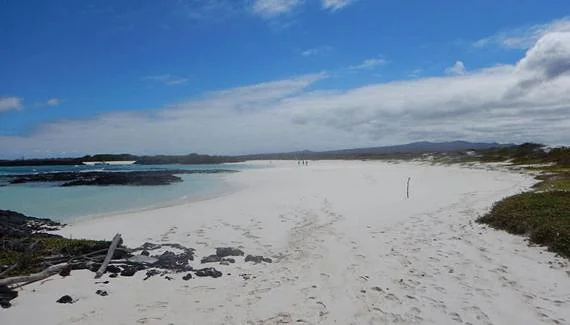
An hour's walk on a paved path through the cactus, and you reach one of the finest beaches in the archipelago, white sand and marine iguanas. The open side is for walking only; swim in the sheltered cove, where rays and reef sharks glide by.
-
4 Concha de Perla and Los Túneles, on Isabela
A lagoon hidden in the mangroves at the end of a boardwalk, where sea lions come to play with swimmers. Further out, by boat, Los Túneles form a maze of lava arches where sea turtles sleep and blue-footed boobies nest. Keep a full day for the trip.
-
5 Bartolomé and its pinnacle By cruise
The most photographed landscape in the Galápagos: a wooden staircase climbs to the top of a volcanic cone, facing Pinnacle Rock and two crescent bays. You sometimes see Galápagos penguins, the only ones living this close to the equator. The island can only be reached by cruise or on a day trip from Santa Cruz.
The classic trap
Trying to see everything in four days. Crossings between islands take two hours and start at dawn, and each island needs at least two days for its excursions. Stay a week, choose two or three islands, or board a cruise: the finest islands, such as Genovesa or Española, can only be visited that way.
Our itineraries in the Galapagos Islands
| Length | Itinerary | What you see |
|---|---|---|
| 5 days | Santa Cruz › Isabela | The giant tortoises, Tortuga Bay, Los Túneles |
| 8 days | San Cristóbal › Santa Cruz › Isabela | Kicker Rock, the three inhabited islands, Isabela's volcanoes |
| 2 weeks | Three inhabited islands, then a four-day cruise | The whole archipelago, Española, Genovesa and their bird colonies |
Fly into San Cristóbal and out of Baltra, or the other way round: you will save a crossing. Keep three nights on Santa Cruz for trips to Bartolomé, North Seymour or Plaza, then move on to Isabela, the quietest. Got two weeks? Add a short cruise to the south or north, where no day boat goes.
When to visit the Galapagos Islands
| Appeal | Season | Temperatures | Sea | Crowds and prices |
|---|---|---|---|---|
| Warm seasonJan. to Apr. | 24 to 31°C | 24 to 26°C | Medium | |
| Shoulder seasonMay and June | 22 to 29°C | 22 to 25°C | Medium | |
| Cool seasonJuly to Oct. | 19 to 25°C | 19 to 22°C | High | |
| Year's endNov. and Dec. | 21 to 27°C | 21 to 24°C | High |
Our advice
Every season has its case, because the wildlife is there all year round. From January to April, the water is warm and the sea calm, ideal for snorkelling. From June to November, the cold Humboldt Current cools the water and the mist, the garúa, covers the highlands, but marine life is at its peak. Avoid July, August and the end-of-year holidays if you want less crowded boats.
Getting to the Galapagos Islands
-
By plane to Quito or Guayaquil The first leg
From London, you reach Ecuador with a connection, usually in Madrid or Amsterdam, in fifteen to sixteen hours; from the United States, direct flights leave Miami, Houston and Atlanta. Guayaquil is closest to the archipelago; Quito deserves a night or two for its old town.
-
By plane to the archipelago The only way in
Daily flights link Quito and Guayaquil with the airports of Baltra, next to Santa Cruz, and San Cristóbal, in an hour and three quarters from Guayaquil. At the departure airport you pay for the transit control card, then on arrival the national park fee: 200 dollars per foreign adult.
-
By boat between the islands On the spot
Fast launches link Santa Cruz with San Cristóbal and Isabela in about two hours, once in the morning and once in the afternoon. Buy your ticket the day before, and bring something for seasickness: the crossing is often rough.
Allow a spare day in Quito or Guayaquil on the way out: flights to the archipelago leave early in the morning, and bags are searched to keep out seeds, fruit and insects. Carry US dollars in cash, Ecuador's currency: the park fee is often paid in cash.
Getting around the Galapagos Islands
On each inhabited island, white pick-up taxis and rental bikes are enough to reach the beaches and highlands. Between the islands, you take the launches or, at a higher price, small planes. Most park sites can only be visited with a naturalist guide, on a day trip from the port or aboard a cruise.
Good to know
Stay two metres from the animals, never touch them and never feed them: the park rangers are watching, and so are the guides. Leave nothing on the beaches, take nothing away, not even a shell, and clean your shoes between islands so you do not carry seeds. These rules are the reason the animals are still not afraid of you.
What to eat in the Galapagos Islands
- Ceviche: fish or prawns marinated in lime, served fresh with toasted corn and plantain chips.
- Galápagos lobster: caught from September to December, grilled over wood fire in the little harbour restaurants.
- Encocado: a fish stew in coconut milk, from Ecuador's coast.
- Bolón de verde: a ball of mashed green plantain, with cheese or pork, for a breakfast that lasts.
- Canchalagua: a small local mollusc, served as ceviche, much loved by islanders.
- Highland coffee: grown on the damp slopes of Santa Cruz and San Cristóbal, best tasted at the farm.
To eat like the locals, look in Puerto Ayora for the street of kioskos, Calle Charles Binford, where you will sit down in the evening at plastic tables in front of the catch of the day. Everywhere, the set lunch, the almuerzo, gives you soup, a main course and juice for a few dollars.
Where to stay in the Galapagos Islands
| Area | What for | Good to know |
|---|---|---|
| Puerto Ayora, Santa Cruz | Day trips, giant tortoises, restaurants | The centre of the archipelago |
| Puerto Baquerizo Moreno, San Cristóbal | Kicker Rock, sea lions, airport | The liveliest after Santa Cruz |
| Puerto Villamil, Isabela | Volcanoes, Los Túneles, beach | The quietest and wildest |
| Aboard a cruise | Remote islands, bird colonies | The most expensive, the most complete |
How much does a trip in the Galapagos Islands cost?
| Trip | Length | Budget per person |
|---|---|---|
| Budget (hostels, launches, two day trips) | 8 days | €1,300 to €1,800 |
| Comfort (hotels, daily trips) | 8 days | €2,500 to €3,500 |
| Luxury (week-long yacht cruise) | 8 days | €5,000 to €8,000 |
- Entry fees: 200 dollars for the national park and 20 dollars for the transit card, on top of the flight.
- Domestic flights: a return from Quito or Guayaquil often costs between 300 and 500 dollars.
- Day trips: a guided day out to Bartolomé or North Seymour often costs over 200 dollars.
- Last-minute cruises: booked on the spot in Puerto Ayora, they are sometimes much cheaper, if you are flexible on dates.
- Meals: you will eat for little at the kioskos and almuerzos, far less than in the seafront restaurants.
Traditions and way of life in the Galapagos Islands
The Galápagos were discovered by chance in 1535, by a bishop of Panama whose ship had drifted off course. For three centuries they were a hideout for pirates and whalers, who took giant tortoises aboard as a store of live meat. In 1835 Charles Darwin spent five weeks here aboard the Beagle; the finches and tortoises, different from one island to the next, fed his theory of evolution.
The archipelago became Ecuador's first national park in 1959, then one of the very first World Heritage Sites, in 1978. Its thirty thousand or so inhabitants live from fishing and tourism, under strict rules. Passing through Floreana? Leave a postcard in the barrel at Post Office Bay, as the whalers did: another traveller may carry it all the way to your door.