
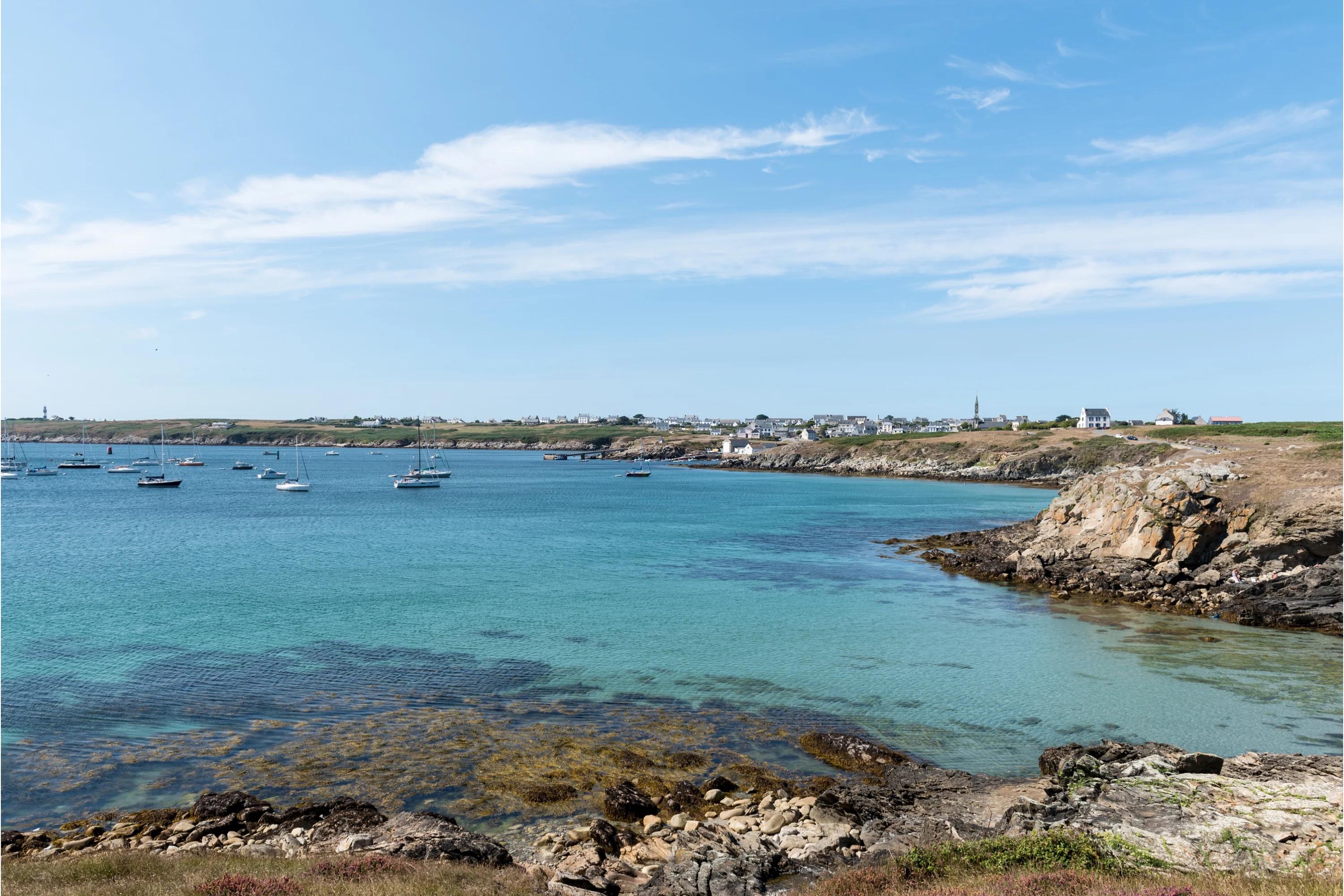
Ouessant. The name alone brings the salt spray of the Iroise Sea to your face, even while you’re just booking your crossing with the Penn Ar Bed ferry company. Now that the sturdy ship is leaving the Brest harbor, you’re hoping it’ll just be spray and not heavy seas. After all, "He who sees Ouessant sees his blood," as the sailors well-versed in the demanding Finistère coastline like to say. But October often gifts the courageous traveler with the peaceful respite of an Indian summer, and you might just find yourself stepping off at the port of Le Stiff in a T-shirt on a calm sea, two hours after leaving Brest and following a stop at Le Conquet and the island of Molène.
Seen from the sky, Ouessant seems to defend Brittany, acting as its westernmost sentinel, taking on the menacing shape of a crab claw opening toward the open sea. But its pincers prove to be benevolent, as the legendary Nividic and La Jument lighthouses signal the tips to passing ships and mark the way leading to the fold of the claw: the port of Lampaul, the island's capital. However, you’ve landed on the other side, at Le Stiff. A shuttle, or your own legs if you rented a bike upon arrival, will take you to Lampaul via the D81 departmental road, the island's backbone. Along the way, the agricultural plots and meadows separated by low stone walls, the thorny heaths, and the rare trees rising bravely against the wind tint the interior landscapes with an austere humility that’s not unlike the Breton temperament itself.
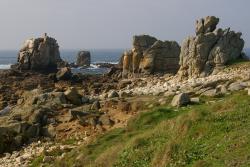 On Ouessant, the grandiose is primarily found on the coasts: the granite rises up in chaos, cliffs, monoliths, or cathedrals. You can admire these mineral compositions from the heath, while walking through short-grass meadows that rival any golf green, or from a pebble bank or one of the few small sandy beaches. This is the first gift of Ouessant: the contemplation of the sky-sea-rock trilogy, which the October sun illuminates with a subtle, warm light.
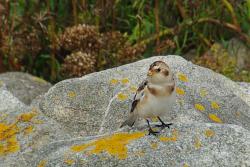
The Ouessant autumn also lends itself to another form of contemplation, certainly sharper and even more scholarly: that of the many feathered species that stay, stop over, or get lost on the island, a refuge with a temperate climate that serves as a migratory crossroads. Sit on one of the beaches, for example, and let the tide come in (yes, you have to be patient). You’ll spot small waders with orange legs (plovers, turnstones), long straight beaks (godwits, oystercatchers), or curved ones (curlews), as well as hyperactive songbirds (pipits, wheatears, wagtails, etc.).
You’ll likely also run into some surprising bipeds dressed in khaki, wearing rubber boots, and equipped with optical gear. These are the workhorses of ornithology: known as twitchers, they travel across Europe with the sole goal of adding to their tally of observed species. They know full well that in autumn, Ouessant offers them the chance to complete their harmless hunting list with rarities arriving from the Far North or even the American continent. At Ty Korn, the must-visit pub-restaurant (gourmet-level!) in Lampaul, you’ll hear them chatting warmly this evening about the day’s sightings or those they hope for tomorrow.
And what about you? How many evenings will you spend at Ty Korn? Knowing that the outbound ferry is in the morning and the return is in the late afternoon, you can really make the most of your arrival and departure days. A long weekend of a day or two is enough to discover Ouessant: its fierce North Coast, its two luminous western tips, its dizzying South Coast, and its interior. Because even if your first impression while driving the D81 from Le Stiff port wasn't the most enthusiastic, the little Ouessant paths will know how to surprise you around a bend with beautiful granite facades, painted shutters, fresh vegetable patches, and lush gardens.
"He who sees Ouessant sees his blood." In any case, yours will be well-oxygenated!
Safe travels!



Comments (2)